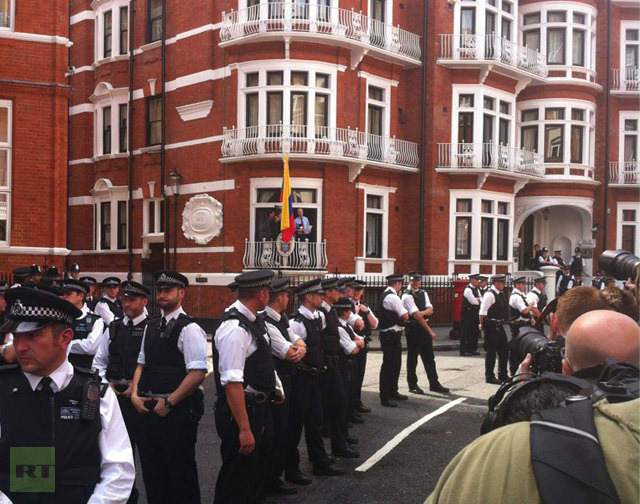
UK High Court grants Julian Assange opportunity to appeal extradition

Spread the love

Original article by Ana Vračar republished from peoples’ dispatch under Creative Commons Attribution-ShareAlike 4.0 (CC BY-SA) license.

Source: Official International Campaign to free Julian Assange

Julian Assange was granted another opportunity to appeal his extradition to the US after the UK High Court found US assurances of a fair trial inadequate

WikiLeaks founder Julian Assange has been granted another opportunity to appeal his extradition to the United States by the UK High Court on Monday, May 20. This decision allows Assange and his legal team to contest US extradition efforts in court once again, with a new date yet to be set.

Today’s decision also offers a glimmer of hope in a case that could see Assange prosecuted on espionage charges and potentially sentenced to over 170 years in prison in the US.

The ruling was met with hope from Assange’s supporters outside the court, as well as relief from family members and organizations who have been advocating for an end to his persecution since WikiLeaks published thousands of documents exposing US war crimes in Iraq and Afghanistan. The campaign for his release has intensified since his imprisonment in Belmarsh prison five years ago.

Following the ruling, Assange’s supporters reiterated calls for the US to drop the case entirely, allowing him to go free. “In trying to imprison him, the US is sending the unambiguous message that they have no respect for freedom of expression, and that they wish to send a warning to journalists and publishers everywhere: that they too could be targeted, for receiving and publishing classified material — even if doing so is in the public interest,” said Simon Crowther, legal adviser at Amnesty International.

Caitlin Vogus, deputy director of advocacy at Freedom of the Press Foundation, also urged the court to refuse to extradite Assange. “But better yet, the Biden administration can and should end this case now. If Biden continues to pursue the Assange prosecution, he risks creating a precedent that could be used against any reporter who exposes government secrets, even if they reveal official crimes. If the Biden administration cares about press freedom, it must drop the Assange case immediately,” Vogus said.

The High Court ruling follows a deferral from March this year, when the British judiciary sought assurances from the US that Assange would receive a fair trial if extradited. Specifically, Assange’s legal team demanded guarantees that he would be granted First Amendment rights to free speech, be treated equally in court despite being an Australian national, and that the prosecution would not seek the death penalty.

In response, the US legal team provided a list of assurances, but today, the UK court found them unsatisfactory. Apart from the assurance that the death penalty would not be pursued, Assange’s current and former legal representatives described the US explanations as inconclusive, raising concerns that he would face cruel treatment if deported.

Original article by Ana Vračar republished from peoples’ dispatch under Creative Commons Attribution-ShareAlike 4.0 (CC BY-SA) license.

Continue ReadingUK High Court grants Julian Assange opportunity to appeal extradition

Morning Star: Freeing Assange is a struggle for justice, journalism and peace

Spread the love

https://morningstaronline.co.uk/article/editorial-freeing-assange-struggle-justice-journalism-and-peace

JUDGES must decide tomorrow if Julian Assange would enjoy the same rights as a US citizen if tried in the US.

It’s an ironic question. The persecution of the WikiLeaks founder has rested from the beginning on US exceptionalism — that rules do not apply to the United States as they apply to other countries — and extraterritoriality, that US law somehow applies to non-US citizens’ conduct thousands of miles away from the US.

Both apply too to the crimes Assange is being tormented for exposing.

The US can murder citizens of other countries by the hundred in drone strikes, without due process or even much in the way of diplomatic upset.

It can launch illegal war after illegal war, its soldiers can laugh as they gun down unarmed civilians from helicopters, it can loftily decline to recognise the authority of bodies like the International Criminal Court (while publicly welcoming indictments of other countries’ officials before that court): but still it claims to police a “rules-based international order” under supposed threat from its rivals.

This is about journalism: as New York Times executive editor Dean Baquet has stated, it sets a frightening precedent when a journalist can be accused of espionage for publishing classified material that was handed to him. Assange did not leak the information: he was never in the US government’s employ. The Assange case warns reporters everywhere that publicising the crimes of the powerful could result in years behind bars.

https://morningstaronline.co.uk/article/editorial-freeing-assange-struggle-justice-journalism-and-peace

Continue ReadingMorning Star: Freeing Assange is a struggle for justice, journalism and peace

Julian Assange’s extradition appeal hangs in the balance as UK court seeks US “assurances”

Spread the love

Original article by Tanupriya Singh republished from peoples dispatch under a Creative Commons Attribution-ShareAlike 4.0 (CC BY-SA) license.
Protesters gathered outside the Royal Courts of Justice in London on Tuesday. Photo: Free Assange UK Campaign/X

The UK High Court has granted WikiLeaks founder Julian Assange provisional permission to appeal his extradition to the US, on grounds including the risk of the death penalty.

The UK High Court has granted provisional permission to journalist and WikiLeaks founder Julian Assange to appeal his extradition to the US. The ruling was handed down by judges Dame Victoria Sharp and Justice Jeremy Johnson in London on March 26, as supporters of Assange gathered outside the court to demand his freedom.

The US has sought to extradite Assange to prosecute him on 18 charges, 17 of which are under the draconian Espionage Act, for the publication of classified documents on WikiLeaks exposing war crimes and human rights abuses committed by US forces, including in Iraq and Afghanistan.

The extradition was approved by the UK Home Office in 2022, protracting an already difficult legal battle for the imprisoned journalist. Assange has been held at the Belmarsh high security prison for five years without a trial or conviction.

In its decision, the Court has granted Assange permission to appeal against his extradition, with the matter adjourned till May 20. However, the appeal will proceed only if the US and the UK are unable to provide the Court with assurances regarding Assange’s treatment following an extradition.

The US and the UK have until April 16 to file these assurances. This will also pave the way for further submissions to be made before a final decision is reached.

In the meantime, the temporary permission to appeal has been granted on three out of nine grounds including: a) that extradition may be “incompatible with the right of freedom of expression” under the European Convention on Human Rights; and b) that the applicant (Assange) might be “prejudiced on grounds of nationality” which is related to whether or not he will be protected under the First Amendment of the US Constitution given that Assange is not a citizen.

The third ground of appeal upheld by the Court for now is “inadequate speciality protection/death penalty protection”, which bars extradition under the UK’s 2003 Extradition Act.

In the application, Assange’s legal team noted that despite the fact that none of the charges leveled by the US as part of the extradition request carry the death penalty, the accusations made against him could lead to additional charges of aiding and abetting treason, which would be capital offenses.

They further highlighted statements made by US officials, including by Donald Trump, former president and potential Republican candidate for the upcoming US election, calling for the death penalty for Assange.

During the two-day “permission hearing” held in February ahead of the March 26 decision, the US prosecution admitted that there were no assurances that Assange would not be handed the death penalty.

Read more: US obfuscates and misrepresents on second day of Assange hearings

The US now has three weeks to provide the Court with “satisfactory assurances” that Assange will be permitted to rely on the First Amendment (protecting free speech), that he will not be prejudiced at trial (including sentence) because of nationality (his status as non- US citizen), that he will be afford the same protections under the First Amendment as a US citizen, and that the death penalty will not be imposed.

This is not the first time that such proposals have been made in Assange’s case. In fact, despite a lower court acknowledging Assange’s risk of suicide in 2021, his extradition was approved based on “diplomatic assurances” given by the US.

These included that Assange would not be subject to brutal Special Administrative Measures (SAMs), that he would not be kept at the ADX Florence maximum security prison, and that he could serve a custodial sentence in Australia, his country of origin. However, these protections would not apply if Assange was deemed to have committed a “future act” that could necessitate SAMs.

The entirely unilateral nature of these assurances raised alarm, especially given that these actions would be at the discretion of US prison authorities and not subject to judicial review.

“The UK remains intent on extraditing Assange despite the grave risk that he will be subjected to torture or ill-treatment in the US,” Simon Crowther, Legal Adviser at Amnesty International, said in response to Tuesday’s ruling.

“While the US has allegedly assured the UK that it will not violate Assange’s rights, we know from past cases that such ‘guarantees’ are deeply flawed — and the diplomatic assurances so far in the Assange case are riddled with loopholes.”

Meanwhile, the Court dismissed critical grounds for appeal raised by Assange’s team, in particular that the extradition was for a political offense, and as such prohibited under the UK-US Extradition Treaty. Assange’s lawyers had argued in February that espionage was universally accepted as a political offense, given that it was an offense directed at the state.

“These were the most important revelations of criminal US state behavior in history,” Assange’s lawyer, Mark Summers, had told the Court regarding the materials published by WikiLeaks. This included the “Collateral Murder Video” in which a US Army Apache helicopter had killed 11 unarmed civilians in Baghdad in 2007.

Read more: Assange’s Last Stand

Addressing the press outside the court, Assange’s wife, Stella, stated that the decision was “astounding”. She pointed out that though the Court had recognized the violation of Julian Assange’s rights, “what the Courts have done have done [is] to invite a political intervention from the United States to send a letter saying ‘it’s all okay’. Five years into this case, the US has managed to show the Court that their case remains an attack on press freedom, an attack on Julian’s life.”

“What the Courts have not agreed to look at is the evidence that the US has plotted to assassinate Julian, to kidnap him, because if it acknowledged that then of course he cannot be sent to the US.”

The Court astonishingly justified its refusal to admit this new evidence, of a plot by the US’ Central Intelligence Agency (CIA) to kidnap and assassinate Assange, stating that “on the face of the allegations…the contemplation of extreme measures against the applicant (whether poisoning for example or rendition) were a response to the fear that the applicant might flee to Russia”.

“The rationale for such conduct is removed if the applicant is extradited. Extradition would result in him being lawfully in the custody of the US authorities, and the reasons (if they can be called that) for rendition or kidnap or assassination then fall away”.

Meanwhile, Assange’s brother, Gabriel Shipton, reiterated that the fact that the Court had sought political assurances from the US revealed the political nature of the case itself.

Stella Assange added, “Julian is a political prisoner, he is a journalist, and he is being persecuted because he exposed the true cost of war in human lives. This case is a retribution, it is a signal to all of you, that if you expose the interests that are driving war they will come after you, they will put you in prison and they will try to kill you.”

“The Biden administration should not issue assurances, they should drop this shameful case that should have never been brought,” she said, calling people to pressure the US government and to support House Resolution 934.

The text, which is in the US Congress, states that “regular journalistic activities, including the obtainment and publication of information, are protected under the First Amendment and that the federal government should drop all charges against and attempts to extradite Julian Assange.”

“If Julian goes down for this, every serious journalist around the world is going to be slightly more cautious about exposing war crimes, corporate greed…We need the maximum pressure all across the US on the Biden administration, on the candidates in the forthcoming election, to say ‘Drop the charges against Julian Assange,’” MP and former Labor Party leader Jeremy Corbyn told Democracy Now.

If the UK High Court does not grant Assange the permission to appeal, he will have exhausted his options within the country’s legal system, and will have to approach the European Court of Human Rights (ECHR), immediately seeking an interim measure against the extradition under Rule 39 (“risk of irreparable harm”) pending a full hearing of the case. The ECHR’s verdict will be binding on the UK.

Original article by Tanupriya Singh republished from peoples dispatch under a Creative Commons Attribution-ShareAlike 4.0 (CC BY-SA) license.
Continue ReadingJulian Assange’s extradition appeal hangs in the balance as UK court seeks US “assurances”

Israelis engulfed by a wave of international condemnation over shooting of more than 100 Palestinian aid seekers

Spread the love

https://morningstaronline.co.uk/article/israelis-engulfed-wave-international-condemnation-over-shooting-more-100-palestinian

Palestinians walk through the destruction from the Israeli offensive in Jabaliya refugee camp in the Gaza Strip on Febraury 29, 2024

THE Israelis were engulfed by a wave of international condemnation on today following the shooting of more than 100 Palestinians during an aid delivery in Gaza.

This came after Israeli troops opened fire on Palestinians scrambling for desperately needed food at an aid station in Gaza City on Thursday.

While the Israeli military said that a “stampede” occurred when thousands of Palestinians surrounded a convoy of 38 aid trucks, local officials said the Israeli forces opened fire at people.

Israel said that many of the dead were trampled in a chaotic crush for the food aid, and that its troops only fired when they felt endangered by the crowd.

The Palestinian death toll in Gaza now stands at more than 30,035, mainly women and children.

Israel’s killing spree in Gaza began after a Hamas attack on October 7 left 1,200 people dead.

https://morningstaronline.co.uk/article/israelis-engulfed-wave-international-condemnation-over-shooting-more-100-palestinian

Continue ReadingIsraelis engulfed by a wave of international condemnation over shooting of more than 100 Palestinian aid seekers

‘The Child Deaths We Feared Are Here,’ Says UNICEF

Spread the love

Original article by JAKE JOHNSON republished from Common Dreams under Creative Commons (CC BY-NC-ND 3.0).

A Palestinian child receives treatment at a private children’s hospital in Rafah that specializes in providing care to children suffering from malnutrition.
 (Photo: Mohammed Talatene/Picture Alliance via Getty Images)

The United Nations Children’s Fund said at least 10 kids in a northern Gaza hospital have died of malnutrition and dehydration—and many more are “fighting for their lives.”

The United Nations Children’s Fund said Sunday that at least 10 children have reportedly died of starvation and dehydration at a hospital in northern Gaza as Israeli forces continue to obstruct and attack aid convoys, fueling desperation across the territory.

Adele Khodr, UNICEF’s regional director for the Middle East and North Africa, said malnutrition is ravaging the Gaza Strip and warned that child deaths “are likely to rapidly increase” unless Israel ends its military assault and allows humanitarian aid to flow unimpeded.

“The child deaths we feared are here,” said Khodr. “At least ten children have reportedly died because of dehydration and malnutrition in Kamal Adwan Hospital in the northern Gaza Strip in recent days. There are likely more children fighting for their lives somewhere in one of Gaza’s few remaining hospitals, and likely even more children in the north unable to obtain care at all.”

“These tragic and horrific deaths are man-made, predictable, and entirely preventable,” Khodr added.

Nearly half of the more than 30,000 people killed by U.S.-backed Israeli forces in Gaza since October have been children, and humanitarian officials have said disease and famine could soon become bigger killers than Israel’s bombs and bullets. United Nations experts and human rights groups have accused the Israeli government of using starvation as a weapon of war, intentionally depriving Gazans of food and other necessities.

A group of U.N. officials warned last month that an “explosion in preventable child deaths” was looming.

“The sense of helplessness and despair among parents and doctors in realizing that lifesaving aid, just a few kilometers away, is being kept out of reach, must be as unbearable, but worse still are the anguished cries of those babies slowly perishing under the world’s gaze,” Khodr said Sunday. “The lives of thousands more babies and children depend on urgent action being taken now.”

Agnes Callamard, secretary-general of Amnesty Internationalsaid that “these deaths are unlawful, the result of acts by Israel authorities which engineered famine.”

“They knew the likely outcome of their actions but persisted. Over weeks and months,” Callamard added. “And all states that cut UNRWA funding, sold weapons, and supported Israel bear responsibility too.”

While virtually all of Gaza’s population is in need of food, conditions are particularly dire in the northern part of the territory. Carl Skau, deputy executive director of the World Food Program, told members of the U.N. Security Council last week that “if nothing changes, a famine is imminent in northern Gaza.”

With aid deliveries plummeting due to Israel’s obstruction, families have been forced to eat grass, leaves, animal feed, and scraps left behind by rats. On Saturday, the U.S. airdropped 38,000 meals into Gaza—a move that critics said would do little to slow the rapid spread of hunger across the Palestinian territory.

Melanie Ward, CEO of Medical Aid for Palestinians, described conditions in Gaza as “the fastest decline in a population’s nutrition status ever recorded.”

“That means children are being starved at the fastest rate the world has ever seen,” Ward said in an appearance on CNN. “We could save them all. But we’re not being able to.”

This story has been updated to include comment from Agnes Callamard of Amnesty International.

Original article by JAKE JOHNSON republished from Common Dreams under Creative Commons (CC BY-NC-ND 3.0).

Continue Reading‘The Child Deaths We Feared Are Here,’ Says UNICEF