dizzy: I am intending to make a statement soon on the topic of fake-manufactured terrorism.


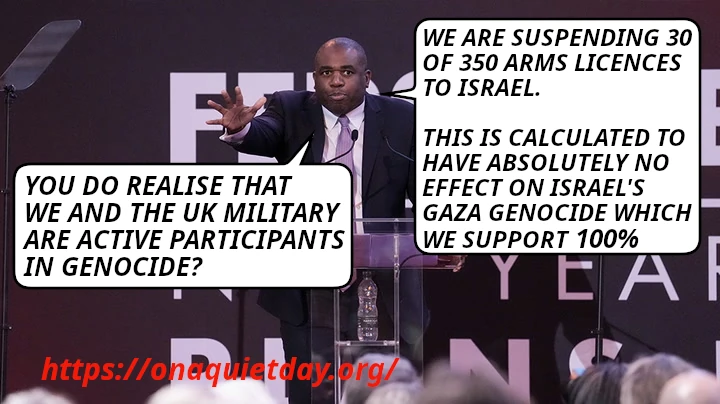
dizzy: I am intending to make a statement soon on the topic of fake-manufactured terrorism.
Original article by Brett Wilkins republished from Common Dreams under Creative Commons (CC BY-NC-ND 3.0).
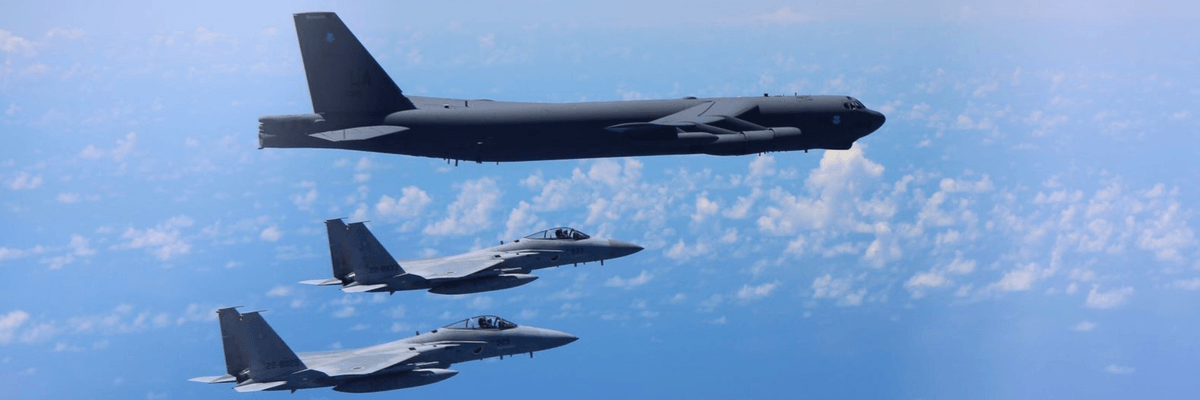
U.S. military forces launched dozens of airstrikes on more than 75 Islamic State targets in Syria on Sunday after the fall of longtime Syrian President Bashar al-Assad and amid ongoing Israeli and Turkish attacks on the war-torn Middle Eastern nation.
According to U.S. Central Command (CENTCOM), warplanes including B-52 bombers, F-15 fighters, and A-10 ground attack aircraft “conducted dozens of precision airstrikes targeting known ISIS camps and operatives in central Syria.”
CENTCOM called the strikes “part of the ongoing mission to disrupt, degrade, and defeat ISIS in order to prevent the terrorist group from conducting external operations and to ensure that ISIS does not seek to take advantage of the current situation to reconstitute in central Syria.”
The U.S., “together with allies and partners in the region, will continue to carry out operations to degrade ISIS operational capabilities even during this dynamic period in Syria,” CENTCOM added.
“The Biden administration ordering ongoing airstrikes is a disappointing sign that they have no intent on reversing their deadly policy of interventionism.”
Responding Monday to the latest attacks on Syria by U.S. forces, Danaka Katovich, national co-director of the peace group CodePink, told Common Dreams: “We condemn the U.S. airstrikes in Syria. The U.S. has sowed chaos in Syria and the entire region for years and the Biden administration ordering ongoing airstrikes is a disappointing sign that they have no intent on reversing their deadly policy of interventionism.”
U.S. and coalition forces have killed and maimed at least tens of thousands of Syrians and Iraqis during the Obama, Trump, and Biden administrations as part of the anti-ISIS campaign and wider so-called War on Terror.
Commenting on the dearth of coverage of the strikes by the corporate media, prominent Greek leftist Yanis Varoufakis said on social media that “the Western press are waxing lyrical about the new Syria being born—but not a word on the U.S. and Israeli bombs falling from the sky.”
“Is there no bottom to the moral void of the Western press?” he added.
Sunday’s U.S. strikes came as al-Assad and relatives fled to Russia—where they have been granted asylum—amid the fall of the capital, Damascus, to rebel forces.
Also on Sunday, Israeli forces seized more territory in Syria’s Golan Heights and ordered residents of five villages to “stay home and not go out until further notice” if they want to remain safe. Israel conquered the western two-thirds of the Golan Heights in 1967 and has unlawfully occupied it ever since. In 1981, Israel illegally annexed the occupied lands.
“We will not allow any hostile force to establish itself on our border,” right-wing Israeli Prime Minister Benjamin Netanyahu—who is wanted by the International Criminal Court for alleged war crimes and crimes against humanity in Gaza—said in a video posted on social media.
Numerous Israelis celebrated the seizure on social media, while others cautioned against boasting about what is almost certainly an illegal conquest.
Sorry, this content could not be embedded.
X
Meanwhile in northern Syria, Turkish airstrikes in support of Syrian National Army rebels—who are battling U.S.-backed Syrian Democratic Forces (SDF) fighters in and around the Kurdish-controlled city of Manbij—reportedly killed numerous civilians along with dozens of militants.
In what it called a “horrific massacre,” the London-based Syrian Observatory for Human Rights said Monday that 11 civilians from the same family, including women and six children, were killed in a Turkish drone strike on the SDF-controlled village of Al-Mustariha in northern Raqqa Governate.
Original article by Brett Wilkins republished from Common Dreams under Creative Commons (CC BY-NC-ND 3.0).
Michelle Spear, University of Bristol
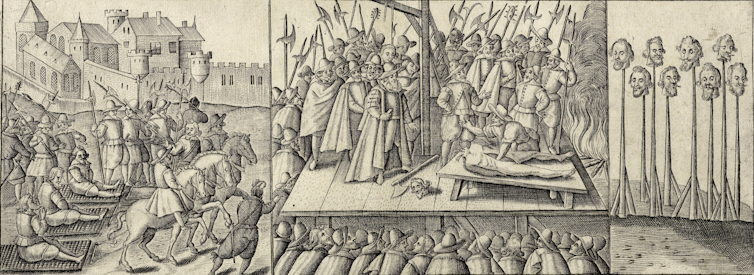
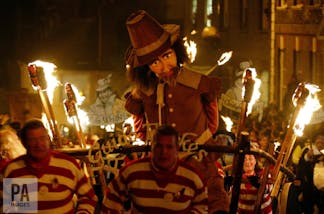
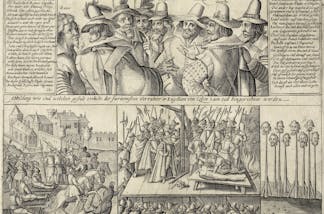
After their infamous plot to destroy parliament was foiled, Guy Fawkes and his co-conspirators received one of the most severe judicial sentences in English history: hanging, drawing and quartering. According to the Treason Act 1351, this punishment involved:
That you be drawn on a hurdle to the place of execution, where you shall be hanged by the neck and being alive cut down, your privy members shall be cut off and your bowels taken out and burned before you, your head severed from your body and your body divided into four quarters to be disposed of at the King’s pleasure.
This process aimed not only to inflict excruciating pain on the condemned, but to serve as a deterrent – demonstrating the fate of those who betrayed the Crown. While Fawkes reportedly jumped from the gallows – which meant he avoided the full extent of his punishment – his co-conspirators apparently weren’t so lucky.
By dissecting each stage of this medieval punishment from an anatomical perspective, we can understand the profound agony each of them endured.
Before his public execution on January 31 1606, Fawkes was tortured to force a confession about his involvement in the “gunpowder plot”.
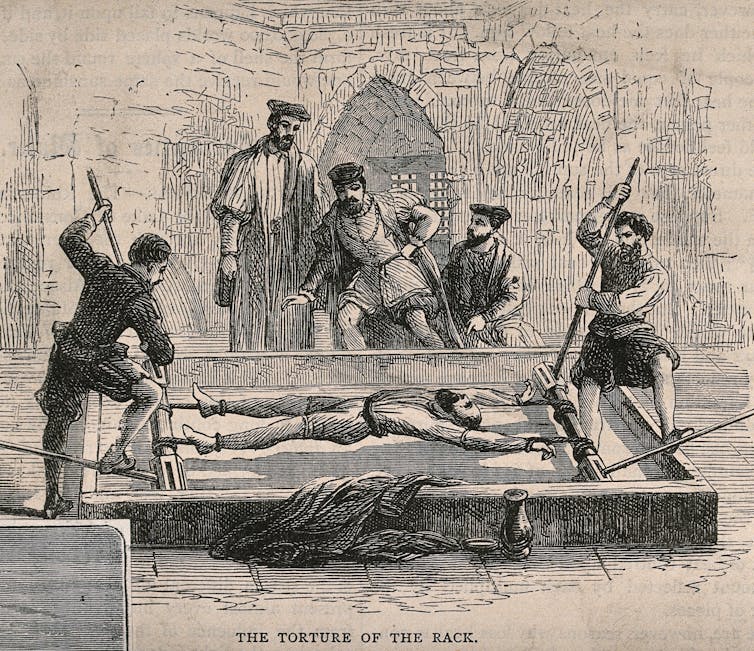
The Tower of London records confirm that King James I personally authorised “the gentler tortures first”. Accounts reveal that Fawkes was stretched on the rack – a device designed to slowly pull the limbs in opposite directions. This stretching inflicted severe trauma on the shoulders, elbows and hips, as well as the spine.
The forces exerted by the rack probably exceeded those required for joint or hip dislocation under normal conditions.
Substantive differences between Fawkes’ signatures on confessions between November 8 and shortly before his execution may indicate the amount of nerve and soft tissue damage sustained. It also illustrates how remarkable his final leap from the gallows was.
After surviving the torture of the rack, Fawkes and his gang faced the next stage of their punishment: hanging. But this form of hanging only partially strangled the condemned – preserving their consciousness and prolonging their suffering.
Partial strangulation exerts extreme pressure on several critical neck structures. The hyoid bone, a small u-shaped structure above the larynx, is prone to bruising or fracture under compression.
Simultaneously, pressure on the carotid arteries restricts blood flow to the brain, while compression of the jugular veins causes pooling of blood in the head – probably resulting in visible haemorrhages in the eyes and face.
Because the larynx and trachea (both essential for airflow) are partially obstructed, this makes breathing laboured. Strain on the cervical spine and surrounding muscles in the neck can lead to tearing, muscle spasms or dislocation of the vertebra – causing severe pain.
Fawkes brought his agony to a premature end by leaping from the gallows. Accounts from the time tell us:
His body being weak with the torture and sickness, he was scarce able to go up the ladder – yet with much ado, by the help of the hangman, went high enough to break his neck by the fall.
This probably caused him to suffer a bilateral fracture of his second cervical vertebra, assisted by his own bodyweight – an injury known as the “hangman’s fracture”.
After enduring partial hanging, the victim would then be “drawn” – a process which involved disembowelling them while still alive. This act mainly targeted the organs of the abdominal cavity – including the intestines, liver and kidney, as well as major blood vessels such as the abdominal aorta.
The physiological response to disembowelment would have been immediate and severe. The abdominal cavity possesses a high concentration of pain receptors – particularly around the membranous lining of the abdomen. When punctured, these pain receptors would have sent intense pain signals to the brain, overwhelming the body’s capacity for pain management. Shock would soon follow due to the rapid drop in blood pressure caused by massive amounts of blood loss.
Quartering was also supposed to be performed while the victim was still alive. Though no accounts exist detailing at what phase victims typically lost consciousness during execution, it’s highly unlikely many survived the shock of being drawn.
So, at this stage, publicity superseded punishment given the victim’s likely earlier demise. Limbs that were removed from criminals were preserved by boiling them with spices. These were then toured around the country to act as a deterrent for others.
Though accounts suggest Fawkes’s body parts were sent to “the four corners of the United Kingdom”, there is no specific record of what was sent where. However, his head was displayed in London.
The punishment of hanging, drawing and quartering was designed to be as anatomically devastating as it was psychologically terrifying. Each stage of the process exploited the vulnerabilities of the human body to create maximum pain and suffering, while also serving as a grim reminder of the consequences of treason.
This punishment also gives us an insight into how medieval justice systems used the body as a canvas for social and political messaging. Fawkes’s fate, though unimaginable today, exemplifies the extremes to which the state could, and would, go to maintain control, power and authority over its subjects.
The sentence of hanging, drawing and quartering was officially removed from English law as part of the Forfeiture Act of 1870.
Michelle Spear, Professor of Anatomy, University of Bristol
This article is republished from The Conversation under a Creative Commons license. Read the original article.
Original article well said by Adam Ramsay republished from openDemocracy under a Creative Commons Attribution-NonCommercial 4.0 International licence.
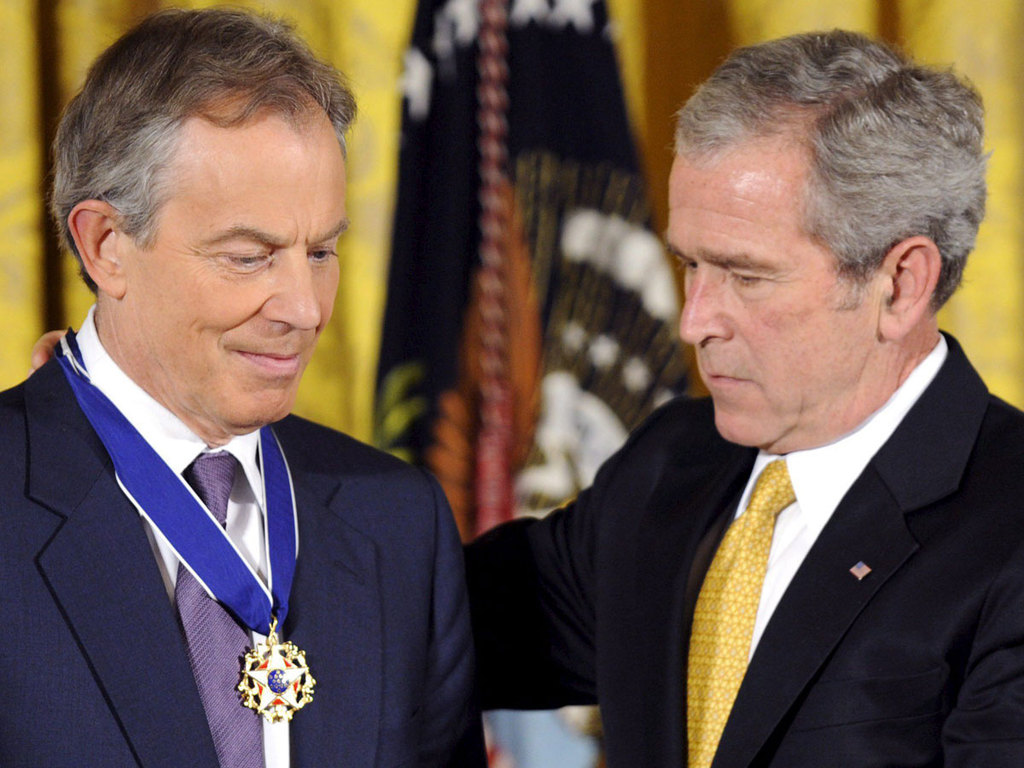
Twenty years ago today, [20 March] war was once again unleashed on Baghdad. In the UK – and much of the rest of the world – people sat in front of their TVs watching the skies above the ancient city flash with flame as buildings were rendered to rubble, the limbs and lives inside crushed.
The real victims of George Bush and Tony Blair’s shock and awe were, of course, the people of Iraq. Estimates of violent deaths range from a hundred thousand to a million. That doesn’t include the arms and legs that were lost, the families devastated, the melted minds and broken souls, trauma that will shatter down generations. It doesn’t include anyone killed in the conflict since then: there are still British and US troops in the country. It doesn’t include the poverty resulting from crushed infrastructure, the hopes abandoned and the potential immolated.
And that’s just the 2003 war: Britain has bombed Iraq in seven of the last 11 decades.
But in far gentler ways, the war was to shape the lives of those watching through their TVs, too. The invasion of Iraq – along with the other post-9/11 wars – was a road our governments chose irrevocably to drive us down. And we, too, have been changed by the journey.
The financial cost of the Iraq war to the US government, up to 2020, is estimated at $2trn. The post-9/11 wars together cost the US around $8trn, a quarter of its debt of $31trn. Much of the money was borrowed from foreign governments, in a debt boom which, some economists have argued, played a key role in the 2008 crash.
It was in this period, in particular, that China bought up billions of dollars of US government debt. Just before Barack Obama was elected in 2008, Beijing had overtaken Tokyo as the world’s largest holder of US Treasury bonds. Today, America’s neoconservatives are obsessed with China’s power over the US. What they rarely mention is that this was delivered by their wars in Iraq, Afghanistan and Pakistan.
Britain’s financial contribution was more meagre – in 2015 the UK government estimated it had spent £8.1bn on the invasion of Iraq, and around £21bn on Afghanistan. But these are hardly figures to be sniffed at.
Also significant, in both cases, is where this money went: the Iraq war saw a revolution in the outsourcing of violence. In 2003, when the war began, the UK foreign office spent £12.6m on private security firms. By 2015, just one contract – paying G4S to guard Britain’s embassy in Afghanistan – was worth £100m.
Over the course of the wars, the UK became the world centre for private military contractors – or, to use the old fashioned word, mercenaries. While many of these are private army units, others offer more specialist skills: retired senior British spooks now offer intelligence advice to central-Asian dictators and, as we found out with Cambridge Analytica during the Brexit vote, psychological operations teams who honed their skills in Iraq soon realised how much money they could make trialling their wares on the domestic population.
This vast expansion of the military industrial complex in both the US and UK hasn’t just done direct damage to our politics and economy – affecting the living standards of hundreds of millions of people across the world. It has also distorted our society, steered investment into militarised technology when research is desperately needed to address the climate and biodiversity crises.
Similarly, the war changed British politics. First, and perhaps most profoundly, because it was waged on a lie, perhaps the most notorious lie in modern Britain, that Saddam Hussein had weapons of mass destruction.
Acres of text have been written about the rapid decline in public trust in politicians in the UK in recent years. Very few grapple with the basic point – that, within the memory of most voters, a prime minister looked us in the eye, and told us that he had to lead us into war, based on a threat that turned out to be fictional. There are lots of reasons people increasingly don’t trust politicians – and therefore trust democracy less and less. But the Iraq war is a long way up the list.
Obama – who had opposed the war – managed to rally some of that breakdown of trust into a positive movement (whatever you think of his presidency, the movement behind it was positive). So did the SNP in Scotland.
But often, it went the other way. If the war hadn’t happened, would Cleggmania have swung the 2010 election from Gordon Brown to David Cameron? Probably not. And this, of course, led to the second great lie of modern British politics, the one about tuition fees and austerity.
Without the invasion, would Donald Trump have won in 2016? Would Brexit have happened?
There is a generation of us – now approaching our 40s – who were coming into political consciousness as Iraq was bombed. Many of us marched against the war, many more were horrified by it. The generation before us – Gen X – were amazingly unpolitical. Coming of age in the 1990s, at the end of history, very few got involved in social movements or joined political parties.
When I was involved in student politics in the years following Bush and Blair’s invasion, student unions across the UK were smashing turnout records. Soon, those enraged by the war found Make Poverty History, the climate crisis, the financial crisis and austerity. A generation of political organisers grew up through climate camps and Occupy and became a leading force behind Bernie Sanders and Jeremy Corbyn, helping organise a magnificent younger cohort of Gen-Zers which arrived after us.
But I shouldn’t end on a positive note. The disaster predicted by the millions across the world who marched against the war has played out. Hundreds of thousands have died. The Middle East continues to be dominated by dictators.
This war was justified on the grounds that Saddam was a threat to the world. But while his weapons of mass destruction were invented, scientists were already warning us about a very real risk; already telling us that we had a few short decades to address the climate crisis.
Rather than launching a war that would give the West access to some of the world’s largest oil reserves, the US and UK could have channelled their vast resources into weaning us off the fossil fuels that pay for the brutal regimes of dictators. Instead, we incinerated that money, and the world, with it.
Original article well said by Adam Ramsay republished from openDemocracy under a Creative Commons Attribution-NonCommercial 4.0 International licence.
The Highway to Hell was a short poem published by me to oppose the USUK-Iraq War 2003.
THE HIGHWAY TO HELL
I respect all religions
And belief-systems worldwide
But
I have no time
for those b******s
That claim to be Christians
That claim Divine guidance
On the Highway to Hell
dt
26/7/23 https://en.wikipedia.org/wiki/Highway_of_Death
The wikipedia page appears incomplete. I understood that large earth-moving machines were used to kill retreating Iraqi soldiers through burying them alive but there’s no mention of it.

