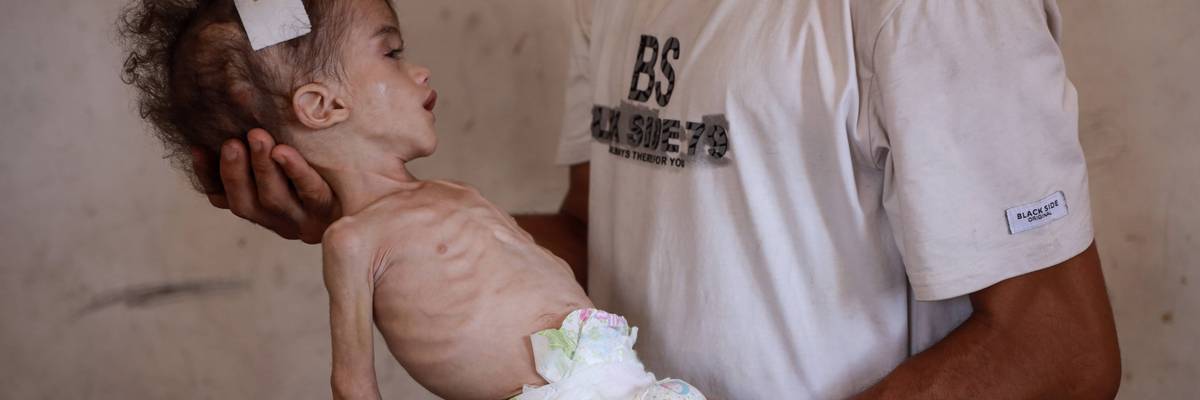
Issam Fadi Nabiyye, a 1-year-old Palestinian who lives with his family in the Sheikh Radwan neighborhood of Gaza City, is seen suffering from severe malnutrition in this July 6, 2026 photo. (Photo by Abdalhkem Abu Riash/Anadolu via Getty Images)
“The October 2025 ceasefire has led to measurable gains in humanitarian access and overall conditions across the Gaza Strip. However, the situation remains deeply fragile.”
Although the Gaza Strip is no longer officially enduring famine, a majority of Palestinians there are suffering “crisis or worse” levels of hunger in an emergency that is expected to worsen in the coming months if Israel’s bombardment and siege—which many experts say is a key component of an ongoing genocide—continue.
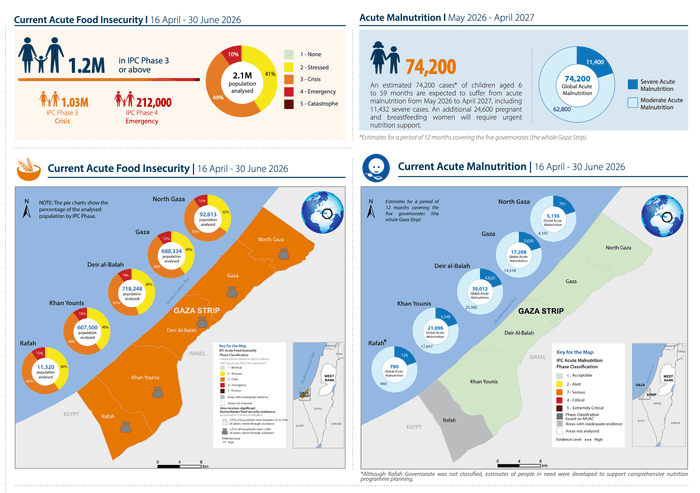
The Integrated Phase Food Security Classification—which ranks food security levels on a scale of 1 to 5—on Thursday published an analysis showing that from mid-April to the end of June, more than 1.2 million people, or 59% of Gaza’s population, were experiencing IPC Phase 3 (crisis) or worse levels of food insecurity. This included about 212,000 people in IPC Phase 4 (emergency). All five Gaza governorates were classified as being in Phase 3.
“After two years of conflict, the October 2025 ceasefire has led to measurable gains in humanitarian access and overall conditions across the Gaza Strip,” IPC said in a statement. “However, the situation remains deeply fragile, with civilians continuing to endure harsh conditions.”
#Gaza Strip The Oct 2025 ceasefire has led to measurable gains in humanitarian access & conditions across the Gaza Strip, yet the situation remains deeply fragile. 1.4 million people are facing high levels of acute food insecurity through Dec 2026. More: www.ipcinfo.org/ipcinfo-webs…
This marks an improvement from a year ago, when a “worst-case scenario” was developing into a Phase 5 (catastrophe) famine that was formally declared by the IPC in August 2025. At least hundreds of Palestinians, many of them children, have died from malnutrition since Israel launched its US-backed war on Gaza in retaliation for the Hamas-led attack of October 7, 2023.
The IPC declared last December that while Gaza was no longer in a famine, the situation remained critical for the war-ravaged Palestinians there. The new IPC report warns that two-thirds of Gaza’s population are projected to face Phase 3 crisis conditions by the end of the year.
The organization also said that 74,200 Palestinian children under the age of 5 in Gaza will likely need treatment for acute malnutrition through next April.
(Image by Integrated Phase Food Security Classification)
Responding to the new IPC data, United Nations Children’s Fund Executive Director Catherine Russell said Thursday that “acute malnutrition has fallen, but many children are still going hungry, and some children may never fully recover from prolonged lack of proper nutrition.”
“This progress shows that when humanitarian access improves and aid gets through, children can be pulled back from the brink,” she added. “But it rests on a supplementary feeding program that doesn’t reach all children, and where funding is running out.”
Israeli forces have killed or wounded more than 250,000 Palestinians since then, and forcibly displaced, starved, or sickened over 2 million others since then, resulting in worldwide allegations of genocide embodied in an International Court of Justice case filed by South Africa at the end of 2023 and now formally supported by nearly 20 nations.
Like many members of their public, Israeli and US officials under both the Biden and Trump administrations initially denied that Israel was starving Gazans. However, Israeli officials warned in private that Gaza was facing starvation, while US President Donald Trump, Vice President JD Vance, and other administration figures have acknowledged that Palestinians were starving to death in the strip. That did not stop them from continuing to give billions of dollars in US armed aid to Israel.
In response to the new IPC report, acting United Nations World Food Program Executive Director Carl Skau said that “there is progress on food security in Gaza, but it is fragile and can easily be reversed.”
“The overall humanitarian situation remains brutal: Families lack water, sanitation, and medicine,” Skau added. “We need sustained access, funding, and stability so people of Gaza can begin recovery.”
The heads of various United Nations agencies concurred that a lasting peace—which Israel is not allowing as it continues bombing and besieging Gaza despite a nominal nine-month ceasefire—is imperative for that recovery.
Despite the so-called ceasefire in Gaza, civilians continue to pay a heavy price every day.
People are being killed in their homes, in their communities, and while carrying out ordinary acts of daily life – as Israel increases its control of Gaza.
“Food security in Gaza cannot recover unless local food production starts again and farmers, herders, fishers, and other producers can rebuild their livelihoods,” UN Food and Agriculture Organization Director-General Qu Dongyu said on Thursday. “Producers need access to farmland and the sea, and to seeds, tools, livestock supplies, and other agricultural inputs, as well as technical support.”
“Restrictions on agricultural imports and humanitarian supplies must be lifted,” Qu added. “Without these essentials, food production, and security will remain a pressing situation.”
The IPC said that “recent gains remain fragile,” and that “advancing peace plans is essential to support recovery, enable the safe return of displaced populations, and help households rebuild their livelihoods.”
Keir Starmer objects to criticism of the IDF. He asks how could anyone object to them starving people to death, forced marches like the Nazis did, bombing Gaza’s hospitals and universities, mass-murdering journalists, healthworkers and starving people queuing for food, killing and raping prisoners and murdering children. He calls for people to stop obstructing his genocide for Israel.
This work by Middle East Monitor is licensed under a Creative Commons Attribution-NonCommercial-ShareAlike 4.0 International License.
U.S. Navy warplane takes off from the aircraft carrier USS Abraham Lincoln during Operation Epic Fury targeting Iran in the Gulf of Oman, on March 01, 2026. [U.S. Navy / Handout – Anadolu Agency]
Bahrain and Kuwait quietly deployed fighter jets to strike targets within Iran earlier this month, marking their first known direct military response against Tehran, The Wall Street Journal reported on Friday, citing “people familiar with the matter.”
The strikes hit facilities used to store drones and missiles, along with other military installations, according to the report.
The United Arab Emirates, which had previously launched several attacks on Iran during the early stages of the conflict, reportedly contributed intelligence on potential targets and provided defensive air support, reflecting growing coordination among Arab states in countering Iran, the report said.
For several weeks, Iran has concentrated its retaliatory attacks on Bahrain and Kuwait, both home to US military bases.
Although the two Gulf nations maintain relatively modest air forces equipped with American and European-made fighter jets, they were unwilling to allow Tehran to continue striking them without responding, the report said.
Regional tensions have escalated over the past two weeks after US President Donald Trump announced on July 8 that the ceasefire outlined in the Islamabad MoU was no longer in effect.
Since then, the US and Iran have exchanged strikes, with Washington targeting sites inside Iran, while Tehran says it has attacked US military facilities and equipmnt across several countries in the region.
Orcas discuss rotting brain, front Orca says he wishes someone would lock him up, small Orca speaks bluntly.Keir Starmer objects to criticism of the IDF. He asks how could anyone object to them starving people to death, forced marches like the Nazis did, bombing Gaza’s hospitals and universities, mass-murdering journalists, healthworkers and starving people queuing for food, killing and raping prisoners and murdering children. He calls for people to stop obstructing his genocide for Israel.
This work by Middle East Monitor is licensed under a Creative Commons Attribution-NonCommercial-ShareAlike 4.0 International License.
Israeli soldiers block the road leading to Nablus Hospital, after raiding the hospital and detaining a wounded Palestinian, and his sibling in Nablus, West Bank, Palestine on July 24, 2026. [Nedal Eshtayah – Anadolu Agency]
Israeli forces detained at least 70 Palestinians in raids across the occupied West Bank on Saturday, while eight others were injured in a separate attack by occupiers, according to Palestinian media and the Palestinian Red Crescent Society, Anadolu reports.
The official Voice of Palestine radio said Israeli forces arrested more than 40 young Palestinian men in an ongoing raid on the town of Tell, west of Nablus in the northern part of the occupied territory.
Israeli troops seized a house in the town and converted it into a field interrogation center, the broadcaster said.
It added that Israeli forces were carrying out extensive raids on homes across the town while surrounding it from all directions.
On Friday, Israeli Premier Benjamin Netanyahu and Defense Minister Israel Katz ordered a “wide-scale military operation” in Palestinian villages across the West Bank following an attack near the illegal Havat Gilad settlement that killed two Israeli soldiers and wounded three others.
According to sources and witnesses, Israeli occupiers later attacked several Palestinian communities in the Nablus governorate, setting fire to Palestinian homes and other property.
Four Palestinians were killed on Friday in an attack by Israeli occupiers and Israeli forces on the town of Tell, according to the Palestinian Health Ministry.
Meanwhile, the official Palestinian news agency Wafa reported that Israeli forces launched widespread raids before dawn in the city of Jenin and several towns and villages across the governorate.
Troops also searched a number of homes and detained five Palestinians, while military operations continued in several parts of the governorate, according to local sources cited by the agency. Separately, Israeli forces detained three Palestinians in the Bethlehem governorate.
In another incident, the Palestinian Red Crescent Society said eight Palestinians were injured, including six who were shot with live fire, in an attack by Israeli occupiers on the village of Farata, east of Qalqilya in northwestern West Bank. The organization did not immediately provide further details on the attack or the condition of the injured.
In northern West Bank, the Israeli army detained at least six Palestinians during extensive raids across neighborhoods and towns in Jenin, amid a heavy military deployment and continued troop movements.
The Israeli army also raided the city of Tubas and the Al-Far’a refugee camp in northern West Bank, launching a large-scale campaign of raids on Palestinian homes.
In the central West Bank, the army detained 13 Palestinians from various areas across the Ramallah and Al-Bireh governorate.
In the southern West Bank, Israeli forces raided Hebron and detained eight Palestinians.
This work by Middle East Monitor is licensed under a Creative Commons Attribution-NonCommercial-ShareAlike 4.0 International License.
Donald Trump sings and dances, says that it’s fun to kill everyone … unless he gets distracted or falls asleep.
Orcas discuss rotting brain, front Orca says he wishes someone would lock him up, small Orca speaks bluntly.Keir Starmer objects to criticism of the IDF. He asks how could anyone object to them starving people to death, forced marches like the Nazis did, bombing Gaza’s hospitals and universities, mass-murdering journalists, healthworkers and starving people queuing for food, killing and raping prisoners and murdering children. He calls for people to stop obstructing his genocide for Israel.
This work by Middle East Monitor is licensed under a Creative Commons Attribution-NonCommercial-ShareAlike 4.0 International License.
President Donald Trump (L) greets Lebanese President Joseph Aoun (R) upon his arrival at the White House in Washington, D.C., United States, on July 21, 2026. [Mehmet Eser – Anadolu Agency]
Lebanese President Joseph Aoun said Friday that his meeting with US President Donald Trump was “fruitful,” adding that the time had come to end the war permanently, according to the Lebanese Presidency, Anadolu reports.
In a statement, the presidency said Aoun made the remarks while receiving EU Ambassador Sandra De Waele, along with a delegation of ambassadors and chargés d’affaires.
Lebanon remains committed to the path of reforms and will continue working to achieve its goals despite the war, Aoun said.
“The continued presence of the UN Interim Force in Lebanon (UNIFIL) remains the best option for the coming phase,” he said, adding that if this was not possible, an alternative force should be created to replace it.
Aoun called on the EU to support the implementation of the “framework formula,” saying Lebanon’s stability would reflect positively on the stability of countries across the region.
For her part, De Waele said Lebanon stood at a crossroads and was at the beginning of a new chapter, adding that the EU supported its path toward security, stability and reforms.
Since March 2, 2026, Israel’s offensive on Lebanon has killed 4,329 people and injured 12,233 others, according to Lebanon’s Health Ministry, while Israel continues to occupy areas in the south despite the agreement.
Israel occupies areas in southern Lebanon, some for decades and others since the 2023-2024 confrontations, and advanced more than 10 kilometers (6.2 miles) into Lebanese territory during the current offensive.
Orcas discuss rotting brain, front Orca says he wishes someone would lock him up, small Orca speaks bluntly.Keir Starmer objects to criticism of the IDF. He asks how could anyone object to them starving people to death, forced marches like the Nazis did, bombing Gaza’s hospitals and universities, mass-murdering journalists, healthworkers and starving people queuing for food, killing and raping prisoners and murdering children. He calls for people to stop obstructing his genocide for Israel.
This work by Middle East Monitor is licensed under a Creative Commons Attribution-NonCommercial-ShareAlike 4.0 International License.
US President Donald Trump (2nd L) is welcomed by Saudi Crown Prince Mohammed bin Salman Al Saud (R) as he arrives at Malik Khalid Airport, for the first leg of his three-country Middle East tour in Riyadh, Saudi Arabia on May 13, 2025. [Bandar Al-Jaloud/Saudi Royal Court – Anadolu Agency]
The United States and Saudi Arabia took a step toward nuclear cooperation on 22nd July 22 2026, when U.S. Energy Secretary Chris Wright and Saudi Energy Minister Prince Abdulaziz bin Salman signed a Section 123 Agreement. It creates the legal basis for civilian nuclear trade and comes with a bilateral safeguards agreement. Washington presented it as the foundation of a decades-long, multibillion-dollar partnership favouring American companies.
One day later, however, President Donald Trump introduced a condition that was absent from the original announcement: Saudi Arabia must normalize relations with Israel through the Abraham Accords or “the deal is off.”
The ultimatum turns what had looked like a completed nuclear framework into a politically conditional bargain, creating uncertainty for Riyadh, Congress, and prospective U.S. suppliers.
Scope, legal and commercial framework, timeline, and significance
Section 123 of the Atomic Energy Act requires nine nonproliferation criteria, including peaceful-use guarantees, safeguards, physical-security requirements, and U.S. consent rights over enrichment, reprocessing, and retransfers of American-origin material. The agreement does not authorize a reactor by itself; it enables licensing, exports, fuel services, training, and technical cooperation. For Saudi Arabia, the agreement opens the door to American reactors, fuel services, training, and regulatory support. For Washington, it promises exports, jobs, and lasting influence. Cooperation could extend to research and peaceful applications beyond electricity generation.
The difficult question is uranium enrichment. Unlike the US–UAE “gold standard,” under which Abu Dhabi renounced enrichment and reprocessing, the Saudi agreement may leave that door open. Washington and Riyadh could study enrichment inside the kingdom, perhaps using tightly controlled American technology or a sealed “black box” system. That might reduce the risk, but enrichment on Saudi soil would still carry serious proliferation implications.
The agreement is expected to last roughly 30 years. Saudi Arabia must choose technology, sites, financing, and suppliers while expanding regulatory capacity. Large reactors require years of licensing and construction, while most small modular designs remain commercially immature. The agreement is an enabling framework, not a construction schedule. Trump’s new condition now makes even that framework uncertain.
Commercially, the agreement strengthens companies such as Westinghouse and emerging small-reactor suppliers. Success will depend on financing, project costs, and whether American vendors can match state-backed competitors.
Benefits for Saudi Arabia and US opportunities
Saudi electricity demand is climbing as its population, industries, cooling needs, desalination plants, and Vision 2030 projects grow. Nuclear plants could provide steady low-carbon power while reducing the oil and gas burned at home, leaving more hydrocarbons for export or higher-value uses.
Desalination strengthens the case. As the world’s largest producer of desalinated water, Saudi Arabia could use nuclear facilities for electricity and process heat with lower direct emissions. Nuclear power could also complement solar after sunset and during peak demand. The Saudi National Atomic Energy Project includes reactors, fuel-cycle capabilities, and applications in industry, medicine, research, and water. A domestic program could create specialized jobs and support engineering and manufacturing, but it should complement cheaper renewable and efficiency options.
Saudi Arabia must still decide where nuclear power belongs within its expanding solar and gas systems. Reactors offer steady output but require large upfront commitments and management of construction risk. A phased program beginning with strong regulation, workforce development, and one carefully selected project would be more practical than announcing a large fleet before local institutions are ready.For the United States, benefits extend to fuel, maintenance, safety systems, and training. Continued involvement provides leverage over standards and safeguards, while Saudi investment could support the American nuclear supply chain.
Principal challenges and risks
Nonproliferation remains the central concern. Saudi Arabia has a comprehensive safeguards agreement with the IAEA but has not adopted the Additional Protocol, which gives inspectors wider access to search for undeclared activity. Riyadh should accept it before receiving sensitive technology or material.
The concern is simple: technology used to produce reactor fuel can also make weapons-grade material. Crown Prince Mohammed bin Salman has said Saudi Arabia would pursue a bomb if Iran acquired one. Even tightly controlled enrichment could give Riyadh a latent capability and weaken the precedent established by the UAE.
The bilateral safeguards agreement, IAEA monitoring, U.S. consent rights, and export licensing can reduce risk, but only with access, transparency, and enforcement. Arrangements must also address spent fuel, reprocessing, waste, cybersecurity, physical protection, and dual-use knowledge.
Cost is another challenge. Large nuclear projects often face delays and overruns, especially in newcomer countries. Saudi Arabia needs an independent regulator with adequate staff, authority, and expertise, alongside credible plans for emergencies, waste, decommissioning, liability, and oversight.
Congress will review the agreement for 90 days of continuous session. Lawmakers will focus on enrichment and safeguards. Supporters will emphasize jobs and influence; critics will reject weaker standards. Israel’s concern is equally direct. It fears Saudi enrichment could encourage an arms race and will likely demand firm limits, tougher inspections, and a clear link between nuclear cooperation and normalization.
Comparison with alternatives and US competitiveness
Without an attractive American offer, Saudi Arabia could select Russia’s Rosatom, China’s CNNC, South Korea’s KEPCO, or French suppliers. Russia and China can offer state financing, integrated fuel services, and fewer political conditions, but choosing them would expand their strategic influence and weaken U.S. visibility into the Saudi program. South Korea and France offer credible commercial and safety records, although some projects may still depend on U.S.-origin technology and approvals.
Washington therefore faces a difficult balance. Terms that are too restrictive could push Riyadh toward suppliers demanding less transparency, while too much flexibility could weaken global nonproliferation standards. A U.S.-operated or technically sealed enrichment facility might offer a compromise, but only with the Additional Protocol, continuous monitoring, clear termination rules, and the removal of sensitive material during a crisis.
Regional context: Iran, Abraham Accords, and stability
The agreement comes amid renewed conflict with Iran and uncertainty over Tehran’s nuclear program. For Riyadh, nuclear cooperation strengthens ties with Washington, reduces dependence on Russian or Chinese technology, and signals continued American investment in the kingdom’s security. Trump’s July 23 ultimatum goes beyond using nuclear cooperation as an incentive. By declaring that “the deal is off” without normalization, he has made the Abraham Accords a condition for implementation. That may give Washington leverage for a wider regional bargain, but it also leaves Riyadh with less room to maneuver. Saudi leaders continue to demand credible progress toward Palestinian statehood and face strong regional opposition to normalization, particularly during the Iran war. A public ultimatum may therefore harden positions instead of bringing an agreement closer.
With strong safeguards, the agreement could show that civilian nuclear energy and regional security can advance together. But if enrichment rules look permissive, Iran may cite the deal to defend its own program, while Egypt, Turkey, and others could demand similar rights. Depending on implementation, the agreement could either reinforce deterrence or accelerate regional nuclear hedging.
Conclusion: Opportunities vs. risks
The agreement offers real benefits: diversified Saudi electricity generation, support for desalination and industry, commercial opportunities for US companies, and stronger bilateral ties. American participation is preferable to withdrawing and leaving the market to suppliers offering less transparency.
But engagement alone will not be enough, and normalization cannot replace nuclear safeguards. Success requires Saudi adoption of the Additional Protocol, enforceable limits on enrichment and reprocessing, congressional oversight, credible waste and security plans, and sustained regional diplomacy. Trump’s ultimatum could produce a broader strategic bargain, but it could also stall an energy agreement Washington had already presented as complete.
Ultimately, the deal’s value will depend on whether the United States can combine nuclear commerce, nonproliferation discipline, and realistic diplomacy without allowing one objective to undermine the others.
Orcas discuss rotting brain, front Orca says he wishes someone would lock him up, small Orca speaks bluntly.Keir Starmer objects to criticism of the IDF. He asks how could anyone object to them starving people to death, forced marches like the Nazis did, bombing Gaza’s hospitals and universities, mass-murdering journalists, healthworkers and starving people queuing for food, killing and raping prisoners and murdering children. He calls for people to stop obstructing his genocide for Israel.