Colleen Murrell, Dublin City University
Accusations about Israeli censorship of the media went mainstream in the US recently when the New York Times published an opinion piece headlined: The Israeli Censorship Regime is Growing. That Needs to Stop..
In the piece Jodie Ginsberg, the chief executive of the Committee to Protect Journalists (CPJ), wrote: “The high rate of journalists’ deaths and arrests, including a slew in the West Bank; laws allowing its government to shut down foreign news outlets deemed a security risk, which the prime minister has explicitly threatened to use against Al Jazeera; and its refusal to permit foreign journalists independent access to Gaza all speak to a leadership that is deliberately restricting press freedom. That is the hallmark of a dictatorship, not a democracy.”
As well as restrictions on media access to Gaza, particular broadcasters face other restrictions. At the start of April Israeli prime minister Benjamin Netanyahu had proclaimed he would “act immediately to stop” Qatar-based broadcaster Al Jazeera’s operations inside Israel.
Israel’s parliament passed a bill allowing it to close Al Jazeera’s office in Israel, block its website and ban local channels from using its coverage. However ongoing ceasefire negotiations with Hamas, brokered through Qatar, were perhaps a bulwark against haste. The company is still broadcasting from Israel, but its future status is uncertain.
At the annual International Journalism Festival in Perugia on April 17-21, one of Al Jazeera’s former Gaza-based correspondents Youmna ElSayed, spoke of the dangers of covering the war as a Palestinian journalist, including the belief that she, along with others, had been targeted by the Israeli military. “Journalists were under fire from day one,” she said. Despite having little equipment and the destruction of media offices, “We did what we could to show the world what was really going on,” she said.
The CPJ said on April 20 that at least 97 journalists and media workers were among the more than 34,000 people killed since the war began.
ElSayed regretted leaving Gaza but said it was her only choice to save the lives of her children. She said: “This entire world would have known nothing, seen nothing of what has been happening in Gaza … if it wasn’t for those Palestinian journalists.”
She claimed that international journalists had given up on forcing the Israeli army to let them into Gaza. “This is something that is unprecedented and has not happened anywhere else in the world. But yet, international journalists have given up on that right.”
Access to Gaza
However, journalists’ organisations and the correspondents themselves have been lobbying for access to Gaza for months now. But the Israeli government appears to be not giving way.
The BBC’s international editor Jeremy Bowen, also speaking in Perugia, confirmed that it had been a really difficult story to cover, principally, “because the main meat of it – which is what’s happening in Gaza, we can’t get close to”.
From a production point of view, he said sometimes it feels like, “climbing through mud trying to generate the material that’s necessary to put together a report for television news”. He added it was very hard “to be a TV reporter on a story that you can’t see yourself”.
The Israeli government says the number of international journalists given press accreditation to work in Israel since October 2023 is 3,400. This has given journalists access to the West Bank and enabled coverage of settler violence against the local Palestinian population, but not to Gaza.
But as I wrote in November, the only permitted trips into Gaza have been via Israel Defense Forces-controlled embeds (where the journalist travels with the military and therefore their ability to see or cover stories is restricted).
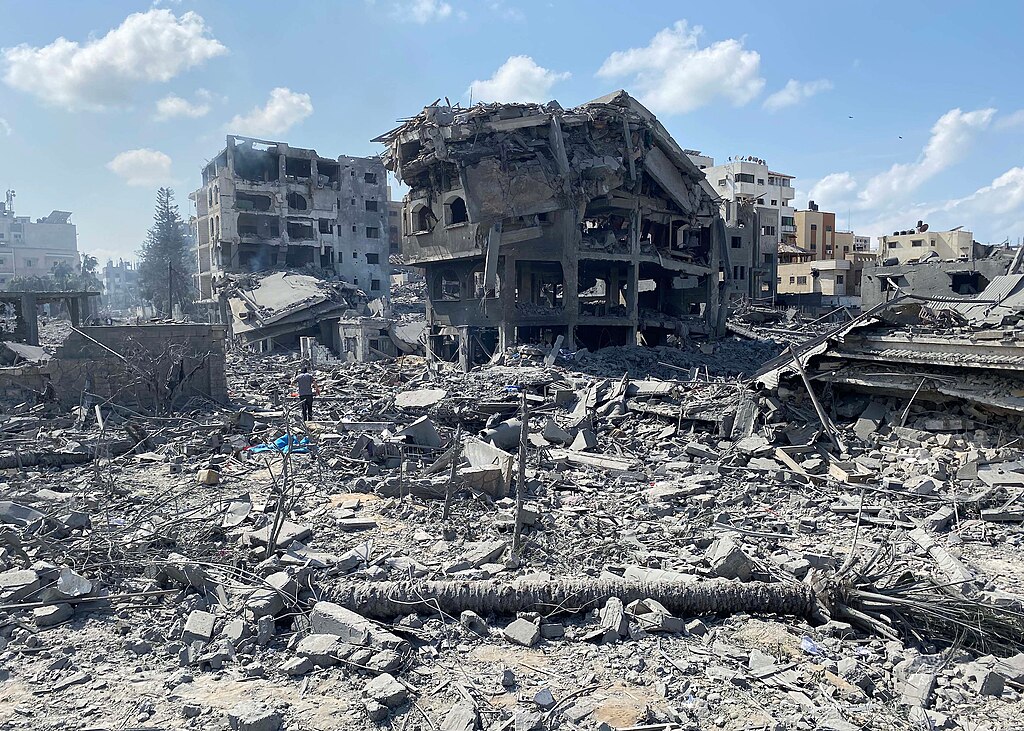
CNN’s Clarissa Ward was the first foreign journalist who made it into Gaza without the army, and she did this by accompanying an aid convoy supported by the United Arab Emirates in December 2023. During this two-hour trip to Rafah, where 2.3 million residents are now based, the area was bombed and she filmed operations in a field hospital, and talked to doctors and injured children.
With 20 years of war reporting under her belt, she concluded: “Like Grozny, Aleppo and Mariupol, Gaza will go down as one of the great horrors of modern warfare.”
From outside the country, media outlets keep trying to check and verify information on the bombings from the IDF by using geo-location and AI software to scan satellite imagery for bomb craters and destruction. In December this enabled the New York Times to conclude that “during the first six weeks of the war in Gaza, Israel routinely used one of its biggest and most destructive bombs in areas it designated safe for civilians”.
Israeli media coverage
Within Israel, the media are mostly publishing the IDF version of events unchallenged. According to Israeli journalist and activist Anat Saragusti: “Hebrew-speaking Israelis watching television news are not exposed at all to what’s going on in Gaza. We don’t see atrocities, the rubble, the destruction and the humanitarian crisis. The world sees something completely different.”
Meanwhile, the left-wing newspaper Haaretz (published in Hebrew and in English) has been threatened with financial penalties for “sabotaging Israel in wartime” through its more nuanced journalism. According to reporter Ido David Cohen, writing in December, it is the television news channels that present the most extreme example of censorship, as they have “devoted themselves to national morale, exclusively relying on official military statements and completely ignoring Palestinian casualties”.
In the same article, cultural commentator and academic David Gurevitz claimed the numbers of Palestinians killed remains an abstract concept for many Israelis: “The Israeli audience isn’t capable of accommodating two kinds of pain together, seeing and identifying with the human victim of the other side as such, and the media follow suit.”
This argument was backed up this month by Israeli journalist Yossi Klein who wrote: “The most taboo number in Israel is 34,000. You can’t talk about it, you can’t mention it, and if someone speaking on a panel accidentally blurts it out, they should add, disdainfully: ‘according to Palestinian sources’.”
Colleen Murrell, Full Professor in Journalism, Dublin City University
This article is republished from The Conversation under a Creative Commons license. Read the original article.