THE top 10 per cent of Britain’s population has more wealth than the other 90 per cent combined, according to TUC analysis of official Office for National Statistics (ONS) figures released today.
The huge inequality between rich and poor has widened under 14 years of Tory rule, which saw an “explosion” in insecure work and a decline in living standards.
Under the Conservatives, real wages grew by just 0.3 per cent a year — compared with 1.5 per cent from 1997 to 2010 under Labour.
The TUC estimates that the average worker would be £117 a week better off had pay increased since 2010 at the same pace as between 1997 and 2010.
Pay growth during Conservative-led governments from 2010-2024 was worse than for any other period of government since the 1920s.
The Tories also oversaw the worst fall in living standards since records began in 1955, the TUC said.
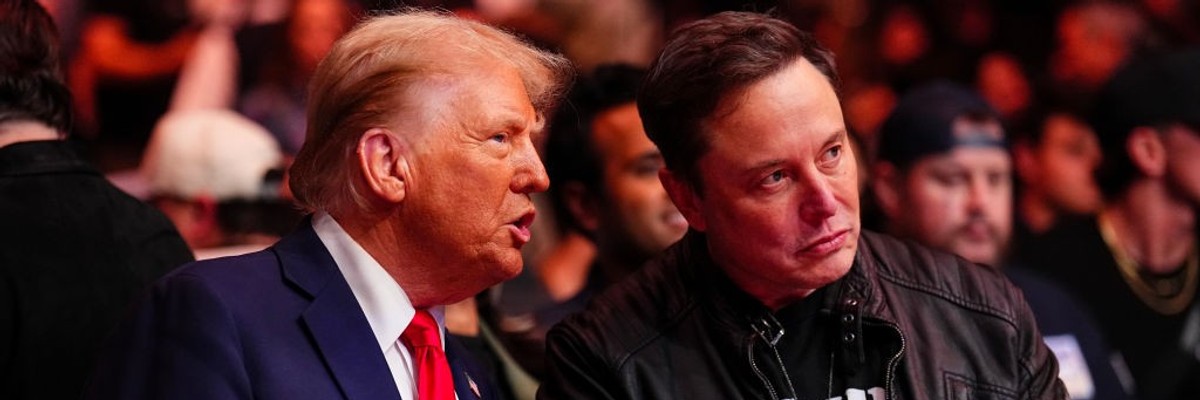
President-elect Donald Trump and Elon Musk talk ringside during the UFC 309 event at Madison Square Garden on November 16, 2024 in New York City. (Photo: Chris Unger/Zuffa LLC)
It appears that Trump has entered into a power-sharing agreement with Musk and several other wealthy individuals including Vivek Ramaswamy, Robert F. Kennedy Jr., and David Sacks.
Democracy decays into oligarchy when a few individuals accumulate most of the political power.
The reelection of Donald Trump has accelerated the decline of the United States into oligarchy. Trump has had billionaire donors for each of his presidential campaigns, but in 2024 the role of these wealthy donors expanded. Donors such as Elon Musk made gigantic contributions to Trump’s campaign; in return for this they are taking an active role in the Trump White House. Perhaps, this time around, Trump turned the oval office into a time-share.
On December 19, Elon Musk led the call for House Republicans to repudiate a continuing resolution they had just negotiated to keep the federal government running through the end of the year. Perhaps Musk’s charter includes coordination with Congress.
When Elon Musk and Vivek Ramaswamy speak of increasing government efficiency, they usually start with services for the unfortunate.
It appears that Trump has entered into a power-sharing agreement with Musk and several other wealthy individuals including Vivek Ramaswamy, Robert F. Kennedy Jr., and David Sacks. However this arrangement works, it’s likely that the Trump administration will cater to billionaires—Sen. Bernie Sanders (I-Vt.) observed that the 13 billionaires chosen by Trump to serve in his administration have a combined wealth of at least $383 billion.
What do these billionaires want? The oligarchs and billionaires want lower taxes and reduced government regulations. Of course, each billionaire has a particular set of interests; for example, David Sacks, Trump’s “AI and crypto czar,” is a venture capitalist with heavy investment in AI and crypto. Sadly. most of the oligarchs are climate-change deniers.
The oligarchs want more wealth. Robert Reich observes:
Since [1980], the median wage of the bottom 90% has stagnated. The share of the nation’s wealth owned by the richest 400 Americans has quadrupled (from less than 1% to 3.5%) while the share owned by the entire bottom half of America has dropped to 1.3%… The richest 1% of Americans now has more wealth than the bottom 90% combined.
The oligarchs share a fiscally conservative agenda. They intend to shrink the size of the federal government. The particulars vary but the oligarchs are not concerned with the size of the defense budget; their cost-cutting focus is on programs that service the poor and disadvantaged—such as Medicaid. When Elon Musk and Vivek Ramaswamy speak of increasing government efficiency, they usually start with services for the unfortunate.
What are the practical consequences of this shift to oligarchy? It’s unsettling to be in a political situation where we do not understand who is in charge at the White House. We don’t know how power-sharing will work. The relationship between Trump and Congress has been fraught. The shift to oligarchy will make this relationship even more difficult.
Will the oligarchs fix the economy? Trump was elected because he promised to fix the economy. Most Americans believed he would drive down inflation; they thought Trump would reduce the cost of food, housing, and household and medical expenses. Since November 5, Trump has given no indication of how he plans to do this. Perhaps he has lost interest.
During the presidential campaign, Trump said his inflation-fighting agenda would rely upon tariffs, but it’s likely that the oligarchs will influence how Trump’s tariff strategy plays out. Musk has huge business interests in China, and it’s unlikely that he would support a tariff policy that would hurt his relationships with the country.
Trump has appointed a “czar” for immigration (Tom Homan), energy (Doug Burgum), and AI & Crypto (Sacks). Trump has not appointed a czar for inflation. With much fanfare, Trump has appointed a commission on “government efficiency;” they’ve already started meeting. Trump has not appointed to a commission to curb inflation.
After January 20, Trump will own inflation and the economy. Trump’s immigration “purge” will drive up the cost of food. Trump’s tariffs will drive up the cost of household expenses.
Trump’s trying to ignore inflation. Or turn it over to an oligarch co-president. Stay tuned.
1 September 2022 (IEEFA): Underperforming carbon capture projects considerably outnumber successful projects globally, and by large margins, with both the technology and regulatory framework found wanting, finds a new report by the Institute for Energy Economics and Financial Analysis (IEEFA).
The report, The Carbon Capture Crux – Lessons Learned, studies 13 flagship large-scale carbon capture and storage (CCS)/carbon capture utilisation and storage (CCUS) projects in the natural gas, industrial and power sectors in terms of their history, economics and performance. These projects account for around 55% of the total current operational capacity worldwide.
Author Bruce Robertson says seven of the thirteen projects underperformed, two failed, and one was mothballed
“CCS technology has been going for 50 years and many projects have failed and continued to fail, with only a handful working.
“Many international bodies and national governments are relying on carbon capture in the fossil fuel sector to get to Net Zero, and it simply won’t work.
“Although some indication it might have a role to play in hard-to-abate sectors such as cement, fertilisers and steel, overall results indicate a financial, technical and emissions-reduction framework that continues to overstate and underperform.”
IEEFA’s study found that Shute Creek in the U.S. underperformed its carbon capture capacity by around 36% over its lifetime, Boundary Dam in Canada by about 50%, and the Gorgon project off the coast of Western Australia by about 50% over its first five-year period.
“The two most successful projects are in the gas processing sector – Sleipner and Snøhvit in Norway. This is mostly due to the country’s unique regulatory environment for oil and gas companies,” says co-author Milad Mousavian.
“Governments globally are looking for quick solutions to the current energy and ongoing climate crisis, but unwittingly latching onto CCS as a fix is problematic.”
Last week the Australian government approved two new massive offshore greenhouse gas storage areas, saying CCS “has a vital role to play to help Australia meet its net zero targets. Australia is ideally placed to become a world leader in this emerging industry”.
However, Robertson says, carbon capture technology is not new and is not a climate solution.
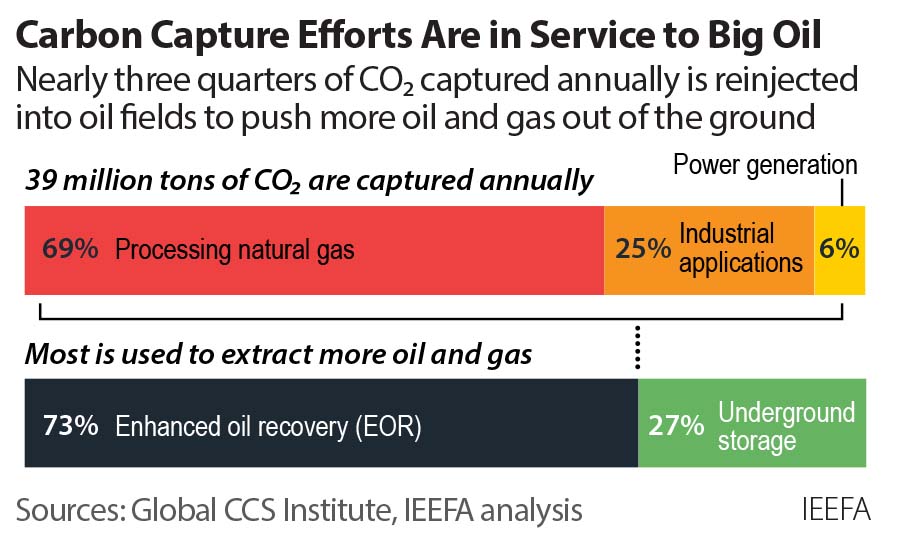
“As our report shows, CCS has been around for decades, mostly serving the oil industry through enhanced oil recovery (EOR). Around 80–90% of all captured carbon in the gas sector is used for EOR, which itself leads to more CO2 emissions.”
About three-quarters of the CO2 captured annually by multi-billion-dollar CCUS facilities, roughly 28 million tonnes (MT) out of 39MT total capture capacity globally, is reinjected and sequestered in oil fields to push more oil out of the ground.
The International Energy Agency says annual carbon capture capacity needs to increase to 1.6 billion tonnes of CO2 by 2030 to align with a net zero by 2050 pathway.
“In addition to being wildly unrealistic as a climate solution, based on historical trajectories, much of this captured carbon will be used for enhanced oil recovery,” says Robertson.
History shows CCS projects have major financial and technological risks. Close to 90% of proposed CCS capacity in the power sector has failed at implementation stage or was suspended early — including Petra Nova and the Kemper coal gasification power plant in the U.S. Further, most projects have failed to operate at their theoretically designed capturing rates. As a result, the 90% emission reduction target generally claimed by the industry has been unreachable in practice.
Finding suitable storage sites and keeping it there is also a major challenge—the trapped CO2 underground needs monitoring for centuries to ensure it does not come back to the atmosphere.
The report identifies interim considerations for CCS projects if no alternative solutions to emissions reduction are found.
Safe storage locations must be identified, and a long-term monitoring plan and compensation mechanism in case of failure developed.
The CCS project must not promote enhanced oil recovery.
To avoid project liability being handed over to taxpayers, as is currently the situation with Gorgon, large oil and gas companies mainly benefiting from CCS at their gas developments must be liable for any failure/leakage and monitoring costs of CCS projects, specifically if they get subsidies, grants and tax credits for capturing the carbon.
It must not be used by governments to greenlight or extend the life of any type of fossil fuel asset as a climate solution.
Robertson says more research could be done on CCS applications in industries where emissions are hard to abate such as, cement, as an interim partial solution to meeting net zero targets.
“As a solution to tackling catastrophic rising emissions in its current framework however, CCS is not a climate solution.”
People participate in a “march on billionaires” event on July 17, 2020 in New York City. (Photo: Spencer Platt/Getty Images)
“Americans overwhelmingly prefer raising taxes on the ultra-wealthy and huge corporations to making cuts to critical programs like healthcare, medical research, and infrastructure,” said Sen. Elizabeth Warren.
The United States’ astronomical levels of economic inequality are poised to become further entrenched in the coming years as what The New York Timesdescribed Sunday as “the greatest wealth transfer in history” gets underway, with the richest members of the Baby Boomer generation set to pass trillions of dollars in assets on to their descendants—often paying little or nothing in taxes.
“Most will leave behind thousands of dollars, a home, or not much at all. Others are leaving their heirs hundreds of thousands, or millions, or billions of dollars in various assets,” the Times reported. “Of the $84 trillion projected to be passed down from older Americans to millennial and Gen X heirs through 2045, $16 trillion will be transferred within the next decade.”
The newspaper added that thanks to the loophole-ridden U.S. tax system, “heirs increasingly don’t need to wait for the passing of elders to directly benefit from family money, a result of the bursting popularity of ‘giving while living‘—including property purchases, repeated tax-free cash transfers of estate money, and more—providing millions a head start.”
“The trillions of dollars going to heirs will largely reinforce inequality,” the Times observed. “The wealthiest 10% of households will be giving and receiving a majority of the riches. Within that range, the top 1%—which holds about as much wealth as the bottom 90%, and is predominantly white—will dictate the broadest share of the money flow. The more diverse bottom 50% of households will account for only 8% of the transfers.”
1/Months in the making, here's the final cut of my story on the long-awaited wealth transfer, no longer in the future tense: We're closer to 2053 than 1992. Elites are already disbursing to heirs while alive. The masses likely need luck or a paradigm shifthttps://t.co/FDKNafpCyV
Don Moynihan, a professor at Georgetown University’s McCourt School of Public Policy, argued that the Times analysis further demonstrates that “we are not taxing the very wealthy enough.”
The Times noted that individuals in the U.S. can pass nearly $13 million in assets to heirs without paying the federal estate tax, which only applies to around two of every 1,000 American estates.
“As a result, although high-net-worth and ultrahigh-net-worth individuals could inherit more than $30 trillion by 2045, their prospective taxes on estates and transfers is $4.2 trillion,” the Times observed.
The explosion of wealth inequality in the U.S. over the past several decades has prompted growing calls for systemic reform but little substantive action from lawmakers. In 2017, congressional Republicans and then-President Donald Trump contributed to the inequality boom by ramming through tax legislation that disproportionately benefited the wealthiest Americans.
Now in control of the U.S. House, Republicans are trying to make the Trump tax cuts for individuals permanent and eliminate the estate tax altogether—a move that would give the nation’s wealthiest households another $2 trillion in tax breaks.
In April, Sen. Bernie Sanders (I-Vt.) led several of his colleagues in offering an alternative proposal: Legislation that would impose progressively higher taxes on estates worth between $3.5 million and $1 billion, as well as a 65% levy on estates worth more than $1 billion.
“At a time of massive wealth and income inequality, we need to make sure that people who inherit over $3.5 million pay their fair share of taxes,” Sanders said last month. “We do not need to provide a huge handout to multi-millionaires and billionaires. It is unacceptable that working families across the country today are struggling to file their taxes on time and put food on the table, while the wealthiest among us profit off of enormous tax loopholes and giant tax breaks.”
Sen. Elizabeth Warren (D-Mass.), a co-sponsor of Sanders’ legislation, tweeted Monday that “Americans overwhelmingly prefer raising taxes on the ultra-wealthy and huge corporations to making cuts to critical programs like healthcare, medical research, and infrastructure.”
“Congressional Republicans need to get on board,” the senator added.
Americans overwhelmingly prefer raising taxes on the ultra-wealthy and huge corporations to making cuts to critical programs like health care, medical research, and infrastructure. Congressional Republicans need to get on board.
Morris Pearl, a former managing director at the asset management behemoth BlackRock and the chair of the Patriotic Millionaires, stressed in an interview with the Times that structural changes to the U.S. tax code—not just a crackdown on wealthy tax cheats—are necessary to slow the rise of inequality.
“People are following the law just fine. I generally don’t pay much taxes,” said Pearl, whose group has warned that democracy “will not survive” unless the rich are taxed much more aggressively.
Stressing the ease with which rich families in U.S. are able to pass assets on to their heirs tax-free, Pearl told the Times that he currently holds stock that his wife’s father, “who died a long time ago, bought in the 1970s,” an investment that “has gone from a few thousand dollars to many hundreds of thousands of dollars”—unrealized capital gains that are not subject to taxation.
University of California, Berkeley economists Emmanuel Saez and Gabriel Zucman have estimated that $2.7 trillion of the $4.25 trillion in wealth held by U.S. billionaires is unrealized.
“I’ve never paid a penny of taxes on all that,” Pearl said of his inherited equities, “and I may not ever, because I might not sell and then my kids are going to have millions of dollars in income that’s never taxed in any way, shape, or form.”