Hugh Kirsch, 66, with his sister Oona Herzberg. Hundreds of contract disputes have erupted between cash-strapped councils and financially struggling care providers. Photograph: Oona Kirsch
Hugh Kirsch’s case one of wave of evictions of vulnerable residents caused by crisis in adult social care funding
A pensioner with severe learning disabilities who was a victim of one of the most notorious care home abuse scandals of recent years has been told he faces eviction over a dispute about who pays for the costs of his state-funded care.
The family of Hugh Kirsch, 66, said they had been warned he would have to leave his supported home because the council that funds his care refused to increase fees in line with costs and his care provider could no longer afford to subsidise the price.
The case is one of a growing wave of evictions of vulnerable residents caused by the crisis in adult social care funding in which hundreds of contract disputes erupt between cash-strapped councils and financially struggling care providers.
Kirsch’s sister Oona Herzberg said he was “trapped in the crosshairs of funding issues that have nothing to do with him”, and urged his funder, Haringey council, to fulfil its responsibilities to meet his care needs.
She told the Guardian: “It would be cruel and inhuman to evict Hughie. He would be traumatised after what he has been though, and so would we. He would be totally bewildered and upset, and would withdraw inside himself.”
Keir Starmer, Angela Rayner and Rachel Reeves wear the uniform of the rich and powerful. They have all had clothes bought for them by multi-millionaire Labour donor Lord Alli. CORRECTION: It appears that Rachel Reeves clothing was provided by Juliet Rosenfeld.Keir Starmer says that the Labour Party under his leadership all feel a small part of Scunthorpe.
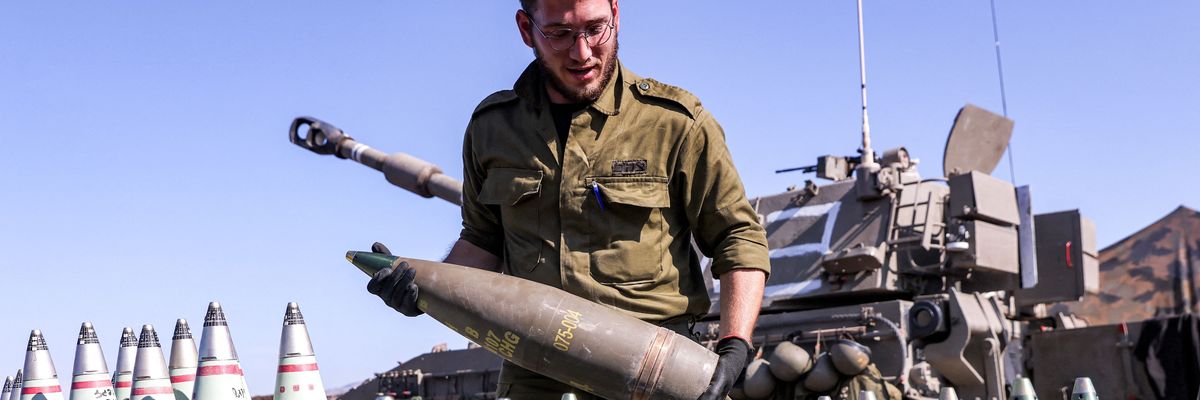
An Israeli soldier carries a U.S.-supplied 155mm artillery shell near a self-propelled howitzer deployed at a position near the border with Lebanon in the upper Galilee region of northern Israel on October 18, 2023. (Photo: Jalaa Marey/ AFP via Getty Images)
Like the Biden administration, Trump is claiming an “emergency” in order to bypass Congress.
As Palestinians released from Israeli imprisonment recount torture and other abuse suffered at the hands of their former captors, the Trump administration on Friday approved a new $3 billion weapons package for Israel.
The new package, reported by Zeteo‘s Prem Thakker, includes nearly $2.716 billion worth of bombs and weapons guidance kits, as well as $295 million in bulldozers. The Trump administration said that “an emergency exists that requires the immediate sale,” allowing it to bypass Congress, as the Biden administration did on multiple occasions. However, the weapons won’t be delivered until 2026 or 2027.
The Trump-Vance State Department just approved $3.01 billion in arms & equipment sales to Israel$2.04 billion in bombs$675.7 million in bombs & weapon guidance kits$295 million in bulldozersAdministration said "an emergency exists that requires the immediate sale," waiving congressional review
From October 2023 to October 2024, Israel received a record $17.9 billion worth of U.S. arms as it waged a war of annihilation against the Gaza Strip that left more than 170,000 Palestinians dead, maimed, or missing and millions more displaced, starved, or sickened. Israel is facing genocide allegations in an International Court of Justice case brought by South Africa. The International Criminal Court has also issued arrest warrants for Israeli Prime Minister Benjamin Netanyahu and former Israeli Defense Minister Yoav Gallant.
Reporting on the new package came after U.S. Sen. Bernie Sanders (I-Vt.) on Monday announced an effort to block four other arms sales totaling $8.56 billion in offensive American weaponry to Israel.
Meanwhile, some of the approximately 1,000 Palestinians released by Israel as part of a prisoner swap described grim stories of abuse by Israeli forces. The former detainees, who were arrested but never charged with any crimes, “have returned visibly malnourished and scarred by the physical and psychological torture they say they faced in Israeli prisons,” according to The Washington Post. Some returned to what were once their homes to find them destroyed and their relatives killed or wounded by Israeli forces.
Eyas al-Bursh, a doctor volunteering at al-Shifa Hospital in Gaza City when he was captured by Israeli troops, was held in Sde Teiman and the Ofer military prison in the illegally occupied West Bank for 11 months.
“The places where we were held were harsh, sleep was impossible, and we remained handcuffed and blindfolded,” al-Bursh told the Post.
“We endured psychological and physical torture without a single day of respite—whether through beatings, abuse, punches, or even verbal insults and humiliation,” he added.
The Israel Defense Forces told the Post that it “acts in accordance with Israeli and international law in order to protect the rights of the detainees held in the detention and questioning facilities.”
However, farmer Ashraf al-Radhi, who was held for 14 months—including at the notorious Sde Teiman prison in Israel’s Negev Desert—told the Post that “we witnessed all kinds of humiliation.”
According to the newspaper:
Radhi said he “wished for death” during his detention, which included long periods when he was blindfolded, handcuffed, andcrammed into a filthy cell with dozens of other prisoners. The 34-year-old said he had no access to a lawyer; no idea why he was there; or what, in his absence, had become of his family.
Rahdi also said that Mohammed al-Akka, a 44-year-old detainee held with him, died last December. Al-Akka is one of dozens of Palestinian prisoners who have died in Israeli custody, some from suspected torture and, in at least one case, rape with an electric baton. A number of Israeli reservists are being investigated for the alleged gang-rape of a Sde Teiman prisoner.
Neo-Fascist Climate Science Denier Donald Trump says Burn, Baby, Burn.Elon Musk urges you to be a Fascist like him, says that you can ignore facts and reality then.
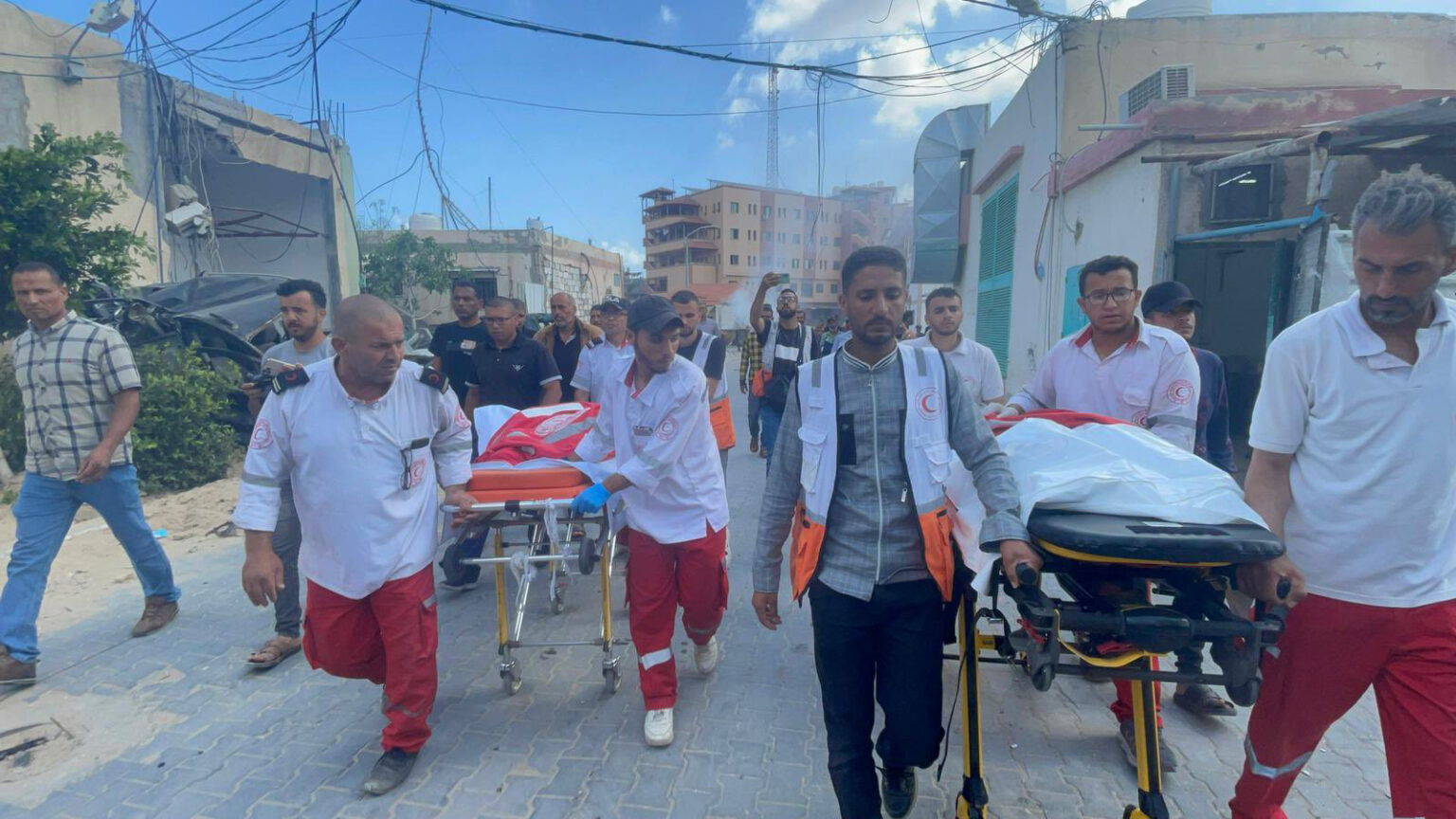
Palestinian Red Crescent crews mourn fellow paramedics Haitham Tubasi and Suhail Hassouna, killed by Israeli forced (Photo via PRCS)
A new report from the Palestinian Ministry of Health warns that over 1,000 health workers in Gaza have been killed by Israeli forces since October 2023. Meanwhile, a severe shortage of essential hygiene supplies continues to exacerbate the health crisis
Israel has killed 1,151 workers in Gaza’s healthcare system since October 2023, according to the Palestinian Ministry of Health. Among the dead are 260 nurses, 184 health associates, 165 physicians, and 76 pharmacists, along with hundreds of management and support staff. While most of the victims’ names have been confirmed by health authorities, over 150 confirmations are still pending due to Israel’s refusal to release the martyrs’ bodies.
In addition to those killed, hundreds of health workers remain imprisoned, where they face abuse and torture, as documented by international organizations. Ziad Muhammad Al-Dalu, a physician from Al-Shifa Hospital, was among those who died in Israeli custody, as reported by the Ministry of Health. His death serves as yet another example of Israel’s deliberate targeting of Gaza’s healthcare workers and infrastructure, actions that violate international humanitarian law.
The ongoing attacks on healthcare have left tens of thousands of people with life-altering injuries. According to the World Health Organization (WHO), approximately 25% of those injured between October 2023 and July 2024 have suffered burns, severe limb injuries, or amputations, with no access to rehabilitation services. Dozens of physiotherapists were killed in the attacks, and inpatient rehabilitation services have been shut down for months. “Even the most essential assistive devices, like wheelchairs and crutches, are lacking due to the restricted flow of aid,” the WHO said.
Israel’s blockade on humanitarian aid continues to choke Gaza’s healthcare system. At the moment, one of the most urgent problems is the shortage of soap and detergents. With the cost of a small bar of soap reaching USD 10—a price that could buy approximately 2 kilograms of soap in Germany—many families in Gaza are unable to afford basic hygiene supplies. “A family relying on cash-for-work income would spend 60% of the unskilled income on consumable hygiene products,” warned organizations monitoring water and sanitation in Gaza.
With soap being an omnipresent product, it might be difficult to imagine how severe the effects of a shortage might be, particularly for children. Health and hygiene officials estimate that adequate access to soap in the Gaza Strip could reduce respiratory infections by 20% and diarrheal diseases by up to 40%. This would potentially prevent illness in at least one in three children currently suffering from diarrhea. However, humanitarian organizations estimate that delivering the 5 million soap bars needed each month to meet demand in Gaza is basically impossible under the existing restrictions.
Despite this situation, Gaza recently completed the first phase of its polio vaccination campaign, with an 87% coverage rate among children—just below the 90% benchmark. The campaign is set to resume in the coming weeks, but incidents of Israeli forces obstructing access to those taking part in it persist, jeopardizing future public health efforts.
As winter approaches, the need for essential medicines, hygiene supplies, and nutritious food in Gaza becomes even more urgent. Concerns about potential floods and worsening living conditions highlight once again the critical need for an immediate ceasefire and rebuilding of the health system.
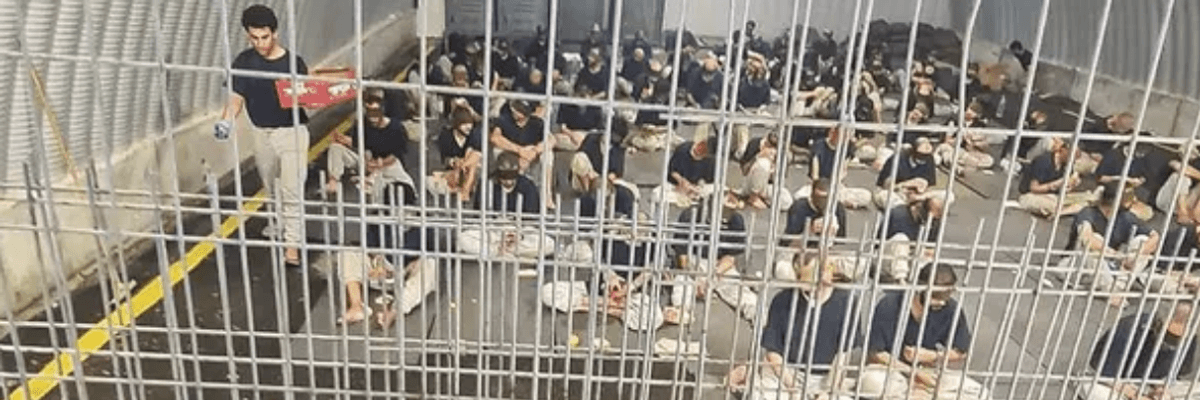
Palestinians imprisoned at Sde Teiman are shackled and blindfolded 24 hours a day and are forced to sit still and silent in painful positions for hours on end. (Photo: Whistleblower)
“Teeth were broken, bones were broken,” said one soldier. “You notice how easy it is to lose your humanity,” said another.
An Israeli newspaper on Friday published interviews with Israel Defense Forces reservists and medical staff who witnessed the “day-to-day torture” of Palestinian prisoners at the notorious Sde Teiman prison in the Negev Desert, where dozens of detainees have died and others were allegedly raped.
The Israelis described seeing torture and abuse of Palestinians detained in Sde Teiman, who included everyone from Hamas fighters to innocent civilians, and ranged in age from children to octogenarians.
“We said, ‘It’s torture.’ But you don’t get into it; you change the subject immediately.”
“What’s happening there is total dehumanization. You don’t really relate to them as if they’re real human beings,” said one public hospital physician who worked at Sde Teiman. “In the end it’s no less than torture. There are ways to administer even poor treatment, or even to torture a person, without crushing cigarettes on them.”
One female former medical staffer said that “the place was totally unimaginable, I had never considered anything like it.”
“My first thought was: What have I done?” she said, describing prisoners being forced to relieve themselves in diapers and take their meals through straws.
“The conditions there were described as torture,” she added. “Maybe. In many senses, yes, I agree with that. Maybe even insane torture.”
Israel cannot prosecute this war—ostensibly against Hamas but actually against all Palestinians in Gaza—without irreparably dehumanising itself and its soldiers, and causing far more harm than good.
This has been clear for months. Sde Teiman should wake up anyone still sleeping.
A 37-year-old male reservist said some of the worst abuse was committed by members of Force 100, the unit of the nine Israelis recently arrested for allegedly gang-raping a Sde Teiman prisoner.
“They took… guys aside and really laid into them,” he said. “I think that each time teeth were broken, bones were broken… And there was also a dog.”
Former Sde Teiman prisoners have described dogs attacking and performing “vile acts” on them.
Another IDF reservist said that “when you come to the camp, the first thing that hits you is the smell… of dozens of people who have been sitting in close quarters for more than a month in the same clothes and in insane heat.”
“They let them shower for a few minutes around twice a week, but I don’t remember ever seeing that they gave them a change of clothes, in any case not on my shifts,” he added.
The Haaretz interviewees said that much of the abuse occurred in the open.
“It wasn’t something that was done in the dark,” the 37-year-old reservist said. “Everyone saw what was going on… It’s not something that was done behind the back of the commander of the camp.”
“Most of the guys were just fine with what was happening,” he continued. “There were some who were a little bothered by it, and there were others who were bothered by it at the start and then they toed the line with the system.”
“There were people who in conversations suddenly mentioned the word ‘torture,’” he added. “And then we said, ‘It’s torture.’ But you don’t get into it; you change the subject immediately.”
Some of those interviewed by Haaretz expressed misgivings about what they did or saw at Sde Teiman.
“When I was there, I wrestled with myself about whether to stay on and try to do the right thing, the best I could as a moral person, or whether I should just get up and declare that I refused to take part in it,” said one male reservist and student. “I came out with a heavy feeling of guilt.”
Another reservist said, “The more distance I have from the place, the more my eyes have opened up.”
“What most disturbed me was to see how easily and how quickly ordinary people can disconnect themselves and not see the reality right in front of their eyes when they’re in the midst of a shocking human situation,” he added.
There were also rare moments of mercy.
“Sometimes the military police gave the minors candy, like in the evening, before sleep,” the 37-year-old reservist said. “One time a detainee started to cry. He was older, 60 years old. So the duty officer tried to speak to him and cheer him up a little.”
But more often, guards were “filled with rage,” said one reservist, who added that “there’s a desire for revenge.”
“What most disturbed me was to see how easily and how quickly ordinary people can disconnect themselves and not see the reality right in front of their eyes.”
One reservist said that “there was a female officer who gave us a briefing on the day we arrived. She said, ‘It will be hard for you. You’ll want to pity them, but it’s forbidden. Remember that they aren’t people.”
“You notice how easy it is to lose your humanity in a second, how easy it is to come up with justifications for treating people as if they’re not people,” he added.
One 27-year-old female reservist said that upon arriving at Sde Teiman—where she was welcomed with popcorn and cotton candy—she was alarmed to find that “good people whom I know talked about being cruel and abusive to people, like they were talking about something routine.”
“The dehumanization frightened me,” she said. “I couldn’t understand how a group of young people who were around me every day underwent such a dangerous process in such a short time.”
Another reservist said that some Sde Teiman staff—especially the volunteers—were “sadists” who “really enjoy beating up Arabs.”
The Haaretz interviews add to a growing body of evidence of torture and other war crimes perpetrated by Israelis against Palestinian prisoners at Sde Teiman and other lockups.
Former Palestinian detainees and Israeli personnel have described beatings, rape and sexual torture by male and female soldiers, routine amputations due to constant shackling, burnings, electrocutions, attacks by dogs, ice-water dousings, denial of food and water, sleep deprivation, constant loud music, and other abuse.
The Israeli military is investigating the deaths of at least 36 Sde Teiman detainees, including one who died after allegedly being sodomized with an electric baton.
On Friday, Alice Jill Edwards, the United Nations special rapporteur on torture, said that “there are no circumstances in which sexual torture or sexualized inhuman and degrading treatment can be justified.”
“I am troubled by recent attempts by Israeli citizens—including reportedly one member of Parliament—to intervene violently after the arrests of soldiers on these abuse charges,” she said of the recent storming of Sde Teiman and another base by a far-right mob in response to the arrests of the alleged rapists.
“Criminal proceedings into all allegations must proceed unhindered,” Edwards added. “No one is above the law. No one is immune from prosecution for torture.”
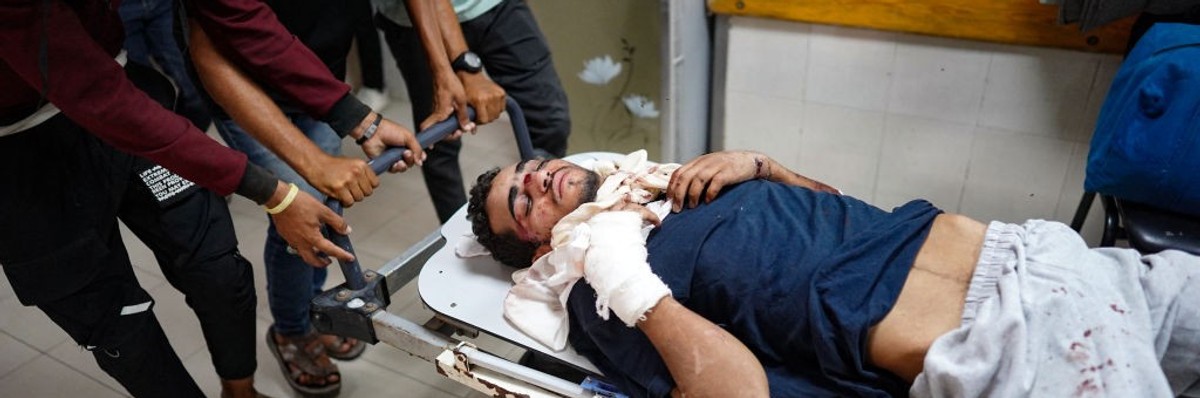
Palestinian Faouzi Abdel Aal, 21, is rushed to Nasser hospital in the southern Gaza Strip to receive treatment for his injuries, after being reportedly released from an Israeli detention center on July 25, 2024. (Photo: Bashar Taleb/AFP via Getty Images)
The U.N. report found evidence of sexual violence, waterboarding, and the use of dogs against detainees, many of whom were deprived of food, water, sleep, and toilet access.
The Office of the United Nations High Commissioner for Human Rights on Wednesday released a report detailing torture and abuse of Palestinians at Israeli detention centers, including sexual violence, waterboarding, and the use of dogs.
Israeli security forces have also used electric shocks, burned detainees with cigarettes, and deprived them of food, water, sleep, and toilet access, according to the 23-page OHCHR report, based largely on interviews with released detainees. Some detainees said they were held with their arms suspended from the ceiling; were forced to be naked for prolonged periods, wearing only diapers; and were blindfolded for extended periods.
Israel security forces have arrested thousands of Palestinians from the West Bank and Gaza since October, many of them arbitrarily; they held more than 9,400 “security detainees” as of the end of June, often in secret and incommunicado, without providing a reason for the detainment, the report says.
“The testimonies gathered by my office and other entities indicate a range of appalling acts, such as waterboarding and the release of dogs on detainees, amongst other acts, in flagrant violation of international human rights law and international humanitarian law,” U.N. Human Rights chief Volker Türk said in a statement accompanying the report.
New @UNHumanRights report addresses arbitrary, prolonged & 'incommunicado' detention of thousands of Palestinians by Israeli authorities since October.
Most of the detainees have been men and adolescent boys, though some are also women and adolescent girls, and there are many reported instances of sexual and gender-based violence, the report says, including “the forced nudity of both men and women; beatings while naked, including on the genitals; electrocution of the genitals and anus; being forced to undergo repeated humiliating strip searches; widespread sexual slurs and threats of rape; and the inappropriate touching of women by both male and female soldiers.”
OHCHR also said it had video evidence of detainees filmed in “deliberately humiliating positions” while handcuffed and blindfolded, and noted it received “consistent reports” of Israeli security forces “inserting objects into detainees’ anuses.”
Some detainees also reported “cage-like” facilities and overcrowding. The report says that 13 to 20 male detainees were kept in cells designed for five people, forcing many to sleep on the floor. There were “poor living, hygiene, and health conditions, with reports of water running only one hour per day over several weeks” and detainees faced “exposure to cold temperatures due to the confiscation of blankets and removal of windows panes in cold weather.”
At least 53 Palestinian detainees have died in Israeli detention centers since October, according to the report, which suggests that the detention system appears “to constitute a collectively punitive measure against Palestinians,” citing the words of Itamar Ben-Gvir, Israel’s minister of national security, who has said that “terrorists” deserve the most “stringent conditions.” Male detainees reported losing between about 55 and 120 pounds while in custody.
The OHCHR report comes as a highly controversial case involving detention abuse unfolds in Israel. The Israeli military is investigating nine soldiers for alleged “substantial abuse” of a Palestinian detainee who reportedly had to be hospitalized and could not walk after they attacked him. Far-right Israeli groups and political figures have protested the investigation.
Concern about Israeli detentions of Palestinians has been high for many months. In January, a Palestinian watchdog group issued a report condemning the forced disappearance of Gazans, and The New York Times found evidence of detainees being stripped and beaten.
Not all of the alarms about the situation in Israeli detentions centers have come from abroad. In February, Israeli’s public defender’s office issued a report calling for improved prison conditions, including for Palestinians. In April, local human rights groups called for a closure of the Sde Teiman military base detention center, due to its notorious conditions.
The calls were prompted in part by gruesome reports including amputations of detainees’ limbs due to handcuff injuries. The United Nations Relief and Works Agency for Palestine Refugees in the Near East then issued a damning report on detainee treatment, including of its own staff, some of whom had been detained and subjected to harsh interrogation.
Last week, Save the Children called for an end to the Israel’s arbitrary detainment of Palestinian minors, with a regional director saying that “these children are trapped, unable to move or see the sun, forced into crowded cells with appalling, unsanitary conditions, and subject to severe abuse and violence.”
Experts said Wednesday that the OHCHR report served mainly to confirm previous findings on Israeli detention centers. Neil Sammonds, a campaigner at the U.K.-based progressive advocacy group War on Want, said on social media that leaders of the new U.K. government haven’t spoken up about abuses at Israeli detention centers. He also said that the report could be used as evidence by the International Criminal Court, which has sought arrest warrants for both Israeli and Hamas leaders.
Latest UN report on Israel's abusive detention & torture adds little to what we've known for months, but underscores inertia of political leaders (I personally briefed still silent @DavidLammy & @Keir_Starmer in March) & opens door even wider for the ICC https://t.co/qOjDsR2ikN
The new report also addresses abuses of Israelis held by Hamas and affiliated groups. The Palestinian militants killed roughly 1,200 people in a horrific set of attacks in southern Israel on October 7 and kidnapped about 250 Israelis, more than 100 of whom have since been released. Like Palestinian detainees, the released Israelis reported “appalling” conditions, the report says, including beatings, receiving surgery without anesthetic, and sexual and gender-based violence. The Israeli government has reported that 44 of the remaining hostages in Gaza have died.
Both Israel and Hamas have refused to allow the International Committee of the Red Cross to visit detainees or hostages. The OHCHR called for both sides to allow such independent monitoring.