The Green Party’s revised transport policy, approved at its Autumn Conference, sets out a radical programme to transform transport in England & Wales. The proposed measures would aim to reduce carbon emissions by around 75% within a decade by reducing travel and expanding electrification of all modes. The party says the measures would also hugely reduce transport’s impacts on road danger and health while delivering a more equitable society.
Among a raft of ambitious initiatives, the policies include:
Transforming road and public transport – A step change away from car dependency, with major investment in better buses and rail. It aims for a 50% increase in rail travel and more frequent and reliable bus services, connecting homes with jobs, education, shops, healthcare. The policy also opposes almost all new road building.
Making Active Travel the natural choice – Safe, high-quality walking, wheeling and cycling networks, using road space reallocated from private motor vehicles. The policy aims for at least half of journeys in England’s towns and cities to be by active travel within five years, compared to a third in 2025.
Fairer and cleaner aviation – Reduce demand for passenger and freight flights, halt airport expansion, and ensure those who take the most polluting and unnecessary flights contribute the most. The policy specifically targets private jets, premium-class travel, and frequent flyers, while supporting cleaner alternatives and sustainable aviation.
Green Party parliamentary spokesperson on transport, Sian Berry MP, said:
“For too long transport policy has focused on moving vehicles rather than enabling people to get where they need to go. Our new policy is about giving everyone genuine choices – reliable and affordable public transport, safe walking, wheeling and cycling, and communities where owning a car isn’t a prerequisite for participating fully in society.
“We also need to tackle transport’s contribution to the climate crisis in an equitable and fair way. That means providing attractive alternatives to car and air travel, moving more freight onto rail and electrification. Those responsible for the most polluting and unnecessary journeys, including users of private jets and frequent flyers, will make the greatest contribution.”
Co-convenors of the policy, Jeremy Drew and Mark Strong, said:
“We have worked hard with an expert team of professionals and academics to revise our policy. It sets out measures to achieve a 75% reduction in transport carbon emissions within ten years, while making it easier for people and businesses to choose cleaner and healthier alternatives, which will improve not just transport but wider society.”
If you’re thinking of buying a new electric car worth up to £37,000, the UK government has offered to knock up to £3,750 off the price. The measure adds up to £650 million in grants for people to buy EVs (electric vehicles), but as a researcher who studies transport policy and climate change, I think this money would be better spent subsidising e-bikes.
Numerous questions surround the new government policy. Might people who can afford a new car buy one anyway, without the 10% discount? Might car dealers simply reduce the discounts they offer by a similar amount? Given the 20% VAT on an EV, doesn’t a sale actually result in a 200% immediate return for the government? And isn’t this mainly a bung to car manufacturers and company fleets?
The grants come on top of financial assistance for replacing cars, vans, taxis and motorbikes with electric options, announced in February – £120 million in total, including £500 grants for e-motorbikes. But almost no subsidies are available for two-wheeled, pedal-assisted EVs: e-bikes and e-cargo bikes.
The main financial help for buying e-bikes is the cycle to work salary-sacrifice scheme. The employer buys the bike and then instalments are deducted from a participant’s pay before tax, but the scheme’s eligibility is limited to employees on standard payroll tax (PAYE workers) whose sacrifices don’t drop their pay below minimum wage.
This also excludes those who are out of work, the low-paid, the self-employed and retired, arguably people who might benefit most from an e-bike.
Benefits beyond carbon savings
We know that e-bike owners replace lots of trips and miles driven by cars. We also know the upfront cost of around £2,000-£3,000 is a barrier to more people owning one, despite e-bikes being much cheaper than cars.
Estimates of annual carbon savings from e-bikers avoiding car trips vary, from as little as 87kg CO₂ in a 2016 study to 394kg in research published the following year. Estimates published in 2020 and 2023 put the annual climate dividend at 225kg and 168kg of CO₂ respectively – roughly in line with emissions for one person making a return short-haul flight.
E-bikes provide extra propulsion to make long or arduous journeys easier for more riders. Umomos/Shutterstock
These might seem small savings compared to the tonnes of CO₂ that an EV can save. However, e-bike incentives would have two big advantages.
First, policies that encourage active travel, including cycling, have been assessed by the government multiple times to determine the payoff from investment. It turns out that they have huge benefit to cost ratios – 9:1 on average (internationally it’s 6:1).
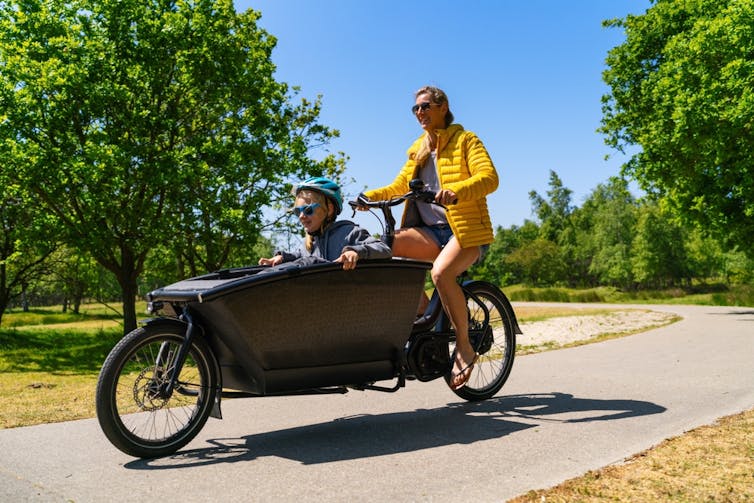
Conservatively, policies to encourage cycling pay back £5.50 in social benefits for every £1 invested. These benefits are largely savings for the healthcare system. In a project I worked on, in which we lent e-cargo bikes for free to 49 households in Leeds, Brighton and Oxford for several months, e-cargo bike users cycled up to three times more than non-users in our surveys.
E-cargo bike borrowers also reported mental-health benefits on top of satisfaction at being able to combine fitness with functional everyday trips, which were longer than they would attempt on a conventional bike. The cargo bikes especially helped with combining trips – commutes with shopping and school runs, for instance – meaning that more than 50% of trips and miles replaced car usage.
Second, e-bike incentives can be designed to appeal especially to the lower-paid, who have been found to use their e-bikes more than wealthier buyers, which would also replace more car trips. The highest of a sliding scale of means-tested incentives in a Canadian study attracted poorer first-time e-bike buyers with existing high car-use.
This reaped average annual carbon savings of 1,456kg for those in receipt of the maximum CAN$1,600 (£868). As the authors suggest, these incentives may have helped low-income households realise their preferences for less dependence on cars.
E-bike grants could get more people out of cars
But how many drivers want to drive less? According to research that groups people into camps based on travel preferences, up to 50% of travellers in the UK are “malcontented motorists” and “active aspirers” (to travel differently).
Our research also found that guilt, or trying to minimise car use, was a major motivator for nearly all of our participants. While the government has funded free e-(cargo) bike trials like ours, the main cycling organisations we talked to pointed out that use would “fall off a cliff” when the trial ends because of the cost barrier. Those who would struggle to buy one were back in the same position as before.
A government evaluation of free e-bike loans concluded they were poor value for money, but it tracked purchases made soon after with a tiny response rate. Our project followed up after a year and found 20% of our borrowers had bought an e-cargo bike. Trial loans and grants together might achieve even more.
The new EV grant money could provide nearly 750,000 e-bike or e-cargo bike purchase-incentives the size of the Canadian ones, which could lead to annual carbon savings of 1.125 million tonnes of CO₂, according to the weekly average savings they found in that group.
Given the conservative benefit to cost ratio of 5.5:1 from such a UK scheme, this investment could also reap more than £3.6 billion in social benefits – especially from a fitter car-dependent population. There would potentially be a massive boost to the struggling UK e-bike and e-cargo bike market as well.