This month brought yet another record-breaking spate of flash floods and deadly heatwaves across the US. Yet, as a new study by Heated (6/27/24) reveals, despite ample reporting on these events, a majority of news outlets still did not link these events to their cause: climate change.
Emily Atkin and Arielle Samuelson, writers for the climate-focused, Substack-based outlet, analyzed 133 digital breaking news articles from national, international and regional outlets reporting on this month’s extreme weather. Just 44% mentioned the climate crisis or global warming. Broken down by weather event: 52% of stories that covered heatwaves, and only 25% of stories that covered extreme rainfall, mentioned climate change.
As Atkin and Samuelson write, by now we know that climate change is the main cause of both extreme heat and extreme flooding. And we know the biggest contributor of climate-disrupting greenhouse gasses: fossil fuels, which account for about 75% of global emissions annually.
Still, the study’s authors found, only 11% of the articles they studied mentioned fossil fuels. Only one piece (BBC, 6/24/24) mentioned deforestation, which scientists say contributes about 20% of annual greenhouse gas emissions. None mentioned animal agriculture, which the FAO estimates contributes about 12% of global emissions.
Stark omissions
The omissions were laughably stark: A New York Post piece (6/21/24) ended with a New Yorker and former Marine who said he’d been in “way hotter conditions”—in Kuwait and Iraq. An AP article (6/4/24) quoted the “explanation” offered by a spokesperson for the Arizona Department of Forestry and Fire Management: “It does seem like Mother Nature is turning up the heat on us a little sooner than usual.”
Heated recognized some outlets that consistently mentioned climate change in their breaking coverage of heat and floods this month. That list included NPR, Vox, Axios, BBC and Agence France-Presse (AFP).
Then there were the outlets whose breaking coverage never mentioned it: ABC News, USA Today, The Hill, the New York Post and Fox Weather. When questioned, many of these outlets pointed the study’s authors to other climate coverage they had done, but this study’s focus on breaking news stories was deliberate:
Our analysis focused only on breaking stories because climate change is not a follow-up story; it is the story of the lethal and economically devastating extreme weather playing out across the country. To not mention climate change in a breaking news story about record heat in June 2024 is like not mentioning Covid-19 in a breaking news article about record hospitalizations in March 2020. It’s an abdication of journalistic responsibility to inform.
Explaining isn’t hard
A crucial takeaway for journalists and editors in this piece is that explaining the cause of these weather events isn’t hard. It’s often a matter of adding a sentence at most, Atkin and Samuelson write. They provide examples of stories that successfully made this connection, as with BBC (6/24/24):
Scientists say extreme weather events are becoming more frequent and intense as a result of human-caused climate change, fueled by activities like burning fossil fuels and cutting down forests.
Heatwaves are becoming more severe and prolonged due to the global climate crisis, caused primarily by the burning of fossil fuels.
Notably, the Guardian piece was a reprint of an AParticle that did not originally include that sentence; Heated confirmed that it was added by a Guardian editor.
AP, however, was sometimes able to provide appropriate context, as in a June 21 piece:
This month’s sizzling daytime temperatures were 35 times more likely and 2.5 degrees F hotter (1.4 degrees C) because of the warming from the burning of coal, oil and natural gas—in other words, human-caused climate change.
More denial than acknowledgment
During last summer’s apocalyptic orange haze on the East Coast, caused by record Canadian wildfires, I conducted a similar study (FAIR.org, 7/18/23) on US TV news’s coverage. Out of 115 segments, only 38% mentioned climate change’s role. Of those 115, 10 mentioned it in passing, 10 engaged in climate denial and 12 gave a brief explanation without alluding to the reality that climate change is human-caused. Only five segments acknowledged that climate change was human caused, and just seven fully fleshed out the fact that the main cause of the climate crisis is fossil fuels.
When there are more segments denying climate change than acknowledging fossil fuels’ role in it, you know there’s a problem.
This year, I noticed coverage of worldwide coral bleaching that did make the appropriate connections (FAIR.org, 5/17/24). As Atkin and Samuelson emphasized, the difference between careless and responsible reporting on this issue is often just a few words.
The Washington Post (11/22/23) said it couldn’t make a definitive assessment of whether Biden’s atrocity claims were true. But Israel’s official casualty list (11/11/23) had already debunked them.
In late November, the Washington Post (11/22/23) factchecked President Joe Biden’s repeated claims that babies had been beheaded during Hamas’s October 7 attack in Israel.
Biden’s remarks during a November 15 news conference triggered the factcheck:
Hamas has already said publicly that they plan on attacking Israel again, like they did before, to where they were cutting babies’ heads off to burning women and children alive.
Despite acknowledging a lack of confirmation of such atrocities, the Post stopped short of branding Biden’s statements false, and declined to dole out any of its iconic Pinocchios.
“It’s too soon in the Israel/Gaza war to make a definitive assessment,” Post Factchecker Glenn Kessler wrote, noting that even the most basic facts weren’t yet known.
“The Israeli prime minister’s office has said about 1,200 people were killed on October 7, down from an initial estimate of 1,400,” he said, “but it’s unclear how many were civilians or soldiers.”
An authoritative count
That statement isn’t true. While the exact number killed amid the extreme violence and chaos of October 7 may never be finalized, an authoritative count of civilian deaths—as well as data that definitively refutes claims babies were beheaded—was available to anyone with access to the internet little more than a month after the attack.
That’s when Bituah Leumi, or National Insurance Institute, Israel’s social security agency, posted a Hebrew-language website (11/9/23) with the name, gender and age of every identified civilian victim and where each had been attacked.
Two days later Bituah Leumi (also transliterated as Bituach Leumi) posted an English-language news release (11/11/23) publicizing the website as a memorial to the civilian victims of the “Iron Swords” war—Israel’s name for Hamas’s attack and Israel Defense Forces’ response. (The news release refers to “695 identified war casualties,” but there are no wounded; all the victims are listed as “killed.”)
The journalistic importance of the memorial website was shown less than a month later, when Haaretz (12/4/23), Israel’s oldest newspaper, used the social security agency’s data to debunk some of the most sensational atrocities blamed on Hamas.
‘Proved untrue’
Haaretz (12/4/23) reported that Israeli Prime Minister Benjamin Netanyahu’s most sensational atrocity claims were “inaccurate.”
Haaretz’s 2,000-word, English-language article was cautious, with allowances for mistaken and exaggerated reports from traumatized observers describing horrific scenes of carnage. But unlike the Washington Post’s factcheck, the Israeli newspaper didn’t pull its punches, flatly concluding that some of the claims of atrocities “have been proved untrue.”
Chief among the claims disproved was that Hamas fighters deliberately slaughtered dozens of babies—beheading some, burning and hanging others.
“According to sources including Israel’s National Insurance Institute, kibbutz leaders and the police, on October 7 one baby was murdered, 10-month-old Mila Cohen,” the Haaretz article stated. “She was killed with her father, Ohad, on Kibbutz Be’eri.” The child’s mother survived.
In addition to a single infant, the social security agency’s list of victims includes only a few other young children. Haaretz’s reporters were able to determine the circumstances of each of their deaths:
According to the National Insurance Institute, five other children aged 6 or under were murdered, including Omer Kedem Siman Tov, 2, and his 6-year-old twin sisters Arbel and Shachar, who were killed on Kibbutz Nir Oz. There was also 5-year-old Yazan Zakaria Abu Jama from Arara in the southern Negev, who was killed in a Hamas rocket strike, and 5-year-old Eitan Kapshetar, who was murdered with his parents and his 8-year-old sister, Aline, near Sderot.
Haaretz also used the social security data to refute allegations made by Israeli Prime Minister Benjamin Netanyahu to Biden that Hamas targeted and tortured children:
There is no evidence that children from several families were murdered together, rendering inaccurate Netanyahu’s remark to US President Joe Biden that Hamas terrorists “took dozens of children, tied them up, burned them and executed them.”
‘Details still sparse’
The Washington Post (12/4/23) acknowledged the Haaretz story the same day it was published, with a one-paragraph “update” inserted into its November 22 factcheck. While crediting Haaretz with doing a “detailed examination of unverified accounts of alleged atrocities disseminated by Israeli first-responders and army officers,” the Post downgraded the Israeli newspaper’s conclusion, saying only that “no accounts of beheaded or burned babies could be verified.”
While the Post noted that Haaretz “could document only one case of a baby being killed in the Hamas attacks,” the update did not explain that the source of that critical fact was an agency of the Israeli government. Nor did the Post alter the factcheck’s inconclusive, mishmashed “Bottom Line”:
Almost two months after the Hamas attack, details are still sparse on claims of beheading of babies. One IDF official says he found a decapitated baby; a first responder says “little kids” were beheaded, though an exact number was not provided. Forensic records that would document the cause of death have not been released. There also are reports of at least two beheadings of adults—a soldier and a Thai worker. First responders say they viewed these bodies.
There is little dispute that many of the civilians killed by militants on October 7 died in especially brutal ways. But caution is still warranted, especially at the presidential level, about statements that babies were beheaded. The available evidence does not need exaggeration.
An unnecessary retraction
PolitiFact (11/21/23) retracted this story (10/20/23) because it didn’t include Israeli claims about mutilated babies that—according to Israel’s official records—didn’t exist.
The Post wasn’t the only factchecker that wavered when judging reports of slaughtered Israeli babies. The Poynter Institute’s PolitiFact retracted its story (10/20/23), headlined “How Politicians, Media Outlets Amplified Uncorroborated Report of Beheaded Babies.”
PolitiFact took the embarrassing action after being savaged by the Committee for Accuracy in Middle East Reporting and Analysis, better known as CAMERA.
CAMERA, which Haaretz (9/5/16) described as “a right-wing media watchdog that routinely attacks news outlets over their coverage of Israel,” blasted PolitiFact as “unethical,” “sloppy and misleading” (11/8/23) for failing to include in its story all reports of mutilated babies made by Israeli military spokespeople, government officials and emergency response workers.
PolitiFact (11/21/23) conceded “our initial story was incomplete,” and published a revised story (11/21/23) that included many of those comments. The new version also quoted an Israel Defense Forces spokesperson stating “that verified testimonies state some people were beheaded, but they could not confirm how many.”
Like the Post’s Factchecker, PolitiFact drew no conclusions about the truth or falsity of those claims, declining to issue a rating on its “Truth-O-Meter.”
‘Details still emerging’
Snopes (10/12/23) says it’s still too soon to say whether babies were beheaded on October 7, thought it promises, “We will update this story once more information comes to light.”
The factchecking website Snopes (10/12/23, last updated 12/18/23) also declined to provide a definite answer to the question posed in its headline: “Were Israeli Babies Beheaded by Hamas Militants During Attack on Kfar Aza?”
“At present, details are still emerging from communities affected in Israel, the death tolls are still being counted, and the manner of many deaths have not yet been confirmed,” Snopes stated.
In one of eight updates, Snopes cited Haaretz’s December 4 “analysis of child deaths during the October 7 attack.” But, as with the Washington Post’s update, Snopes did not mention that the newspaper had used Israeli social security data in its investigation.
FactCheck, a project of the Annenberg Public Policy Center at the University of Pennsylvania, (10/13/23) did find that a Facebook video was correct in saying “that ‘no evidence has been provided’ for the viral claim that ‘40 babies’ were ‘beheaded’ by Hamas.”
But a November 14 update, included in the story, quoted the head of Israel’s National Center of Forensic Medicine saying that “many bodies” of victims he had examined were “without heads.” But he couldn’t determine whether the decapitations were deliberate or the result of explosions.
FactCheck has not published any more on the issue.
The missing proof
FAIR.org (10/20/23): “The claim about beheading babies was…a shocking story that served to turn off logic and critical thinking.”
There’s a reason why the major factchecking organizations hesitate to pass judgment on the widespread claim of slaughtered babies: They rightly conclude that the lack of verifying evidence, such as photos or autopsy reports, does not conclusively prove the claims are false.
FAIR contributor Saurav Sarkar made that precise point in his report (10/20/23) lambasting “corporate media” for “their repetition of the shocking, unsubstantiated claim that Hamas had beheaded 40 babies in its violent attack on a kibbutz in southern Israel on October 7.”
“So we have a story, and that story was generated in a grossly irresponsible way, and then repeated over and over,” Sarkar stated. “But what proof do we have that the story is false? After all, even if it was reported badly, and repeated without additional substantiation, it might be true.”
Bituah Leumi, the Israeli social security agency, provided that missing proof when it posted the official list of victims that showed only one infant was killed in the attack.
The mainstream US news media ignored that authoritative evidence.
‘War on truth’
AFP (12/15/23) reported that data from Israel’s social security agency “invalidates some statements by Israeli authorities in the days following the attack.”
The first major news outlet outside of Israel to use data from the social security agency’s website was the French wire service Agence France-Presse.
The AFP’s 1,000-word, English-language dispatch, headlined “Israel Social Security Data Reveals True Picture of October 7 Deaths,” was picked up by France24 (12/15/23), the Times of India (12/15/23), the financial weekly Barron’s (12/15/23) and a scattering of small newspapers, including the Caledonian (Vermont) Record (12/15/23).
The AFP story covered much the same ground as Haaretz’s analysis, listing the same slain infant—Mila Cohen—and five other young victims under 7 years old in refuting claims of wholesale slaughter of babies.
While Google searches found no US mainstream media reporting on the Israeli social security agency’s data, several independent journalists did.
Gareth Porter, an American historian and journalist whose credentials go back to the Vietnam War, cited the social security data in an article in Consortium News (1/6/24) that argued that the Netanyahu government sought to build support for the invasion of Gaza by “inventing stories about nonexistent atrocities and planting them with credulous US news outlets.”
In February, Jeremy Scahill used that data to make the same case in a 8,000-word article, headlined “Netanyahu’s War on Truth,” in the Intercept (2/7/24), the investigative website he helped found.
Both journalists credit the December 15 AFP dispatch as the source of the Israeli social security data. (Porter’s story provides a link to the Times of India; Scahill links to France24.)
Earlier this week a third independent journalist, Glenn Greenwald (3/3/24), quoted the December 4 Haaretz report, which used the Israeli social security data, in a YouTube video, titled “October 7 Reports Implode: Beheaded Babies, NY Times Scandal & More.”
Emotion-inflaming stories
Media focus on the imaginary beheaded babies helped Israel get away with killing hundreds of actual babies (Al Jazeera, 1/25/24).
In the months since the Haaretz and AFP reports were published, Bituah Leumi has updated its civilian death count to 779, including 76 foreign workers, as more victims are identified (Jewish News Syndicate, 1/15/24.).
But a detailed examination this week of the 16-page list of victims on the memorial website found no additional infants or young children—only those already accounted for by Haaretz and AFP—and a total of 36 children under 18 years old.
Mila Cohen remains the only infant reported killed in the October 7 attack.
US corporate media’s failure to cite the social security agency’s data to forcefully refute claims of butchered babies and other outrages comes at a high cost. Such emotion-inflaming stories continue to foul the public debate over whether Israel’s invasion of Gaza, which has resulted in the deaths of more than 30,000 Palestinians (AP, 2/29/24)—two-thirds of those women and children (PBS, 2/19/24)—is a criminally disproportionate response to the Hamas attack.
The ministry said of the 30,035 people killed so far in the conflict, more than 13,000 were children and 8,800 women. At least 70,457 people have been injured, of which more than 11,000 are in critical condition and need to be evacuated.
In January, when the Health Ministry had estimated the number of children killed at 10,000, Al Jazeera (1/25/24) published the names of more than 4,200 Palestinian dead under 18 years old. Of those children named, 502 were under 2 years old—that is, infants.
Unfounded horror stories about Hamas’s infant victims that should have been debunked were still being repeated by Biden (12/12/23) at a campaign fundraiser more than two months after Israel was attacked:
I saw some of the photographs when I was there—tying a mother and her daughter together on a rope and then pouring kerosene on them and then burning them, beheading infants, doing things that are just inhuman—totally, completely inhuman.
This time the Washington Post didn’t factcheck Biden—even though the White House stated months earlier that the president had never seen such photos (CNN, 10/12/23).
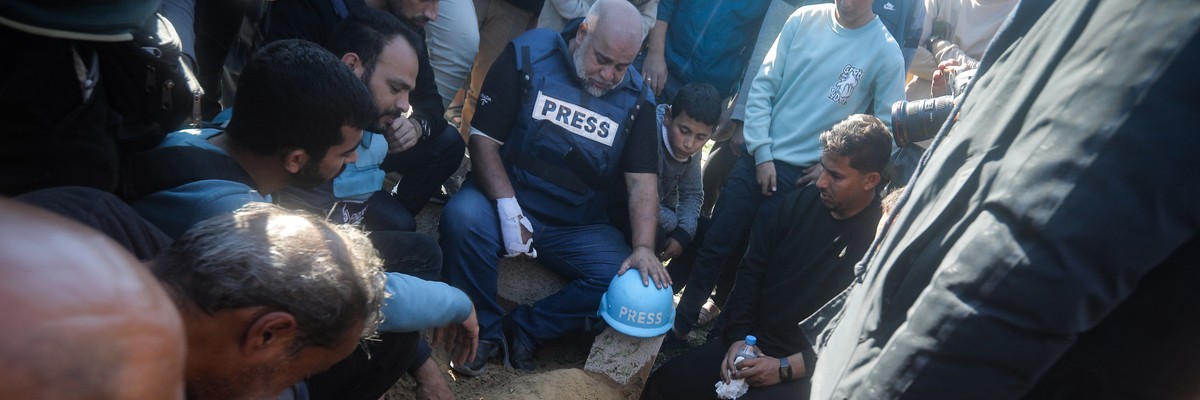
A press helmet is placed over the grave of Hamza Dahdouh, a Palestinian journalist who worked for Al Jazeera and was killed in an Israeli airstrike on Rafah on January 7, 2024. (Photo: Mohammed Talatene/picture alliance via Getty Images)
The international community must “hold Israel accountable for its heinous crimes,” said the Al Jazeera Media Network.
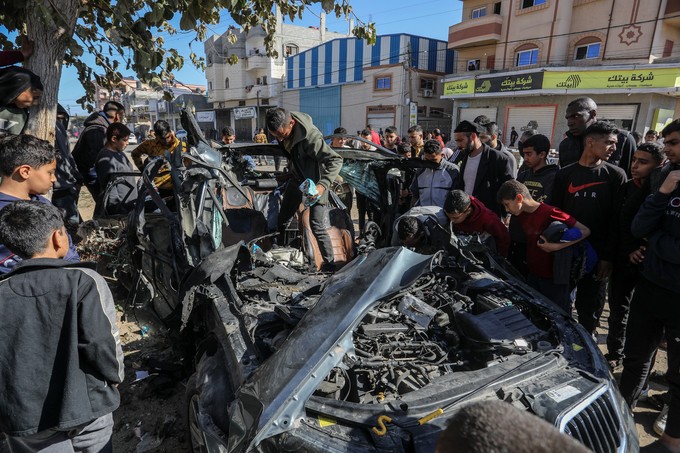
An Israeli airstrike in the southern Gaza city of Rafah on Sunday killed two Palestinian journalists and seriously wounded a third, adding to the war’s grisly toll on media workers.
The Al Jazeera Media Network said in a statement that the Israeli military targeted the journalists’ car as they were driving through the northern part of Rafah. The strike killed Hamza Dahdouh, the 27-year-old son of Al Jazeera‘s Gaza bureau chief, and Mustafa Thuraya, a freelance videographer working with Agence France-Presse. Hazem Rajab was injured in the Israeli strike.
“The assassination of Mustafa and Hamza, Al Jazeera correspondent Wael Dahdouh’s son, whilst they were on their way to carry out their duty in the Gaza Strip reaffirms the need to take immediate necessary legal measures against the occupation forces to ensure that there is no impunity,” the network said, imploring the international community to “hold Israel accountable for its heinous crimes.”
Hamza is the fifth member of Wael Dahdouh’s family killed in Israel’s assault on the Gaza Strip. Earlier in the war, Israeli strikes killed Dahdouh’s wife, younger son, daughter, and grandson. Wael himself was wounded by an Israeli drone strike that killed Al Jazeera journalist Samer Abu Daqqa.
“Hamza was everything to me, the eldest boy, he was the soul of my soul,” Wael said in anguished remarks from the cemetery where his son was buried. “These are the tears of parting and loss, the tears of humanity.”
“Hamza was not part of me. He was all of me.”
Al Jazeera’s Wael al-Dahdouh says goodbye to one more family member, his son Hamza, 'just like droves of people here do every day, every hour and every second.'
Christophe Deloire, secretary-general of Reporters Without Borders, expressed “shock” in response to news of Dahdouh and Thuraya’s killing.
“This unbearable massacre must stop,” Deloire wrote on social media. “Israel must be held accountable for this eradication of journalism in Gaza. We will continue to refer to the International Criminal Court so that maximum priority is given to crimes against journalists. Justice must be served.”
(Photo: Abed Rahim Khatib/Anadolu via Getty Images)
Since October 7, Israeli forces have killed dozens of media workers in the Gaza Strip, where around 1,000 journalists were working before the assault. According to the Committee to Protect Journalists (CPJ), more journalists were killed in the first 10 weeks of the war “than have ever been killed in a single country over an entire year.”
“CPJ is particularly concerned about an apparent pattern of targeting journalists and their families by the Israeli military,” the group said last month. An investigation by Reporters Without Borders concluded that Reuters video journalist Issam Abdallah and his colleagues were deliberately targeted in October 13 strikes in southern Lebanon.
Reporters Without Borders has filed two war crimes complaints with the International Criminal Court since early October. The second complaint, submitted last month, accuses the Israel Defense Forces of intentionally killing seven Palestinian journalists.
“Targeting reporters is a war crime,” the group wrote in a social media post on Sunday.