Interview: Harris or Trump doesn’t matter for Gaza genocide

Spread the love

Original article by Nandini Naira Archer republished from Open Democracy under a Creative Commons Attribution-NonCommercial 4.0 International licence.

Pro-Palestine protest outside the Democratic National Convention in Chicago in August 2024. | Fatih Aktas/Anadolu via Getty Images

A year on and no end in sight to genocide – thanks to US support for Israel, which will continue beyond election

A year on from the outset of Israel’s war on Gaza, Israeli forces have killed more than 42,000 Palestinians – and this is just the confirmed death toll. A recent study by the Lancet medical journal projected that the death toll could exceed 186,000 when counting indirect deaths – from starvation and diseases due to the Israeli blockade on humanitarian aid, food, water and medicines.

To take stock of where we’re at and whether this nightmare is likely to end any time soon, openDemocracy spoke to Tariq Kenney-Shawa, a foreign policy analyst based in New York and US Policy Fellow at Al-Shabaka: The Palestinian Policy Network.

openDemocracy: It’s been a year since this latest iteration of Israel’s war on Gaza commenced. Is the end in sight? What’s Israel’s end game?

Tariq: Unfortunately, I don’t see any light at the end of the tunnel here. There is no end in sight to Israel’s genocide in Gaza. And that’s mainly because Israel hasn’t faced an ounce of accountability or pressure to de-escalate from the international community (the US and other western benefactors) to end this.

Get our free Daily Email Get one whole story, direct to your inbox every weekday. Sign up now

I’ve tended to be doubtful when people insist that Israel doesn’t have a plan in Gaza and is just destroying and killing for the sake of it. Israel does have a plan and it has been acting on it. It truly sees this moment in history, as well as the blank check from the US, as a golden strategic opportunity to take leaps towards its ultimate goal of ‘maximum land with minimum Palestinians’ and wider regional domination through brute force.

Israel’s end game in Gaza is erasure, and for the last 12 months, they’ve been laying the foundation for a new reality in Gaza for us all to see. In addition to “thinning out the population,” as Netanyahu said, through genocide, collective punishment, and ethnic cleansing, Israel has been effectively chopping up the Strip into smaller, more controllable enclaves that will come to represent the new “facts on the ground.”

openDemocracy: Has anything about the conflict surprised you?

Tariq: I think one of the most surprising aspects about both the genocide in Gaza and now Israel’s escalation across the region is that it has gone on uninterrupted and without international intervention for so long, despite the fact that just about every massacre has been broadcast for the world to see on social media.

As someone who is part of a generation that grew up being taught that the phrase “never again” really meant something, this is what I have found most jarring. Of course, Gaza is not the first time the international “rules-based” order has been exposed as a crutch for Western hegemony. From Vietnam to Iraq, the West’s selective application of international law has long been exposed for what it is. But Gaza is the first postwar genocide both entirely perpetrated by a Western ally and funded, facilitated, and justified by the West itself, not to mention the first to be so thoroughly recorded for the world to see.

openDemocracy: Now with recent escalations including Iran, do you think realistically we’re on the verge of all-out war in the region?

Tariq: I think we are already seeing an all-out regional war by every definition of the term. Israeli fighter jets are bombing Gaza, the West Bank, Lebanon, Syria, Yemen, and Iran. This is not to mention the strikes the US, UK, and other Israeli benefactors have carried out on Israel’s behalf.

It boils down to this: Israel will continue to escalate across the region in hopes of achieving its extremist, expansionist goals as long as the US taxpayer continues to foot the bill and US assets and personnel are off the coast of Haifa to come to Israel’s defence if need be.

openDemocracy: It seems that the Biden administration actually gave Israel the green light to mount large-scale attacks on Lebanon. Has the US ever really been interested in stabilising the region? Does the US want an all-out war?

Tariq: The Biden Administration has either explicitly or implicitly (through uninterrupted weapons transfers and diplomatic shielding) given Israel the green light for a year of genocide and regional escalation.

I believe it is clear that the US ultimately shares the same strategic objectives as Israel, which range from silencing Palestinians once and for all to destroying groups like Hezbollah to causing significant damage to Iran. These are all outcomes that the US would celebrate (just take the public statement the US made following Israel’s assassination of Hassan Nasrallah as one example).

Does the Biden Administration wish Israel could go about some of their operations differently? Perhaps. But at the end of the day, the costs of Israel’s unparalleled violence, the mass death of Arabs and the destruction of their lands, is a price the US is willing to accept. If the US didn’t want an all-out war, they would stop giving Israel all the weapons and diplomatic space to keep escalating at will. Because while every US administration has been pro-Israel, other US presidents have stood up to Israel when they felt US interests were at risk.

openDemocracy: Do you think things will change after the US elections on November 5?

Tariq: Nothing will fundamentally change, regardless of who wins the elections on November 5. For Palestinians, the genocide will continue because neither candidate has exhibited any indication that they intend to hold Israel accountable for war crimes and genocide or use any of the ample leverage that the US has to influence Israel’s conduct.

In fact, it’s the opposite. Donald Trump insists he would let Israel “finish the job” in Gaza, while Kamala Harris promises that she will continue the Biden Administration’s policy of giving Israel “everything it needs” and continues to make it clear that she intends to be a carbon copy of the Biden Administration. The truth is, both Harris and Trump spell continued disaster for both Palestinians and the wider region, and there is no “lesser evil” here.

The truth is, the Biden administration’s resume on Israel-Palestine, even long before October 7, has in many ways mirrored that of Trump’s.

If Biden wanted to make good on his commitment to a “two-state solution,” he would have at least started by reversing the norm shattering pro-Israel policies of his predecessor. The Biden Administration has actually given Israel more military and diplomatic assistance than any previous administration.

The only substantial difference between Trump and Biden has been their rhetoric. But one could argue that Biden’s lofty, yet empty words actually does more harm than good by distracting us from the fact that he has given Israel everything it needed to get away with genocide right in front of our eyes. If Harris wins in November, it will be more of the same, and you don’t need to take my word for it, she has made it abundantly clear herself.

Original article by Nandini Naira Archer republished from Open Democracy under a Creative Commons Attribution-NonCommercial 4.0 International licence.

Continue ReadingInterview: Harris or Trump doesn’t matter for Gaza genocide

In Overwhelming Vote, UN General Assembly Demands Swift End to Israeli Occupation

Spread the love

Original article by Jake Johnson republished from Common Dreams under Creative Commons (CC BY-NC-ND 3.0). 

The U.N. General Assembly approves a resolution calling for an end to Israel’s occupation of Palestinian territories on September 18, 2024. (Photo by Selcuk Acar/Anadolu via Getty Images)

“The vast majority of countries have made it clear: Israel’s occupation of Palestine must end, and all countries have a definite duty not to aid or assist its continuation.”

The United Nations General Assembly on Wednesday passed a resolution demanding that the Israeli government end its occupation of Palestinian territories within 12 months, affirming a recent International Court of Justice opinion that deemed the decadeslong occupation unlawful.

The Palestine-led resolution, co-sponsored by dozens of nations, calls on Israel to swiftly withdraw “all its military forces” from Gaza and the West Bank, including East Jerusalem. The final vote tally was 124 member states in favor and 14 against, with 43 nations abstaining.

Unsurprisingly, Israel and the United States—Israel’s top ally and arms supplier—were among the 14 countries that opposed the resolution, which is not legally binding. The United Kingdom, which recently suspended some arms export licenses for Israel, abstained from Wednesday’s vote, a decision that the advocacy group Global Justice Now (GJN) said shows “complete disregard for the ongoing suffering of Palestinians forced to live under military-enforced racial discrimination.”

“The vast majority of countries have made it clear: Israel’s occupation of Palestine must end, and all countries have a definite duty not to aid or assist its continuation,” said GJN’s Tim Bierley. “To stay on the right side of international law, the U.K.’s dealings with Israel must drastically change, including closing all loopholes in its partial arms ban and revoking any trade or investment relations that might assist the occupation.”

The Palestinian-led Boycott, Divestment, and Sanctions (BDS) Movement welcomed passage of the resolution, noting that the U.N. General Assembly voted “for the first time in 42 years” in favor of “imposing sanctions on Israel.”

The resolution specifically calls on all U.N. member states to “implement sanctions, including travel bans and asset freezes, against natural and legal persons engaged in the maintenance of Israel’s unlawful presence in the occupied Palestinian territory, including in relation to settler violence.”

The resolution’s passage came nearly two months after the International Court of Justice (ICJ), the U.N.’s highest legal body, handed down an advisory opinion concluding that Israel’s occupation of Palestinian territories is illegal and must end “as rapidly as possible.”

The newly approved resolution states that “respect for the International Court of Justice and its functions… is essential to international law and justice and to an international order based on the rule of law.”

The Biden administration, which is heavily arming the Israeli military as it assails Gaza and the West Bank, criticized the ICJ’s opinion as overly broad.

Nihad Awad, national executive director of the Council on American-Islamic Relations (CAIR), said in a statement Wednesday that “the Biden administration should join the overwhelming majority of nations around the world in condemning these crimes against the Palestinian people, demanding an end to the occupation, and exerting serious pressure on the Israeli government to comply.”

“We welcome this U.N. resolution demanding an end to one of the worst and ongoing crimes against humanity of the past century,” said Awad.

Ahead of Wednesday’s vote, a group of U.N. experts said in a statement that many countries “appear unwilling or unable to take the necessary steps to meet their obligations” in the wake of the ICJ’s opinion.

“Devastating attacks on Palestinians across the occupied Palestinian territory show that by continuing to turn a blind eye to the horrific plight of the Palestinian people, the international community is furthering genocidal violence,” the experts said. “States must act now. They must listen to voices calling on them to take action to stop Israel’s attacks against the Palestinians and end its unlawful occupation. All states have a legal obligation to comply with the ICJ’s ruling and must promote adherence to norms that protect civilians.”

Original article by Jake Johnson republished from Common Dreams under Creative Commons (CC BY-NC-ND 3.0). 

Continue ReadingIn Overwhelming Vote, UN General Assembly Demands Swift End to Israeli Occupation

Coming Soon :: UK Labour Party Conference 2024

Spread the love
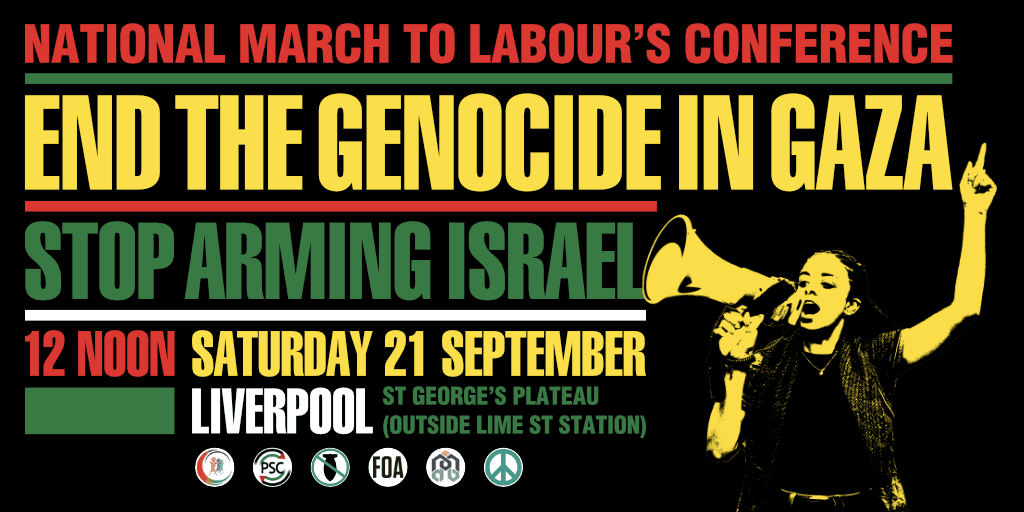
End the genocide in Gaza protest at Labour Party Conference, Liverpool 21 September 2024.

UK Labour Party Conference is starting on Sunday 22 September 2024. A protest has been announced on the 21st protesting the Labour party’s support for Israel’s genocide in Gaza.

I oppose Keir Starmer and the UK Labour Party for many reasons: their complicity in and support for Israel’s Zionist genocide in Gaza and the West Bank and attacks on the poor and disabled e.g. denying winter fuel payment benefits from poor and disabled pensioners likely to result in many deaths and the refusals to repeal the two-child benefit cap and the bedroom tax. Essentially the Labour Party are Zionist scum Blue Tories pretending to be Socialists. They are part of a global agenda to diminish international law to facilitate and support Israel’s racist, Fascist, genocide in Gaza and the West Bank.

I object to Labour Party Deputy Angela Rayner’s efforts to attack me while hiding – actually very typical of New Labour sihts in my experience.

Deputy Labour Party Leader Angela Rayner calls for police to kill and harass innocent people.

May be elaborated and extended.

Keir Starmer says pensioners can freeze to death and poor children can starve and be condemned to failure and misery all their lives.
Continue ReadingComing Soon :: UK Labour Party Conference 2024

Gaza war: countries selling Israel weapons are violating international law – legal expert

Spread the love

[dizzy: This article was published  April 4, 2024 and refers to the United Kingdom’s previous Conservative government. Since then UK has a new Labour government under UK Prime Minister Keir Starmer. UK violating International law will not have changed since April 2024 and Keir Starmer should be well-aware of legal requirements since he is often referred to as a human rights legal expert.]

EPA-EFE/Abir Sultan

Lawrence Hill-Cawthorne, University of Bristol

The UK government has received internal legal advice that Israel has broken international humanitarian law in its current war on Gaza. The advice was revealed by Alicia Kearns, the Conservative chair of the House of Commons foreign affairs select committee, in a speech to a fundraising event on March 13 and leaked to the UK’s Observer newspaper.

The paper quoted British barrister and war crimes prosecutor Sir Geoffrey Nice as saying: “Countries supplying arms to Israel may now be complicit in criminal warfare. The public should be told what the advice says.”

The Guardian has now revealed that the prime minister, Rishi Sunak, has since received a letter signed by 600 lawyers and academics, including three former supreme court justices – among them Baroness Hale, the court’s former president – as well as former court of appeal judges and more than 60 KCs, warning that UK arms sales to Israel are also illegal under international law.

But what does international law actually say on this issue, and what are the UK’s (and other nations’) legal obligations in relation to the ongoing assault on Gaza?

In recent months, a number of countries have announced they are suspending arms exports to Israel. These include Canada, Belgium, Italy, Spain and the Netherlands, as well as the Japanese company Itochu Corporation. Germany and the US – by far the biggest suppliers of arms to Israel – have not as yet signalled intentions to follow suit.

Neither has the UK. But with arms exports amounting to £42 million in 2022, it is not one of Israel’s major suppliers.

Suspending arms exports to Israel indicates not only political concerns, but also fear over the legality of continuing to support Israel militarily in its assault on Gaza. The Netherlands court of appeal ruled in February that the Dutch government must discontinue its sales of F35 fighter jet parts on the basis of its obligations under the UN arms trade treaty. A similar lawsuit is currently pending in Denmark which exports F35 parts to the US, which then sells the finished jets to Israel.

In the UK, the high court dismissed an attempt to challenge the government’s continued licensing of arms exports to Israel. But this was because the particular procedural hurdle that applicants in such cases have to get over is notoriously high. The judgment said nothing definitive as to Israel’s (or the UK’s) compliance with international law.

Following this, 130 MPs and peers from across party lines recently signed a letter to the foreign secretary calling on the government to suspend arms exports to Israel.

Arms trade treaty

So what is the position under international law of countries, such as the UK, that support Israel militarily? There are many specific and general rules of international law that are relevant here.

The most obvious, and the one emphasised in the British MPs’ letter, is found in the UN arms trade treaty, to which the UK is a party. Article 7 requires a risk assessment for all weapons transfers, and prohibits exports where there is an overriding risk that the weapons could be used to commit serious violations of international humanitarian law (the law of armed conflict).

The only objective test we have for determining risk of future violations is to examine whether there is evidence of a pattern of past violations by Israel. UN reporting of past serious violations is one of the key considerations that the UK’s own policy points to in determining future risk. In 2019, the UK court of appeal suspended arms exports to Saudi Arabia based on the government’s failure to assess whether past violations of international law had likely been committed in Yemen.

The available evidence suggests there have been countless examples of Israeli actions in Gaza that appear, on their face, to be inconsistent with international humanitarian law. Among the most recent examples are the Israeli attack on an aid convoy on April 1, the destruction of Gaza’s hospitals, and the well-documented famine that now engulfs the territory.

The Hague court of appeal that ordered the Dutch government to suspend arms exports to Israel relied on reports from Amnesty International and the UN when it listed multiple examples of apparent violations of the law of armed conflict in Gaza.

And in the long-awaited UN security council resolution adopted on March 25, with the US abstaining, the security council condemned “all attacks against civilians and civilian objects, as well as all violence and hostilities against civilians”, and demanded the flow of humanitarian assistance into Gaza, in line with international humanitarian law.

This suggests a pattern of past serious violations and thus a clear risk of continuing violations. So, signatories to the arms trade treaty continuing to supply weapons to Israel likely do so in breach of article 7.

Geneva conventions

Yet all nations have other obligations that take on particular importance in relation to Gaza. One of these is the obligation to prevent genocide under article 1 of the Genocide convention (which was the focus of the letter to the prime minister referred to above).

This is especially relevant since the International Court of Justice (ICJ) determined in January that there is an imminent risk of irreparable harm to the rights of Palestinians in Gaza under the Genocide Convention.

But it also includes article 1 of the 1949 Geneva conventions, which requires states to “ensure respect” for international humanitarian law. There is overwhelming support for the view that this requires all states not only to avoid aiding or assisting violations (for example, through arms exports) but to take proactive steps to ensure warring parties comply with their obligations under international law. They can do so via diplomatic channels or by imposing sanctions.

On March 1, Nicaragua instituted proceedings before the ICJ against Germany (the second-biggest arms exporter to Israel), in part alleging that it is violating article 1 of the Geneva conventions due to its support for Israel.

In this way, all countries are legally obliged to ensure that others comply with international humanitarian law. If the catastrophic destruction, massive civilian death toll and immense suffering of those still alive in Gaza is not enough to pull Israel’s allies into line over their continuing arms sales, it is difficult to conceive of any situation that ever could.

Lawrence Hill-Cawthorne, Associate Professor of Law, University of Bristol

This article is republished from The Conversation under a Creative Commons license. Read the original article.

Continue ReadingGaza war: countries selling Israel weapons are violating international law – legal expert

Palestine supporters blockade entrance to arms factory in Kent

Spread the love

https://morningstaronline.co.uk/article/palestine-supporters-blockade-entrance-to-arms-factory-kent

Photo: Martin Pope

AN ISRAELI arms factory in Kent was under siege today [yesterday] after Palestine supporters blockaded its entrance roads.

The Instro Precision factory is part of Israeli-owned Elbit Systems, which is believed to manufacture military drones, pilotless aircraft and other weapons for Israel.

Palestine Action mounted the blockade and vehicles were used to block the entrances.

Activists also covered the premises in red paint, symbolising “Palestinian bloodshed.”

Palestine Action said the factory’s products were not affected by last week’s government announcement that 50 [dizzy:30] out of 320 arms export licences were being suspended.

https://morningstaronline.co.uk/article/palestine-supporters-blockade-entrance-to-arms-factory-kent

Continue ReadingPalestine supporters blockade entrance to arms factory in Kent