Tag: aliens

  • Star Trek at 60: the secret of this pioneering series was its exploration of humanity, not aliens

    Spread the love

    Stephen McVeigh, Swansea University
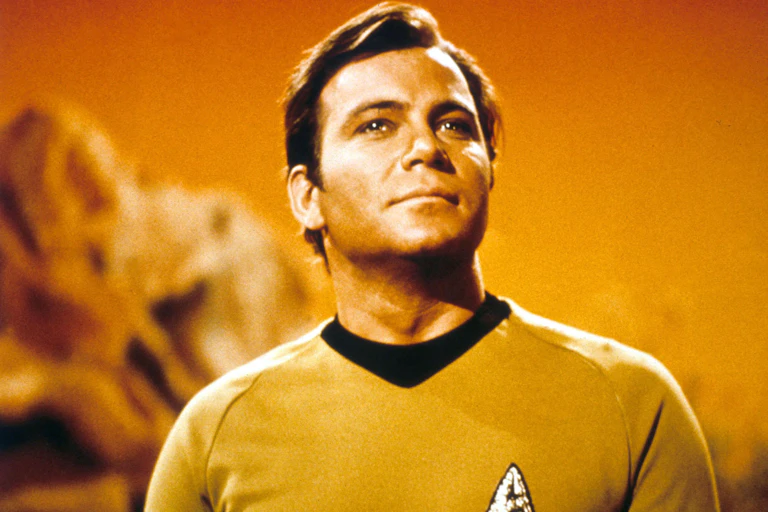
    Captain James T. Kirk, played in the original Star Trek series by William Shatner. RGR Collection/Alamy

    When Star Trek first appeared on television screens 60 years ago, audiences expected science fiction to offer aliens, monsters and futuristic technology. What they encountered was something far more ambitious.

    From its very first broadcast episode on September 8 1966, Star Trek established that its true subject was the exploration of humanity itself. For all its reputation as an action-packed space adventure, the franchise has endured because it repeatedly returned to a universal question: what does it mean to be human?

    In that first episode, entitled The Man Trap, the alien antagonist survives by appearing to each observer as the person they most wish to see. Dr Leonard “Bones” McCoy meets a lost love from his past; others see figures shaped by memory, expectation, desire and longing.

    The creature, soon dubbed the “salt vampire” by fans of the series, is not simply a shape-shifter. Its power lies in exploiting human perception. Rather than asking viewers to fear an alien with superior strength or advanced weaponry, the episode asks a more profound question: can we trust our experience of reality?

    Preview of The Man Trap, the first Star Trek episode to air in September 1966. Video: RetroAlexander.

    Sixty years on, this question looks remarkably prescient. Modern neuroscience increasingly suggests that perception is not a passive recording of the external world. According to theories of predictive processing, the brain continually generates expectations and compares them with incoming sensory information.

    The philosopher Andy Clark has described the brain as a “prediction machine”. Neuroscientist Anil Seth argues that our experience of reality can be understood as a form of “controlled hallucination”, generated by the brain but constrained by evidence from the senses.

    Long before such ideas were articulated, The Man Trap imagined a world in which people confront the same reality, but perceive it in profoundly different ways – based not only on what they see, but what they want to see.

    This insight links the episode to a much older intellectual tradition. The ancient Greek philosopher Plato’s allegory of the cave imagined people mistaking shadows for reality, confusing appearance with truth.

    The USS Enterprise crew’s first alien encounter offers a 20th-century variation on the same theme. They actively participate in their own deception because the creature reflects their hopes, memories and desires.

    This helps explain why The Man Trap feels strikingly contemporary. In today’s world, shaped by algorithmically curated information, political polarisation and increasingly personalised media environments, disagreement is often less about opinions than competing versions of reality itself.

    The nature of humanity

    Star Trek’s memorable debut was not an isolated exploration of a philosophical problem. It was the beginning of a broader inquiry into the nature of humanity.

    The Devil in the Dark (first aired March 1967) explores empathy and the challenge of understanding the unfamiliar. The apparently monstrous Horta is revealed to be an intelligent life-form protecting its offspring, forcing viewers to reconsider assumptions about difference and otherness.

    The Enemy Within (October 1966) shifts the inquiry inward, splitting Captain James T. Kirk into opposing aspects of his personality and challenging the assumption that human beings can divide their virtues from their vices.

    The episode argues that the qualities that make Kirk an effective leader – courage, decisiveness and resolve – are inseparable from darker instincts such as aggression and desire. Rather than presenting humanity as a triumph over these impulses, the episode suggests that human identity itself depends upon their integration.

    The City on the Edge of Forever (April 1967), regarded by many as the series’ masterpiece, shifts the focus to ethics. Kirk discovers that saving the woman he loves would alter history catastrophically, forcing him to choose between personal happiness and moral responsibility.

    Together, these and many more of the 79 original Star Trek episodes form a remarkable investigation into human nature. The progression reveals a series less interested in strange new worlds than the human beings who encounter them.

    The City On the Edge of Forever is regarded as one of the series’ finest episodes. Video: Robin Sellex.

    Philosophical inquiry

    While many science-fiction programmes have aged with their technologies, Star Trek has endured because its deepest questions remain unresolved. We still debate perception, identity, empathy, consciousness and moral responsibility, because they are permanent features of human existence.

    At its best, Star Trek engaged science fiction as a form of philosophical inquiry. Alien civilisations became thought experiments about prejudice and empathy. Time travel became a vehicle for exploring ethics. Artificial intelligence became a means of questioning consciousness and identity. The future it imagined served as a laboratory for understanding ourselves.

    The closing moments of The Man Trap illustrate this perfectly. Reflecting on the death of the salt vampire, Kirk recalls his conversation with the archaologist Robert Crater, who has long been working on the planet, about the fate of the American bison – driven to the brink of extinction by humans.

    This comparison transforms what might have been a conventional monster story into something morally complex. The creature is dangerous yet is also the last of its kind. Is it merely a predator, or the victim of a larger tragedy?

    The episode, like many others, offers no simple answer. Crater views the creature from a perspective of compassion and preservation. Kirk simply sees an immediate threat to his crew. Both are responding to the same reality, yet they arrive at different conclusions.

    The original Star Trek’s lasting legacy is not technological prophecy, but a sustained exploration of what it means to be human. Its enduring achievement lies not in predicting mobile phones, iPads or video calls, but in recognising that the most fascinating and vexing mystery remains humanity itself.

    The final frontier, it suggests, lies not among the stars but within ourselves.

    Stephen McVeigh, Professor of History, Faculty of Humanities and Social Sciences, Swansea University

    This article is republished from The Conversation under a Creative Commons license. Read the original article.
    How ‘Star Trek’ almost failed to launch
    Star Trek’s version of time travel is more realistic than most sci fi
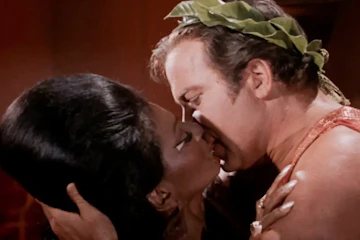
    Television screen grab of white man kissing Black woman.

    The story behind ‘Star Trek’ actress Nichelle Nichols’ iconic interracial kiss

    The cast of Aliens stand together with Sigourney Weaver at the front.

    How Aliens became the rare sequel that was as good as – or better than – the original

  • Trump says he will order the release of Pentagon files on aliens and UFOs

    Spread the love

    https://www.theguardian.com/world/2026/feb/20/trump-aliens-ufos-pentagon-files-release

    The president’s announcement came after predecessor Barack Obama went viral last week for saying aliens are ‘real’

    Donald Trump has announced he is directing the defense department and other agencies to release whatever files they have on the search for alien life.

    In a post on his social media platform, Trump said that he will ask the defense secretary and others “to begin the process of identifying and releasing Government files related to alien and extraterrestrial life, unidentified aerial phenomena (UAP), and unidentified flying objects (UFOs).”

    Comments from Trump’s predecessor, Barack Obama, went viral last weekend after podcast host Brian Tyler Cohen asked the former president if aliens are “real.”

    “They’re real, but I haven’t seen them,” Obama responded. “And they’re not being kept in, what is it? Area 51. There’s no underground facility, unless there’s this enormous conspiracy and they hid it from the president of the United States.”

    On Thursday, Trump accused Obama of disclosing “classified information”.

    The president told reporters aboard Air Force One, “I don’t know if they’re real or not,” and said of Obama, “I may get him out of trouble by declassifying.”

    Obama clarified earlier this week that he had not seen evidence that aliens “have made contact with us,” but said, “statistically, the universe is so vast that the odds are good there’s life out there.”

    https://www.theguardian.com/world/2026/feb/20/trump-aliens-ufos-pentagon-files-release

  • Do aliens exist? We studied what scientists really think

    Spread the love
    PeopleImages.com – Yuri A/Shutterstock

    Peter Vickers, Durham University; Henry Taylor, University of Birmingham, and Sean McMahon, University of Edinburgh

    News stories about the likely existence of extraterrestrial life, and our chances of detecting it, tend to be positive. We are often told that we might discover it any time now. Finding life beyond Earth is “only a matter of time”, we were told in September 2023. “We are close” was a headline from September 2024.

    It’s easy to see why. Headlines such as “We’re probably not close” or “Nobody knows” aren’t very clickable. But what does the relevant community of experts actually think when considered as a whole? Are optimistic predictions common or rare? Is there even a consensus? In our new paper, published in Nature Astronomy, we’ve found out.

    During February to June 2024, we carried out four surveys regarding the likely existence of basic, complex and intelligent extraterrestrial life. We sent emails to astrobiologists (scientists who study extraterrestrial life), as well as to scientists in other areas, including biologists and physicists.

    In total, 521 astrobiologists responded, and we received 534 non-astrobiologist responses. The results reveal that 86.6% of the surveyed astrobiologists responded either “agree” or “strongly agree” that it’s likely that extraterrestrial life (of at least a basic kind) exists somewhere in the universe.

    Less than 2% disagreed, with 12% staying neutral. So, based on this, we might say that there’s a solid consensus that extraterrestrial life, of some form, exists somewhere out there.

    Scientists who weren’t astrobiologists essentially concurred, with an overall agreement score of 88.4%. In other words, one cannot say that astrobiologists are biased toward believing in extraterrestrial life, compared with other scientists.

    When we turn to “complex” extraterrestrial life or “intelligent” aliens, our results were 67.4% agreement, and 58.2% agreement, respectively for astrobiologists and other scientists. So, scientists tend to think that alien life exists, even in more advanced forms.

    These results are made even more significant by the fact that disagreement for all categories was low. For example, only 10.2% of astrobiologists disagreed with the claim that intelligent aliens likely exist.

    Optimists and pessimists

    Are scientists merely speculating? Usually, we should only take notice of a scientific consensus when it is based on evidence (and lots of it). As there is no proper evidence, scientists may be guessing. However, scientists did have the option of voting “neutral”, an option that was chosen by some scientists who felt that they would be speculating.

    Only 12% chose this option. There is actually a lot of “indirect” or “theoretical” evidence that alien life exists. For example, we do now know that habitable environments are very common in the universe.

    We have several in our own solar system, including the sub-surface oceans of the moons Europa and Enceladus, and arguably also the environment a few kilometres below the surface of Mars. It also seems relevant that Mars used to be highly habitable, with lakes and rivers of liquid water on its surface and a substantial atmosphere.

    It is reasonable to generalise from here to a truly gargantuan number of habitable environments across the galaxy, and wider universe. We also know (since we’re here) that life can get started from non-life – it happened on Earth, after all. Although the origin of the first, simple forms of life is poorly understood, there is no compelling reason to think that it requires astronomically rare conditions. And even if it does, the probability of life getting started (abiogenesis) is clearly non-zero.

    This can help us to see the 86.6% agreement in a new light. Perhaps it is not, actually, a surprisingly strong consensus. Perhaps it is a surprisingly weak consensus. Consider the numbers: there are more than 100 billion galaxies. And we know that habitable environments are everywhere.

    Let’s say there are 100 billion billion habitable worlds (planets or moons) in the universe. Suppose we are such pessimists that we think life’s chances of getting started on any given habitable world is one in a billion billion. In that case, we would still answer “agree” to the statement that it is likely that alien life exists in the universe.

    Thus, optimists and pessimists should all have answered “agree” or “strongly agree” to our survey, with only the most radical pessimists about the origin of life disagreeing.

    Bearing this in mind, we could present our data another way. Suppose we discount the 60 neutral votes we received. Perhaps these scientists felt that they would be speculating, and didn’t want to take a stance. In which case, it makes sense to ignore their votes. This leaves 461 votes in total, of which 451 were for agree or strongly agree. Now, we have an overall agreement percentage of 97.8%.

    This move is not as illegitimate as it looks. Scientists know that if they choose “neutral” they can’t possibly be wrong. Thus, this is the “safe” choice. In research, it is often called “satisficing”.

    As the geophysicist Edward Bullard wrote back in 1975 while debating whether all continents were once joined together, instead of making a choice “it is more prudent to keep quiet, … sit on the fence, and wait in statesmanlike ambiguity for more data”. Not only is keeping quiet a safe choice for scientists, it means the scientist doesn’t need to think too hard – it is the easy choice.

    Getting the balance right

    What we probably want is balance. On one side, we have the lack of direct empirical evidence and the reluctance of responsible scientists to speculate. On the other side, we have evidence of other kinds, including the truly gargantuan number of habitable environments in the universe.

    We know that the probability of life getting started is non-zero. Perhaps 86.6% agreement, with 12% neutral and less than 2% disagreement, is a sensible compromise, all things considered.

    Perhaps – given the problem of satisficing – whenever we present such results, we should present two results for overall agreement: one with neutral votes included (86.6%), and one with neutral votes disregarded (97.8%). Neither result is the single, correct result.

    Each perspective speaks to different analytical needs and helps prevent oversimplification of the data. Ultimately, reporting both numbers – and being transparent about their contexts – is the most honest way to represent the true complexity of responses.

    Peter Vickers, Professor in Philosophy of Science, Durham University; Henry Taylor, Associate Professor, Department of Philosophy, University of Birmingham, and Sean McMahon, Reader in Astrobiology, University of Edinburgh

    This article is republished from The Conversation under a Creative Commons license. Read the original article.