US Troops Near Venezuela Reportedly Denied Holiday Leave as Fears Grow of Unpopular and Lengthy Trump War

Spread the love

Original article by Stephen Prager republished from Common Dreams under Creative Commons (CC BY-NC-ND 3.0). 
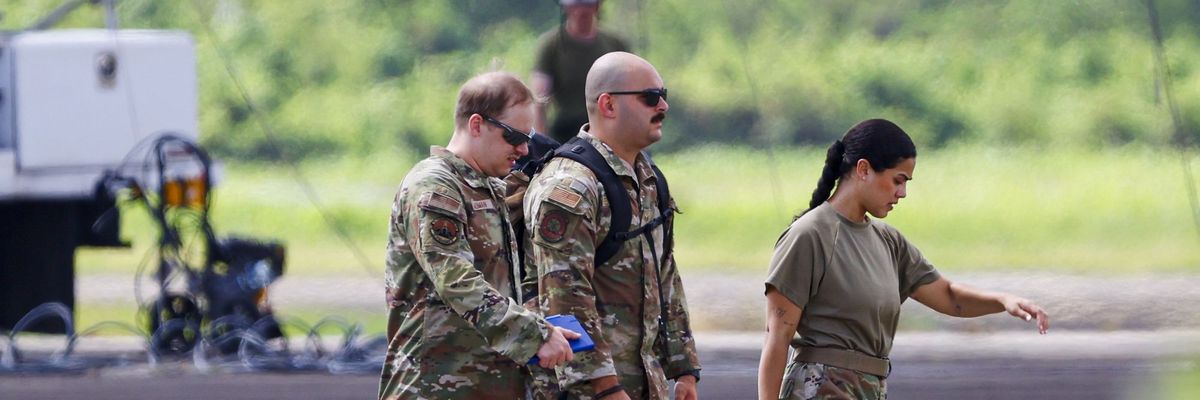
US Air Force personnel patrol the area surrounding José Aponte de la Torre Airport, the former Roosevelt Roads Naval Station, September 11, 2025, in Ceiba, Puerto Rico. (Photo by Miguel J. Rodríguez Carrillo/Getty Images)

Meanwhile, newly released documents suggest the administration is gearing up to have troops in the region until the end of Trump’s term.

Following reports that the Trump administration is eyeing a “deadly new phase” of military actions against Venezuela, including land strikes, a new report suggests that the US troops stationed near the South American nation are being denied holiday leave in anticipation of immediate action.

On Monday, NewsNation White House Correspondent Kellie Meyer reported via social media that the United States Southern Command (SOUTHCOM) is “restricting/limiting leave over the Thanksgiving and Christmas holidays in preparation for possible land strikes in the next 10 days to two weeks.”

SOUTHCOM has denied the claim, with a spokesperson saying: “Our service members and civilian employees are always afforded the opportunity to take leave throughout the year, and that includes holiday periods.”

As of yet, reports only suggest that the US may be planning imminent airstrikes against Venezuela. But as documents reported Tuesday by The Intercept revealed, the US is planning to maintain “a massive military presence in the Caribbean almost to the end of President Donald Trump’s term in office—suggesting the recent influx of American troops to the region won’t end anytime soon.”

According to the report: “One spreadsheet outlining supplies for ‘Puerto Rico Troops’ notes tens of thousands of pounds of baked goods are scheduled for delivery from November 15 of this year to November 11, 2028. Foodstuff set to feed the troops include individually wrapped honey buns, vanilla cupcakes, sweet rolls, hamburger rolls, and flour tortillas.” The food is slated to be delivered to every branch of the military, including the Coast Guard, Army, Navy, Air Force, and Marine Corps.

“The procurement’s length of time and the level of effort seemed to point to these operations continuing at the current level for several years,” said Mark Cancian, an analyst with the Center for Strategic and International Studies. “That’s significant because it means that the Navy will maintain a large presence in the Caribbean that is far larger than what it has been in recent years. It further implies that the Navy will be involved in these counter-drug operations.”

The Pentagon currently has more than 15,000 troops stationed in the region, the most since 1989, when the US launched a land invasion of Panama to topple the drug-running dictator Manuel Noriega, whom it had previously supported.

The reports came shortly after the US State Department designated the so-called “Cartel de los Soles,” which the US accuses Venezuelan President Nicolás Maduro of leading, as a “terrorist organization.” This is despite the fact that it is not actually an organized cartel at all, but a media shorthand developed to refer to the alleged connections that high-level Venezuelan officials have to the drug trade.

“It is not a group,” Adam Isaacson, director for defense oversight at the Washington Office on Latin America organization, told the Associated Press Tuesday. “It’s not like a group that people would ever identify themselves as members. They don’t have regular meetings. They don’t have a hierarchy.”

Colombian journalist Juan Esteban Silva explains that the terrorist designation, despite its factual flimsiness, “gives the US authority to conduct covert operations, bring terrorism and drug charges, issue international arrest warrants, freeze assets, and block transactions. It also enables extraterritorial prosecution, travel restrictions, broader law enforcement and military cooperation, and asset seizures.”

Maduro’s government called the designation an “infamous, vile lie to justify an illegitimate and illegal intervention against Venezuela under the classic US format of regime change.”

It comes after Reuters reported Sunday that “covert operations” in Venezuela “would likely be the first part of the new action against Maduro” and that the US was “prepared to use every element of American power” to achieve its goals in the region.

While stopping drug trafficking was the initial justification for the administration’s push for regime change, White House messaging has shifted in recent days, with officials telling Fox News that it “goes beyond the Maduro regime” and is also about “getting Russia, China, and Iran out of the Western hemisphere.”

On Monday, US Rep. María Salazar (R-Fla.) gave a more candid explanation for the potentially imminent military action and the need for regime change on Fox Business.

Maduro, she said, “is understanding that we’re about to go in.” She went on: “Venezuela, for the American oil companies, will be a field day, because it will be more than a trillion dollars in economic activity. American companies can go in and fix all the oil rigs and everything that has to do with the Venezuelan petroleum companies.”

Prior to returning to office, Trump said at a rally in 2023 that he regretted not invading Venezuela during his first term: “We would have taken [Venezuela] over; we would have gotten to all that oil; it would have been right next door.”

Though the White House appears increasingly committed to military action against Venezuela, it is overwhelmingly unpopular among Americans.

CBS News/YouGov survey published on Sunday found that 70% of Americans—including 91% of Democrats and 42% of Republicans—are against the “US taking military action in Venezuela,” and a majority don’t believe a direct attack on Venezuela would even achieve the Trump administration’s stated goal of reducing the flow of drugs to the United States.

The same poll found that just 13% of Americans consider Venezuela to be a “major threat” to “US security,” while 48% consider it a “minor threat,” and 39% consider it to be “not a threat.”

Alfons López Tena, a former member of the Catalan parliament and an analyst on public and international affairs, expressed shock at the Trump administration’s brazenness despite the total lack of public consent for war.

“The US doesn’t feel at all like a country marching into war, 70% oppose military action in Venezuela,” he said. “The government’s cursory explanations show they are so heedless of public opinion that they don’t even feel the need to mount a proper propaganda campaign.”

Nathan J. Robinson, the editor-in-chief ofthe left-wing magazine Current Affairs, meanwhile, said he’s not surprised.

“It’s no mystery to a leftist when the US government’s foreign policy is out of step with popular opinion,” he said, “because we understand foreign policy is shaped by narrow elite interests.”

Original article by Stephen Prager republished from Common Dreams under Creative Commons (CC BY-NC-ND 3.0). 

Donald Fuhrump says that Amerikkka doesn't bother with crimes or charges anymore, not being 100% Amerikkkan and opposing his real estate intentions is enough.
Donald Fuhrump says that Amerikkka doesn’t bother with crimes or charges anymore, not being 100% Amerikkkan and opposing his real estate intentions is enough.
Orcas discuss how Trump was re-elected and him being an obviously insane, xenophobic Fascist.
Orcas discuss Donald Trump and the killer apes' concept of democracy. Front Orca warns that Trump is crashing his country's economy and that everything he does he does for the fantastically wealthy.
Orcas discuss Donald Trump and the killer apes’ concept of democracy. Front Orca warns that Trump is crashing his country’s economy and that everything he does he does for the fantastically wealthy.
Continue ReadingUS Troops Near Venezuela Reportedly Denied Holiday Leave as Fears Grow of Unpopular and Lengthy Trump War

Venezuela Mobilizes Military as US Aircraft Carrier Approaches

Spread the love

Original article by Julia Conley republished from Common Dreams under a Creative Commons (CC BY-NC-ND 3.0).
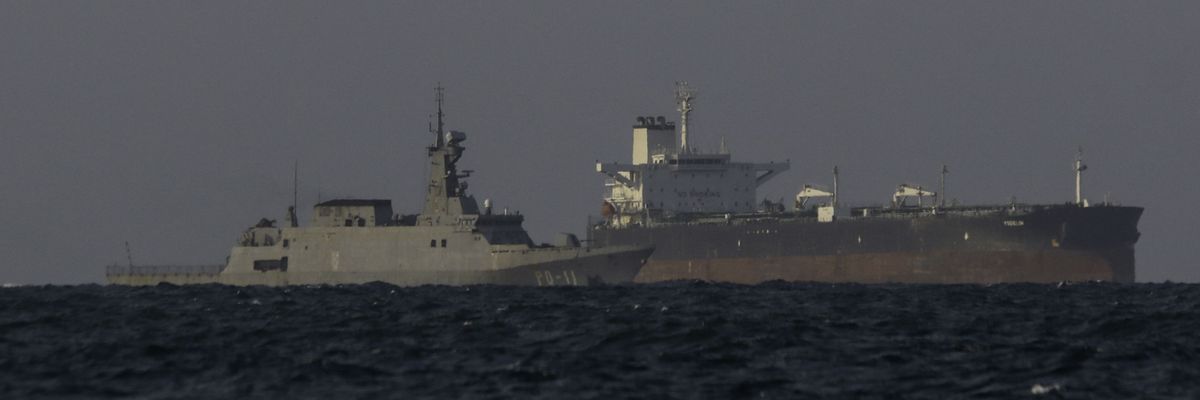
A Venezuelan navy patrol boat escorts Panamanian flagged crude oil tanker Yoselin near the El Palito refinery in Puerto Cabello, Venezuela on November 11, 2025. (Photo by Juan Carlos Hernandez/AFP via Getty Images)

“The only reason to move it there is to use it against Venezuela,” said one policy expert of the deployment of the USS Gerald R. Ford.

White House officials have sought to walk back President Donald Trump’s repeated threats against Venezuela in recent days—even as the Department of Defense has continue to strike boats in the Caribbean and eastern Pacific—but officials in the South American country on Tuesday took the arrival of a US aircraft carrier in the region seriously despite the administration’s claims that it won’t target Venezuela directly.

As the USS Gerald R. Ford entered waters near Latin America, accompanied by three warships, Defense Minister Vladimir Padrino López said Venezuela’s entire military arsenal had been placed on “full operational readiness,” with President Nicolás Maduro ordering the deployment of nearly 200,000 soldiers.

The government also approved the “massive deployment of ground, aerial, naval, riverine, and missile forces,” López announced.

Venezuela’s military deployment comes weeks after US Defense Secretary Pete Hegseth ordered the Ford to relocate from Europe to Latin America following several military strikes on boats in the Caribbean and Pacific that the Trump administration has claimed are meant to stop drug trafficking out of Venezuela—despite the fact that US intelligence agencies and United Nations experts agree that the country plays virtually no role in the trafficking of fentanyl, the top cause of drug overdoses in the US.

At least 76 people have been killed in the strikes so far, and the Associated Press reported last week that the victims have included an out-of-work bus driver and a struggling fisherman—people who in some cases had turned to helping drug traffickers transport cocaine across the Caribbean, but were hardly the high-level “narco-terrorists” that Hegseth and Trump have insisted they’ve killed in the region.

With the carrier strike group entering the Caribbean region, the US now has about 15,000 troops in the area where tensions have escalated since the boat strikes began in September.

Mark Cancian, a senior defense adviser at the Center for Strategic and International Studies, told the Washington Post that Venezuelan officials had good reason to mobilize forces.

“The only reason to move it there is to use it against Venezuela,” Cancian said of the Ford deployment. “The shot clock has started because this is not an asset they can just keep there indefinitely. They have to use it or move it.”

Since beginning the boat bombings, Trump has signaled the US attacks could move to Venezuela directly, with the Wall Street Journal reporting late last month that the administration was preparing to target “ports and airports controlled by the military that are allegedly used to traffic drugs, including naval facilities and airstrips.”

Trump also authorized Central Intelligence Agency operations last month, falsely claiming the country has “emptied” its prisons into the US and again asserting that “we have a lot of drugs coming in from Venezuela.”

Democratic senators have introduced two war powers resolutions aimed at stopping the US from striking inside Venezuela and at halting the boat-bombing campaign—but Republicans have voted them down after administration officials assured the caucus that the White House was not currently planning to attack Venezuela.

Maduro said last month that Trump’s actions in the region in recent months amount to attempts at “regime change,” adding that “if Venezuela did not possess oil, gas, gold, fertile land, and water, the imperialists wouldn’t even look at our country.”

Trump himself said publicly in 2023 that if he had won the 2020 presidential election, “we would have taken [Venezuela] over, we would have gotten all that oil.”

On Tuesday, both the United Kingdom and Colombia announced that they were halting intelligence sharing with the US in the region, saying that working with the US as it attacks small vessels in the Caribbean could make the countries complicit in violations of international law.

“All levels of law enforcement intelligence are ordered to suspend communications and other agreements with US security agencies,” Colombian President Gustavo Petro said. “This measure will remain in place as long as missile attacks on boats in the Caribbean continue. The fight against drugs must be subordinate to the human rights of the Caribbean people.”

Original article by Julia Conley republished from Common Dreams under a Creative Commons (CC BY-NC-ND 3.0).
Donald Fuhrump says that Amerikkka doesn't bother with crimes or charges anymore, not being 100% Amerikkkan and opposing his real estate intentions is enough.
Donald Fuhrump says that Amerikkka doesn’t bother with crimes or charges anymore, not being 100% Amerikkkan and opposing his real estate intentions is enough.
Continue ReadingVenezuela Mobilizes Military as US Aircraft Carrier Approaches

Trump’s return threatens renewed assault on Venezuela

Spread the love

https://morningstaronline.co.uk/article/trump’s-return-threatens-renewed-assault-venezuela

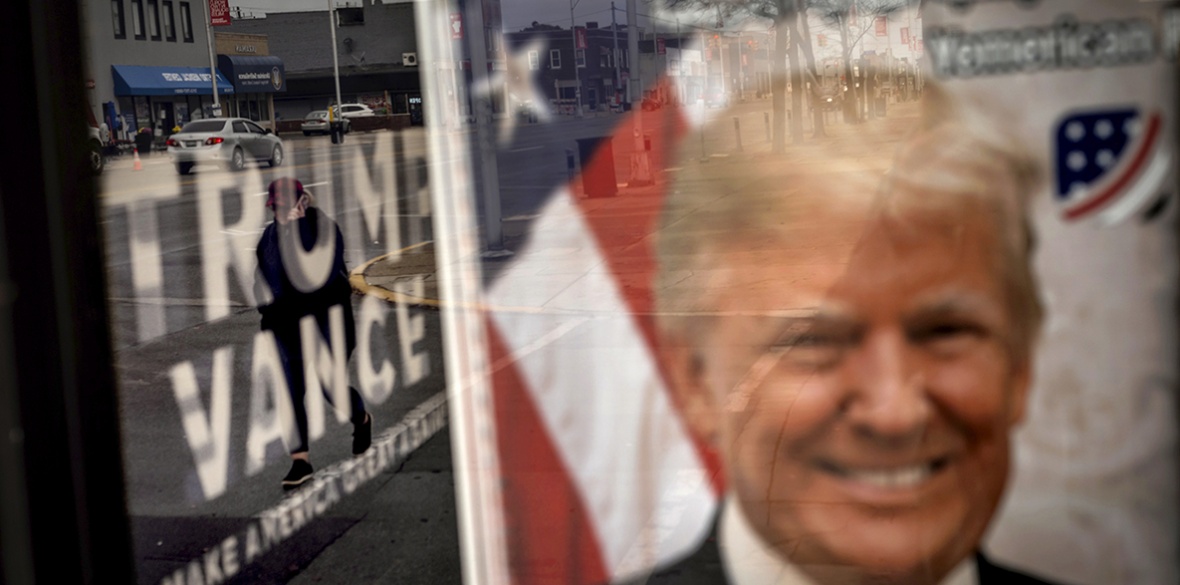
An image of Republican presidential nominee former President Donald Trump hangs in the window of a campaign office in Hamtramck, Michigan, November 4, 2024

TIM YOUNG warns that the president-elect’s record of economic and political interference from his last stint in the White House show dangerous potential for escalated aggression against the Bolivarian government from 2025

THE US election result raises the spectre of Trump renewing the assault on Venezuela that his loss to Biden interrupted in 2020.

In office between 2016 and 2020, Trump’s approach to Latin America showed an implacable hostility towards Venezuela, as well as other governments in the region determined to advance their population’s interests, not those of the US.

Venezuela has been subjected to US extraterritorial intervention and interference for over two decades. From the early days of Hugo Chavez’s election as president in 1998, the US has sought, in conjunction with Venezuela’s economic and political elites, to topple the Venezuelan government and re-establish its control and influence over the country and its oil wealth.

While the global situation has changed since 2020, with wars in Ukraine and the Middle East and the US’s developing aggressive strategy towards Russia and China, there is no reason to believe the US’s long-standing desire to destabilise the Venezuelan government and achieve “regime change” is off the table.

For his part, Trump made it plain when campaigning this year in North Carolina what motivated his drive to unseat Maduro: “When I left, Venezuela was ready to collapse. We would have taken it over; we would have gotten all that oil.”

The solidarity movement in Britain must be prepared to defend Venezuela’s sovereignty against any renewed offensive by Trump when he assumes the presidency in 2025 — as well as continuing to campaign for Britain to give Venezuela back its gold.

https://morningstaronline.co.uk/article/trump’s-return-threatens-renewed-assault-venezuela

Continue ReadingTrump’s return threatens renewed assault on Venezuela