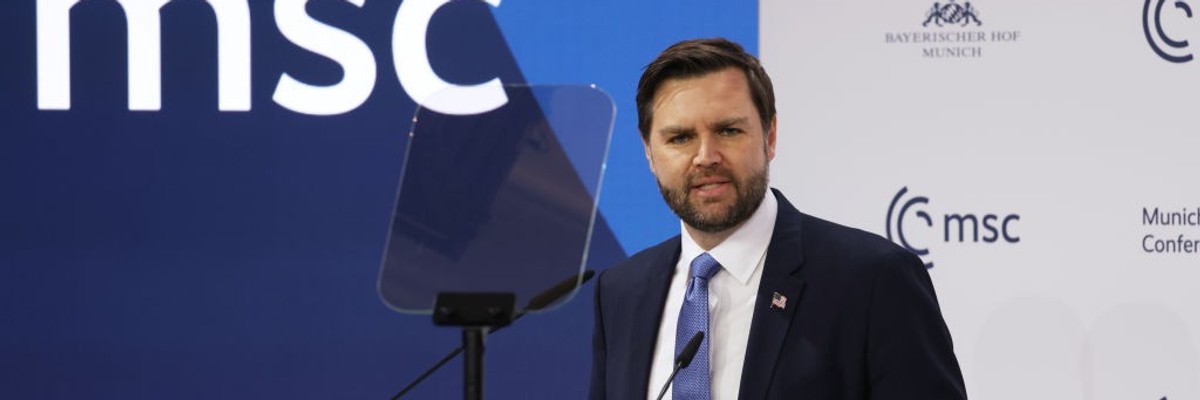
U.S. Vice President JD Vance speaks at the Munich Security Conference on February 14, 2025. (Photo: Sean Gallup/Getty Images)
Rebuking the U.S. vice president, German Chancellor Olaf Scholz said that “a commitment to ‘never again’ is not reconcilable with support for the AfD.”
U.S. Vice President JD Vance faced growing backlash on Saturday after scolding the European political establishment for shunning far-right parties and subsequently meeting with the leader of the neo-Nazi Alternative for Germany, just a week ahead of the country’s general election.
While Vance did not explicitly mention Alternative for Germany, or AfD, during his remarks Friday at the Munich Security Conference, he declared that “there is no room for firewalls”—a reference to mainstream German political parties’ refusal to work with AfD or include it in governing coalitions.
The Guardianreported that “a whisper of ‘Jesus Christ’ and the squirming in chairs could be heard in an overflow room” during the U.S. vice president’s remarks, which he delivered a week after hundreds of thousands took to the streets of Munich to protest far-right extremism.
Following his speech, Vance met with AfD leader Alice Weidel, who praised the vice president’s Munich address as “excellent” in a post on X—a social media platform owned by billionaire Elon Musk, who has also expressed support for AfD as he works to dismantle agencies throughout the U.S. government.
Reutersreported that Weidel—whose grandfather was a Nazi judge appointed directly by Adolf Hitler—met with Vance at his hotel “for about 30 minutes and discussed the Ukraine war, German domestic policy, and freedom of speech.”
On Saturday, German Chancellor Olaf Scholz rebuked Vance and said that “we will not accept outsiders intervening in our democracy,” even “friends and allies.”
“Never again fascism, never again racism, never again aggressive war,” Scholz said in his speech at the Munich Security Conference. “That is why an overwhelming majority in our country opposes anyone who glorifies or justifies criminal National Socialism.”
“A commitment to ‘never again’ is not reconcilable with support for the AfD,” said Scholz.
Elon Musk urges you to be a Fascist like him, says that you can ignore facts and reality then.Climate Science Denier Donald Trump says Burn, Baby, Burn.
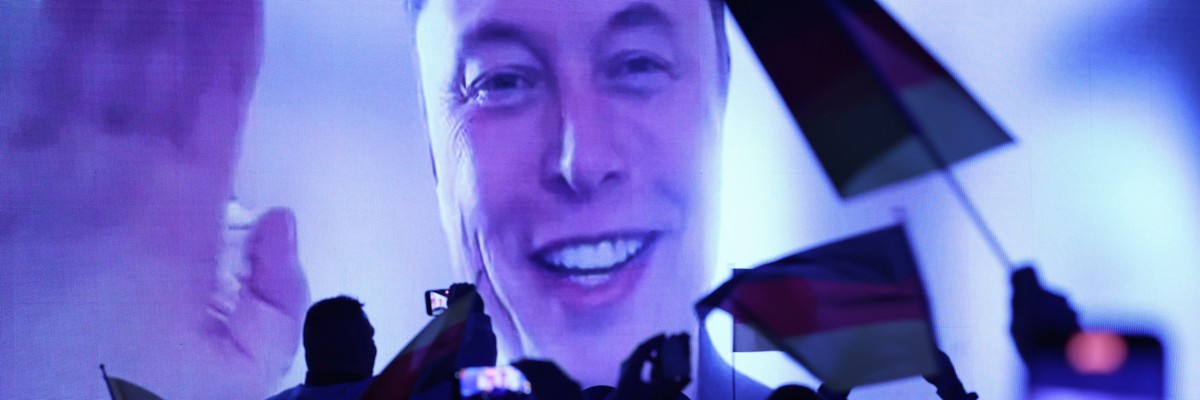
Tech billionaire Elon Musk speaks live via a video transmission during the election campaign launch rally of the far-right Alternative for Germany (AfD) political party as AfD supporters wave German flags on January 25, 2025 in Halle, Germany. (Photo by Sean Gallup/Getty Images)
“All the people who were shrugging and equivocating over Elon and whether he was aligning with Nazi, far-right forces should be launched into the sun,” wrote one observer.
Billionaire Elon Musk made virtual appearance at a Saturday campaign event for the far-right Alternative for Germany party—known by the initials AfD—ahead of a snap federal election in Germany next month. The campaign appearance comes less than a week after Musk was accused of performing a Nazi salute twice on stage at a post-inauguration celebration for U.S. President Donal Trump.
“A nazi speaking at a nazi rally. It’s really not deeper than that,” wrote the independent journalist Marisa Kabas on Saturday.
Musk has endorsed the AfD, known for it’s strong anti-immigrant stance, and earlier this month hosted AfD co-leader Alice Weidel—who was also at Saturday’s campaign event—for an interview on his platform X. Members of the AfD have been accused of downplaying the crimes of Nazi Germany and using Nazi slogans.
Musk told onlookers at the event, which took place in Halle, that he thinks AfD is the best hope for Germany and said that it’s good to be proud of German culture, according to Reuters andThe Guardian.
“It’s good to be proud of German culture, German values, and not to lose that in some sort of multiculturalism that dilutes everything,” Musk said, according to Reuters, addressing the crowd via a live video.
“Children should not be guilty of the sins of their parents, let alone their great grandparents,” Musk also said, which, per Reuters, apparently referred to Germany’s Nazi past.
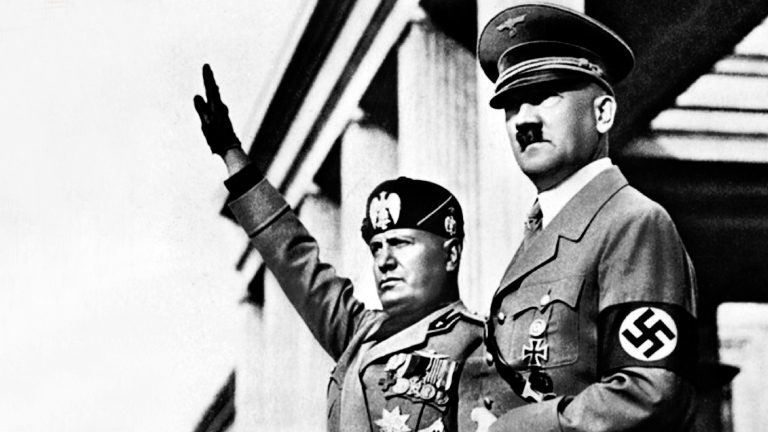
Musk’s “Nazi-like salutes” earlier this week drew sharp rebuke from some, but not all. The Anti-Defamation League, an organization whose mission is to combat antisemitism, called the move “an awkward gesture” and “not a Nazi salute.”
For his part, Musk wrote on X that the reaction was an example of Democratic “dirty tricks.” He also said that “the ‘everyone is Hitler’ attack is sooo tired.”
Washington Post columnist Karen Attiah, reacting to the news of Musk’s appearance at the rally, wrote that “all the people who were shrugging and equivocating over Elon and whether he was aligning with Nazi, far-right forces should be launched into the sun. May they never be taken seriously again.”
The EU has come under growing pressure to take action after a series of forays by Musk into European politics. Photograph: Benoît Tessier/Reuters
Musk’s company has been accused of manipulating systems to give far-right posts and politicians greater visibility
The European Commission has asked X to hand over internal documents about its algorithms, as it steps up its investigation into whether Elon Musk’s social media platform has breached EU rules on content moderation.
The EU’s executive branch told the company it wanted to see internal documentation about its “recommender system”, which makes content suggestions to users, and any recent changes made to it, by 15 February.
X has been under investigation since December 2023 under the EU’s content law – known as the Digital Services Act (DSA) – over how it tackles the spread of illegal content and information manipulation. The company has been accused of manipulating the platform’s systems to give far-right posts and politicians greater visibility over other political groups.
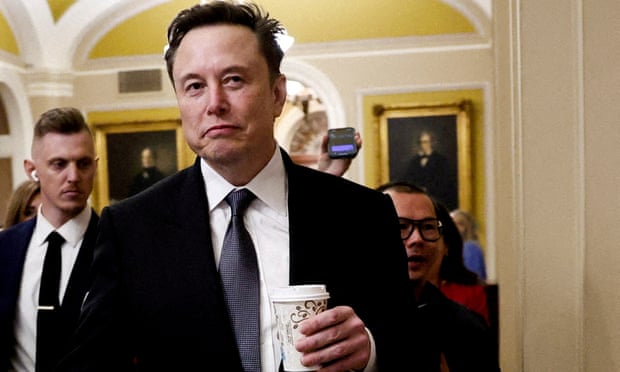
The EU has come under growing pressure in recent weeks to take action after a series of interventions by Musk into European politics. Musk, who will be a part of Donald Trump’s administration in the US, has angered many on the continent with attacks on its leaders as well as expressions of support for Germany’s far-right Alternative für Deutschland (AfD) party.
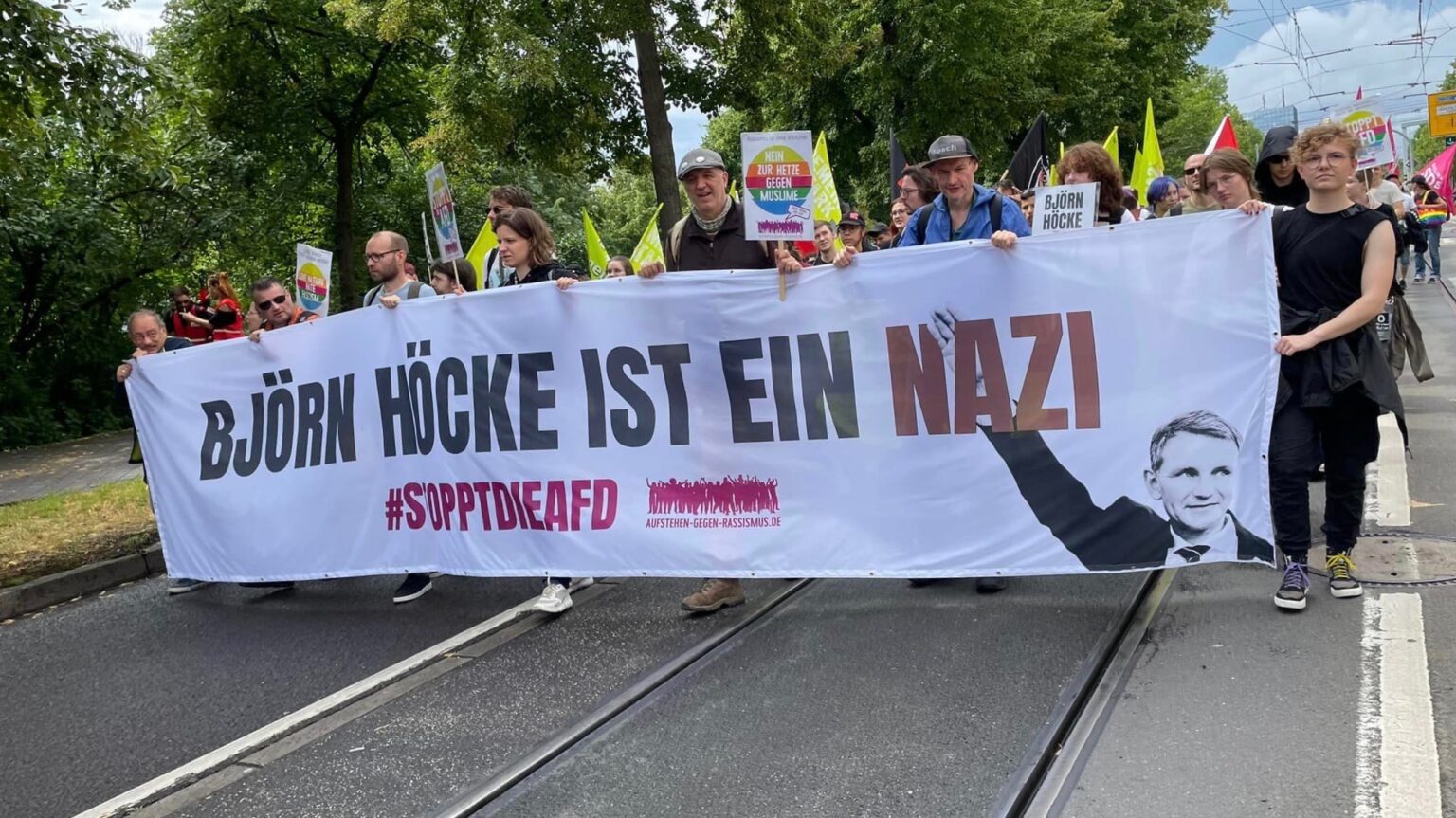
Anti-AfD protest in Magdeburg. (Photo: via Standing Up Against Racism)
The German government has defied EU law by imposing border controls, while Green politicians decry “the poison of Islam” in parliament. Meanwhile, the far-right AfD has surged in recent state elections. What’s driving Germany’s sharp shift to the right?
Germany is entering a period of reaction. This is not only evident from the rise of the far-right Alternative for Germany (Alternative für Deutschland, AfD), but also from the hardline policies of the governing coalition’s so-called centrist parties. The Social Democrats (SPD), Greens, and Liberal Democrats (FDP) have introduced unprecedented measures against migrants and critics of state policies. In September 2024, Federal Interior Minister Nancy Faeser (SPD) imposed border controls, defying European criticism and undermining the EU’s Schengen Agreement. Political scientist Christopher Wratil of the University of Vienna said that Berlin can “no longer claim others are not complying with EU law,” adding that the government is acting “as if the AfD were already in power.” Soon after Faeser’s announcement, Green parliamentary leader Katharina Dröge referred to “the poison of Islam” (das Gift des Islams) during a Bundestag session.
Germany challenged on multiple fronts
To explain this drastic rightward shift, it is necessary to understand the international situation confronting Germany’s ruling class. There are three main fronts on which the German state is currently bogged down.
Firstly, in Ukraine, where NATO’s confrontation with Russia is stalling, if not collapsing entirely. As the second-largest backer of the Zelensky regime, Berlin remains fully committed to winning the war. The government’s July 2024 decision to approve the stationing of US Tomahawk cruise missiles on German soil confirms this. Sanctions on Russia have strained the German economy, especially energy-intensive industries, but the state has absorbed much of the burden through subsidies. The Federation of German Industries, representing 100,000 companies, continues to back the government’s policies. However, popular support for the war is crumbling, as recent EU and state elections show. The two parties most critical of arms deliveries to Ukraine – the AfD and the Sahra Wagenknecht Alliance for Reason and Justice (Bündnis Sahra Wagenknecht, BSW) – made record gains, while the governing coalition suffered heavy losses.
The second front, not yet erupted into open conflict, is East Asia, in the confrontation with China. German capital faces the same dilemma as its US counterpart: while business with China remains lucrative, Chinese producers are outpacing American and European competitors, challenging Western hegemony. Germany has been more reserved than the US in taking a confrontational stance, but the government’s plan to invest 10 billion euros into a 30-billion-euro Intel chip production project in Germany shows its intent to reduce reliance on China. Meanwhile, the Green foreign minister, who called Xi Jinping a “dictator” in 2023, has led a cross-party effort to instrumentalize Taiwan against Beijing. The Ministry of Defense’s recent decision to send a warship through the Taiwan Strait is the latest move in this confrontational policy.
The third front is West Asia, where Germany remains the most outspoken advocate of Israel’s genocidal offensive in Gaza. Unlike the other fronts, there are no economic concerns holding German capital back from fully supporting Israel. This unified stance on Zionism and opposition to the so-called axis of resistance has allowed the government to swiftly implement policies against the Palestinian solidarity movement. While smearing protesters as antisemitic, basic rights such as freedom of assembly and speech are thrown out of the window. Homes are raided, activists arrested, solidarity organizations banned, and laws tightened—most recently with the liberal FDP calling to strip non-EU citizens of the right to assembly. Yet, the Western-backed offensive in Gaza has also stalled, with Israel unable to eliminate Hamas. Domestically, Germany uses force to suppress dissent, but it cannot do so internationally. States from the Global South are openly challenging Germany’s unconditional support for Israel. Namibia accused Berlin of supporting genocide while shirking responsibility for colonial crimes. Nicaragua has filed a case against Germany in the International Court of Justice, accusing it of violating the 1949 Genocide Convention. Others, like Malaysian Prime Minister Anwar Ibrahim, have directly confronted German politicians: “Where have we thrown away our humanity? Why this hypocrisy?”
The escalations on these fronts, along with rising domestic discontent, are fueling insecurity among Germany’s ruling class. A shift to the right is seen as necessary to capture broad sections of the population, keep them integrated into the system, and conjure scapegoats. The consistent messaging around the “Russian threat” and “Islamic terrorism” is used to justify massive military spending, cuts to social programs, and sweeping surveillance laws, including the right to secretly invade private homes. Meanwhile, migrants are blamed for housing shortages and the collapse of the healthcare system.
The collapse of the governing parties in eastern Germany
Elections for two state governments in eastern Germany made international headlines in August 2024 after the far-right AfD made massive gains, even becoming the strongest political force in Thuringia, where it led by almost 10%. There are several reasons for the far-right’s success.
Firstly, there is the historical trajectory of the post-1989 era. Over 30 years have passed since the socialist German Democratic Republic (GDR) was incorporated into the Federal Republic, yet West German promises of “blossoming landscapes” remain unfulfilled. The privatization of the East German economy was the largest wealth transfer in European history: millions lost their jobs and were deprived of their rightful shares in the public property they had built. This left East Germans with little to pass to their children. Almost all key positions in the state and economy were taken by West Germans. Deindustrialization led to higher unemployment, lower incomes, and longer working hours compared to the West. The result was a mass exodus, with nearly 4 million people moving westward since 1989 to escape the bleakness.
The East German population has essentially been relegated to second-class citizens in the Federal Republic. This has fostered a general distrust of Western political parties, whose approach has often been to “educate” rather than represent the East: “Your system lost, you have lost, so we will show you how it’s done.” The natural rejection of this condescending, paternalistic attitude has long been reflected in voter support for anti-establishment parties like The Left (Die Linke) and, more recently, the far-right AfD.
While The Left enjoyed broad support in the early 2000s for opposing the neoliberalization of the labor market, it gradually fell out of favor after joining regional and city governments, where it helped implement the same neoliberal policies it once opposed (such as the privatization of public housing in Berlin). This created a political vacuum in which the AfD was able to present itself as the only oppositional force, despite being a neoliberal party. The AfD taps into the economic and social challenges people face, blaming migrants or incompetent politicians in Berlin rather than the economic system itself. It has been especially successful among skilled laborers and small business owners—those most threatened by, or fearful of, social degradation.
This dynamic, which had already been unfolding for several years – was accelerated by the escalation of the Ukraine war in 2022. The question of arms deliveries to Kiev now played a central role in political debates.
The EU elections in June 2024 – in which the whole country participated – showed that Germans are dissatisfied with the governing coalition (SPD, Greens, and liberal FDP). Voters are now turning to the conservative CDU and far-right AfD, both of which call for tougher social cuts in response to current crises. The AfD gained nearly 5%, becoming the second-largest German party in the EU parliament, surpassing even the SPD. While the AfD has criticized further arms deliveries to Ukraine, it does not oppose NATO or the ongoing militarization in Germany. Many likely voted for the AfD due to its demagoguery on Ukraine, particularly calls to end the war with Russia. Polls from September 2024 show more Germans now oppose further arms deliveries to Ukraine (51%) than support them (38%), and 52% believe diplomatic efforts for peace have been insufficient. The BSW, a new party that split from The Left in 2023, centered this issue in its campaign and secured 6% of the national vote in the EU elections.
The two state elections in August 2024 further revealed that consensus around the Ukraine war effort is breaking down, especially in eastern Germany. All three governing parties lost votes, while the AfD and BSW made record gains. The Left, which had been the strongest party in Thuringia and supported arms deliveries to Ukraine, lost nearly 18% and was overtaken by the BSW. The AfD is now the largest party in Thuringia, winning almost a third of the vote. In Saxony, the AfD came close, with 30.6% compared to the CDU’s 31.9%. Notably, the CDU leader in Saxony has broken from the party’s line, calling for an end to arms deliveries and diplomatic negotiations with Russia.
The successes of the AfD and BSW have left the two eastern German states without a clear path forward. All parties currently refuse to form coalitions with the far-right AfD. While mainstream parties have derided the BSW as the “long arm of the Kremlin,” they also acknowledge the need to contend with this new party. Wagenknecht has stated that the BSW will only join coalitions with parties that oppose the stationing of US Tomahawk cruise missiles in Germany—a largely symbolic stance, as state governments have no control over this decision. More concerning for centrist parties is the disintegration of the political landscape, which could allow the opposition to block decisions requiring a two-thirds majority, including the election of constitutional judges. There is a palpable angst that minority parties in federal and state parliaments could “shut down” Germany’s constitutional courts.
Dark prospects
The upsets in eastern Germany are driven, at least in part, by dissent over NATO’s war effort against Russia. Both the AfD and BSW, from different perspectives, argue that supplying more weapons to Ukraine is not in Germany’s “national interest.” This domestic dissent, coupled with military setbacks in Donbass, is clearly causing doubts within the governing coalition. Just days after the elections in Thuringia and Saxony, Chancellor Olaf Scholz (SPD) expressed support for diplomatic negotiations with Moscow to “discuss how we can move from this war situation towards peace more quickly.”
While the German ruling class grapples with the Ukraine dilemma, its commitment to militarizing society remains strong. In this endeavor, the AfD does not stand in its way. Although the far-right party differs on issues like the war against Russia, relations with the USA, and the future of the EU, it poses no threat to German capital. On the contrary, centrist parties can mask themselves as an anti-fascist bulwark, rallying much of the population (including many on the left) around the slogan of “stopping the AfD,” while simultaneously enacting similarly racist and inflammatory policies toward migrants.
Asylum seekers are once again being deported back to Afghanistan, in flagrant disregard of the EU’s own human rights convention. Even “liking” certain social media posts warrants deportation, according to Interior Minister Nancy Faeser (SPD). At the same time, the German government is ramping up its “brain drain” strategy against the Global South. Just a few days after ordering controls on all of Germany’s borders, Faeser signed an agreement with the Kenyan government to make it easier for Germany to poach Kenyan professionals. A similar agreement with Uzbekistan followed a week later.
Germany’s increasingly aggressive neo-colonial policies abroad and its ever-more repressive policies at home are thus two sides of the same coin.