Original article by JULIA CONLEY republished from Common Dreams under Creative Commons (CC BY-NC-ND 3.0).
“These unlawful killings are in blatant violation of international human rights law,” said the rights group.
While Israeli officials continue to claim, despite all evidence to the contrary, that the Israel Defense Forces are targeting Hamas in their bombardment of occupied Palestine, a new report from Amnesty International on Monday details the extent to which the military has frequently used lethal force against civilians across the West Bank in addition to the more than 27,000 people it has killed in Gaza.
Calling for an investigation into possible war crimes, the group said it had analyzed four cases in which the IDF has used “unlawful lethal force” against people in the occupied West Bank and blocked medical professionals from reaching injured residents, with Amnesty’s Crisis Evidence Lab verifying 19 videos and four photos of the incidents.
The events documented in the report account for the deaths of 20 Palestinians, including seven children. Since October 7, when the IDF began attacking the West Bank and Gaza in retaliation for a Hamas-led attack on southern Israel, at least 360 people have been killed by Israeli forces in the West Bank, including 94 children, according to the United Nations Office for the Coordination of Humanitarian Affairs (OCHA).
Erika Guevara-Rosas, Amnesty’s director of global research, advocacy, and policy, said the surge in unlawful deadly attacks in the West Bank have been perpetrated “under the cover of the relentless bombardment and atrocity crimes in Gaza.”
“These unlawful killings are in blatant violation of international human rights law and are committed with impunity in the context of maintaining Israel’s institutionalized regime of systematic oppression and domination over Palestinians,” said Guevara-Rosas. “These cases provide shocking evidence of the deadly consequences of Israel’s unlawful use of force against Palestinians in the West Bank. Israeli authorities, including the Israeli judicial system, have proven shamefully unwilling to ensure justice for Palestinian victims.”
The report was released days after a team of Israeli forces disguised themselves as medical staff and civilians and raided Ibn Sina Hospital in the West Bank city of Jenin, killing three Palestinians who they claimed—without evidence—were planning an attack on Israel.
OCHA has recorded a sharp increase in “search and arrest operations” by the IDF in the occupied West Bank since October 7, with 54% of the 4,382 Palestinians injured in Israel’s assault sustaining their injuries during raids.
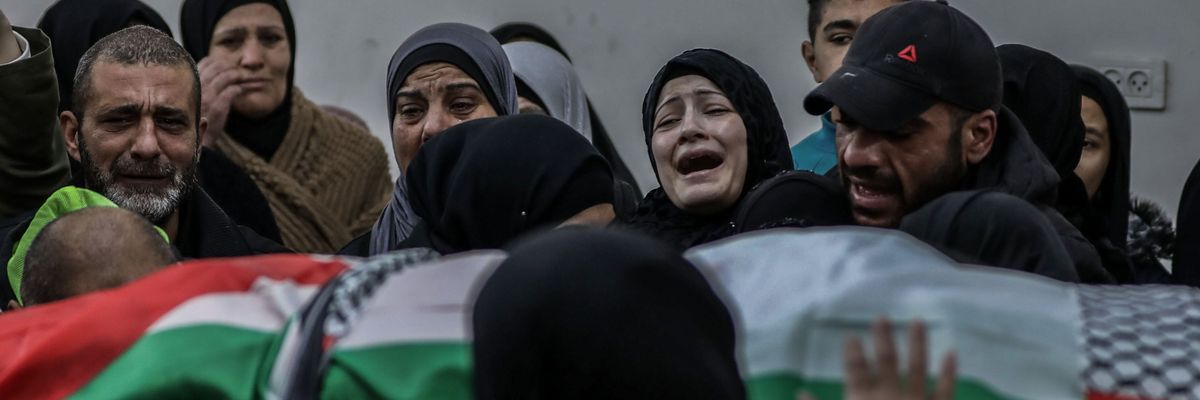
In the early days of the Israeli onslaught, 13 people, including six children, were killed during a raid on Nour Shams refugee camp in Tulkarem that began on October 19 and went on for 30 hours. IDF soldiers “stormed more than 40 residential homes, destroying personal belongings and drilling holes in the walls for sniper outposts” during the operation, which Israel said was in response to an improvised explosive device that was thrown at border police by Palestinians.
Israeli authorities cut off water and electricity to the camp and used bulldozers to destroy infrastructure, while stopping at least two ambulances from reaching people who were injured.
One person killed in the raid was 15-year-old Taha Mahami, who was “unarmed and posed no threat to the soldiers at the time he was shot, based on witness testimony and videos reviewed by Amnesty International.”
“They did not give him a chance. In an instant, my brother was eliminated,” said Fatima Mahamid, the victim’s sister. “Three bullets were fired without any mercy. The first bullet hit him in the leg. The second—in his stomach. Third, in his eye. There were no confrontations… there was no conflict.”
When the children’s father, Ibrahim Mahamid, tried to carry his injured son out of the line of fire, he was shot in the back by the IDF, sustaining damage to his internal organs.
“Neither Taha nor Ibrahim Mahamid posed a threat to security forces or anyone else when they were shot,” said Amnesty. “This unnecessary use of lethal force should be investigated as possible war crimes of wilful killing and willfully causing great suffering or serious injury to body or health.”
In another “egregious” incident in October in Tulkarem, two eyewitnesses interviewed by Amnesty described Israeli forces opening fire from a watch tower on a crowd of at least 80 people who were holding a peaceful protest in solidarity with Gaza.
IDF soldiers opened fire on journalists wearing clearly visible “Press” markings as well as on a Palestinian man who was riding past the protest on a bike.
By carrying out such attacks, said Amnesty, Israel is violating international standards including the U.N. Basic Principles on the Use of Force and Firearms by Law Enforcement Officials.
“These standards prohibit the use of force by law enforcement officials unless strictly necessary and to the extent required for the performance of their duty and require that firearms may only be used as a last resort—when strictly necessary for military personnel or police to protect themselves or others against the imminent threat of death or serious injury,” said the group. “Willful killings of protected persons and willfully causing great suffering or serious injury to protected persons are grave breaches of the Fourth Geneva Convention and war crimes.”
Guevara-Rosas said the incidents documented in the report, and the Israeli onslaught in the West Bank and Gaza as a whole, “is a litmus test for the legitimacy and reputation” of the International Criminal Court, which prosecutes war crimes, and that “it cannot afford to fail it.”
“In this climate of near total impunity, an international justice system worth its salt must step in,” said Guevara-Rosas. “The prosecutor of the International Criminal Court must investigate these killings and injuries as possible war crimes of willful killing and willfully causing great suffering or serious injury.”
Original article by JULIA CONLEY republished from Common Dreams under Creative Commons (CC BY-NC-ND 3.0).
- Amnesty Probe Finds ‘Damning Evidence Of War Crimes’ By Israel In Gaza ›
- 30 Israeli Groups Urge Global Community To Help Stop Surging West Bank Settler Violence ›
- New Amnesty Report Outlines ‘True Extent Of Israeli Apartheid Regime’ ›
- Amnesty International Calls On Israel To End ‘Inhumane’ Measures … ›
- EU Needs To Understand The Realities In The West Bank – POLITICO ›
- Amnesty Joins Rights Groups In Accusing Israel Of Apartheid | AP News ›