Tag: analysis

  • Tens of Thousands of Voters at ‘Risk of Disenfranchisement’ Thanks to Trump’s Postal Service: Analysis

    Spread the love

    Article by Brad Reed republished from Common Dreams under Creative Commons (CC BY-NC-ND 3.0).

    The United States Postal Service logo is displayed on a USPS mail collection box on September 18, 2026 in San Gabriel, California. (Photo by Mario Tama/Getty Images)

    “In every state, a day’s delay in delivery means that if mail voters wait until the last day or two before the election to mail their ballot… they could be disenfranchised.”

    An analysis published Friday by Democracy Docket warned that “tens of thousands” of voters across the US face “risk of disenfranchisement” thanks to actions being taken by the United States Postal Service.

    The analysis, written by veteran election reporter Jim Saksa, points to a new USPS policy known as Regional Transportation Optimization (RTO) that “will eliminate evening mail pickups from post offices more than 50 miles away from a regional processing facility, most of which are located in major urban areas.”

    RECOMMENDED…

    US-POLITICS-CALIFORNIA-VOTE

    ‘Major Win’ for Democracy as Supreme Court Rejects Trump Attack on Mail-In Voting

    North Carolina Board Of Elections Test Voting Machines Ahead Of Election

    Trump’s War on Mail-in Voting is Hitting a Brick Wall—But the Danger is Far From Over

    For people who live in these areas, ballots sent on Election Day will be postmarked and delivered at least a day later than in previous election years, thus making it ineligible to be included in final election tallies.

    “In every state, a day’s delay in delivery means that if mail voters wait until the last day or two before the election to mail their ballot,” Saksa explained, “they could be disenfranchised.”

    Saksa reported that this policy is currently active in “about 42.5% of all ZIP codes” in the continental US, and is scheduled to eventually take effect in around 70% of all ZIP codes. No additional ZIP codes are expected to be added between now and election day.

    Saksa also said that voters concerned about their ballots not being counted should deliver them in person to their local post office, where they can ask an employee to postmark it.

    President Donald Trump has tried for the last several months to use USPS to meddle with states’ mail-in voting systems.

    In March, the president signed an executive order that instructed the United States Postal Service to not deliver ballots in any states that have not given the federal government access to their voter lists.

    The US Supreme Court last month rejected Trump’s efforts to interfere with mail-in voting, allowing states to continue sending ballots to voters as they’ve done in past elections.

    Even with the Supreme Court loss, however, the president’s repeated attacks on voting by mail has had a major impact on the 2026 midterm elections.

    An NBC News poll released in September showed that just 23% of Democratic voters said they planned to vote by mail this year, a double-digit drop from 2024 when 34% of Democrats said they were voting by mail.

    In an interview with Politico published Thursday, Quentin James, founder and president of The Collective Political Action Committee, said Black voters have been expressing concerns about sending in their ballots for fear that Trump will order USPS to not deliver them.

    “I think there’s confusion,” James said. “We know that the president has spent six months talking about changing the rules regarding mail-in voting, and a lot of folks are concerned about their ballot being secure.”

    Indivisible co-founder Leah Greenberg also told Politico that her group is “absolutely hearing concern” about the mail voting process this year.

    “But more importantly,” Greenberg added, “what we’re hearing is people trying to figure out what they can do and how they can organize locally in order to protect elections.”

    Article by Brad Reed republished from Common Dreams under Creative Commons (CC BY-NC-ND 3.0).

    Orcas discuss Donald Trump and the killer apes' concept of democracy. Front Orca warns that Trump is crashing his country's economy and that everything he does he does for the fantastically wealthy.
    Orcas discuss Donald Trump and the killer apes’ concept of democracy. Front Orca warns that Trump is crashing his country’s economy and that everything he does he does for the fantastically wealthy.
    Climate science denier Donald Trump confirms that he knows nothing about democracy and that more liquid gold is being secured according to his policy of global privateering.
    Climate science denier Donald Trump confirms that he knows nothing about democracy and that more liquid gold is being secured according to his policy of global privateering.
    Orcas discuss rotting brain, front Orca says Sundown Syndrome is a dead givaway and he wishes someone would Lock Him Up
    Orcas discuss rotting brain, front Orca says Sundown Syndrome is a dead givaway and he wishes someone would Lock Him Up

  • Patient survival ‘clearly linked’ to nursing numbers

    Spread the love

    https://www.morningstaronline.co.uk/article/patient-survival-clearly-linked-nursing-numbers

    ALANDMARK study into excess patient deaths across NHS hospitals has found a “very clear and consistent” link between nurse staffing and patient mortality — and that replacing them with lower-paid workers makes no difference.

    Dramatic variations in patient death rates were revealed in the first-ever analysis of staffing and death rates over time, sparking calls for NHS England to investigate trusts where deaths have risen.

    Study leader Professor Alison Leary told the Sunday Times that the data across 122 NHS trusts over four years showed “a very clear and consistent relationship between the absence of registered nurses available to patients and excess deaths.”

    “Although organisations have tried to make up for the lack of registered nurses with other staffing groups, this has not improved survival,” added the chair of workforce modelling at London South Bank University and a senior consultant for the World Health Organisation.

    The study, covering December 2020 to May 2024, found that hospitals with lower-than-expected death rates had the highest nurse staffing, with an average of 5.65 hours of registered nurse care per patient per day.

    Those with higher-than-expected deaths meanwhile had significantly fewer nurses available to care for patients, with just 4.59 hours of nurse care per patient per day.

    …

    Article continues at https://www.morningstaronline.co.uk/article/patient-survival-clearly-linked-nursing-numbers

  • Labour MPs launch major rebellion to stop welfare bill

    Spread the love

    https://www.theguardian.com/politics/2025/jun/23/labour-mps-launch-major-rebellion-to-stop-benefits-cuts-bill

    Liz Kendall urged her colleagues to support the bill; however, dozens of backbenchers have already signed the amendment seeking to kill it off. Photograph: James Veysey/Shutterstock

    Amendment intended to kill off legislation that would cut benefits could be backed by up to 100 Labour MPs including senior figures

    …

    Dozens of backbench MPs have signed the amendment. Government whips have already been steeling themselves for a rebellion on the welfare bill when it is first voted on next week.

    A senior MP said: “The government hasn’t listened to private concerns so now will have to address these very public ones.”

    The aim would be to pass a so-called “reasoned amendment”, which halts the passage of a bill. It means the bill would not pass its second reading, saying that provisions “have not been subject to a formal consultation with disabled people, or co-produced with them, or their carers”.

    It also says the bill should not pass until the Office for Budget Responsibility can publish its analysis of the employment impact of the changes this autumn. The amendment adds that most of the additional employment support funding will not be in place until the end of the decade.

    It notes the government’s own impact assessment estimates that 250,000 people will be pushed into poverty as a result of the provisions, including 50,000 children. It calls for an assessment of the impact of the changes on health or care needs and for the conclusion of other reviews.

    …

    Original article at https://www.theguardian.com/politics/2025/jun/23/labour-mps-launch-major-rebellion-to-stop-benefits-cuts-bill

    Keir Starmer says that the Labour Party under his leadership all feel a small part of Scunthorpe.
    Keir Starmer says that the Labour Party under his leadership all feel a small part of Scunthorpe.

  • Carbon capture: a decarbonisation pipe dream

    Spread the love

    Relearning lessons of the past

    1 September 2022 (IEEFA): Underperforming carbon capture projects considerably outnumber successful projects globally, and by large margins, with both the technology and regulatory framework found wanting, finds a new report by the Institute for Energy Economics and Financial Analysis (IEEFA).

    The report, The Carbon Capture Crux – Lessons Learned, studies 13 flagship large-scale carbon capture and storage (CCS)/carbon capture utilisation and storage (CCUS) projects in the natural gas, industrial and power sectors in terms of their history, economics and performance. These projects account for around 55% of the total current operational capacity worldwide.

    Author Bruce Robertson says seven of the thirteen projects underperformed, two failed, and one was mothballed

    “CCS technology has been going for 50 years and many projects have failed and continued to fail, with only a handful working.

    “Many international bodies and national governments are relying on carbon capture in the fossil fuel sector to get to Net Zero, and it simply won’t work.

    “Although some indication it might have a role to play in hard-to-abate sectors such as cement, fertilisers and steel, overall results indicate a financial, technical and emissions-reduction framework that continues to overstate and underperform.”

    IEEFA’s study found that Shute Creek in the U.S. underperformed its carbon capture capacity by around 36% over its lifetime, Boundary Dam in Canada by about 50%, and the Gorgon project off the coast of Western Australia by about 50% over its first five-year period.

    “The two most successful projects are in the gas processing sector – Sleipner and Snøhvit in Norway. This is mostly due to the country’s unique regulatory environment for oil and gas companies,” says co-author Milad Mousavian.

    “Governments globally are looking for quick solutions to the current energy and ongoing climate crisis, but unwittingly latching onto CCS as a fix is problematic.”

    Last week the Australian government approved two new massive offshore greenhouse gas storage areas, saying CCS “has a vital role to play to help Australia meet its net zero targets. Australia is ideally placed to become a world leader in this emerging industry”.

    However, Robertson says, carbon capture technology is not new and is not a climate solution.

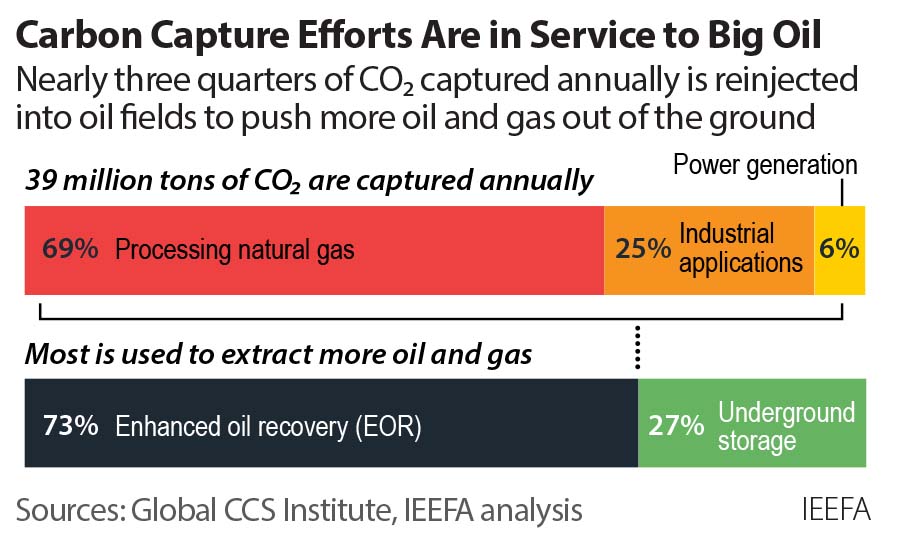
    “As our report shows, CCS has been around for decades, mostly serving the oil industry through enhanced oil recovery (EOR). Around 80–90% of all captured carbon in the gas sector is used for EOR, which itself leads to more CO2 emissions.”

    About three-quarters of the CO2 captured annually by multi-billion-dollar CCUS facilities, roughly 28 million tonnes (MT) out of 39MT total capture capacity globally, is reinjected and sequestered in oil fields to push more oil out of the ground.

    The International Energy Agency says annual carbon capture capacity needs to increase to 1.6 billion tonnes of CO2 by 2030 to align with a net zero by 2050 pathway.

    “In addition to being wildly unrealistic as a climate solution, based on historical trajectories, much of this captured carbon will be used for enhanced oil recovery,” says Robertson.

    History shows CCS projects have major financial and technological risks. Close to 90% of proposed CCS capacity in the power sector has failed at implementation stage or was suspended early — including Petra Nova and the Kemper coal gasification power plant in the U.S. Further, most projects have failed to operate at their theoretically designed capturing rates. As a result, the 90% emission reduction target generally claimed by the industry has been unreachable in practice.

    Finding suitable storage sites and keeping it there is also a major challenge—the trapped CO2 underground needs monitoring for centuries to ensure it does not come back to the atmosphere.

    The report identifies interim considerations for CCS projects if no alternative solutions to emissions reduction are found.

    • Safe storage locations must be identified, and a long-term monitoring plan and compensation mechanism in case of failure developed.
    • The CCS project must not promote enhanced oil recovery.
    • To avoid project liability being handed over to taxpayers, as is currently the situation with Gorgon, large oil and gas companies mainly benefiting from CCS at their gas developments must be liable for any failure/leakage and monitoring costs of CCS projects, specifically if they get subsidies, grants and tax credits for capturing the carbon.
    • It must not be used by governments to greenlight or extend the life of any type of fossil fuel asset as a climate solution.

    Robertson says more research could be done on CCS applications in industries where emissions are hard to abate such as, cement, as an interim partial solution to meeting net zero targets.

    “As a solution to tackling catastrophic rising emissions in its current framework however, CCS is not a climate solution.”

    The report: The Carbon Capture Crux – Lessons Learned