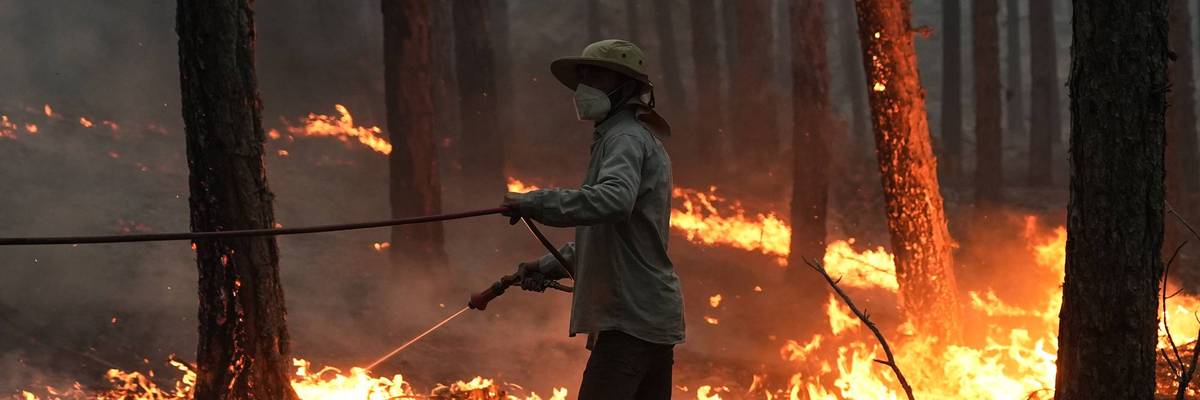
Firefighters extinguish fire at a forested area as aerial and ground crews continue battling a wildfire in the Cine district of Aydin, Türkiye on July 31, 2026. (Photo by Mahmut Serdar Alakus/Anadolu via Getty Images)
“The health harms of climate change are growing faster than the world’s response to them, and in many cases even accelerating.
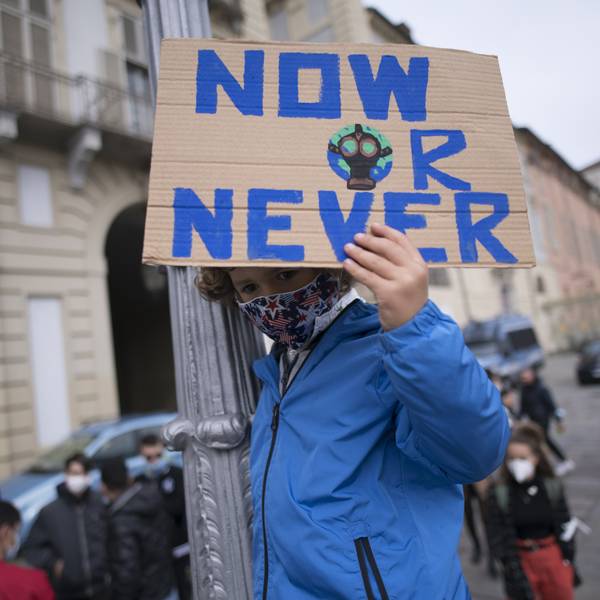
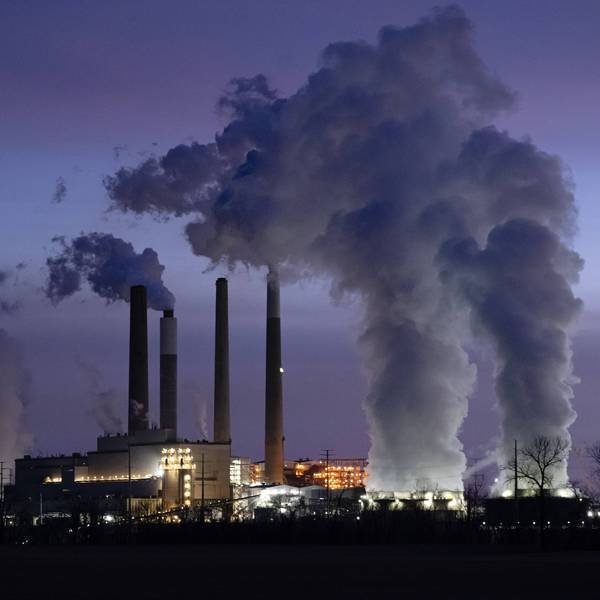
With less than two weeks to go until the 31st United NationsClimate Change Conference, or COP31, brings world leaders to Antalya, Türkiye to discuss the need to transition away from fossil fuels, nearly 150 international experts warned that climate change brought on by greenhouse gas emissions constitutes a “global health emergency” whose harms are accelerating.
But one top indicator that planetary heating has caused a worsening public health crisis is the extreme heat that was blamed for more than 50,000 deaths across Europe this summer, and which could lead to 450,000 excess deaths in the coming months as the climate emergency is compounded by this year’s “Super El Niño.”
According to the report, annual average heat-related deaths have surged by nearly 36% since the Paris climate agreement was signed in 2015, securing pledges from governments to draw down fossil fuel emissions, compared to the decade preceding the deal.
More than 70% of the 710,000 heat-related deaths recorded in 2023 were found to be attributed to climate change, and between 2016-23, 68% of the world’s 540,800 heat-related deaths were linked to the warming planet. The previous decade, 55% of deaths caused by extreme heat were blamed on the climate emergency.
“These numbers point to a clear emergency,” said climate health researcher Marina Romanello, the executive director of the Lancet Countdown. “The risks become even more profound when you consider how different hazards interact and compound. At the same time, drought is spreading, and the world is swinging to water extremes, some drying out, while others are flooding.”
“Progress has been too slow, too small, and isn’t reaching those who need it most.”
The report was published less than two months after a glacial collapse killed at least 1,000 people in Nepal and Tibet as it sent sudden extreme flooding down a mountain into a number of towns.
Türkiye, where COP31 is set to begin on November 9, was one place where massive wildfiresspread rapidly this summer, while hundreds of thousands of people in Spain and France were also displaced by fast-moving blazes.
And in August, more than 5,000 square miles of forest burned in the Northwest Territories in Canada, sparking public health concerns when smoke drifted thousands of miles south to the continental United States.
“A decade after the Paris Agreement, our findings are unambiguous: The health harms of climate change are growing faster than the world’s response to them, and in many cases even accelerating,” said Romanello.
Diarmid Campbell-Lendrum, head of the climate change and health unit at WHO, said the report “demonstrates that climate action is a health intervention. Cleaner energy, stronger health systems and early warning systems are saving lives today. As countries prepare for COP31, placing health at the center of climate policies can help protect communities, strengthen resilience, and deliver immediate benefits for people’s health and wellbeing.”
The 146 scientists who authored the report noted that strides have been made in some countries in expanding clean energy infrastructure, passing health protection regulations, and preparing health systems for climate-related crises and conditions.
“Progress has been too slow, too small, and isn’t reaching those who need it most,” said Romanello. “That is why we are calling for climate change to be formally recognized as a global health emergency, with health placed at the center of every climate decision.”
The report was released a week after the UN Environment Program warned that achieving the Paris Agreement’s goal of limiting planetary heating to 1.5°C above preindustrial temperatures is no longer possible, and that world leaders must now focus efforts on ensuring the overshoot is as short-lived as possible.
In the Lancet Countdown, the researchers called on the UN to declare that climate change is a public health emergency of international concern, which could require an international response.
“Priorities,” said WHO, “include accelerating reductions in greenhouse gas emissions, increasing support for adaptation, and expanding investments that strengthen health system resilience.”
UK Prime Minister Andy Burnham says ignore facts and reality and be a climate science denier like him. He says that he’s delayed the go-ahead for Jackdaw and Rosebank North Sea oil and gas extraction until after the Holborn and St. Pancras by-election – don’t want democracy interfering with Capitalism.Nigel Farage urges you to ignore facts and reality and be a climate science denier like him and his Deputy Richard Tice. He says that Reform UK has received £Millions and £Millions from the fossil fuel industry to promote climate denial and destroy the planet.Donald Trump urges you to ignore facts and reality and be a Climate Science denier like him. He says that he makes millions and millions for destroying the planet, Burn, Baby, Burn and Flood, Baby, Flood.
After a summer of extreme temperatures, drought and a food production crisis, with more than 2,800 excess deaths due to consecutive heatwaves in May and June alone, you’d think the government might be taking a more muscular approach to the climate emergency.
But just days before the UK was plunged into killer-storm territory, Andy Burnham’s government approved new North Sea drilling in the form of the Jackdaw gas field.
Climate experts are clear: no new oil and gas fields are compatible with keeping global heating around the 1.5°C mark. Jackdaw and the as-yet-unapproved Rosebank oil field, the two new North Sea projects previously halted in the courts over their climate impact, are not an exception.
…
And congratulations might be in order for the climate-wreckers once again, with Whitehall ‘sources’ briefing on Saturday night that Burnham and chancellor John Healey are set to “defy eco-zealot Ed Miliband” and approve Rosebank, despite energy secretary Miatta Fahnbulleh insisting she’s the only one who can make the final decision.
Nigel Farage urges you to ignore facts and reality and be a climate science denier like him and his Deputy Richard Tice. He says that Reform UK has received £Millions and £Millions from the fossil fuel industry to promote climate denial and destroy the planet.Donald Trump urges you to ignore facts and reality and be a Climate Science denier like him. He says that he makes millions and millions for destroying the planet, Burn, Baby, Burn and Flood, Baby, Flood.UK Prime Minister Andy Burnham says ignore facts and reality and be a climate science denier like him. He says that he’s delayed the go-ahead for Jackdaw and Rosebank North Sea oil and gas extraction until after the Holborn and St. Pancras by-election – don’t want democracy interfering with Capitalism.
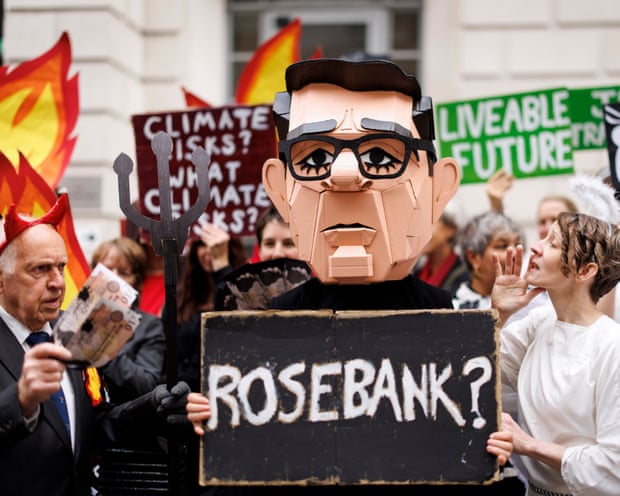
Climate campaigners in London earlier this month protesting against the possible approval of drilling at the Rosebank oilfield in the North Sea. Photograph: Tolga Akmen/EPA
Letter to PM argues series of wrong choices on North Sea oil, Heathrow, EVs and heat pumps will scupper net zero plans
Andy Burnham will “sleepwalk” into climate disaster if he fails to get a grip on a series of important policies whose combined impact could scupper plans to reach net zero, campaigners have said.
But they should be considered in the context of their cumulative impacts rather than be taken separately by different government departments, according to Greenpeace and Friends of the Earth (FoE) in a letter to the prime minister.
Taken together, the emissions resulting from approving drilling at the Rosebank oilfield, expanding Heathrow airport, watering down the UK’s EV targets and cutting heat pump grants would be 402m tonnes of CO2 over the next 25 years, the letter says.
The emissions would be greater than those of 106 coal plants running for a year, more than enough to prevent the UK meeting its carbon budgets and net zero.
Doug Parr, chief scientist at Greenpeace, said: “The Burnham government is facing a series of big decisions over the next few months that could define its legacy on climate. This administration seems to get the urgency of cutting the emissions causing deadly heatwaves and droughts, but there’s a real risk they could still sleepwalk into reversing the strong progress the UK has made so far.”
Nigel Farage urges you to ignore facts and reality and be a climate science denier like him and his Deputy Richard Tice. He says that Reform UK has received £Millions and £Millions from the fossil fuel industry to promote climate denial and destroy the planet.Donald Trump urges you to ignore facts and reality and be a Climate Science denier like him. He says that he makes millions and millions for destroying the planet, Burn, Baby, Burn and Flood, Baby, Flood.UK Prime Minister Andy Burnham says ignore facts and reality and be a climate science denier like him. He says that he’s delayed the go-ahead for Jackdaw and Rosebank North Sea oil and gas extraction until after the Holborn and St. Pancras by-election – don’t want democracy interfering with Capitalism.
This work by Middle East Monitor is licensed under a Creative Commons Attribution-NonCommercial-ShareAlike 4.0 International License.
Posters of former Israeli Chief of General Staff and Yashar Party leader Gadi Eisenkot (right) and Prime Minister and Likud Party leader Benjamin Netanyahu (left) are seen as election campaigns intensify two days before the vote as campaign posters of candidates are displayed on billboards and buildings across the streets ahead of the Knesset elections scheduled for October 27, in Tel Aviv, Israel, on October 25, 2026. [Nir Keidar – Anadolu Agency]
Israelis head to the polls Tuesday in a closely contested parliamentary election that could end Prime Minister Benjamin Netanyahu’s long rule or leave the country facing another political deadlock, with neither major bloc projected to secure a governing majority, Anadolu reports.
The vote will be Israel’s first general election since the Oct. 7, 2023 attacks and the subsequent Israeli offensive on the Gaza Strip, as well as military confrontations with Lebanon and Iran.
It will also be the first Israeli general election held on schedule since 1988, following decades in which successive governments collapsed before completing their four-year terms.
Around 7.3 million people are eligible to vote, including approximately 1.2 million Palestinian citizens of Israel.
Voting will take place at 12,018 polling stations, with approximately 18,000 ballot boxes deployed nationwide.
Most polling stations will open at 7 am (0500GMT) and close at 10 pm (2000GMT). Election day is a public holiday.
Thirty-seven parties and electoral lists are competing for seats in the 120-member Knesset, where a governing coalition requires the support of at least 61 lawmakers.
Under Israel’s proportional representation system, voters choose parties rather than individual candidates. Parties must secure at least 3.25% of valid votes to enter parliament.
No party has ever won an outright Knesset majority, making coalition negotiations decisive in determining who becomes prime minister.
Eisenkot’s party leads final polls
Final surveys published by Israel’s three main television broadcasters put former military chief Gadi Eisenkot’s centrist Yashar party narrowly ahead of Netanyahu’s Likud.
Yashar is projected to win 22 to 23 seats, compared with 19 to 21 for Likud.
The B’Yachad, or Together, alliance led by former prime ministers Naftali Bennett and Yair Lapid is projected to finish third with 14 or 15 seats.
Other opposition parties include the Democrats, led by former general Yair Golan, and former Defense Minister Avigdor Lieberman’s Yisrael Beytenu.
The three surveys project Netanyahu’s right-wing and religious bloc winning 50 seats, while the opposition bloc is forecast to secure between 52 and 56.
Palestinian-led parties are projected to win a combined 14 to 16 seats.
The figures suggest that neither Netanyahu nor Eisenkot has a clear path to the 61-seat majority needed to form a government.
Winning the largest number of seats does not automatically determine who becomes prime minister.
President Isaac Herzog will consult the elected parties before assigning the task of forming a government to the lawmaker considered most likely to command a parliamentary majority.
Netanyahu, 77, is seeking another term after serving as prime minister for more than 18 years across three separate periods.
His campaign has focused heavily on national security, portraying his experience and military policies as essential to confronting regional threats.
However, he faces criticism over his government’s failure to prevent the Oct. 7 attacks, its handling of subsequent conflicts and its opposition to establishing an independent state commission of inquiry into the security failures.
Netanyahu is also standing trial on corruption charges, which he denies, and faces an International Criminal Court arrest warrant over war crimes and crimes against humanity in Gaza.
His potential coalition partners include far-right parties led by National Security Minister Itamar Ben-Gvir and Finance Minister Bezalel Smotrich, alongside the ultra-Orthodox Shas and United Torah Judaism parties.
Ben-Gvir and Smotrich have advocated expanding illegal settlements in the occupied West Bank, rejected Palestinian statehood and encouraged Palestinians to leave Gaza.
The ultra-Orthodox parties have meanwhile faced mounting criticism over demands to preserve military-service exemptions for religious students as the Israeli military struggles with personnel shortages after years of conflict.
Eisenkot offers change in leadership, no major shift in security issues
Eisenkot, 66, served as chief of the Israeli military from 2015 to 2019 and joined Netanyahu’s emergency government following the Oct. 7 attacks.
He later left the government after criticizing Netanyahu’s management of the Gaza offensive and the absence of a clear political strategy.
His son was killed while serving with the Israeli military in Gaza in December 2023.
Eisenkot has campaigned on government accountability, political stability and restoring public confidence in state institutions.
He supports establishing an official inquiry into the Oct. 7 security failures and ending broad military-service exemptions for ultra-Orthodox men.
Despite positioning himself as an alternative to Netanyahu, Eisenkot maintains similar positions on several major security issues.
He opposes establishing a fully sovereign Palestinian state under current conditions and says Hamas’ military capabilities and rule in Gaza must be dismantled.
The election therefore presents voters with competing approaches to leadership, governance, judicial independence and relations with far-right parties, even as the two leading candidates share positions on key security issues.
The Joint List and Ra’am, the principal parties representing Palestinian citizens of Israel, could play a decisive role if neither major bloc secures 61 seats.
Polls project the Joint List winning around nine seats and Ra’am securing between five and seven.
An Eisenkot-led government could require support from one or both Palestinian-led parties, either through formal coalition participation or outside parliamentary backing.
Such an arrangement would face political obstacles.
Lieberman has rejected joining a government dependent on Palestinian-led parties, while other opposition figures have been reluctant to commit to such an agreement.
Netanyahu has repeatedly invoked the possibility of Palestinian-led parties influencing the next government to mobilize right-wing voters.
Coalition scenarios, possible deadlock
Several possible outcomes could emerge from Tuesday’s vote.
Netanyahu could form another government if his bloc secures enough additional seats or attracts lawmakers from outside his existing alliance.
An Eisenkot-led coalition would likely depend on an agreement involving Palestinian-led parties, defections from other camps or difficult compromises among ideologically divided opposition leaders.
A unity government involving Likud and major opposition parties is another possible arrangement, although Eisenkot and several allies have ruled out serving under Netanyahu.
If neither side assembles a majority, Netanyahu could remain caretaker prime minister during prolonged coalition negotiations, potentially leading to another election.
The performance of smaller parties polling near the 3.25% electoral threshold could prove decisive. Parties that fail to meet the threshold win no seats, potentially weakening their political allies and shifting the balance of power between the competing blocs.
Exit polls are expected immediately after voting ends at 10 pm local time Tuesday.
Initial official results will begin emerging overnight, although counting ballots from military personnel, hospitals, prisons and other special voting arrangements could take several days.
Official results are scheduled to be published by Nov. 4, after which coalition negotiations could continue for weeks.
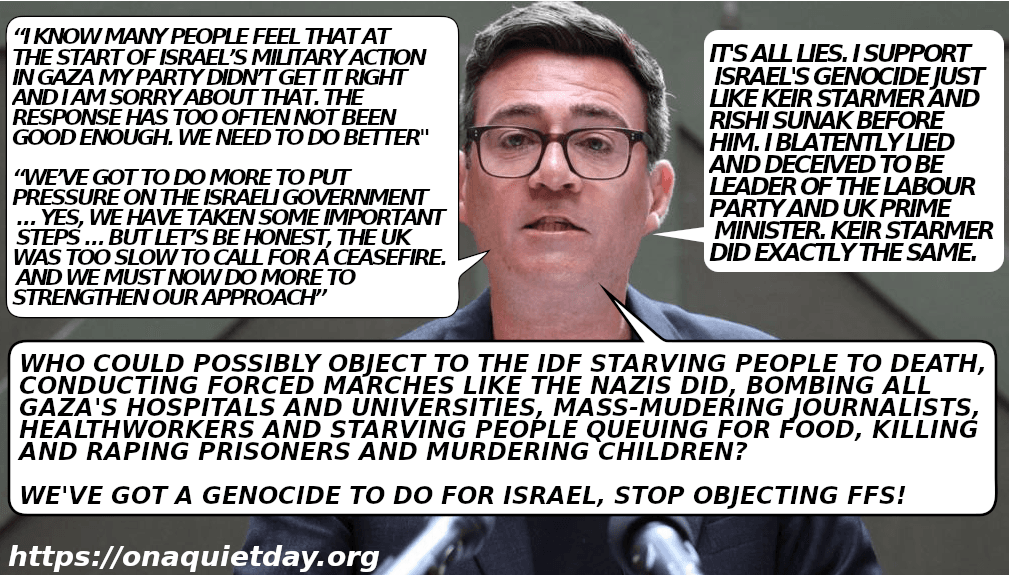
UK Prime Minister Andy Burnham admits to blatently lying and engaging in deception to become leader of the UK Labour Party and Prime Minister. He asks who could possibly object to the IDF starving people to death, conducting forced marches like the Nazis did, bombing all Gaza’s hospitals and universities, mass-murdering journalists, healthworkers and starving people queuing for food, killing and raping prisoners and murdering children. He says they’ve got a genocide to do for Israel and to stop objecting.Ed Miliband says that he and the Labour Party are full of shit criminalising people holding signs as terrorists despite anything he says.