UNRWA Says 6 Workers Among at Least 18 Killed in Israeli Strikes on Gaza School

Spread the love

Original article by Brett Wilkins republished from Common Dreams under Creative Commons (CC BY-NC-ND 3.0). 

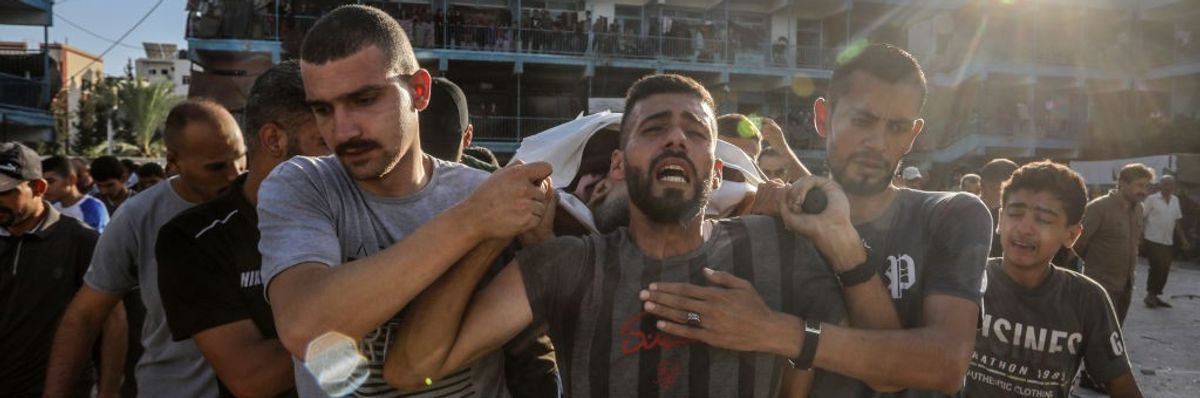
Mourning Palestinian men carry the body of UNRWA staffer Yaser Abu Sharar after he was killed in an Israeli strike on the Nuseirat Refugee Camp in Deir al-Balah, Gaza on September 11, 2024. (Photo: Abed Rahim Khatib/Anadolu via Getty Images)

“This school has been hit five times since the war began. It is home to around 12,000 displaced people, mainly women and children. No one is safe in Gaza. No one is spared.”

The United Nations relief agency for Palestine said Wednesday that six of its workers are among the at least 18 people killed in a pair of Israeli airstrikes targeting a U.N. school in the Gaza Strip where thousands of forcibly displaced Palestinians were sheltering.

The United Nations Relief and Works Agency for Palestine Refugees in the Near East (UNRWA) said the Israeli strikes on one of its schools, located in Nuseirat in central Gaza, resulted in “the highest death toll among our staff in a single incident” since Israeli forces began bombarding the strip following last October’s Hamas-led attack on Israel.

“Among those killed was the manager of the UNRWA shelter and other team members providing assistance to displaced people,” the agency said. “Sincere condolences to their families and loved ones. This school has been hit five times since the war began. It is home to around 12,000 displaced people, mainly women and children.”

Victims of the strikes included women and children.

Earlier on Wednesday the United Nations said the school had been “previously deconflicted with the Israeli forces.”

“No one is safe in Gaza. No one is spared,” UNRWA stressed. “Schools and other civilian infrastructure must be protected at all times, they are not a target.”

Responding to the attacks, U.N. Secretary-General António Guterres said on social media that “these dramatic violations of international humanitarian law need to stop now.”

Israel is currently on trial for genocide at the International Court of Justice, a U.N. body. International Criminal Court Prosecutor Karim Khan is also seeking arrest warrants for Israeli Prime Minister Benjamin Netanyahu, Israeli Defense Minister Yoav Gallant, and three Hamas leaders—at least one of whom, Ismail Haniyeh, has been assassinated.

Over the past 341 days, Israel’s assault on Gaza has left more than 145,000 Palestinians dead, maimed, or missing, according to Palestinian and international officials. Nearly all of Gaza’s 2.3 million people have been forcibly displaced, while Israel’s “complete siege” of Gaza has starved and sickened millions of Palestinians, dozens of whom have died of malnutrition, dehydration, and lack of medical care.

UNRWA says around 200 of its staff members have been killed in more than 450 Israeli attacks on agency facilities since October. More than 500 Palestinians have been killed while seeking shelter under the U.N. flag.

Responding to Israeli claims—reportedly extracted from Palestinian prisoners in an interrogation regime rife with torture and abuse—that a dozen of the more than 13,000 UNRWA workers in Gaza were involved in the October 7 attack, numerous nations including the United States cut off funding to the agency. Almost all of them have restored funding as Israeli lies have been debunked.

Bucking this trend, U.S. President Joe Biden in March signed a bill prohibiting American funding for UNRWA.

Original article by Brett Wilkins republished from Common Dreams under Creative Commons (CC BY-NC-ND 3.0). 

Continue ReadingUNRWA Says 6 Workers Among at Least 18 Killed in Israeli Strikes on Gaza School

UN Chief Says Rich Countries ‘Signing Away Our Future’ With Fossil Fuel Development

Spread the love

Original article by EDWARD CARVER republished from Common Dreams under Creative Commons (CC BY-NC-ND 3.0).

United Nations Secretary-General Antonio Guterres delivers a special address on climate action in New York in June 2024. (Photo: Fatih Aktas/Anadolu via Getty Images)

“I must call out the flood of fossil fuel expansion we are seeing in some of the world’s wealthiest countries,” U.N. Secretary-General António Guterres said. “Countries must phaseout fossil fuels—fast and fairly.”

United Nations Secretary-General António Guterres on Thursday criticized the world’s wealthiest countries for expanding fossil fuel production, one day after an analysis in The Guardian showed that five Western countries are leading a global surge in oil and gas development.

Guterres’ remarks came as part of a “call to action” on extreme heat at a press conference in New York, after record-setting world temperatures earlier in the week and a series of deadly heatwaves across the world this year.

Guterres, who has long been outspoken on the need for climate action, called extreme heat one of the “symptoms” of a “disease” that is the “addiction” to fossil fuels.

“I must call out the flood of fossil fuel expansion we are seeing in some of the world’s wealthiest countries,” he said nine minutes and 53 seconds into his remarks. “In signing such a surge of new oil and gas licenses, they are signing away our future. The leadership of those with the greatest capabilities and capacities is essential. Countries must phaseout fossil fuels—fast and fairly.”

The U.N. chief’s comments may have been based on Wednesday’s findings that five Western countries—the United States, the United Kingdom, Canada, Australia, and Norway—have significantly scaled up oil and gas licensing this year, despite their international climate commitments. The findings came from an analysis of industry data conducted by the International Institute for Sustainable Development and published in The Guardian.

The analysis found that the five countries together have licensed or plan to license projects in 2024 that will emit 11.9 billion metric tons of greenhouse gas emissions over their lifetimes. The news renewed discussions about whether countries such as the U.S., though they claim to be climate leaders, should be considered “petrostates“—a contemptuous term formerly reserved for countries such as Saudi Arabia and Russia.

Guterres has long been outspoken on the issue of fossil fuels. At the COP28 U.N. climate change summit in Dubai last year, he spoke forcefully about the need for phasing them out and meeting the 1.5°C target set in the Paris agreement.

“The 1.5°C limit is only possible if we ultimately stop burning all fossil fuels,” he said. “Not reduce. Not abate. Phase out—with a clear timeframe aligned with 1.5°C.”

The loophole-ridden deal that emerged from Dubai didn’t match Guterres’ ambitions, but did call for “transitioning away from fossil fuels.”

His call to action on Thursday included a four-part plan for dealing with extreme heat: caring for the most vulnerable, protecting workers, boosting resilience, and limiting further temperature rise by phasing out fossil fuels and scaling up renewables.

Guterres warned that 70% of the global workforce—over 2.4 billion people—is at substantial risk of experiencing extreme heat, and the situation is especially dire for workers in Africa and the Middle East. He called for strong laws to protect workers, which some countries are enacting. The Biden administration recently moved to set the first national workplace heat safety protections in the U.S.

Original article by EDWARD CARVER republished from Common Dreams under Creative Commons (CC BY-NC-ND 3.0).

Continue ReadingUN Chief Says Rich Countries ‘Signing Away Our Future’ With Fossil Fuel Development

Israel’s collective punishment of Palestinians in Gaza not acceptable, says UN Chief

Spread the love

Original article by Abdul Rahman republished from peoples dispatch under a Creative Commons Attribution-ShareAlike 4.0 (CC BY-SA) license.
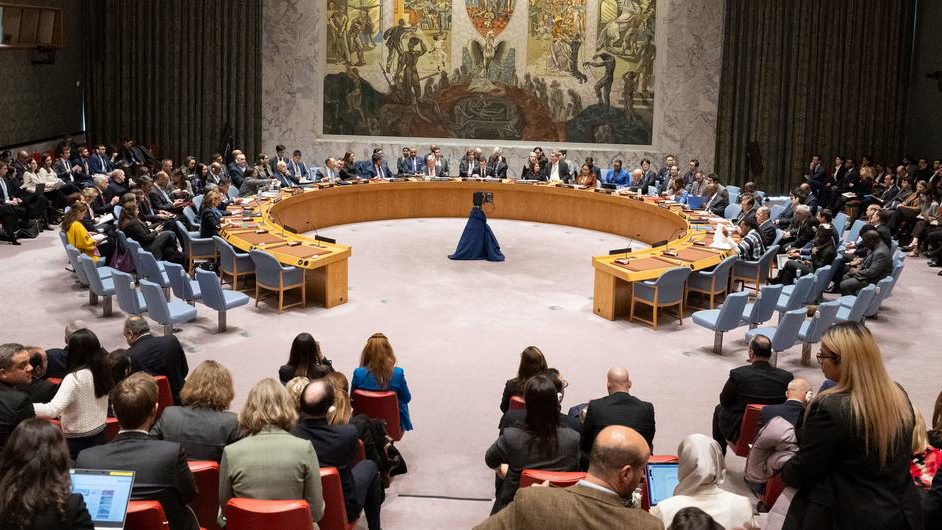
The UN Security Council meets on the situation in the Middle East, including Palestine (Photo via United Nations)

Participants in the UN Security Council highlighted need for a ceasefire in Gaza and a long term solution to the Palestinian question as necessary for peace

On January 23, speaking during the two day extended meeting of the UN Security Council on Palestine, UN Secretary General Antonio Guterres underlined that “Israel’s clear and repeated rejection” of a two-state solution is unacceptable. He also warned that this refusal and “denial of the right to statehood to the Palestinian people would indefinitely prolong a conflict that has become a major threat to global peace and security.”

Most of the countries which participated in the two day proceedings demanded an immediate humanitarian ceasefire and a two-state solution, claiming it necessary for regional and global peace.

Invoking ever deteriorating humanitarian conditions in Gaza, Guterres termed it “collective punishment” executed by Israeli forces, asserting that “nothing can justify it.”

More than 25,700 Palestinians have been killed, over 63,000 have been wounded, and nearly 90% of Gaza’s population has been displaced due to relentless bombings and ground offensives carried out by Israeli armed forces since October 7.

Israel has maintained that its war in Gaza is in response to Palestinian resistance forces, mainly Hamas, attacking inside its borders on October 7, in which nearly 1,200 people were killed and nearly 250 Israelis were taken as hostages.

Speaking in the meeting, Gilad Erdan, the Israeli ambassador to the UN, claimed that until persons involved in the October 7 attacks are handed over and hostages are released, war in Gaza will not end.

Most of the members of the UN Security Council repeated the call for an immediate ceasefire and called for better delivery of humanitarian aid to Gaza.

The Chinese ambassador to the UN, Zhang Jun, also noted that the Israeli leadership’s repeated rejection of a two-state solution is unacceptable, and demanded that it must be rejuvenated by granting Palestinians full membership to the UN.

Israeli Prime Minister Benjamin Netanyahu had, earlier this month, rejected the calls for a Palestinian state, calling it untenable and a threat to Israeli security.

The need for a two-state solution was raised by the Palestinian Foreign Minister Riyad Maliki, who denounced the war in Gaza as Israel’s “premeditated effort to inflict maximum pain on the Palestinian population.”

“No home, hospital, school, mosque, church or UNRWA shelter is safe from Israeli bombardments, 2,000 pound bombs dropped with no care whatsoever for civilian lives,” he noted.

South Africa, which has taken Israel to the International Court of Justice for its genocide of Palestinians, maintained that there cannot be selective implementation of international law and Israel must face consequences for its repeated violations of the same.

US positions provide a carte blanche to Israeli crimes

Speaking during the meeting, the US representative Uzra Zeya claimed the centrality of a two-state solution. She claimed that the US has been making efforts to prevent greater civilian casualties in the Israeli war in Gaza. However, US policies in Gaza were heavily criticized by both the permanent members of the UNSC and others as detrimental to peace.

Chinese ambassador Jun condemned the repeated use of veto by the US in earlier UNSC meetings on ceasefire resolutions, identifying them as impeding all efforts to peace.

The US had vetoed resolutions proposing a ceasefire in the UNSC in previous months and tried to excuse Israeli bombings in Gaza as the Zionist state’s right to self defense.

Jun hoped that all members of the international community must prioritize ceasefire in Gaza, and ways to stop the spread of the war in the region.

Russian Foreign Minister Sergei Lavrov asserted that the UNSC must take steps to prevent further destabilization in the region, which has been caused by US policies which vetoes ceasefire resolutions and provides carte blanche to Israeli acts of “collective punishment of Palestinians.”

Lavrov emphasized that until a ceasefire is implemented the talks about future solutions to the conflict are useless.

Iranian Foreign Minister Hussein Amir Abdollahian warned the US against violating Yemeni sovereignty by carrying out repeated air strikes against it. He alleged that it is a trap laid down by Israel with the objective of expanding the war in Gaza to the regional level.

Abdollahian proposed that a referendum among all Palestinians must be held to find a permanent solution to the Palestinian question.

Lebanese Foreign Minister Abdallah Bou Habib emphasized that all stakeholders, including the US, should see that Israel wants to expand the war across the region, and underlined that his country does not want war.

He emphasized that “what happened on October 7 did not happen in a vacuum” and if no attempts are made to secure a lasting solution “it will happen again,” as there is no peace in the region until there is justice for Palestinians.

Speaking in the meeting on Tuesday, the Saudi delegate Waleed El-Khereiji said that because of the “Israeli war machine,” tensions in the region, including in the Red Sea and Yemen, are increasing. He demanded that the Security Council make sure that Israel stops its violations of international law.

On Sunday, in an interview with CNN, Saudi Foreign Minister Faisal bin Farhad al-Saud denied any possibility of normalization of relations with Israel, as proposed by the US, until there is a road map for a two-state solution and an independent Palestinian state. “What we are seeing is Israelis crushing Gaza, the civilian population of Gaza. This is completely unnecessary, completely unacceptable, and has to stop.”

Original article by Abdul Rahman republished from peoples dispatch under a Creative Commons Attribution-ShareAlike 4.0 (CC BY-SA) license.

Continue ReadingIsrael’s collective punishment of Palestinians in Gaza not acceptable, says UN Chief

Genocide in Gaza Would Not Be Possible Without Western Complicity

Spread the love

Original article by RAMZY BAROUD republished from Common Dreams under Creative Commons (CC BY-NC-ND 3.0). 

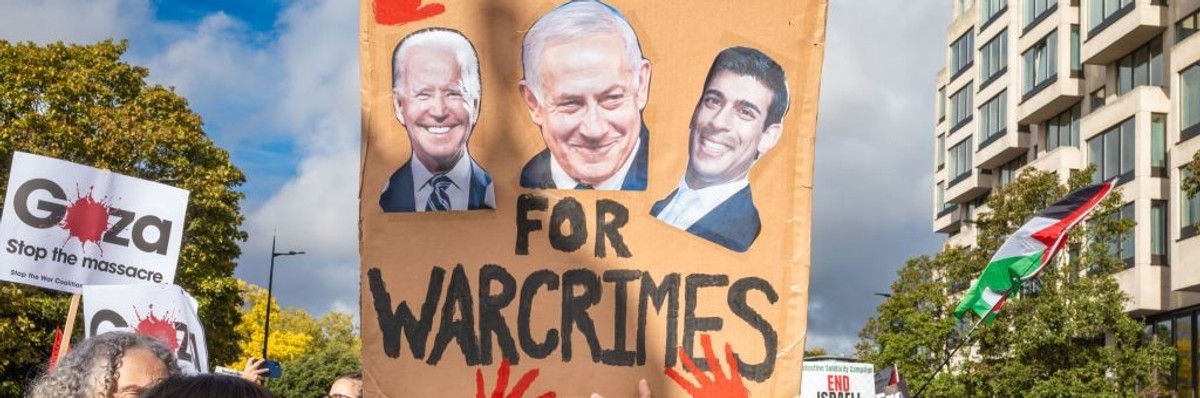
A pro-Palestinian protester holds a placard accusing Biden, Sunak and Netanyahu of war crimes at a demonstration against Israeli attacks on Gaza in central London, UK.  (Photo by: Andy Soloman/UCG/Universal Images Group via Getty Images)

The word ‘hypocrisy’ here does not even begin to describe what is taking place, and the repercussions of this moral failure will be felt around the world for years to come.

On October 20, Secretary-General of the United Nations, Antonio Guterres, stood on the Egyptian side of the Rafah crossing, between Egypt and besieged Gaza.

Guterres was not the only international figure to travel to the Gaza border, hoping to mobilize the international community in the face of an ongoing genocide, in an already impoverished and besieged Strip.

“Behind these walls, we have two million people that is suffering (sic) enormously,” Guterres said.

These efforts, however, paid little dividends.

The spokesperson for the Ministry of Health in Gaza, Ashraf al-Qudra, said in a statement on October 24, that the flow of humanitarian aid into Gaza is “too slow (for it to) change the reality” on the ground.

Never again should the West be allowed to play the role of the mediator, the impartial politician, the judge, or even the self-serving humanitarian.

This means that the seemingly endless UN Security Council debates, General Assembly resolutions and calls for action did little to alter the tragic situation in Gaza in any meaningful way.

This begs the question, what is the use of the elaborate international political, humanitarian and legal systems, if they are unable to stop, or even slow down a genocide that is being aired live on TV screens all across the world?

In previous genocides, whether those accompanying the Great Wars or that of Rwanda in 1994, various justifications were offered to explain the lack of immediate actions. In some cases, no Geneva Conventions existed and, as in Rwanda, many pleaded ignorance.

But, in Gaza, no excuse is acceptable. Every international news company has correspondents or some presence in the Strip. Hundreds of journalists, reporters, bloggers, photographers and cameramen are documenting and counting every event, every massacre and every bomb dropped on civilian homes. It is important here to note that scores of journalists have already been killed in Israeli attacks.

Scientific approximations are telling us, for example, that nearly 25,000 tons of explosives have been dropped on Gaza by Israel in the first 27 days of war. It is equivalent to two atomic bombs, like those dropped by the US on Hiroshima and Nagasaki in 1945.

When US President Joe Biden callously tried to question the numbers of the Palestinian dead, the Gaza medical staff, who are forced to perform life-saving surgeries on the dirty grounds of hospitals, took the time to prove him wrong. On October 26, they produced a list containing the names of 6,747 Palestinian casualties who were killed in the first 19 days of war.

Thousands have been killed and wounded since then, yet Washington and its Western allies insist that “Israel has the right to defend itself” even if this comes at the expense of a whole nation.

The Israelis are not masking their language in any way. The New York Times reported on October 30 that “in private conversations with American counterparts, Israeli officials referred to how the United States and other allied powers resorted to devastating bombings in Germany and Japan during World War II … to try to defeat those countries.” A few days later, Israeli Minister Amichai … has openly declared that nuking Gaza is an option in his country’s genocidal war on the Palestinian people.

On the day the NYT report appeared, Karim Khan, the Prosecutor of the International Criminal Court (ICC), arrived at the Egyptian side of the Rafah border.

He still used the same guarded language, as if not to offend the sensibilities of Israel and its Western allies. “Crimes allegedly committed in both places have to be looked into,” he said, referring to both Israel and Gaza.

One could excuse Khan by arguing that legal jargon must be restrained until a thorough investigation is conducted. But thorough investigations are rarely conducted when it comes to Israeli crimes in Gaza or anywhere else in Palestine.

When an investigation is carried out, international judges frequently find themselves accused by the US and Israel of bias or worse, anti-Semitism. In the case of the investigation spearheaded by a respected South African judge, Richard Goldstone in 2009, the man was forced to retract part of his report.

Khan knows this too well because he is currently sitting on a large and growing file of Israeli war crimes in Palestine, insisting on delaying the procedure under various excuses. Obviously, the US does not favorably view ICC judges who advance war crime cases against Israel. The anti-ICC sanctions imposed by the Trump Administration in 2020 are an example.

Many officials in Western institutions are becoming aware of this hypocrisy. On October 28, Craig Mokhiber resigned from his position as the Director of the New York office of the UN’s High Commissioner for Human Rights in protest of the UN’s failure to stop “a genocide unfolding before our eyes in Gaza.”

On October 20, around 850 members of the EU staff signed a letter to EU Commission President, Ursula von der Leyen, criticizing her “unconditional support” for Israel.

The letter was polite and diplomatic, considering the horrendous moral failure of Von der Leyen, especially when her gung-ho approach to the Russian war in Ukraine is compared to her blind support of Israeli crimes in Gaza. “Only if we acknowledge Israel’s pain, and its right to defend itself, will we have the credibility to say that Israel should react … in line with international humanitarian law,” she said.

The International Olympic Committee, which insists on separating between politics and sports, has no problem meddling in politics when the enemy is a Palestinian.

The IOC issued a statement on November 1, warning any participant in the Paris Olympics, scheduled for 2024, from engaging in any “discriminatory behavior” against Israeli athletes, because “athletes cannot be held responsible for the actions of their governments.”

The word ‘hypocrisy’ here does not even begin to describe what is taking place, and the repercussions of this moral failure will be felt around the world for years to come. Never again should the West be allowed to play the role of the mediator, the impartial politician, the judge, or even the self-serving humanitarian.

This is not a difficult conclusion to reach. Gaza has been turned into a Hiroshima as a result of Western bombs and the blank political check handed to Israel by Western governments and leaders from the onset of the war, in fact, 75 years prior.

Nothing will ever alter this fact, and no ‘strongly worded’ future statements will ever help the West redeem its collective moral failure.

Original article by RAMZY BAROUD republished from Common Dreams under Creative Commons (CC BY-NC-ND 3.0). 

Continue ReadingGenocide in Gaza Would Not Be Possible Without Western Complicity

‘Gates of Hell’ Must Be Closed With Ambitious Action on Fossil Fuels, Says UN Chief

Spread the love
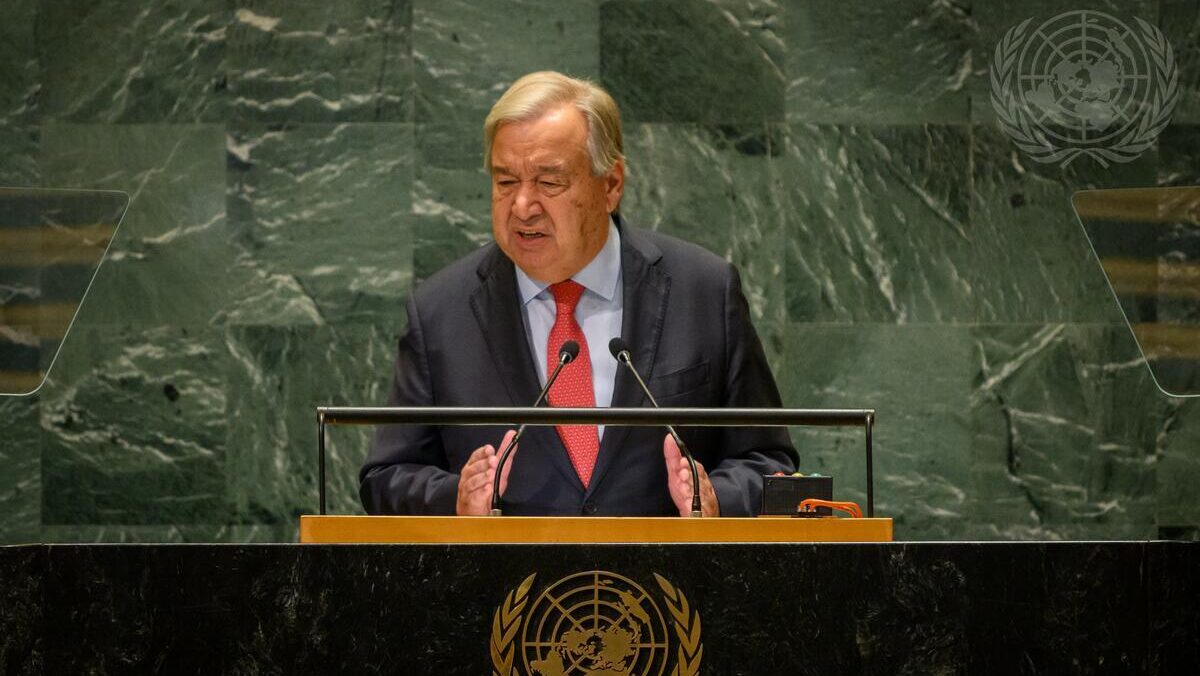
Image of UN chief Antonio Guterres
UN chief Antonio Guterres

Original article by Jessica Corbett republished from Common Dreams under Creative Commons (CC BY-NC-ND 3.0). 

“We must make up time lost to foot-dragging, arm-twisting, and the naked greed of entrenched interests raking in billions from fossil fuels.” [FFS]

United Nations Secretary-General António Guterres kicked off his one-day Climate Ambition Summit at U.N. headquarters in New York City on Wednesday with a simple, clear, and resounding message for world leaders: do more.

“Humanity has opened the gates of hell” by unleashing potent levels of greenhouse gas emissions into the environment since the Industrial Revolution, Guterres told the the audience, which notably did not include some leaders of top polluting nations—such as U.S. President Joe Biden, U.K. Prime Minister Rishi Sunak, and Chinese President Xi Jinping—who refused to attend the event.

“Horrendous heat is having horrendous effects,” Guterres said, echoing his Tuesday speech at the U.N. General Assembly. “Distraught farmers watching crops carried away by floods; sweltering temperatures spawning disease; and thousands fleeing in fear as historic fires rage.”

“Climate action is dwarfed by the scale of the challenge,” he continued. Absent dramatic reforms, humanity is heading toward “a dangerous and unstable world,” with the global temperature set to soar 2.8°C above preindustrial levels. Already, human activity—especially the burning of fossil fuels—has driven heated the planet by about 1.2°C.

“The future of humanity is in your hands—in our hands.”

Under the 2015 Paris climate agreement, nearly every nation on Earth has agreed to work on keeping global temperature rise this century below 2°C, with a target limit of 1.5°C. However, as scientific analyses have repeatedly found over the past eight years, parties to the deal are still way off track.

Current projections are alarming, “but the future is not fixed,” Guterres said, emphasizing that the 1.5°C goal is still in reach. “We can still build a world of clear air, green jobs, and affordable, clean power for all.”

“The path forward is clear,” he declared. “It has been forged by fighters and trailblazers—some of whom are with us today: Activists refusing to be silenced; Indigenous peoples defending their lands from climate extremes; chief executives transforming their business models and financiers funding a just transition; mayors moving towards to a zero-carbon future; and governments working to stamp out fossil fuels and protect vulnerable communities.”

Warning that the global community is decades behind where it should be in the shift to renewables, the U.N. chief charged that “we must make up time lost to foot-dragging, arm-twisting, and the naked greed of entrenched interests raking in billions from fossil fuels.”

Guterres renewed his call for developed countries to reach net-zero as close as possible to 2040, emerging economies to achieve that as close as possible to 2050, and all nations “to implement a fair, equitable, and just energy transition, while providing affordable electricity to all.”

“Many of the poorest nations have every right to be angry—angry that they are suffering most from a climate crisis they did nothing to create; angry that promised finance has not materialized; and angry that their borrowing costs are sky-high,” he noted. “We need a transformation to rebuild trust.”

Shifting from English to French—another official language of the U.N.—Guterres urged governments to push the global financial system toward supporting climate action, including by overhauling the business models of multilateral development banks to better help developing countries.

He also called for operationalizing the Loss and Damage Fund at COP28, the next U.N. climate summit for Paris agreement parties, hosted in November by the United Arab Emirates—which is under fire for appointing an oil executive as the conference president.

“The future of humanity is in your hands—in our hands,” added Guterres, who was forced to leave early on Wednesday for a U.N. Security Council meeting that was scheduled after he announced the climate event. “One summit will not change the world. But today can be a powerful moment to generate momentum, that we build on over the coming months, and in particular at the COP.”

“We can—and we must—turn up the tempo,” he concluded. “Turn plans into action. And turn the tide.”

Original article by Jessica Corbett republished from Common Dreams under Creative Commons (CC BY-NC-ND 3.0). 

Continue Reading‘Gates of Hell’ Must Be Closed With Ambitious Action on Fossil Fuels, Says UN Chief