Youth Demand protest on Labour’s campaign bus, Wrexham 15 Jun 2024.
Three Youth Demand supporters have disrupted Keir Starmer’s election battle bus. They are demanding a two-way arms embargo on Israel and for the incoming UK government to halt all new oil and gas licences granted since 2021.
At around 9:15am the group climbed onto the battle bus as it was parked up for Labour’s campaign rally in Wrexham. The group stood on the roof of the bus holding Palastinian flags and a banner reading ‘Youth Demand an End to Genocide’. They could be heard chanting “Keir Starmer you can’t hide, we charge you with genocide!”.
One of those taking action this morning is Jazz, 22, a support worker from Manchester who said:
“I cannot remain silent whilst our government continues to fuel genocide in Palestine and with the climate crisis. Both the Tories and Labour have shown that they don’t give a shit about those suffering in Palestine and in the global south. Their lack of humanity is disgusting.
By voting Labour you are still voting for a party that refuses to stop buying and selling weapons with Israel. We refuse to inherit a world of suffering, Labour will not get away with their inhumanity. We cannot vote our way out of this – we must act!”
Also taking action is Chester Powell, 23, a student from Leeds, who said:
The Labour Party refuses to call for an end to the buying and selling of arms with Israel, arms that are being used to enact a genocide. We can’t vote our way out of this problem so I’m taking part in civil disobedience to force necessary change.
How can I have a hope for the future when the people in power only seem to be concerned with winning the next election. I can’t have hope that either of the major parties have any interest representing ordinary people over big business. Neither seems to show any empathy for the Palestinians as they are slaughtered in the thousands, so young people like myself must show them what having a spine looks like.”
Kemi Badenoch and Nir Barkat. (Photo: Department for Business / Flickr)
Britain’s business secretary wants to strike a new trade deal with Israel amid its brutal onslaught on Gaza.
Badenoch is negotiating with an Israeli minister who threatens to “wipe out” its enemies
UK-Israel trade talks took place a week after the IDF killed three British aid workers
She decided to continue arms exports to Israel at the same time
The UK government, led by business secretary Kemi Badenoch, has been trying to finalise a new trade agreement with Israel throughout its invasion of Gaza.
The latest – and fifth – round of negotiations between officials of the two countries began on 8 April.
That was just seven days after three British aid workers were killed by the Israel Defense Forces (IDF) in Gaza.
The talks on a free trade agreement (FTA) continued even as UN agencies reported over 33,000 Palestinians had been killed by Israel and the Israeli government announced a date had been set for invading Rafah.
These negotiations were hosted by the UK, with a delegation of Israeli officials travelling to London for in-person discussions.
“An upgraded trade deal will play to British strengths and unlock trade for our world-leading services and digital sectors”, the UK’s Department for Business and Trade noted.
The negotiations are another aspect of Britain’s complicity in genocide, adding to its military and diplomatic support for Israel as it engages in mass attacks on civilians and civilian infrastructure in Gaza.
On the same day the trade talks began in April, Badenoch also authorised continued British arms exports to Israel.
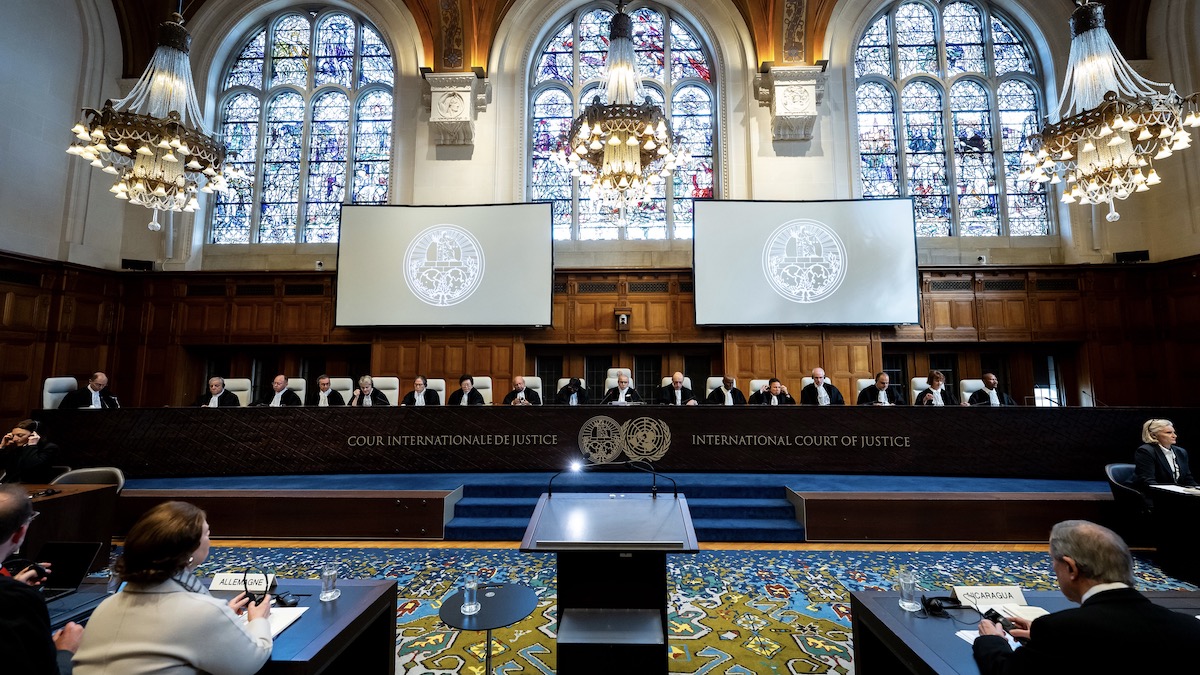
Public ICJ hearing on Nicaragua’s case against Germany. Photo: ICJ
The German MP writes that the response of Germany to Nicaragua’s charges of aiding and abetting genocide in Gaza has been to downplay its role in supplying arms and question the premise that genocide is already taking place
The German government’s appearance before the International Court of Justice in the proceedings for aiding and abetting genocide and violations of international humanitarian law in Gaza is a lesson in Western double standards. On April 8 and 9, Germany sat in the dock in The Hague after Nicaragua filed a case at the highest UN judicial body.
The 43-page document accuses Germany of failing to fulfill its obligations under the Genocide Convention to prevent genocide. Essentially, Germany is accused of aiding and abetting genocide and violating international humanitarian law with its political, financial, and military support for Israel as well as by ceasing to fund the United Nations Relief and Works Agency for Palestine Refugees (UNRWA). In view of the urgency of the situation, Nicaragua requested five interim measures to prevent the facilitation of genocide. These include the demand that Germany stop supplying arms to Israel and resume payments to UNRWA to ensure sufficient humanitarian aid for the Palestinian population.
Does arming a state committing genocide make you an accomplice?
The arguments put forward by the German government in its defense were unconvincing. With a flood of PowerPoint slides, the German representation initially tried to play down the significance of Germany’s arms deliveries to Israel. It argued that the majority of the arms export licenses issued after October 7 were for so-called “other military equipment” (“sonstige Rüstungsgüter”) and only a relatively small proportion for so-called “weapons of war” (“Kriegswaffen”). This was an attempt to deceive the court and the public. For what the German defense failed to mention was the fact that this invented distinction between “other military equipment” and “weapons of war” is a specific feature of German arms export control. Contrary to what the terminology suggests, the category of “other military equipment” can also include weapons that can be used for warfare.
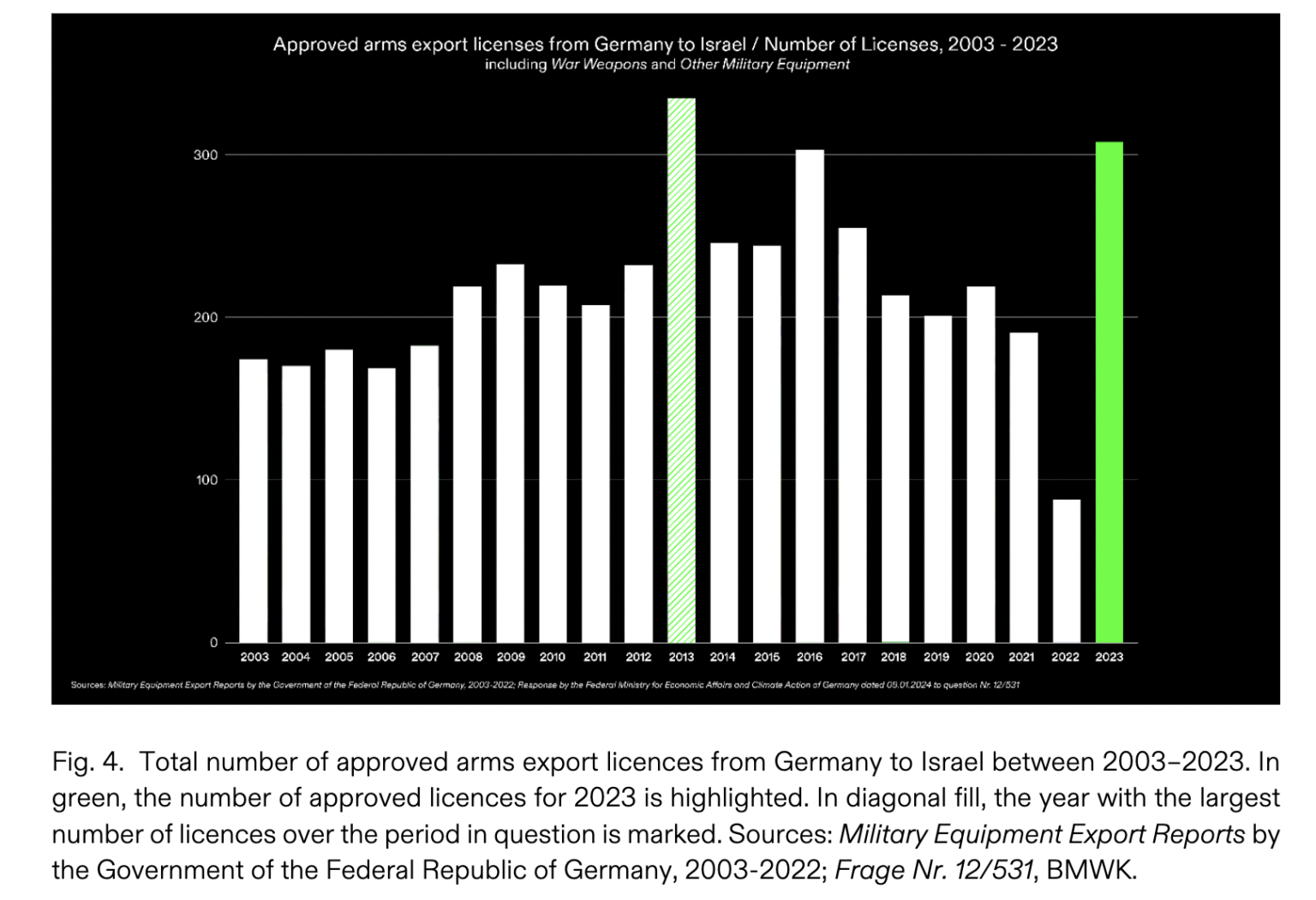
Germany is Israel’s second largest arms supplier after the USA. According to data from the Stockholm International Peace Research Institute (SIPRI), German weapons have accounted for 30% of Israeli arms imports in the last five years. Licenses for new arms exports also increased in 2023. In total, the German government approved the export of weapons to Israel worth EUR 326.5 million – a tenfold increase compared to the previous year. These licenses, most of which were issued after October 7, 2023, include war weapons worth 20 million euros. While the German government tried to justify the approval of 500,000 rounds of ammunition for machine guns with the difficult-to-verify claim that they had been supplied for training purposes, it could not deny the possible use of the approved 3,000 portable anti-tank weapons in war.
Instead, the German government attempted to justify this by arguing that these and the majority of other export licenses had been issued in October 2023, before the war and the humanitarian catastrophe in Gaza had come to a head. This argument ignores the fact that it must have been clear to the world public – and therefore also to the German government – just a few days after October 7 that the partially far-right Israeli government under Prime Minister Netanyahu would use the horrific attack by Hamas as an opportunity to wage a ruthless war against the Palestinian civilian population, committing numerous war crimes that go far beyond any right to self-defense.
It’s not genocide, yet
It was striking that the German government did not even attempt to dispute Nicaragua’s presentation of facts about the extensive violations of international humanitarian law by Israel. Apparently, it also realized that the terrible humanitarian catastrophe caused by Israel’s war, which has killed more than 33,000 people, including more than 13,000 children, can hardly be denied.
The German defense therefore focused on the formalistic argument that the existence of genocide had not yet been established and that Germany could therefore not be found guilty of aiding and abetting genocide. In doing so, however, the German government fails to recognize the central obligation under international law that arises from the Genocide Convention – namely to prevent genocide. This is all the more significant as the ICJ issued protection orders in the case of South Africa against Israel in order to prevent the danger of genocide, which the court considered plausible. Even Israel’s blatant disregard of these orders to protect the Palestinian civilian population has not led to the German government abandoning its unconditional support for Israel.
This shows the absurdity and hypocrisy of the actions of the German government as well as the governments of numerous other NATO states: On the one hand, they ignore all the findings of the most important bodies of the United Nations about Israel’s most serious war crimes and the danger of genocide and, regardless of this, continue to provide unconditional support for Israel’s war. On the other hand, the German government and other Western donor states decided to stop funding UNRWA solely on the basis of unverifiable insinuations by the Israeli government about the alleged involvement of individual UNRWA employees in the Hamas attack on October 7, 2023. The requirements for subjecting 2.2 million people in the Gaza Strip, who depend on UNRWA aid for their daily survival, to collective punishment are apparently lower than for stopping the supply of weapons that could be used to commit genocide. This can hardly be surpassed in terms of cynicism.
Against this backdrop, the German government’s attempt to defend itself before the ICJ by claiming that it had warned Israel of a military offensive on Rafah is hardly credible. In this sense, the German Foreign Minister Annalena Baerbock boasted to the German Parliament just a few days ago that she had already traveled to the region seven times and called on the Israeli government to respect the humanitarian needs of the Palestinian civilian population.
I asked the Federal Foreign Minister in the plenary session of the German Bundestag whether the Federal Government would consequently now declare a ceasefire on Israel, as the UN Human Rights Council recently called for in a resolution, due to Israel’s blatant disregard for these calls and in view of the announcement of a ground offensive in Rafah and the bloodbath to be expected as a result. The German government representative’s verbose answer can be summarized in one word: No.
Like the Foreign Minister, the German legal representation in The Hague gave the impression that the German raison d’état of unconditionally defending Israel was above international law. Threats from Berlin against the most important judicial body of the United Nations that it would no longer be credible if it ruled against Germany fit into this picture. If the German government only accepts international law when it appears to be advantageous for its own government action, it has finally reached the level of the leading NATO member, the US, which has long understood international law only as an instrument of interest-driven politics.
Regardless of how the court decides, Germany and the West must finally fulfill their obligation to prevent genocide and war crimes in order to lend weight to the demand for an immediate ceasefire in Gaza. The consequences of Western double standards, which seem to have reached a temporary climax in the Gaza war, are fatal. Not only does it lead to the West losing its last remnants of credibility in the eyes of the world. Above all, it promotes the erosion of international law, diplomacy and the United Nations as civilizational achievements for the protection of human life and the preservation of peace.
Sevim Dağdelen is a member of the German Bundestag and foreign policy spokesperson for the group “Alliance Sahra Wagenknecht”. She was the only parliamentary observer at the hearings in Nicaragua’s lawsuit against Germany before the ICJ.
The Green Party has repeated its call for a full bilateral ceasefire, the release of all hostages, the suspension of arms exports to Israel, and for key players in the Netanyahu government to be held accountable for possible war crimes, six months on from the 7 October attacks by Hamas.
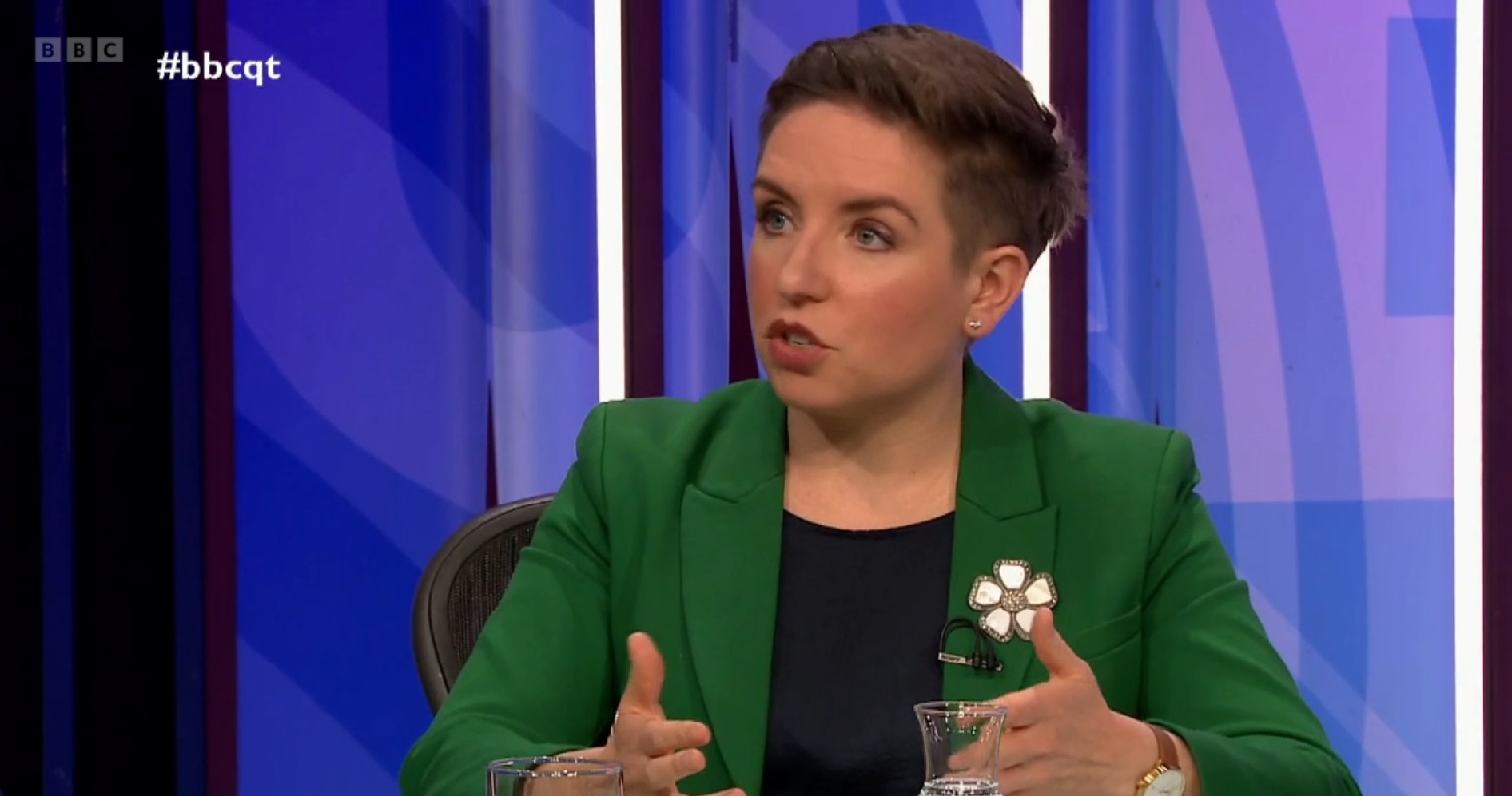
Image of the Green Party’s Carla Denyer on BBC Question Time.
Co-leader of the Green Party, Carla Denyer, said:
“This isn’t just a far away conflict that we have nothing to do with. By consistently refusing to call for a ceasefire and continuing to supply arms, the UK Government has been complicit in the deadly assault on Gaza by the Israel Defence Forces.
“Six months on from the horrific Hamas attacks on Israeli citizens, it is clear that the Netanyahu government’s response has been totally disproportionate. Over 33,000 innocent Palestinian civilians have now been killed, the majority of them women and children. This is not an act of self defence. As the UN’s Human Rights Council has resolved, the actions by the Israeli government are possible war crimes and crimes against humanity. Indeed, the UK Government itself has reportedly concluded secretly that Israel is breaking international humanitarian law.
“It is time for our Government to end their complicity and start leading efforts towards peace. They must finally call for a ceasefire, immediately suspend arms exports to Israel and back the UN Human Rights Council’s call for accountability for all violations of international humanitarian law and international human rights law.”
In the six months since October 7th, the Green Party of England and Wales has called for:
A full bilateral ceasefire
The release of all hostages
A suspension of all arms export licences to Israel until the violence stops
The cessation of all military collaboration with Israel, including use of British bases by Israeli forces, and intelligence sharing
Targeted Boycott, Divestment and Sanctions against individuals and institutions supporting or facilitating Israel’s occupation of Palestine
An investigation by the Metropolitan Police and Director of Public Prosecutions of war crimes committed against UK citizens, or where UK citizens are potential perpetrators
The UK government to use its position as a permanent member of the UN Security Council to vote for, rather than abstain on, ceasefire votes
Targeted sanctions against key individuals in the Israeli leadership, including travel bans and asset freezes on Israel’s government ministers
An end to occupation of the Palestinian territories
The UK government to return to international law being the benchmark for UK policy, and repair the UK’s international reputation as a defender of the international rules-based order.
The editorial boards of the nation’s major media organizations must have been frantic last week.
Used to reporting on US foreign policy, wars and arms exports so as to portray the United States as a benevolent, law-abiding and democracy-defending nation, they were confronted on March 25 with a real challenge dealing with Israel and Gaza. No sooner did the Biden administration, for the first time, abstain and thus allow passage of a United Nations Security Council resolution that was not just critical of Israel, but demanded a ceasefire in Gaza, than US officials began declaring that the resolution that they allowed to pass was really meaningless.
It was “nonbinding,” they said.
The New York Times (3/25/24) reported that US’s UN Ambassdor “Thomas-Greenfield called the resolution ‘nonbinding’”—and let no one contradict her.
That was enough for the New York Times (3/25/24), which produced the most one-sided report on the decision. That article focused initially on how Resolution 2728 (which followed three resolutions that the US had vetoed, and a fourth that was so watered down that China and Russia vetoed it instead) had led to a diplomatic dust-up with the Israeli government: Prime Minister Benjamin Netanyahu canceled a planned visit to Washington by a high-level Israeli delegation to discuss Israel’s planned invasion of Rafah and the future of Gaza and the West Bank.
The Times quoted Richard Gowan, a UN expert at the International Crisis Group: “The abstention is a not-too-coded hint to Netanyahu to rein in operations, above all over Rafah.”
Noting that “Security Council resolutions are considered to be international law,” Times reporters Farnaz Fassihi, Aaron Boxerman and Thomas Fuller wrote, “While the Council has no means of enforcing the resolution, it could impose punitive measures, such as sanctions, on Israel, so long as member states agreed.”
This was nevertheless followed by a quote from Washington’s UN Ambassador Linda Thomas-Greenfield, who abstained from the otherwise unanimous 14–0 vote of the rest of the Security Council, characterizing the resolution as “nonbinding.”
The Times offered no comment from any international law scholars, foreign or US, to rebut or even discuss that claim. Such an expert might have pointed to the unequivocal language of Article 25 of the UN Charter: “The members of the United Nations agree to accept and carry out the decisions of the Security Council in accordance with the present Charter.”
If the US offered its claim that this language only applies to resolutions explicitly referencing the UN Charter’s Chapter VII, dealing with “threats to the peace,” an international law expert (EJIL: Talk!, 1/9/17) might note that the International Court of Justice stated in 1971, “It is not possible to find in the Charter any support for this view.”
‘Creates obligations’
The Washington Post (3/26/24) quoted an international law expert to note that the resolution “creates obligations for Israel and Hamas.”
The Washington Post (3/26/24), though like the Times a firm defender of Washington’s foreign policy consensus, did marginally better. While the Times didn’t mention Britain or France, both major US NATO allies, in its piece on the Security Council vote, the Post noted that the four other veto powers—Britain and France, as well as China and Russia—had all voted in favor of the resolution, along with all 10 elected temporary members of the Council.
The Post also cited one international law legal expert, Donald Rothwell, of the Australian National University, who said the “even-handed” resolution “creates obligations for Israel and Hamas.”
While that quote sounds like the resolution is binding, the Post went on to cite Gowan as saying, “I think it’s pretty clear that if Israel does not comply with the resolution, the Biden administration is not going to allow the Security Council members to impose sanctions or other penalties on Israel.”
The Post (3/25/24) actually ran a stronger, more straightforward piece a day earlier, when it covered the initial vote using an AP story. AP did a fairer job discussing the fraught issue of whether or not the resolution was binding on the warring parties, Israel and Hamas (as well as the nations arming them).
That earlier AP piece, by journalist Edith M. Lederer, quoted US National Security spokesperson John Kirby as explaining that they decided not to veto the resolution because it “does fairly reflect our view that a ceasefire and the release of hostages come together.”
Because of the cutbacks to in-house reporting on national and international news in most of the nation’s major news organizations, most Americans who get their news from television and their local papers end up getting dispatches—often edited for space—from the New York Times, Washington Post or AP wire stories. (The Wall Street Journal, for example, ran the same AP report as the Post.)
‘A demand is a decision’
CNN (3/27/24) quoted US officials claiming the resolution was nonbinding—and noted that “international legal scholars” disagree.
In TV news, CNN (3/27/24) had some of the strongest reporting on the debate over whether the resolution was binding. The news channel said straight out, “While the UN says the latest resolution is nonbinding, experts differ on whether that is the case.”
It went on to say:
After the resolution passed, US officials went to great lengths to say that the resolution isn’t binding. State Department spokesperson Matthew Miller repeatedly said during a news conference that the resolution is nonbinding, before conceding that the technical details of are for international lawyers to determine. Similarly, White House National Security Council spokesman John Kirby and US ambassador to the UN Linda Thomas-Greenfield separately insisted that the resolution is nonbinding.
Those US positions were challenged by China’s UN Ambassador Zhang Jun, who “countered that such resolutions are indeed binding,” and by UN spokesperson Farhan Haq, who said Security Council resolutions are international law, and “so to that extent they are as binding as international law is.”
CNN quoted Maya Ungar, another International Crisis Group analyst:
The US—ascribing to a legal tradition that takes a narrower interpretation—argues that without the use of the word “decides” or evocation of Chapter VII within the text, the resolution is nonbinding…. Other member states and international legal scholars are arguing that there is legal precedence to the idea that a demand is implicitly a decision of the Council.
‘A rhetorical feint’
According to the Guardian (3/26/24), the US’s “nonbinding” interpretation “put the US at odds with other member states, international legal scholars and the UN itself.”
To get a sense of how one-sided or at best cautious the US domestic coverage of this critically urgent story is, consider how it was covered in Britain or Spain, two US allies in NATO.
The British Guardian (3/26/24), which also publishes a US edition, ran with the headline: “Biden Administration’s Gaza Strategy Panned as ‘Mess’ Amid Clashing Goals.” The story began:
The Biden administration’s policy on Gaza has been widely criticized as being in disarray as the defense secretary described the situation as a “humanitarian catastrophe” the day after the State Department declared Israel to be in compliance with international humanitarian law.
But the real contrast is with the Spanish newspaper El País (3/29/24), which bluntly headlined its story “US Sparks Controversy at the UN With Claim That Gaza Ceasefire Resolution Is ‘Nonbinding.’” Not mincing words, the reporters wrote:
By abstaining in the vote on the UN Security Council resolution demanding an immediate ceasefire in Gaza, the United States on Monday sparked not only the anger of Israel, which had asked it to veto the text, but also a sweeping legal and diplomatic controversy due to its claims that the resolution—the first to be passed since the start of the Gaza war—was “nonbinding.” For Washington, it was a rhetorical feint aimed at making the public blow to its great ally in the Middle East less obvious.
El País (3/29/24) quoted the relevant language from the UN Charter: “The members of the United Nations agree to accept and carry out the decisions of the Security Council in accordance with the present Charter.”
After quoting Thompson-Greenfield saying it was a “nonbinding resolution,” and Kirby saying dismissively, “There is no impact at all on Israel,” they wrote,
These claims hit the UN Security Council—the highest executive body of the UN in charge of ensuring world peace and security—like a torpedo. Were the Council’s resolutions binding or not? Our was it that some resolutions were binding and others were not?
The reporters answered their own rhetorical question:
Diplomatic representatives and legal experts came out in force to refute Washington’s claim. UN Secretary-General António Guterres made his opinion clear: the resolutions are binding. Indeed, this is stated in Article 25 of the UN Charter: “The members of the United Nations agree to accept and carry out the decisions of the Security Council in accordance with the present Charter.” Several representatives of the Security Council, led by Mozambique and Sierra Leone, pointed to case law to support this argument. The two African diplomats, both with legal training, said that the Gaza ceasefire resolution is binding, regardless of whether one of the five permanent members of the Council abstains from the vote, as was the case of the US. The diplomats highlighted that in 1971, the advisory opinion of the International Court of Justice (ICJ) established that all resolutions of the UN Security Council are legally binding. The Algerian ambassador to the UN summed it up even more categorically: “Security Council resolutions are binding. Not almost, not partly, not maybe.”
Unlike most most US news organizations, El País went to an expert, in this instance seeking out Adil Haque, a professor of international law at Rutgers University, where he is a professor, and also executive editor of the law journal Just Security. Haque, they wrote, “has no doubts that the resolution is binding.” He explains in the article:
According to the UN Charter, all decisions of the Security Council are binding on all member states. The International Court of Justice has ruled that a resolution need not mention Chapter VII of the Charter [action in case of threats to the peace, breaches of the peace or acts of aggression], refer to international peace and security, or use the word “decides” to make it binding. Any resolution that uses “mandatory language” creates obligations, and that includes the term “demands” used in the resolution on Gaza.” He adds, “For now, it does not seem that the US has a coherent legal argument.”
It should be noted that the New York Times, when there is a dispute regarding a document, typically runs a copy of the document in question—or, if it is too long, the relevant portion of it. In the case of Resolution 2728, which even counting its headline only runs 263 words, that would have not been a hard call. Despite the disagreement between the US and most of the Council over the wording of the ceasefire resolution, the Times chose not to run or even excerpt it.