Original article by Ana Vračar republished from peoples dispatch under a Creative Commons Attribution-ShareAlike 4.0 (CC BY-SA) license.
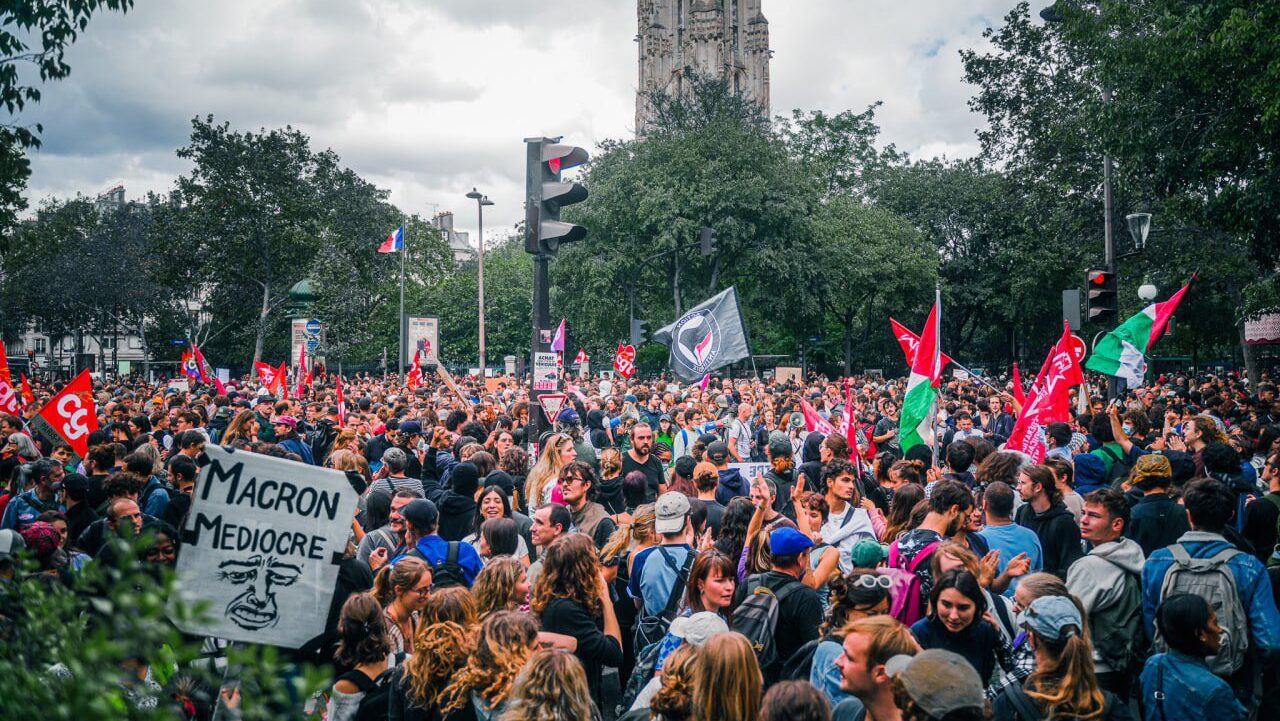
Hundreds of mobilizations across France signaled public rejection of President Emmanuel Macron’s austerity path.
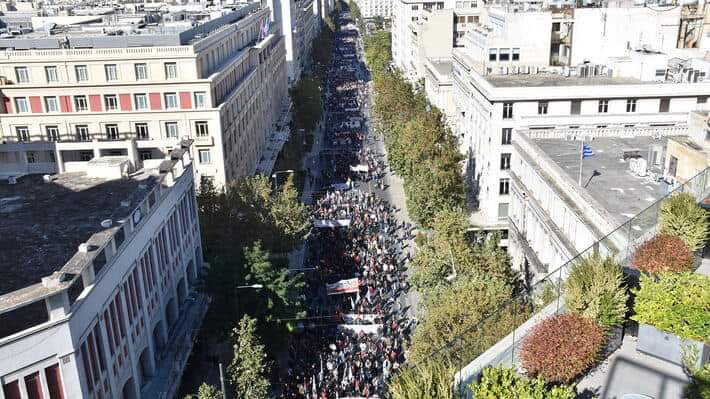
Hundreds of mobilizations, including picket lines and strikes, took place across France on September 10, signaling general rejection of a new wave of austerity policies advanced by the neoliberal camp. Trade unions reported significant participation in multiple sectors, including railways, education, culture, and health – where at least 100 work stoppages occurred during the day.
Grassroots networks estimate that approximately 500,000 people joined the demonstrations, held under the slogan “Let’s Block Everything” (Bloquons tout). Student collectives and Palestine solidarity groups were among those contributing to the day, among many others. Actions took place not only in major cities like Paris and Marseille but also in smaller towns such as Albi and Pau. The day was also marked by a heavy police presence and reports of violence against protesters, including the use of tear gas.
The mobilization came just days after another prime minister appointed by President Emmanuel Macron, François Bayrou, lost a confidence vote in the National Assembly. Macron quickly replaced him with former defense minister Sébastien Lecornu, a representative of the center’s right-wing faction. The appointment irked the public further. Maurizio Coppola of the Italian left party Potere al Popolo, who took part in the actions, told Peoples Dispatch: “Many saw this hasty appointment of a new prime minister as a provocation on the eve of the mobilization.”
Read more: Will another French prime minister fall over the austerity budget?
Demonstrators also saw Lecornu’s appointment as a sign that Macron continues to pursue policies repeatedly rejected by the public. In a recent speech, France Unbowed (La France Insoumise) leader Jean-Luc Mélenchon highlighted the devastating social impact of neoliberal economic policies, pointing out that thousands of children and hundreds of thousands of people in France are homeless. Poverty and inequality, he described, plague the country. The trade union group Solidaires offered similar reflections on the day of action: “After the fall of the Bayrou government, the head of state’s desire to pursue the same policy in the service of special interests can only exacerbate fiscal and social inequalities and the ecological crisis.”
“He must go”
“Macron is to blame for this situation,” Mélenchon wrote on September 10. “He and his decisions are responsible for the chaos. He makes no effort whatsoever to show that he is receiving or listening to the messages coming from the National Assembly or the country. On the contrary, he brazenly pushes ahead to show that he remains in control of his strange and absurd plans. He must go.”
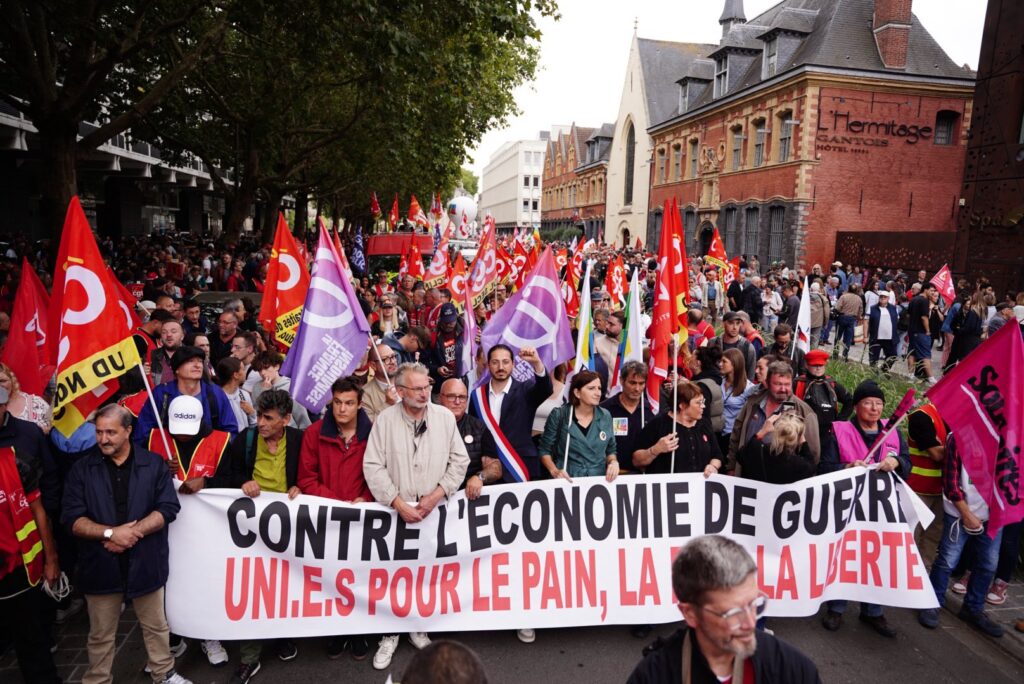
France Unbowed has campaigned for Macron’s removal since the 2024 national election, when he blocked the progressive New Popular Front (Nouveau Front Populaire) from forming a cabinet despite its electoral result, instead entrusting government formation to a succession of neoliberals. The party renewed its call after Bayrou’s collapse but also threw its weight behind the ongoing grassroots struggles. Coppola noted that activists from France Unbowed were active in preparing demonstrations across communities, helping amplify and link popular demands. “Their elected representatives marched with the protesters, defending them from police violence through their institutional status,” he added.
The role of organized labor
Despite the success of the day of action, questions remain. One concerns the role of labor unions, Coppola suggests. While certain unions and confederations, notably Solidaires, joined the call for September 10, others kept more distance. Branches of the General Confederation of Labor (Confédération générale du travail, CGT) and Workers’ Force (Force Ouvrière) participated in the actions, but their leadership chose to emphasize a strike call for September 18. By doing so, these organizations echoed popular demands against austerity but did not fully align themselves with the grassroots initiative.
The ability of grassroots groups and labor unions to connect over and channel the anger that fueled the “Let’s Block Everything” protests may have an important impact on the mobilization’s long-term success. As Coppola points out, “where strikes and blockades were successful, this was only possible thanks to the presence of organized labor.” However, he also adds that some unions joined the day of action only because rank-and-file members pushed for it, highlighting how bottom-up participation remains vital across the struggle.
Another unresolved question is the feasibility of France Unbowed’s proposal to remove Macron. While such an outcome would potentially be a significant victory against austerity, it would trigger new presidential elections with uncertain results. In 2024, the far-right National Rally (Rassemblement National) secured more votes than the left-progressive alliance, making the prospect of an extreme right president a genuine risk.
Nevertheless, the message of September 10 was unmistakable and is unlikely to fade soon. “The message was clear everywhere: no to the [austerity] financial maneuver, [yes to the] strengthening of public services and workers’ rights, taxing the rich, and above all, the resignation of President Macron,” Coppola concluded.
Original article by Ana Vračar republished from peoples dispatch under a Creative Commons Attribution-ShareAlike 4.0 (CC BY-SA) license.