HEAVY HANDED: A police officer detains Reverend Sue Parfitt who declared her support for Palestine Action
… The strongest sign of a new direction on Palestine would be to end the repression.
Reverse the outrageous ban on Palestine Action as a “terrorist” group. Stop the legislation placing further restrictions on protests. Apologise to the thousands rounded up by police for sitting down holding placards. Burnham mentions none of this.
On genocide, he hints it’s for the courts to decide. So address Britain’s appeal to the International Court of Justice to refuse to hear the genocide charges against Israel brought by South Africa, and state that we will no longer obstruct these cases. Call out the US bids to undermine international courts for daring to hold Israel accountable, and its sanctions on UN rapporteur Francesca Albanese.
Burnham rightly observes that Israeli PM Benjamin Netanyahu seeks to make a two-state solution impossible. But pretending that Netanyahu’s excesses have nothing to do with what went before will not wash.
The occupation and colonisation of Palestinian land has proceeded over decades and a fundamental break with Tel Aviv on this, tied to sanctions and a total ban on arms sales, is urgent.
Ultimately that means a fundamental break with Washington. Burnham will hardly say so, but our movement must raise the stakes.
Britain supports the illegal occupation of Palestine because we are tied into a wider network of imperialist alliances led by the United States.
It is inconsistent to demand justice for Palestine while backing Trump’s rearmament drive and remaining a junior military and intelligence partner to the United States. We need an independent foreign policy.
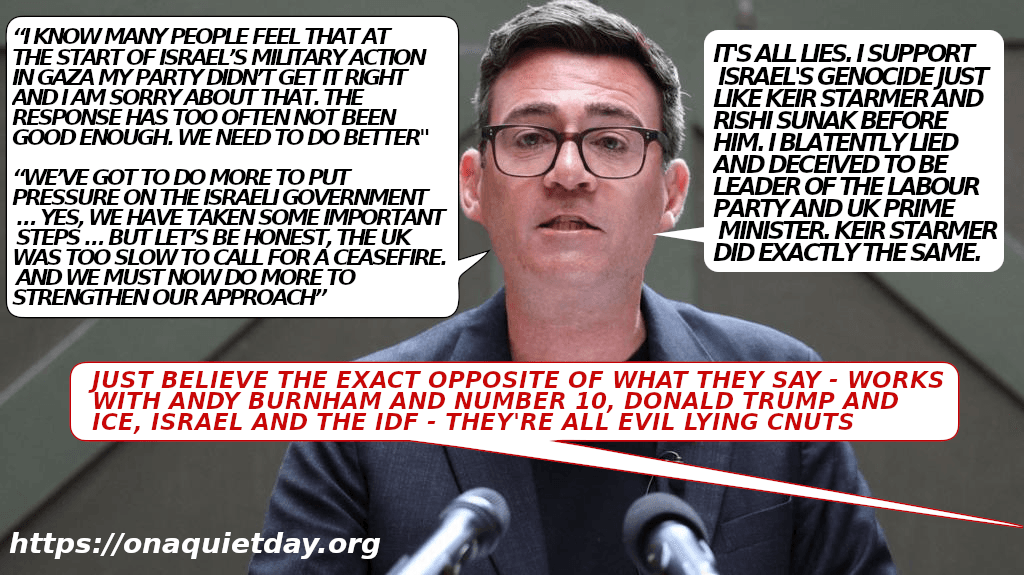
Keir Starmer objects to criticism of the IDF. He asks how could anyone object to them starving people to death, forced marches like the Nazis did, bombing Gaza’s hospitals and universities, mass-murdering journalists, healthworkers and starving people queuing for food, killing and raping prisoners and murdering children. He calls for people to stop obstructing his genocide for Israel.Keir Starmer explains that UK is actively supporting Israel’s genocidal expansion and repeats his previous quotation that he supports Zionism “without qualification”. Keir Starmer said “I said it loud and clear – and meant it – that I support Zionism without qualification.” here: https://www.jewishnews.co.uk/keir-starmer-interview-i-will-work-to-eradicate-antisemitism-from-day-one/Genocide denying UK Foreign Secretary David Lammy says that UK is suspending 30 of 350 arms licences to Israel. He also confirms the UK government’s support for Israel’s Gaza genocide and the UK government and military’s active participation in genocide.
This work by Middle East Monitor is licensed under a Creative Commons Attribution-NonCommercial-ShareAlike 4.0 International License.
The British Union flag on the Houses of Parliament in London, UK, on Friday, July 5, 2024. [Photographer: Jose Sarmento Matos/Bloomberg via Getty Images]
Dozens of British parliamentarians have urged the UK government to impose sanctions on Israeli Prime Minister Benjamin Netanyahu and his justice minister, Yariv Levin, over the “systematic and well-documented torture” of Palestinian civilians in Israeli detention.
According to Sky News, 71 cross-party MPs and peers signed a letter to Foreign Secretary Yvette Cooper calling on Britain to “help end this impunity” by targeting Netanyahu and Levin, who also serves as deputy prime minister, interior minister and religious services minister.
The letter, led by Labour MP Neil Duncan-Jordan, argues that responsibility for the alleged abuse of Palestinian detainees “lies with the government of Israel, including Prime Minister Netanyahu”. It follows the UK’s decision last year to sanction Israeli ministers Itamar Ben-Gvir and Bezalel Smotrich over their extremist comments and conduct towards Palestinians.
The parliamentarians said those measures “remain welcome” but have failed to change Israel’s treatment of Palestinian detainees. Since then, they warned, the situation has “escalated, with near total impunity”.
The letter cites a February 2026 UN report which found that “torture has become integral” to Israel’s domination and punishment of Palestinian men, women and children, including through custodial abuse, forced displacement, mass killings, deprivation and the destruction of the means of life.
MPs also pointed to Netanyahu’s praise for a decision by Israel’s military advocate to drop charges in March in a case involving the alleged rape of a Palestinian detainee by Israeli soldiers, part of which was reportedly captured on CCTV.
They further cited the interception in April and May of the Global Sumud Flotilla and Freedom Flotilla Coalition by Israeli naval forces in international waters. British nationals were among those detained, and detainees alleged that they were beaten and shot. Footage of their treatment was later shared online by Ben-Gvir, Sky News reported.
A spokesperson for the Foreign, Commonwealth and Development Office told Sky News that reports of mistreatment of detainees by Israeli forces were “disgraceful” and said the UK had raised the issue with the Israeli government.
“All detainees must be treated with dignity and in full accordance with international law, and any allegations of torture or mistreatment must be thoroughly investigated,” the spokesperson said.
The Foreign Office also called on Israel to grant the International Committee of the Red Cross “immediate and unrestricted access to all detention facilities”, adding that it was “completely unacceptable” that hundreds of Palestinian children are reportedly held in Israeli detention without charge for months.
The letter was signed by 30 Labour MPs and seven Labour peers, as well as representatives from the Greens, Plaid Cymru, Sinn Fein, the SDLP, the Liberal Democrats, the SNP, the Conservatives, crossbench peers and non-affiliated members of the House of Lords.
Keir Starmer objects to criticism of the IDF. He asks how could anyone object to them starving people to death, forced marches like the Nazis did, bombing Gaza’s hospitals and universities, mass-murdering journalists, healthworkers and starving people queuing for food, killing and raping prisoners and murdering children. He calls for people to stop obstructing his genocide for Israel.Orcas discuss rotting brain, front Orca says Sundown Syndrome is a dead givaway and he wishes someone would Lock Him Up
This work by Middle East Monitor is licensed under a Creative Commons Attribution-NonCommercial-ShareAlike 4.0 International License.
US President Donald Trump (R) meets with the Israeli Prime Minister Benjamin Netanyahu (L) at the White House on February 11, in Washington DC, United States. [Avi Ohayon – GPO – Anadolu Agency]
Israeli Prime Minister Benjamin Netanyahu denied reports Sunday that the US had restricted Israeli military operations in Lebanon, Anadolu reports.
“I heard it was said in the media that President Trump asked not to act against terror tunnels in Lebanon. This is a legend, fake news. He didn’t say anything to me about it, and I didn’t ask him. We operate according to our considerations,” Netanyahu said during a weekly Cabinet meeting.
His remarks contradicted an earlier report by Israel’s public broadcaster KAN late last month that Israel had provided US officials with detailed intelligence on alleged Hezbollah tunnels in the Ali al-Taher Heights in southern Lebanon in an effort to obtain US approval for military operations in the area.
The report suggested Israel sought a US green light to continue its military activities in Lebanon, contrary to Netanyahu’s assertion that Israeli military decisions are made independently.
Since March 2, 2026, Israeli military operations in Lebanon have killed at least 4,303 people and injured 12,202 others, according to Lebanese authorities, while displacing more than one million.
On June 26, Israel and Lebanon signed a framework agreement under US mediation aimed at ending the Israeli occupation of Lebanese territory.
Turning to Gaza, Netanyahu said there would be no reconstruction in the enclave before it is disarmed, a position that departs from the sequencing outlined in US President Donald Trump’s plan to end the war.
“There will be no reconstruction in Gaza without dismantling and demilitarizing the Strip,” he said in his comments carried by the daily Yedioth Ahronoth.
Under the second phase of Trump’s plan, a broader Israeli military withdrawal from Gaza and the launch of reconstruction are to proceed in parallel with the beginning of the disarmament of Palestinian factions.
According to the paper, Netanyahu’s remarks came amid reports that Trump’s Board of Peace intends to move ahead with reconstruction in areas under Israeli military control without linking it to the disarmament of Hamas.
Since October 2023, the Israeli army has killed more than 73,000 people and injured over 173,000 injured, in a deadly offensive that has caused widespread destruction affecting 90% of the enclave’s civilian infrastructure, according to official Gaza data.
Keir Starmer explains that UK is actively supporting Israel’s genocidal expansion and repeats his previous quotation that he supports Zionism “without qualification”. Keir Starmer said “I said it loud and clear – and meant it – that I support Zionism without qualification.” here: https://www.jewishnews.co.uk/keir-starmer-interview-i-will-work-to-eradicate-antisemitism-from-day-one/Orcas discuss rotting brain, front Orca says he wishes someone would lock him up, small Orca speaks bluntly.
This work by Middle East Monitor is licensed under a Creative Commons Attribution-NonCommercial-ShareAlike 4.0 International License.
U.S. President Donald Trump (R) welcomes Israeli Prime Minister Benjamin Netanyahu (L) at his Mar-a-Lago residence in Florida, United States on December 29, 2025. [Amos Ben-Gershom (GPO)/Handout – Anadolu Agency]
Trump and Netanyahu need each other more than they trust each other — and that mutual need, not any shared conviction, is the only thing still holding the alliance together.
There is an old parable about two scorpions in a jar. Neither can leave. Neither trusts the other. And sooner or later, one strikes, not because it wants to kill the other, but because the jar has become unbearable.
Donald Trump and Benjamin Netanyahu are those scorpions now, and the jar is the wreckage of the Middle East they built together.
For the better part of a year, they marched in locked steps. One man’s appetite for spectacle matched by the other’s genius for making disaster look like deliverance. Netanyahu persuaded Trump that Iran could be shattered quickly, cleanly, at no real cost. Trump believed him because believing him was easier than doubting him, and doubt has never been a currency Trump trades in. The war came. But Iran did not break. And when the bill arrived, it was delivered to Trump’s door, not Netanyahu’s.
John Mearsheimer of the University of Chicago, who has spent a career mapping the architecture of American deference to Israeli interests, put the verdict as bluntly as a man of his discipline allows:
Netanyahu convinced Trump the war would be short and decisive, and Trump, in Mearsheimer’s words, was foolish enough to believe him.
Elsewhere, Mearsheimer has been blunter still, arguing flatly that Israel and its lobby own Trump,
and that the President has demonstrated, repeatedly, a willingness to dance to Jerusalem’s tune.
Then came Lebanon, and with it the profanity that told the truth polite diplomacy never does. Reports of a fifteen-minute call, confirmed by Trump himself, describe the President screaming at Netanyahu, demanding to know what the hell he was doing. He called Netanyahu “crazy,” reminded him that he would be sitting in prison were it not for American protection, and scolded him in the most excruciating language, that the world now despised him for it. This is not the language of alliance. It is the language of a landlord screaming at a tenant who has torched the building and still expects a reference letter.
Netanyahu absorbed the insult silently, the way he absorbs everything, with a statement insisting nothing had changed, that Israel’s “position remains the same,” even as his troops turned back from Beirut on Trump’s order. One American official described the call more crudely: Trump had steamrolled him, and all the great warrior-statesman could manage in reply was a chastened “OK, OK”. This isn’t how empires normally treat client states, but this was never a partnership of equals. It is, as Jeffrey Sachs of Columbia University observes, the latest chapter in a decades-long bid for regional dominance. In this script, Netanyahu and the architects of Greater Israel are the sole victors; everyone else is left with the ashes. Sachs does not flinch from naming the architecture. The war on Iran, he argues, was never separate from the older “Clean Break” doctrine first sketched in 1996, a blueprint for regime-change wars with Washington cast as the enforcement arm of Israeli strategy. In that reading, Trump is not a partner but an instrument, wielded by a prime minister facing indictment at home and a coalition that cannot survive a genuine peace.
Gideon Levy of Haaretz, writing from inside Israel’s collapsing consensus, sees the same rot from the other direction. He has warned that Israel follows Netanyahu mindlessly toward a reckoning it has not yet allowed itself to imagine, and that the U.S.-Israel relationship itself is nearing its breaking point. Even Thomas Friedman, hardly a radical, has confessed to being torn, rooting against the Iranian regime while dreading what its defeat would do for two men, he flatly calls terrible people, “alleged crooks” running “anti-democratic projects” in their own countries.
Phyllis Bennis of Institute for Policy Studies frames the arrangement in the coldest terms available: not statesmanship, but real-estate logic: a transactional partnership between a president with no re-election ahead of him but a legacy to launder, and a prime minister facing an October election and a courtroom he has spent years trying to outrun.
Both men need a win they cannot contrive through governance, so they manufacture it through war. Both are impeachable, indictable, and disposable to the very coalitions that elevated them.
AIPAC, the Israeli religious right, and the Republican Zionist bloc in the U.S. Senate are Netanyahu’s insurance policy. Miriam Adelson’s checkbook and the MAGA base are Trump’s. Each man is one betrayal away from being fed to those bases as a sacrifice, and each of them knows it.
This is why the scorpion metaphor holds. Two men who need each other to survive politically are also the two men most capable of mortally stinging each other. Trump has already shown he will humiliate Netanyahu the moment the war stops being useful to him. Netanyahu has already shown he will defy Trump’s orders the moment his coalition demands it. The sting, when it finally comes, will not be ideological. It will be self-preservation, dressed up as principle, in a jar built from the bones of Lebanon, Gaza, and Iran, while the region, and the truth, are left to rot in the glass along with them.
The New York Times, the US’s most powerful establishment news outlet, has reported on President Donald Trump’s “memorandum of understanding” with Iran from a pro-war and/or pro-Israel perspective. Why did Trump end the war without limiting Iran’s “nuclear program” and its support for “proxy forces,” or without conducting “regime” change? These are the questions that have preoccupied the paper of record’s news reporting.
As I’ve noted before (FAIR.org, 3/30/26), multiple Times employees are reporting from and currently living in Israel, despite Israel’s blanket censorship policies, not to mention its killing hundreds of journalists. Meanwhile, the paper has no reporters in Iran, a situation it blames on Iran’s press restrictions.
This editorial decision has no doubt contributed to the paper covering the memorandum from an Israeli perspective, which is not aligned with the 59% of the US adult population who say the US using military force in Iran was the wrong decision.
‘Frightening new reality’
The New York Times (6/14/26) reports that Israel faults a deal that Iran agreed to for not “creating the conditions for the collapse of the Iranian government.”
Over its first article (6/14/26) published about the memorandum, the New YorkTimes headline read, “In Israel, Broad Discontent Even Before Deal’s Details Are Known.” The subhead noted that “Israelis across the political spectrum have said the agreement appears to leave fundamental security threats posed by Iran unaddressed.”
The piece, by Times Jerusalem correspondent Isabel Kershner, uncritically granted anonymity to an “Israeli who had been briefed on the deal with Iran” to “discuss diplomacy.” They listed their “main problems” with the proposal: “no clear answers regarding the treatment of Iran’s stockpile of enriched uranium, and not enough curbs on Iran’s nuclear program,” no “conditions for the collapse of the Iranian government” and “no clear mechanism for forcing Iran to halt its support for its proxy forces.”
One day later, the Times (6/15/26) published an article headlined “Israel Counts the Ways That Netanyahu’s Iran Strategy Failed.” Times Jerusalem bureau chief David M. Halbfinger and Tel Aviv staff writer Ronen Bergman noted that the agreement “omits some of the most important things Israel wanted.”
These “important things” included “to curb Iran’s ballistic missile arsenal” and “its funding of regional proxies like Hezbollah in Lebanon and the Houthis in Yemen, who have attacked Israel with their own arsenals.” The deal “could help Iran bolster those proxies by easing sanctions, which would allow billions of dollars to flow into its bank accounts,” Halbfinger and Bergman added.
‘Catastrophic capitulation’
The New York Times (6/18/26) says “Israel awoke to a frightening new reality”—one that “seeks to handcuff Israel” by forcing it to withdraw from a country it invaded.
Three days later, Halbfinger published an article (6/18/26) headlined “Israel, Stunned by Trump’s Iran Deal, Sees It as a ‘Catastrophic Capitulation.’”
This time, Halbfinger wrote that
Israel awoke to a frightening new reality on Thursday as it absorbed, with disbelief and largely in silence, the terms of President Trump’s preliminary agreement to end the war with Iran.
Halbfinger noted that “it accomplishes none of Israel’s war aims, analysts and officials said, and arguably leaves the country in worse shape on each of them.” Among those aims? “Regime change,” “ballistic missiles and proxy militias” and “Iran’s nuclear program,” listed Halbfinger.
Uncritically parroting Israeli government talking points that frame Israel as the victim is journalistic obfuscation at best: Israel privately lobbied to assassinate Iran’s lead negotiator and to “restart the war with a new round of strikes targeting the country’s oil infrastructure” (Capital and Empire, 5/28/26), and it insists it has the right to continue ethnically cleansing Lebanon.
‘One of the biggest challenges of his career’
The New York Times (6/21/26) says Israeli Prime Minister Benjamin Netanyahu is “fighting for his political survival”—as opposed to the Palestinians, Lebanese and Iranians Netanyahu would like to keep bombing, who are fighting for their actual survival.
One week after her first article about the memorandum was published, the Times’ Kershner wrote another article (6/21/26) headlined “Netanyahu Faces One of the Biggest Challenges of His Career.”
Her thesis was that Netanyahu “is fighting for his political survival” due to “the emergence of a peace deal that Israel is not a party to.” Kershner wrote that Netanyahu “has staked his career on preventing Iran from developing nuclear weapons, which Israel views as an existential threat.”
Kershner, like Halbfinger and Bergman, ignored the fact that Iran has upheld its promise not to build a nuclear weapon (Arms Control Association, 2/25). By contrast, Israel—not Iran—is the only country in the Middle East to possess nuclear weapons, and the US remains the only country to ever use a nuclear weapon in war.
Kershner wrote:
The agreement seeks to curtail Israel’s freedom of action in Lebanon, where the Israeli military has been fighting Hezbollah, the Iran-backed proxy militia on its doorstep. The deal makes no mention of curbing Iran’s ballistic missiles, which Iran has used to attack Israel and US Gulf allies during the wars. And it leaves the nuclear issue to be addressed in further negotiations.
Framing Israel’s killing of more than 4,100 people in Lebanon and displacement of 1.2 million since March (Drop Site News, 6/22/26), as “Israel’s freedom of action” insinuates that Israel is entitled to occupation and ethnic cleansing. And by noting that Iran has used its ballistic missiles “to attack Israel and US Gulf allies during the wars,” Kershner ignored which two countries attacked the other first, and which country used its ballistic missile arsenal to defend itself against further attacks (PBS, 6/18/26; Middle East Eye, 6/23/26).
‘A let down and reality check’
In a New York Times piece (6/15/26) on Iranian reaction to the deal, there is no criticism of the US or Israel, other than an attack on Trump from “a monarchist political activist in Washington who has supported the war against Iran.”
As for the Iranian perspective, the Times published an article (6/15/26) headlined “Many Iranians Express Relief Over Agreement to End the War.” The subhead read, “After enduring months of conflict, ordinary people in Iran were relieved to hear about the deal. Opposition groups were disappointed.”
The Times’ Farnaz Fassihi noted that
Iranians expressed a range of emotions over the agreement to end a war that killed thousands across the region and brought enormous loss with no gain for millions of others.
Fassihi quoted just two sources based in Tehran, one of whom she interviewed by telephone, the other by text message. One asked, “What was the point of this war? What did it bring us exactly?” The other asked: “Is this REAL? Are they serious?”
Fassihi added that
for Iranian opposition groups and some members of the diaspora who had hoped the war would topple the Islamic Republic, the agreement was both a let down and a reality check.
Fassihi cited a social media post by Behnam Amini, a “monarchist political activist in Washington who has supported the war against Iran.”
Fassihi also noted:
In Iran, a minority within the hard-line political faction—those who ideologically favor destruction of Israel and war with the US by any means—unleashed fury at Foreign Minister Abbas Araghchi and Gen. Mohammad Bagher Ghalibaf, the lead negotiator and speaker of parliament.
The piece was unable to quote a source that expressed explicit opposition to the US/Israel’s attacks on Iran—which suggests the limitations of the Times’ long-distance approach to covering Iranian opinion.
FAIR’s work is sustained by our generous contributors, who allow us to remain independent. Donate today to be a part of this important mission.
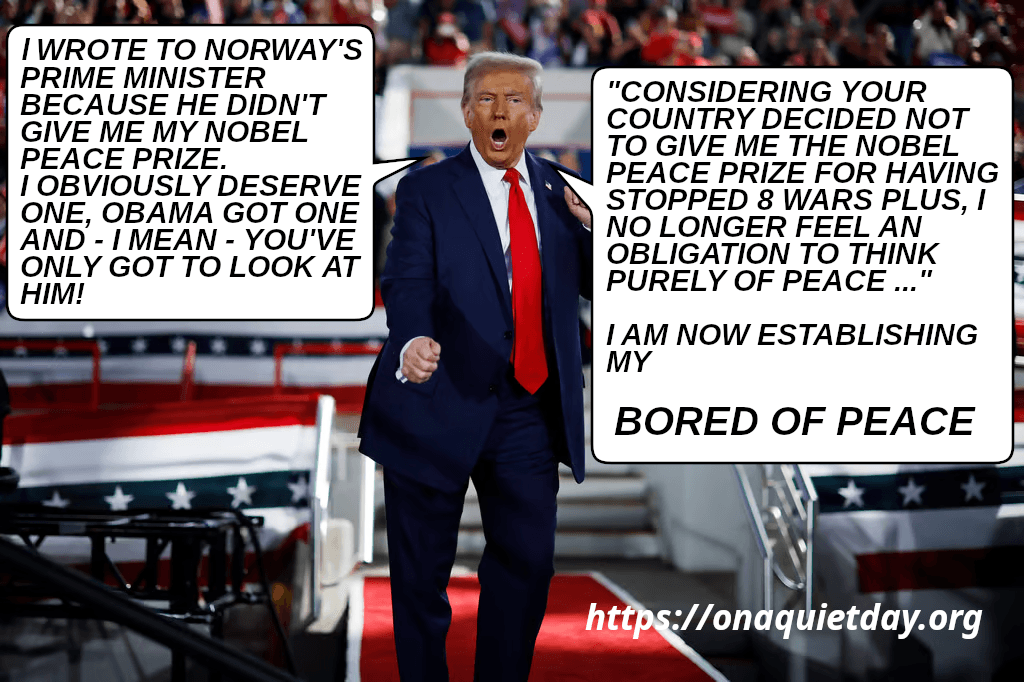
Keir Starmer explains that UK is actively supporting Israel’s genocidal expansion and repeats his previous quotation that he supports Zionism “without qualification”. Keir Starmer said “I said it loud and clear – and meant it – that I support Zionism without qualification.” here: https://www.jewishnews.co.uk/keir-starmer-interview-i-will-work-to-eradicate-antisemitism-from-day-one/Keir Starmer objects to criticism of the IDF. He asks how could anyone object to them starving people to death, forced marches like the Nazis did, bombing Gaza’s hospitals and universities, mass-murdering journalists, healthworkers and starving people queuing for food, killing and raping prisoners and murdering children. He calls for people to stop obstructing his genocide for Israel.Donald Trump explains why he established his Bored of Peace