Tag: Berlin

  • Experts: The key ‘unknowns’ of overshooting the 1.5C global-warming limit

    Spread the love

    Original article by Cecilia Keating and Robert McSweeney republished from Carbon Brief under a CC license. 
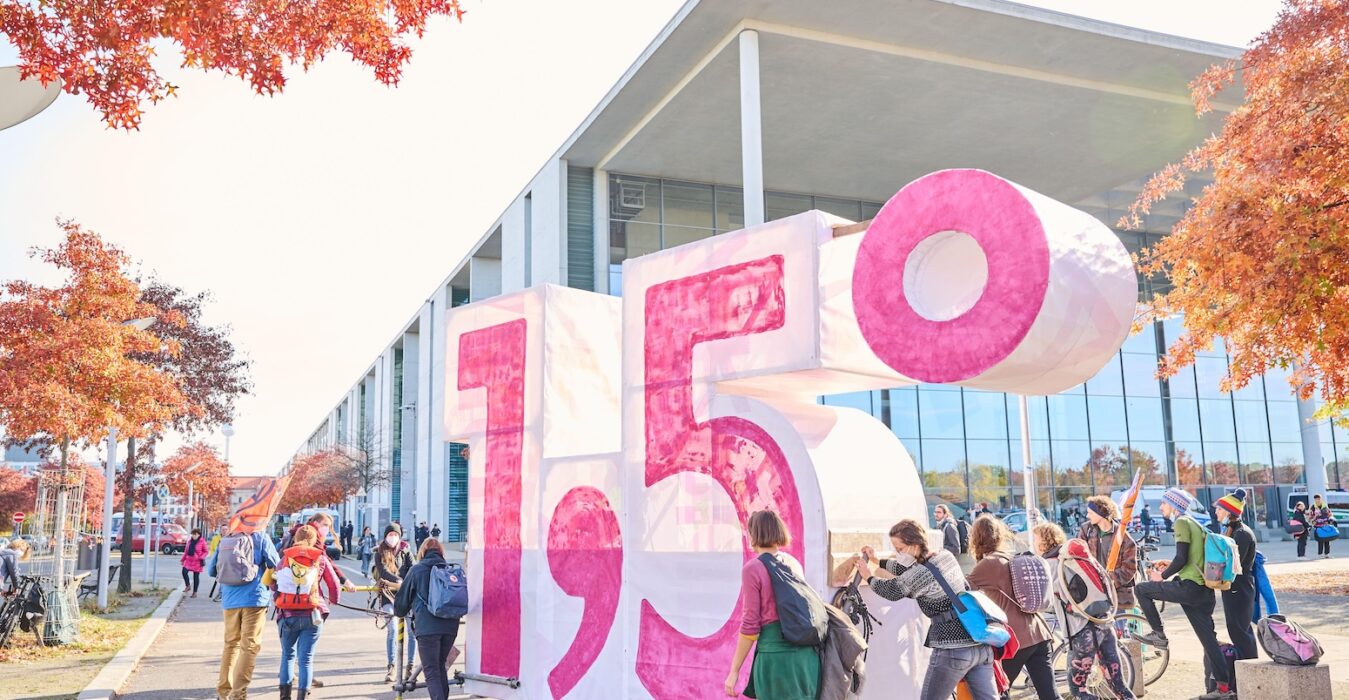
    Demonstrators from Extinction Rebellion push self-made cart in the shape of the 1.5C climate target in Berlin, Germany. Credit: dpa picture alliance / Alamy Stock Photo

    Last week, around 180 scientists, researchers and legal experts gathered in Luxenburg, Austria to attend the first-ever international conference focused on the controversial topic of climate “overshoot”.

    This hypothesised scenario would see global temperatures initially “overshoot” the Paris Agreement’s aspirational limit of 1.5C, before they are brought back down through techniques that would remove carbon dioxide from the atmosphere.

    (For more on the key talking points, new research and discussions that emerged from the three-day conference, see Carbon Brief’s full write-up of the event.)

    On the sidelines of the conference, Carbon Brief asked a range of delegates what they consider to be the key “unknowns” around overshoot.

    Below are their responses, first as sample quotes, then, in full:

    • Dr James Fletcher: “Yes, there will be overshoot, but at what point will that overshoot peak? Are we peaking at 1.6C, 1.7C, 2.1C?”
    • Prof Shobha Maharaj: “There are lots of places in the world where adaptation plans have been made to a 1.5C ceiling. The fact is that these plans are going to need to be modified or probably redeveloped.”
    • Sir Prof Jim Skea: “There are huge knowledge gaps around overshoot and carbon dioxide removal.”
    • Prof Kristie Ebi: “If there is going to be a peak – and, of course, we don’t know what that peak is – then how do you start planning?”
    • Prof Lavanya Rajamani: “To me, a key governance unknown is the extent to which our current legal and regulatory architecture…will actually be responsive to the needs of an overshoot world.”
    • Prof Nebojsa Nakicenovic: “One of my major concerns has been for a long time…is whether, even after reaching net-zero, negative emissions can actually produce a temperature decline.”
    • Prof Debra Roberts: “For me, the big unknown is how all of these areas of increased impact and risk actually intersect with one another and what that means in the real world.”
    • Dr Oliver Geden: “[A key unknown] is whether countries are really willing to commit to net-negative trajectories.”
    • Dr Carl-Friedrich Schleussner: “This is a bigger concern that I have – that we are pushing the habitability in our societies on this planet above that limit and towards maybe existential limits.”
    • Dr Anna Pirani: “I think that tracking global mean surface temperature on an overshoot pathway will be an important unknown.”
    • Prof Richard Betts: “One of the key unknowns is are we going to continue to get the land carbon sink that the models produce.”
    • Prof Hannah Daly: “The biggest unknown is whether countries can translate these global [overshoot] pathways into sustained domestic action…that is politically and socially feasible.”
    • Dr Andrew King: “[W]e still have a lot of uncertainty around other elements in the climate system that relate more to what people actually live through.”
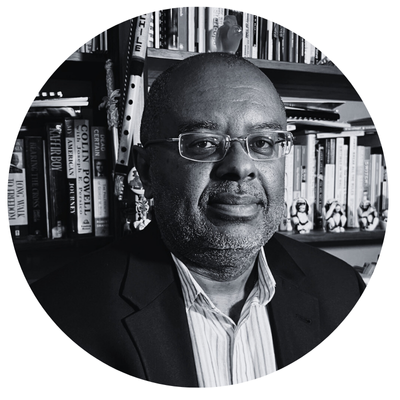
    Dr James Fletcher

    Dr James Fletcher
    Former minister for public service, sustainable development, energy, science and technology for Saint Lucia and negotiator at COP21 in Paris.

    The key unknown is where we’re going to land. At what point will we peak [temperatures] before we start going down, and how long will we stay in that overshoot period? That is a scary thing. Yes, there will be overshoot, but at what point will that overshoot peak? Are we peaking at 1.6C, 1.7C, 2.1C? All of these are scary scenarios for small island developing states – anything above 1.5C is scary. Every fraction of a degree matters to us. Where we peak is very important and how long we stay in this overshoot period is equally important. That’s when you start getting into very serious, irreversible impacts and tipping points.

    Prof Shobha Maharaj

    Prof Shobha Maharaj
    Adjunct professor at the University of Fiji and a coordinating lead author for Working Group II of the IPCC’s seventh assessment

    First of all, there is an assumption that we’re going to go back down from overshoot. Back down is not a given. And secondly, we are still in the phase where we are talking about uncertainty. Climate scientists don’t like uncertainty. We are not acknowledging that uncertainty is the new normal… But because we’re so bogged down in terms of uncertainties, we are not moving towards [the issue of] what we do about it. We know it’s coming. We know the temperatures are going to be high. But there is little talk about the action. 

    The focus seems to be more on how we can understand this or how we can model this, but not what we do on the ground. Especially when it comes to adaptation planning – [and around] how does this modify whatever the plans are? There are lots of places in the world where adaptation plans have been made to a 1.5C ceiling. The fact is that these plans are going to need to be modified or probably redeveloped. And no one is talking about this, especially in the areas that are least resourced in the world – which sets up a big, big problem.
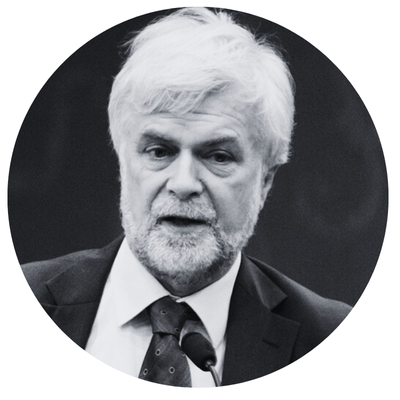
    Sir Prof Jim Skea

    Sir Prof Jim Skea
    Chair of the Intergovernmental Panel on Climate Change (IPCC) and emeritus professor at Imperial College London’s Centre for Environmental Policy

    There are huge knowledge gaps around overshoot and carbon dioxide removal. As it’s very clear from the themes of this conference, we don’t altogether understand how the Earth would react in taking carbon dioxide out of the atmosphere. We don’t understand the nature of the irreversibilities and we don’t understand the effectiveness of CDR techniques, which might themselves be influenced by the level of global warming, plus all the equity and sustainability issues surrounding using CDR techniques.
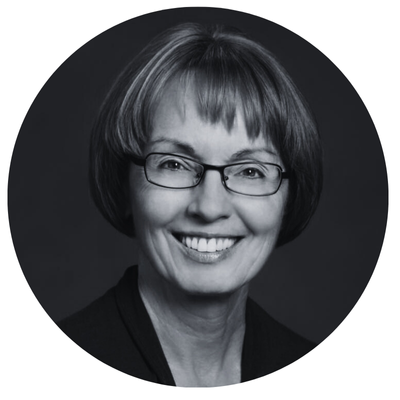
    Prof Kristie Ebi

    Prof Kristie Ebi
    Professor of global health at the University of Washington‘s Center for Health and the Global Environment

    There are all kinds of questions about adaptation and how to approach effective adaptation. At the moment, adaptation is primarily assuming a continual increase in global mean surface temperature. If there is going to be a peak – and of course, we don’t know what that peak is – then how do you start planning? Do you change your planning? There are places, for instance when thinking about hard infrastructure, [where overshoot] may result in a change in your plan – because as you come down the backside, maybe the need would be less. For example, when building a bridge taller. And when implementing early warning systems, how do you take into account that there will be a peak and ultimately a decline? There is almost no work in that. I would say that’s one of the critical unknowns.

    Prof Lavanya Rajamani

    Prof Lavanya Rajamani
    Professor of international environmental law at the University of Oxford

    I think there are several scientific unknowns, but I would like to focus on the governance unknowns with respect to overshoot. To me, a key governance unknown is the extent to which our current legal and regulatory architecture – across levels of governance, so domestic, regional and international – will actually be responsive to the needs of an overshoot world and the consequences of actually not having regulatory and governance architectures in place to address overshoot.
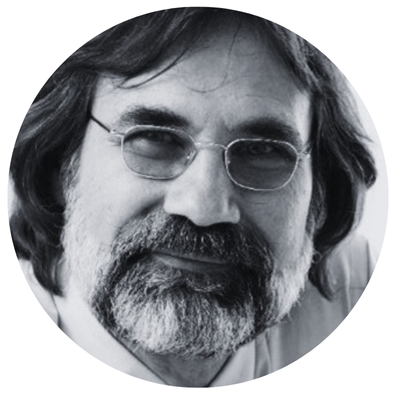
    Prof Nebojsa Nakicenovic

    Prof Nebojsa Nakicenovic
    Distinguished emeritus research scholar at the International Institute for Applied Systems Analysis and executive director of The World In 2050.

    One of my major concerns has been for a long time – as it was clear that we are heading for an overshoot, as we are not reducing the emissions in time – is whether, even after reaching net-zero, negative emissions can actually produce a temperature decline…In other words, there might be asymmetry on the way down [in the global-temperature response to carbon removal] – it might not be symmetrical to the way up [as temperature rise in response to carbon emissions]. And this is really my major concern, that we are planning measures that are so uncertain that we don’t know whether they will reach the goal. 

    The last point I want to make is that I think that the scientific community should, under all conditions, make sure that the highest priority is on mitigation.
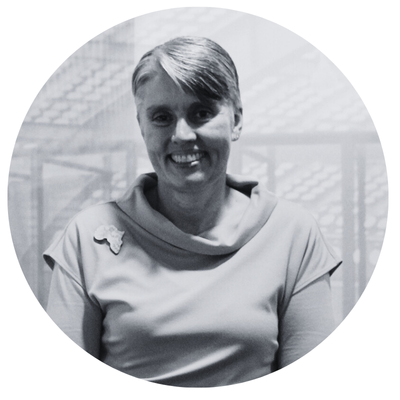
    Prof Debra Roberts

    Prof Debra Roberts
    Honorary professor at the University of KwaZulu-Natal, coordinating lead author on the IPCC’s forthcoming special report on climate change and cities, board chair of the Red Cross Red Crescent Climate Centre and co-chair of Working Group II for the IPCC’s sixth assessment

    Well, I think coming from the policy and practitioner community, what I’m hearing a lot about are the potential impacts that come from the exceedance component of overshoot. What I’m not hearing a lot about is the responses to overshoot and their impacts – and how those impacts might interact with the impacts from temperature exceedance. So there’s quite a complex risk landscape emerging. It’s three dimensional in many ways, but we’re only talking about one dimension and, for policymakers, we need to understand that three dimensional element in order to understand what options remain on the table. For me, the big unknown is how all of these areas of increased impact and risk actually intersect with one another and what that means in the real world.
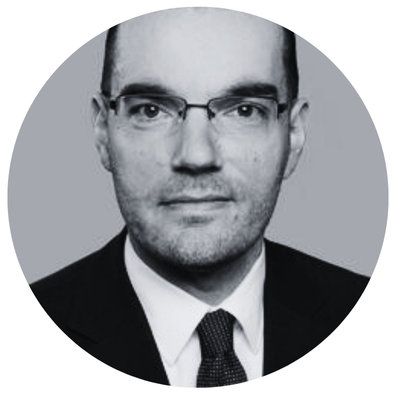
    Prof Oliver Geden

    Dr Oliver Geden
    Senior fellow and head of the climate policy and politics research cluster at the German Institute for International and Security Affairs and vice-chair of IPCC Working Group III

    [A key unknown] is whether countries are really willing to commit to net-negative trajectories. We are assuming, in science, global pathways going net negative, with hardly any country saying they want to go there. So maybe it is just an academic thought experiment. So we don’t know yet if [overshoot] is even relevant. It is relevant in the sense that if we do, [the] 1.5C [target] stays on the table. But I think the next phase needs to be that countries – or the UNFCCC as a whole – needs to decide what they want to do. 
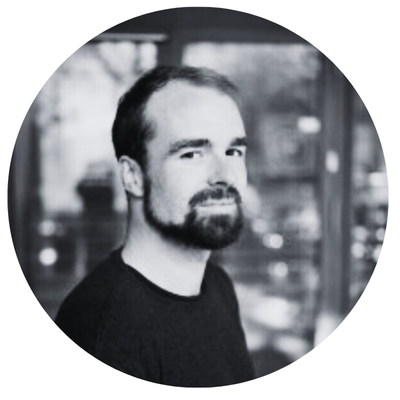
    Dr Carl-Friedrich Schleussner

    Dr Carl-Friedrich Schleussner
    Research group leader and senior research scholar at the International Institute for Applied Systems Analysis

    I’m convinced that there’s an upper limit of overshoot that we can afford – and it might be not far outside the Paris range [1.5C-2C] – before human societies will be overwhelmed with the task of bringing temperatures back down again. This [societal limit] is lower than the geophysical limits or the CDR limit.

    The impacts of climate change and the challenges that will come with it will undermine society’s abilities to cooperatively engage in what is required to achieve long-term temperature reversal. This is a bigger concern that I have – that we are pushing the habitability in our societies on this planet above that limit and towards maybe existential limits. We may not be able to walk back from it, even if we wanted to. That is a big unknown to me.

    I’m convinced that there is an upper limit to how much overshoot we can afford, and it might be just about 2C or a bit above – it might not be much more than that. But we do not have good evidence for this. But I think these scenarios of going to 3C and then assuming we can go back down – I have doubts that future societies grappling with the impacts of climate change will be in the position to embark on such an endeavour.
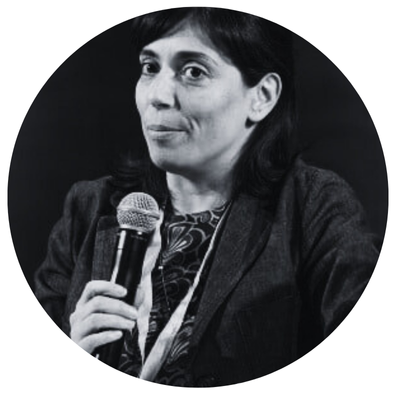
    Dr Anna Pirani

    Dr Anna Pirani
    Senior research associate at the Euro-Mediterranean Center on Climate Change (CMCC) and former head of the Technical Support Unit for Working Group I of the IPCC

    I think that tracking global mean surface temperature on an overshoot pathway will be an important unknown – how to take account of natural variability in that context, to inform where we are on an overshoot pathway and how well we’re doing on it. I think, methodologically, that would prove to be a challenge. The fact that it occurs over many, many years – many decades – and, yet, we sort of think about it as a nice curve. We see these graphs that say “by the 2050s, we will be here and we’ll start declining and so on”. I think that what that actually translates to in the evolution of global surface temperatures is going to be very difficult to measure and track. Even how we report on that, internationally, in the UNFCCC [UN Framework Convention on Climate Change] context and what the WMO [World Meteorological Organization] does in terms of reporting an overshoot trajectory, that would be quite a challenge. 
    Prof Richard Betts

    Prof Richard Betts
    Head of climate impacts research in the Met Office Hadley Centre and professor at the University of Exeter

    One of the key unknowns is are we going to continue to get the land carbon sink that the models produce. We have got model simulations of returning from an overshoot. 

    If you are lowering temperatures, you have got to reduce emissions. The amount you reduce emissions depends on how much carbon is taken up naturally by the system – by forests, oceans and so on. The models will do this; they give you an answer. But we don’t know whether they are doing the right thing. They have never been tested in this kind of situation.

    In my field of expertise, one of the key [unknowns] is how these carbon sinks are going to behave in the future. That is why we are trying to get real-world data into the models – including through the Amazon FACE project – so we can really try and narrow the uncertainties in future carbon sinks. If the carbon sinks are weaker than the models think, it is going to be even harder to reduce emissions and we will need to remove even more by carbon capture and removal. 
    Prof Hannah Daly

    Prof Hannah Daly
    Professor of sustainable energy at University College Cork

    We know ever more about the profound – and often irreversible – damages that will be felt as we overshoot 1.5C. Yet we seem no closer to understanding what will unlock the urgent decarbonisation that remains our only way to avoid the worst impacts of climate change. 

    Global models can show, on paper, what returning temperatures to safer levels after overshoot might look like. The biggest unknown is whether countries can translate these global pathways into sustained domestic action – over decades and without precedent in history – that is politically and socially feasible.
    Dr Andrew King

    Dr Andrew King
    Associate professor in climate science at the University of Melbourne

    I think, firstly, can we actually achieve net-negative emissions to bring temperatures down past a peak? It’s a completely different world and, unfortunately, it’s likely to be challenging and we’re setting ourselves up to need to do it more. So I think that’s a huge unknown. 

    But then, beyond that, I think also, whilst we’ve built some understanding of how global temperature would respond to net-zero or net-negative emissions, we still have a lot of uncertainty around other elements in the climate system that relate more to what people actually live through. In our warming world, we’ve seen that global warming relates to local warming being experienced by everyone at different amounts. But, in an overshoot climate, we would see quite diverse changes for different people, different areas of the world, experiencing very different changes in our local climates. And also definitely worsening of some climate hazards and possibly reversibility in others, so a very different risk landscape as well, emerging post net-zero – and I think we still don’t know very much about that as well.

    Original article by Cecilia Keating and Robert McSweeney republished from Carbon Brief under a CC license. 

    Nigel Farage urges you to ignore facts and reality and be a climate science denier like him and his Deputy Richard Tice. He says that Reform UK has received £Millions and £Millions from the fossil fuel industry to promote climate denial and destroy the planet.
    Nigel Farage urges you to ignore facts and reality and be a climate science denier like him and his Deputy Richard Tice. He says that Reform UK has received £Millions and £Millions from the fossil fuel industry to promote climate denial and destroy the planet.
    Donald Trump urges you to be a Climate Science denier like him. He says that he makes millions and millions for destroying the planet, Burn, Baby, Burn and Flood, Baby, Flood.
    Donald Trump urges you to be a Climate Science denier like him. He says that he makes millions and millions for destroying the planet, Burn, Baby, Burn and Flood, Baby, Flood.
    Elon Musk urges you to be a Fascist like him, says that you can ignore facts and reality then.
    Elon Musk urges you to be a Fascist like him, says that you can ignore facts and reality then.

  • Massive Berlin protest exposes widening split between the people and government on Palestine and Gaza genocide

    Spread the love

    Original article by Ana Vračar republished from peoples dispatch under a Creative Commons Attribution-ShareAlike 4.0 (CC BY-SA) license.

    Source: Laurențiu Dragota/DKP Berlin

    Mass Berlin demo illustrates growing divide between public and government position on genocide in Gaza.

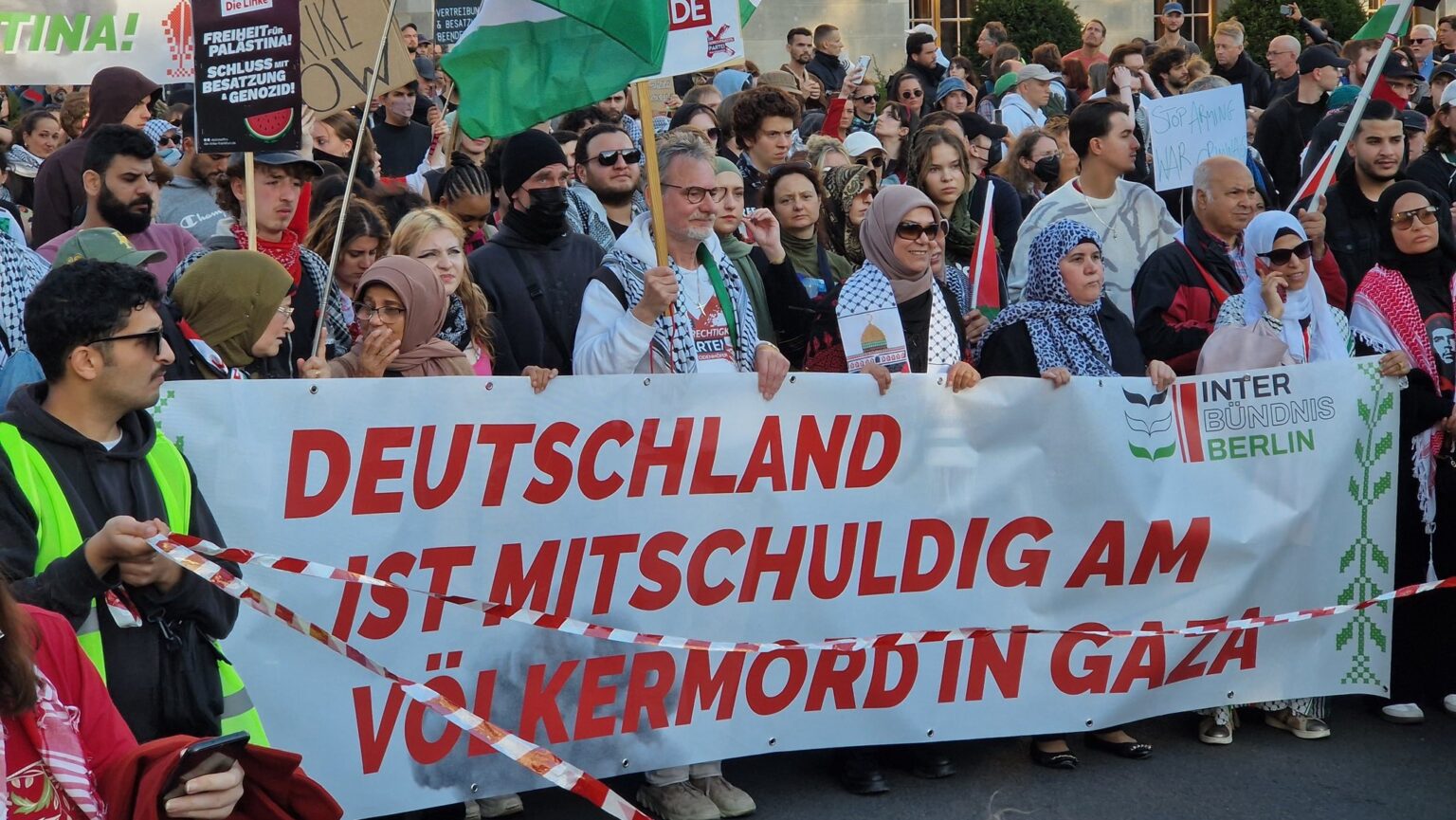
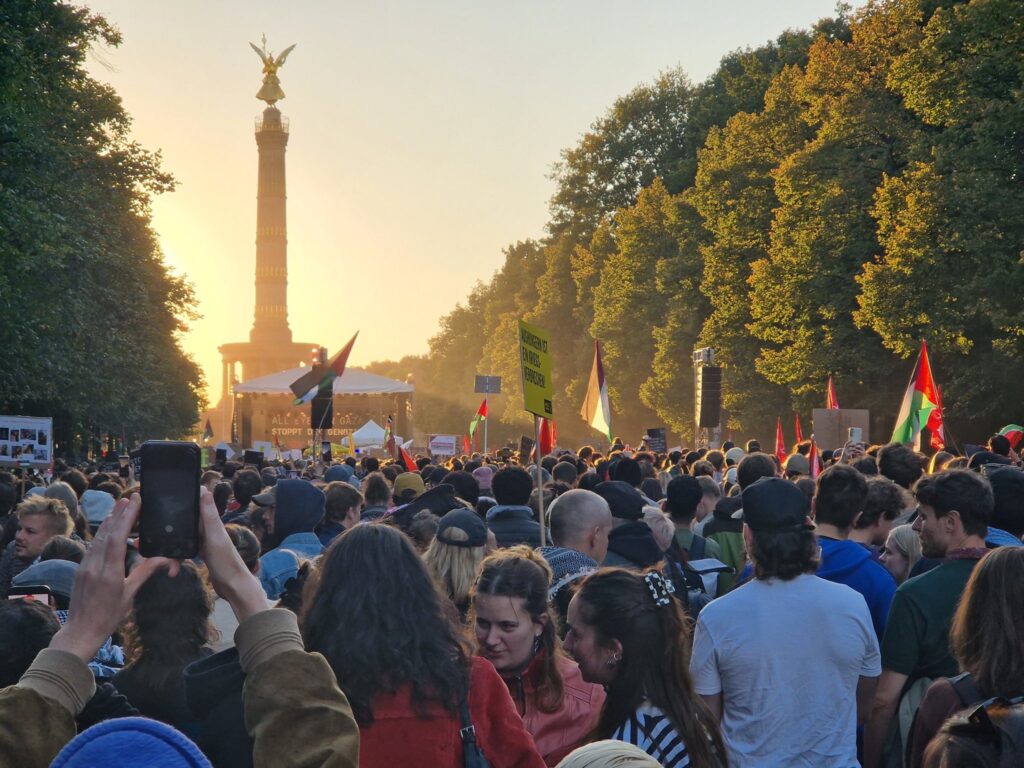
    Germany’s biggest demonstration to date in solidarity with Palestine brought more than 100,000 people into the streets of Berlin on Saturday, September 27. Initiated by a wide coalition of organizations – including Palestinian groups, peace and health associations, climate activists, and artists – the protest demanded an end to German-Israeli military cooperation and repression of solidarity movements, as well as support for Palestinians’ right to self-determination.

    “We are taking to the streets to demand an immediate end to the genocide in Gaza and to stand up for the right of the Palestinian people to self-determination, freedom, and dignity,” Basem Said of the Palestinian community in Berlin said of the protest’s demands.

    Read more: Thousands march to denounce Netanyahu at UNGA: “Everywhere you go, you will be met with empty rooms”

    “While everyone can see the mass atrocities being committed by the Israeli army in Gaza, the German government denies the systematic violence,” the organizers wrote in their call. Framed this way, the march explicitly challenged the principle of Staatsräson, Germany’s self-declared “reason of state” tying much of its political identity to support for Israel.

    The demonstration comes as the divide between public and governmental positions on this issue widens. Recent polling shows that a majority of Germans – 62% – believe Israel is committing genocide in Gaza. That figure rises to nearly 80% among supporters of the left party Die Linke and over 70% among those of the Greens and the Social Democrats. Yet the government continues to deepen ties with Israel even as other European administrations have made minor concessions under pressure from mass mobilizations, such as symbolic recognition of Palestinian statehood at the UN General Assembly’s high-level week.

    Source: Laurențiu Dragota/DKP Berlin

    Similar behavior continued in the days leading up to the protest. On September 25, for example, German Minister for Economic Affairs Katherina Reiche met with her Israeli counterpart, emphasizing the “unique, deep and multi-layered nature” of the cooperation between the two countries. “Israel’s economy is not only resilient but globally recognized for its cutting-edge technology, entrepreneurial spirit and vibrant start-up economy,” Reiche was quoted saying. By that date, Israel had killed at least 65,000 Palestinians in Gaza, with hundreds of thousands more suffering starvation and violent displacement.

    “The German government continues to hold on to its cause and support the Israeli government,” said Dr. Khaled Hamad, one of the signatories of the initiative Together for Gaza (Zusammen für Gaza). “German involvement in the genocide against the Palestinians must be stopped, and double standards ended.”

    Read more: “Elbit Out!” Activists launch campaign to expel arms company from Romania

    The organizers and supporters of Saturday’s events were diverse. Coordinators of the central event included the Palestinian community in Germany, eye4palestine, Amnesty International Germany, and medico international, joined by Fridays for Future groups, the Genocide and Holocaust Studies Crisis Network, and Germans Against Genocide. They were echoed by journalists, writers, and left-wing political activists who launched the call for the demonstration. In total, dozens of organizations and initiatives participated in the preparation under the umbrellas of All Eyes on Gaza and Together for Gaza.

    Demonstrations are expected to continue across Europe throughout October. In Germany, a peace protest is scheduled for the coming weekend, coinciding with German Unity Day. In Spain, Italy, Romania, Croatia, and other countries, actions in the following days will denounce government complicity after two years of genocide in Gaza and renew demands to end all ties with the occupation regime.

    Original article by Ana Vračar republished from peoples dispatch under a Creative Commons Attribution-ShareAlike 4.0 (CC BY-SA) license.

    Keir Starmer objects to criticism of the IDF. He asks how could anyone object to them starving people to death, forced marches like the Nazis did, bombing Gaza's hospitals and universities, mass-murdering journalists, healthworkers and starving people queuing for food, killing and raping prisoners and murdering children. He calls for people to stop obstructing his genocide for Israel.
    Keir Starmer objects to criticism of the IDF. He asks how could anyone object to them starving people to death, forced marches like the Nazis did, bombing Gaza’s hospitals and universities, mass-murdering journalists, healthworkers and starving people queuing for food, killing and raping prisoners and murdering children. He calls for people to stop obstructing his genocide for Israel.
  • The Online Speech Given by Yanis Varoufakis After German Police Raid Palestine Congress

    Spread the love

    Original article by BRETT WILKINS republished from Common Dreams under Creative Commons (CC BY-NC-ND 3.0). 

    German police move in to break up the Palestine Congress being held in Berlin on April 12, 2024.  (Photo: Sean Gallup/Getty Images)

    “Friends, we are here because vengeance is a lazy form of grief. We are here to promote not vengeance but peace and coexistence across Israel-Palestine.”

    Prominent Greek leftist Yanis Varoufakis on Friday condemned the German government’s complicity in Israel’s ongoing genocidal attack on Gaza as well as its domestic crackdown on pro-Palestinian advocacy in an online speech originally meant to be delivered before a conference that was raided by Berlin police earlier in the day.

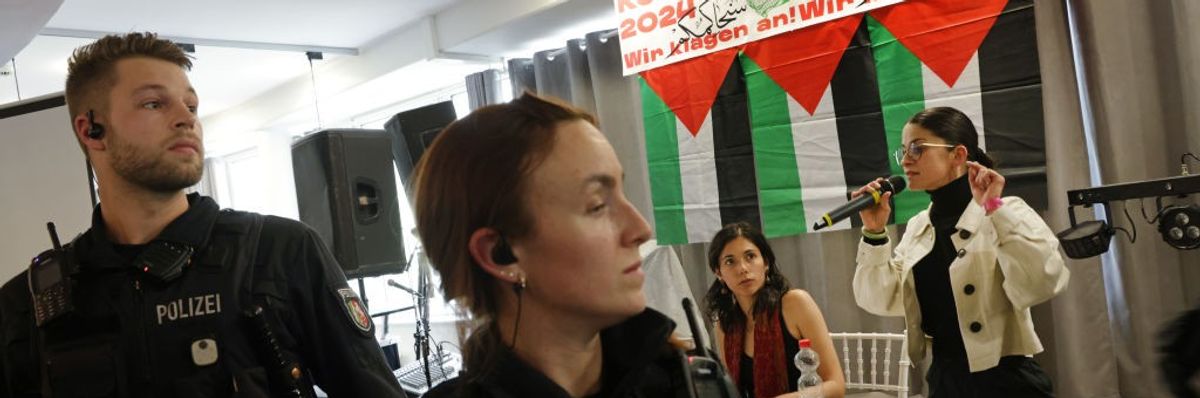
    Varoufakis—a former Greek finance minister who heads the Democracy in Europe Movement 2025 (DiEM25)—was scheduled to address the Palestine Congress, which was slated to run through Sunday in the German capital. However, hundreds of police officers blockaded the event venue on Germaniastraße in Templehof before storming the building and demanding organizers cut the livestream and end the event. Several people including at least one Jewish participant were led away by police.

    “This is what democracy in Europe right now really looks like!” DiEM25 said on social media.

    In his speech, Varoufakis lamented that “a decent people, the people of Germany, are led down a perilous road to a heartless society by being made to associate themselves with another genocide carried out in their name, with their complicity.”

    “You want to silence us. To ban us. To demonize us. To accuse us. You, therefore, leave us with no choice but to meet your accusations with our accusations,” Varoufakis said, referring to the German political establishment—including the leftist Greens.

    “So, let’s be clear: We are here, in Berlin, with our Palestinian Congress because, unlike the German political system and the German media, we condemn genocide and war crimes regardless of who is perpetrating them,” Varoufakis said. “Because we oppose apartheid in the land of Israel-Palestine no matter who has the upper hand—just as we opposed apartheid in the American South or in South Africa. Because we stand for universal human rights, freedom, and equality among Jews, Palestinians, Bedouins, and Christians in the ancient land of Palestine.”

    https://twitter.com/yarahawari/status/1778836307097096416?ref_src=twsrc%5Etfw%7Ctwcamp%5Etweetembed%7Ctwterm%5E1778836307097096416%7Ctwgr%5Ea59fcf8949a60daf2728818d6c3540d72106e14f%7Ctwcon%5Es1_c10&ref_url=https%3A%2F%2Fwww.commondreams.org%2Fnews%2Fvaroufakis-palestine-congress

    Varoufakis’ speech comes as Germany faces an International Court of Justice case brought by Nicaragua and which accuses Berlin of complicity in the Israeli genocide in Gaza, where nearly 110,000 Palestinians—mostly innocent men, women, and children—have been killed or maimed by over the past six months.

    The convening of the Palestine Congress, and the antagonism against it by authorities, coincides with a growing crackdown by German officials on pro-Palestinian voices in academic, artistic, literary, and other spaces.

    Watch Varoufakis’ speech:

    Read Varoufakis’ remarks as prepared for delivery:

    Friends,

    Congratulations, and heartfelt thanks, for being here, despite the threats, despite the ironclad police outside this venue, despite the panoply of the German press, despite the German state, despite the German political system that demonizes you for being here.

    “Why a Palestinian Congress, Mr. Varoufakis?” a German journalist asked me recently. Because, as Hanan Asrawi once said: “We cannot rely on the silenced to tell us about their suffering.”

    Today, Asrawi’s reason has grown depressingly stronger: Because we cannot rely on the silenced who are also massacred and starved to tell us about the massacres and the starvation.

    But there is another reason too: Because a proud, a decent people, the people of Germany, are led down a perilous road to a heartless society by being made to associate themselves with another genocide carried out in their name, with their complicity.

    I am neither Jewish nor Palestinian. But I am incredibly proud to be here amongst Jews and Palestinians—to blend my voice for peace and universal human rights with Jewish voices for peace and universal human rights—with Palestinian voices for peace and universal human rights. Being together, here, today, is proof that coexistence is not only possible—but that it is here! Already.

    “Why not a Jewish Congress, Mr. Varoufakis?” the same German journalist asked me, imagining that he was being smart. I welcomed his question.

    For if a single Jew is threatened, anywhere, just because she or he is Jewish, I shall wear the Star of David on my lapel and offer my solidarity—whatever the cost, whatever it takes.

    So, let’s be clear: If Jews were under attack, anywhere in the world, I would be the first to canvass for a Jewish Congress in which to register our solidarity. Similarly, when Palestinians are massacred because they are Palestinians—under a dogma that to be dead they must have been Hamas—I shall wear my keffiyeh and offer my solidarity whatever the cost, whatever it takes.

    Universal human rights are either universal or they mean nothing.

    With this in mind, I answered the German journalist’s question with a few of my own:

    • Are 2 million Israeli Jews, who were thrown out of their homes and into an open-air prison 80 years ago, still being kept in that open-air prison, without access to the outside world, with minimal food and water, no chance of a normal life, of traveling anywhere, and bombed periodically for 80 years? No.
    • Are Israeli Jews being starved intentionally by an army of occupation, their children writhing on the floor, screaming from hunger? No.
    • Are there thousands of Jewish injured children with no surviving parents crawling through the rubble of what used to be their homes? No.
    • Are Israeli Jews being bombed by the world’s most sophisticated planes and bombs today? No.
    • Are Israeli Jews experiencing complete ecocide of what little land they can still call their own, not one tree left under which to seek shade or whose fruit to taste? No.
    • Are Israeli Jewish children killed by snipers today at the orders of a member state of the United Nations? No.
    • Are Israeli Jews driven out of their homes by armed gangs today? No.
    • Is Israel fighting for its existence today? No.

    If the answer to any of these questions was yes, I would be participating in a Jewish Solidarity Congress today.

    Friends, today, we would have loved to have a decent, democratic, mutually respectful debate on how to bring peace and universal human rights for everyone, Jews and Palestinians, Bedouins and Christians, from the Jordan River to the Mediterranean Sea, with people who think differently to us.

    Sadly, the whole of the German political system has decided not to allow this. In a joint statement including not just the CDU-CSU or the FDP but also the SPD, the Greens and, remarkably, two leaders of Die Linke, joined forces to ensure that such a civilized debate, in which we may disagree agreeably, never takes place in Germany.

    I say to them: You want to silence us. To ban us. To demonize us. To accuse us. You, therefore, leave us with no choice but to meet your accusations with our accusations. You chose this. Not us. You accuse us of anti-Semitic hatred. We accuse you of being the antisemite’s best friend by equating the right of Israel to commit war crimes with the right of Israeli Jews to defend themselves.

    You accuse us of supporting terrorism. We accuse you of equating legitimate resistance to an apartheid state with atrocities against civilians which I have always and will always condemn, whomever commits them—Palestinians, Jewish settlers, my own family, whomever. We accuse you of not recognizing the duty of the people of Gaza to tear down the wall of the open prison they have been encased in for 80 years—and of equating this act of tearing down the Wall of Shame—which is no more defensible than the Berlin Wall was—with acts of terror.

    You accuse us of trivializing Hamas’ October 7 terror. We accuse you of trivializing the 80 years of Israel’s ethnic cleansing of Palestinians and the erection of an ironclad apartheid system across Israel-Palestine. We accuse you of trivializing Netanyahu’s long-term support of Hamas as a means of destroying the two-state-solution that you claim to favor. We accuse you of trivializing the unprecedented terror unleashed by the Israeli army on the people of Gaza, the West Bank, and Easr Jerusalem.

    You accuse the organizers of today’s Congress that we are, and I quote, “not interested in talking about possibilities for peaceful coexistence in the Middle East against the background of the war in Gaza.” Are you serious? Have you lost your mind? We accuse you of supporting a German state that is, after the United States, the largest supplier of the weapons that the Netanyahu government uses to massacre Palestinians as part of a grand plan to make a two-state solution, and peaceful coexistence between Jews and Palestinians, impossible.

    We accuse you of never answering the pertinent question that every German must answer: How much Palestinian blood must flow before your justified guilt over the Holocaust is washed away?

    So, let’ s be clear: We are here, in Berlin, with our Palestinian Congress because, unlike the German political system and the German media, we condemn genocide and war crimes regardless of who is perpetrating them. Because we oppose apartheid in the land of Israel-Palestine no matter who has the upper hand—just as we opposed apartheid in the American South or in South Africa. Because we stand for universal human rights, freedom, and equality among Jews, Palestinians, Bedouins, and Christians in the ancient land of Palestine.

    And so that we are even clearer on the questions, legitimate and malignant, that we must always be ready to answer: Do I condemn Hamas’ atrocities? I condemn every single atrocity, whomever is the perpetrator or the victim. What I do not condemn is armed resistance to an apartheid system designed as part of a slow-burning—but inexorable—ethnic cleansing program.

    Put differently, I condemn every attack on civilians while, at the same time, I celebrate anyone who risks their life to TEAR DOWN THE WALL.

    Is Israel not engaged in a war for its very existence? No, it is not. Israel is a nuclear-armed state with perhaps the most technologically advanced army in the world and the panoply of the U.S. military machine having its back. There is no symmetry with Hamas, a group which can cause serious damage to Israelis but which has no capacity whatsoever to defeat Israel’s military, or even to prevent Israel from continuing to implement the slow genocide of Palestinians under the system of apartheid that has been erected with longstanding U.S. and E.U. support.

    Are Israelis not justified to fear that Hamas wants to exterminate them? Of course they are! Jews have suffered a Holocaust that was preceded by pogroms and a deep-seated antisemitism permeating Europe and the Americas for centuries. It is only natural that Israelis live in fear of a new pogrom if the Israeli army folds. However, by imposing apartheid on their neighbors, by treating them like sub-humans, the Israeli state is stoking the fires of antisemitism, is strengthening Palestinians and Israelis who just want to annihilate each other, and, in the end, contributing to the awful insecurity consuming Jews in Israel and the diaspora.

    Apartheid against the Palestinians is the Israelis’ worst “self-defense.”

    What about antisemitism? It is always a clear and present danger. And it must be eradicated, especially amongst the ranks of the global Left and the Palestinians fighting for Palestinian civil liberties around the world.

    Why don’t Palestinians pursue their objectives by peaceful means? They did. The PLO recognized Israel and renounced armed struggle. And what did they get for it? Absolute humiliation and systematic ethnic cleansing. That is what nurtured Hamas and elevated it in the eyes of many Palestinians as the only alternative to a slow genocide under Israel’s apartheid.

    What should be done now? What might bring peace to Israel-Palestine? An immediate ceasefire. The release of all hostages: Hamas’ and the thousands held by Israel. A peace process, under the U.N., supported by a commitment by the international community to end apartheid and to safeguard equal civil liberties for all.

    As for what must replace apartheid, it is up to Israelis and Palestinians to decide between the two-state solution and the solution of a single federal secular state.

    Friends, we are here because vengeance is a lazy form of grief. We are here to promote not vengeance but peace and coexistence across Israel-Palestine. We are here to tell German democrats, including our former comrades of Die Linke, that they have covered themselves in shame long enough—that two wrongs do not one right make—that allowing Israel to get away with war crimes is not going to ameliorate the legacy of Germany’s crimes against the Jewish people.

    Beyond today’s congress, we have a duty, in Germany, to change the conversation. We have a duty to persuade the vast majority of decent Germans out there that universal human rights are what matters. That “never again” means never again. For anyone, Jew, Palestinian, Ukrainian, Russian, Yemeni, Sudanese, Rwandan—for everyone, everywhere.

    In this context, I am pleased to announce that DiEM25’s German political party MERA25 will be on the ballot paper in the European Parliament election this coming June—seeking the vote of German humanists who crave a member of European Parliament representing Germany and calling out the E.U.’s complicity in genocide—a complicity that is Europe’s greatest gift to the antisemites in Europe and beyond.

    I salute you all and suggest we never forget that none of us are free if one of us is in chains.

    Original article by BRETT WILKINS republished from Common Dreams under Creative Commons (CC BY-NC-ND 3.0). 

    US Official Says Iran’s Message Is: ‘Don’t F*ck With Us and We Won’t F*ck With You’

    ‘Genocidal Actions’ Persist in Gaza as Israel Blocks Aid and US Weapons Flow

    US Tax Day Campaign Urges Congress to Stop Arming Israel’s Genocide in Gaza

  • Germany bans public grieving and solidarity with Palestine

    Spread the love

    Original article republished from peoples dispatch under a Creative Commons Attribution-ShareAlike 4.0 (CC BY-SA) license.

    Demonstrators in Berlin take the streets in solidarity with Palestine (Photo: Montecruz Foto)

    Germany is home to Europe’s largest Palestinian community, with roughly 80,000 Palestinians living in the country. For years, German authorities have tried to stifle Palestinian activism in the country, viewing it as a nuisance to its explicit policy of “unconditional support for Israel.” Demonstrations, such as one earlier this year to mark the 75th anniversary of the Nakba, have been sporadically banned in recent years and organizations, like the Palestinian prisoner solidarity network Samidoun, have also come under increasing scrutiny.

    Yet the criminalization of solidarity with Palestine on a national level has taken on entirely new dimensions since October 7. After a small demonstration on Berlin’s busy Sonnenallee street on the evening of October 7, the German media and body politic have been up in arms about Palestinians supposedly celebrating terrorism and antisemitism on German streets.

    Talking points that were two weeks ago only uttered by far-right AfD politicians are now being openly expressed by politicians from all parliamentary parties in Germany. Playing off the idea of “imported antisemitism,” the social democratic Chancellor Olaf Scholz is now arguing that “we must finally deport on a large scale” residents who do not hold German citizenship and openly protest against Israel. The Christian Democrats (CDU) are even demanding that the recognition of Israel’s right to exist must become a precondition for German citizenship.

    Samidoun has been made into public enemy number one, as the media presents the group as a bastion for “sympathizers of terror” that poses “a particular danger, because as a secular organization, they are building bridges between Islamists and radical leftists.” In a speech before parliament on October 12, Chancellor Scholz personally announced a ban on Samidoun along with a ban on the activities of Hamas in Germany. 

    In Berlin specifically, which is home to one of the largest Palestinian diaspora communities outside the Arab world, the authorities have been particularly hostile towards any signs of solidarity with Palestine. Since October 7, every demonstration explicitly or implicitly referring to Palestine has been banned, leaving the roughly 30,000 Palestinians living in Berlin with no means of expressing their anguish at the siege and bombardment of Gaza.

    Solidarity groups have been trying to bypass this censorship by avoiding political statements and focusing on humanitarian campaigning, yet even demonstrations and slogans such as “Children in Gaza need help” and “Solidarity with the civilian population in the Gaza Strip” were banned. On October 13, the police went so far as to ban a demonstration registered by the group “Jewish Voice for a Just Peace in the Middle East” entitled “Jewish Berliners against violence in the Middle East.” 

    Sonnenallee, a busy street in the district in which many Arab migrants live, has become a focal point of dissent against Israel’s attack on Gaza. The police patrol Sonnenallee every evening with tight controls on the public squares. Racial profiling and brutal arrests are commonplace and often recorded and posted to social media. One particular video shows police officers stomping out a candle-lit vigil with their boots.

    In a letter to all Berlin schools, the city’s Department for Education, Youth and Family set out strict guidelines on how to discuss the situation in Palestine with students. “Any demonstrative action or expression of opinion that can be understood as advocating or approving of the attacks against Israel or support for the terrorist organizations carrying them out, such as Hamas or Hezbollah, constitutes a threat to school peace in the current situation and is prohibited.” According to the letter, these may include the following: “visibly wearing relevant clothing (for example, the kuffiyeh known as the Palestinian scarf), displaying stickers and patches with inscriptions such as ‘free Palestine’ or a map of Israel in the colors of Palestine (white, red, black, green), and shouting ‘free Palestine!’ and demonstrating verbal support for Hamas and its terrorism.”

    At one high school on Sonnenallee, a 61-year-old teacher attempted to confiscate a Palestinian flag from a 14-year-old student and ended up in a physical altercation with a second 15-year-old student. The parents’ association of the school tried to organize a demonstration under the slogan “No place for racism, no place for violence” as a reaction to the incident, yet it was promptly banned by the police, ostensibly as a “a precautionary measure”. The Central Council of Palestinians in Germany has since sent a letter in response to Berlin’s Department for Education, expressing their “great concern about the psychological and educational development [of their children]” in Berlin schools.

    As other European states are witnessing mass protests in solidarity with Palestine, the German state has been able to use force and violence to prevent such scenes on German streets. Yet it is unlikely that the government will be able to ban these sentiments of solidarity indefinitely, especially as the images of Israel’s brutal attack on Gaza continue to circulate around the world.

    Original article republished from peoples dispatch under a Creative Commons Attribution-ShareAlike 4.0 (CC BY-SA) license.