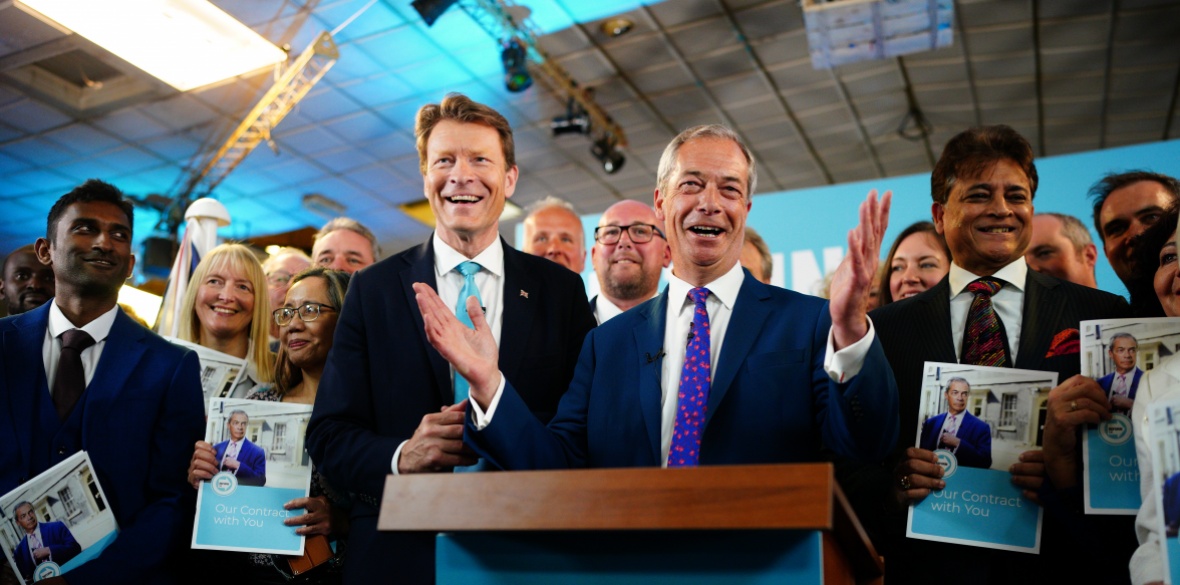
Reform UK chairman Richard Tice (left) and party leader Nigel Farage launch ‘Our Contract with You’ in Merthyr Tydfil while on the General Election campaign trail, June 17, 2024
REFORM started targeting Labour “red wall” voters today as the hard-right party launched its reactionary election manifesto in Wales.
The party’s owner and leader Nigel Farage went to Merthyr Tydfil, once represented by Labour pioneer Keir Hardie, to tell voters that “Labour is not very different to the Conservatives … it is just more incompetent.”
And he restated his aim of being the main challenger to Labour for government by 2029, likely date of the next general election following July 4.
The nationalist party’s platform is anti-migrant, opposed to climate action and supportive of NHS privatisation while cutting foreign aid and leaving the European Court of Human Rights.
It aims to take advantage of muted enthusiasm for Sir Keir Starmer’s Labour in working-class communities by rekindling the Brexit divisions it skilfully exploited in 2019.
Reform’s increasing prominence in the general election comes as the Tory Party’s campaign looks on the verge of expiring.
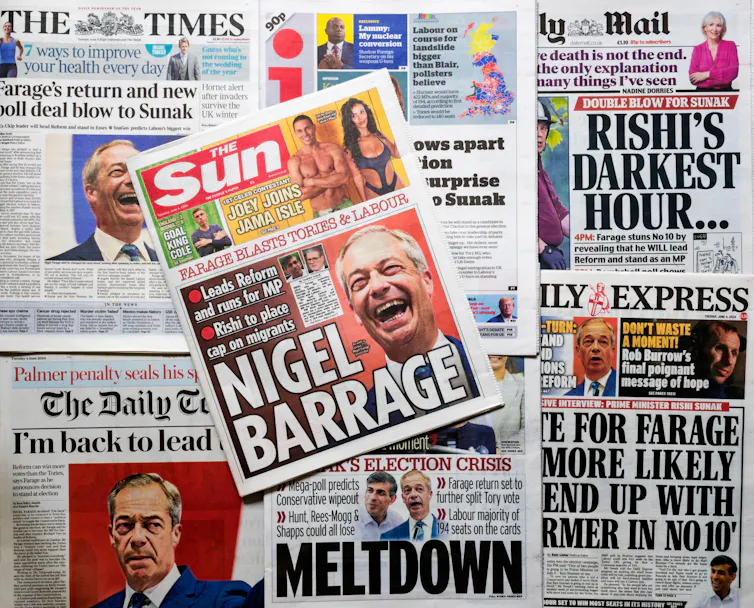
Nigel Farage, a man who has never been elected to the House of Commons despite years of trying, has again been allowed to set the agenda in the UK.
Ten years after Ukip won the European parliament elections, throwing the Conservative party into turmoil and leading David Cameron to promise a referendum on the UK’s membership of the European Union, Farage is at it again. Or more precisely, he is being allowed to go at it again.
The mainstream elite in the media and in politics who claim to oppose Farage, and who pretend to stand as a bulwark against far-right politics, are again duly buying into the hype he has created for himself.
We could already feel that hype bubbling as Farage took over as leader of Reform. He’d seen the party’s fortunes rising and started to think there could be something in it for him to step into the campaign.
We could see it in the coverage of every move he made thereafter – every milkshake thrown, every inflammatory quip quoted and beer drunk, snapped and plastered all over the news as some kind of morbid excitement set in among the media. Finally, something exciting is happening in this otherwise rather dull campaign, where offers of “change” and pledges to be “bold” are hollow slogans for the sides of battle buses.
To understand how a party which only received 2% of the registered votes in the 2019 general election, failing to get even one MP elected, can get such attention, we must travel back in time.
Ukip was a party created by a eurosceptic elite, for a eurosceptic elite, to put pressure on the Conservatives via the EU elections. It all seemed a rather desperate move at the time, as the issue was marginal at best.
The party received 15.6% of the vote in the 2004 European elections and 16% in 2009. But these are second order elections, prone to low turnout and high protest vote. In these settings, Ukip really only received a mere 6% and 5.6% of the registered vote, once turnout was taken into account. Hardly the voice of the “silent majority”.
The 2005 and 2010 general elections clearly showed the limits of Ukip’s appeal. In 2005, the party received 1.4% of the vote and in 2010, it took 2%.
Ukip’s election vote share
Ukip results in general elections (GE) and European elections (EU). A Mondon., CC BY-ND
Still, the first “breakthrough” was in 2014 when Ukip won the EU elections with 26.6%. An “earthquake”, we were told. This was the start of the “left behind” myth which served Farage well as it diverted attention away from his elitist stance. The fantasised “white working class” would come to play a key role in shaping the narrative after the victories of both Donald Trump in the US and Brexit. Proper scrutiny of Ukip’s (and Reform’s) programmes (or Trump’s for that matter) would have also shown that beyond typical far-right measures and other gimmicks, their project was always deeply skewed in favour of the wealthy.
Yet even though Ukip really only received the support of one out of ten registered voters (9.5%) in 2014, in particularly favourable circumstances, the mainstream elite could not get enough of Farage. Finally, the UK had a “populist” contender worthy of the name. They too could feel the same voyeuristic thrills as their European counterparts, watching the “irresistible” rise of the far right (or “populism” to be politically correct, as we would not want to offend the far right, no matter how clear Farage has made his views).
What is striking is that it is this election which set in motion the 2016 referendum, even though Ukip was the only party running on a platform demanding that the UK leave the EU. For all the talk of “taking back control” and “sovereignty”, this reactionary experiment was decided based on the support of less than 10% of voters. Even in terms of votes cast, the referendum was forced onto almost three out of four voters who had decided to vote for parties who were not formally demanding the country leave the EU.
In case you missed it… Alamy/Urban images
All this is to say, Farage has simply never been that popular. This is despite him campaigning in incredibly fertile environments in which parts of the media are dedicated to propping him up, and where even those who seemingly oppose his politics cannot get enough of him – as demonstrated by his record number of appearances on the BBC or the countless articles on “populism” in the Guardian.
Just look at how much coverage a press conference given after one single poll has received, when other parties fail to get issues such as climate change, poverty or social care on the agenda.
And if you think this is because immigration is people’s key concern, think again. Indeed, as I explored with Lancaster university’s Aaron Winter in a report for the Runnymede Trust, the “immigration issue” is one that is clearly constructed in a top-down manner. Unsurprisingly, when people are asked about the key concerns in their personal lives, immigration doesn’t rate. Ironically, the exaggerated focus on immigration could be argued to be elite manipulation rather than the other way around.
So, what’s behind the rise of Farage? Well, the same processes which have been at play across much of Europe: the hyping of far-right politics as a diversion. As has become abundantly clear, there is no mainstreaming or rise of far-right politics without the active involvement of mainstream forces who normalise and platform them.
Want more election coverage from The Conversation’s academic experts? Over the coming weeks, we’ll bring you informed analysis of developments in the campaign and we’ll fact check the claims being made.
Sign up for our new, weekly election newsletter, delivered every Friday throughout the campaign and beyond.
The far right then plays a convenient role, serving to scare the electorate at a time when distrust in governing parties is sky high. The message is: “we are bad but they are worse”.
Yet this strategy is exhausted. Patience has run out and the far right is no longer as repulsive as it once was, now that most mainstream parties mimic its discourse.
The solution is simple. Stop fighting it on its turf. Instead, turn to issues which are not only core to people’s concerns, but far less amenable to far right hijacking. This takes bold actions and real change though – both being in short supply in our mainstream parties.
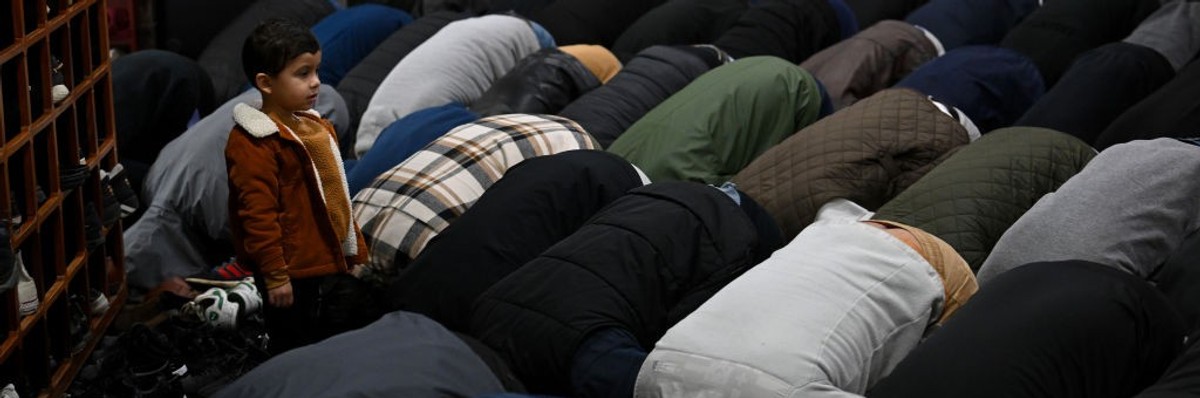
A young boy watches as people pray during a funeral service for 6-year-old Palestinian American Wadea Al-Fayoumi at the Mosque Foundation on October 16, 2023 in Bridgeview, Illinois. (Photo: Joshua Lott/The Washington Post via Getty Images)
“The way to stop the hate is to end the apartheid, occupation, and genocide occurring in Palestine,” said one CAIR leader.
Nearly four months into Israel’s war on the Gaza Strip, the largest Muslim civil rights and advocacy group in the United States on Monday highlighted that the U.S. saw a dramatic rise in Islamophobic hate during the final three months of 2023.
In line with data released last month, the Council on American-Islamic Relations (CAIR) revealed that it received 3,578 complaints from October through December—a 178% jump from a similar three-month period the previous year.
The highest reported categories last quarter were employment discrimination (19%), hate crimes and incidents (13%), and education discrimination (13%), according to CAIR, which plans to release a full analysis and dataset in the months ahead.
Victims of high-profile incidents have included six-year-old Wadea Al-Fayoume, who was stabbed to death in Illinois; three university students shot and wounded in Vermont; and a New York City food cart vendor harassed by a former U.S. State Department official.
“Despite this disturbing wave of bias targeting the Muslim, Arab American, and Palestinian communities, we are witnessing an impressive resilience in the face of bigotry.”
“Despite this disturbing wave of bias targeting the Muslim, Arab American, and Palestinian communities, we are witnessing an impressive resilience in the face of bigotry,” said CAIR national executive director Nihad Awad in a statement.
CAIR’s Monday release comes as the death toll in Gaza has topped 26,600 people—including at least 11,500 children—with over 65,300 others injured and thousands more missing. The vast majority of Gaza’s 2.3 million residents are displaced and hungry.
Despite the International Court of Justice (ICJ) on Friday ordering Israel to “take all measures within its power” to prevent genocide in Gaza, the U.S.-backed Israeli assault on the besieged enclave continues, and fears of a wider regional war keep mounting.
The ICJ’s initial ruling last week also emboldened supporters of a cease-fire, who have repeatedly taken to the streets around the world since Israel launched its current military campaign against Gaza in retaliation for a Hamas-led attack on October 7.
“In the face of relentless hate and bogus smears, American Muslims, Arabs, and a broad coalition of Jewish, Christian, African American, Asian Americans, and others continue calling for justice for Palestine,” CAIR research and advocacy director Corey Saylor said Monday. “This coalition knows the way to stop the hate is to end the apartheid, occupation, and genocide occurring in Palestine.”
In the last 3 months of 2023, we received 3,578 complaints of anti-Muslim and anti-Palestinian bias. That's a 178% increase over previous year. Today at 1 p.m. ET, we plant to host a livestream to discuss and explain this data and its significance.
As Common Dreams reported earlier this month, since Israel declared war, there has also been a significant rise in antisemitism in the United States and worldwide—though reliable figures have been hard to come by, as some individuals and groups conflate protests against the war or criticism of the right-wing Israeli government with hostility toward Jews.
U.S. Attorney General Merrick Garland said in the early weeks of the war that the Department of Justice was monitoring the increase in threats against Jewish, Muslim, and Arab communities nationwide and the Department of Homeland Security last month released resources to help houses of worship and faith-based groups enhance their security.
However, the United States also gives Israel $3.8 billion in annual military aid, and since October 7, U.S. President Joe Biden has sought a new $14.3 billion package while also bypassing Congress to arm Israeli forces—degrading many Arab and Muslim Americans’ trust in the Democrat, who is seeking reelection in November.
As a federal court on Friday held a hearing for a case accusing Biden, Secretary of State Antony Blinken, and Secretary of Defense Lloyd Austin of complicity in genocide, some local leaders in Michigan—a key swing state with the nation’s biggest Arab American population—refused to meet with a delegation from the president’s campaign.
Dawud Walid, the executive director of CAIR’s Michigan chapter, told CNN on Saturday: “There is no possibility of repair while he is supporting an act of genocide. So, there is no reason to have communication.”
dizzy: I’ve been considering Islamaphobia recently. The term doesn’t do it justice – it’s more of a relentless hatred as the title of this article suggests than a fear or similar. It appears to be a form of Neo-Fascism with Muslims as the scapegoat with the classic German Fascist concept of untermensch applied to them.
Opposition to or criticism of Zionism is not anti-semitism of course, they are obviously and clearly distinct. The Zionist UK Labour Party claims that they are equal.