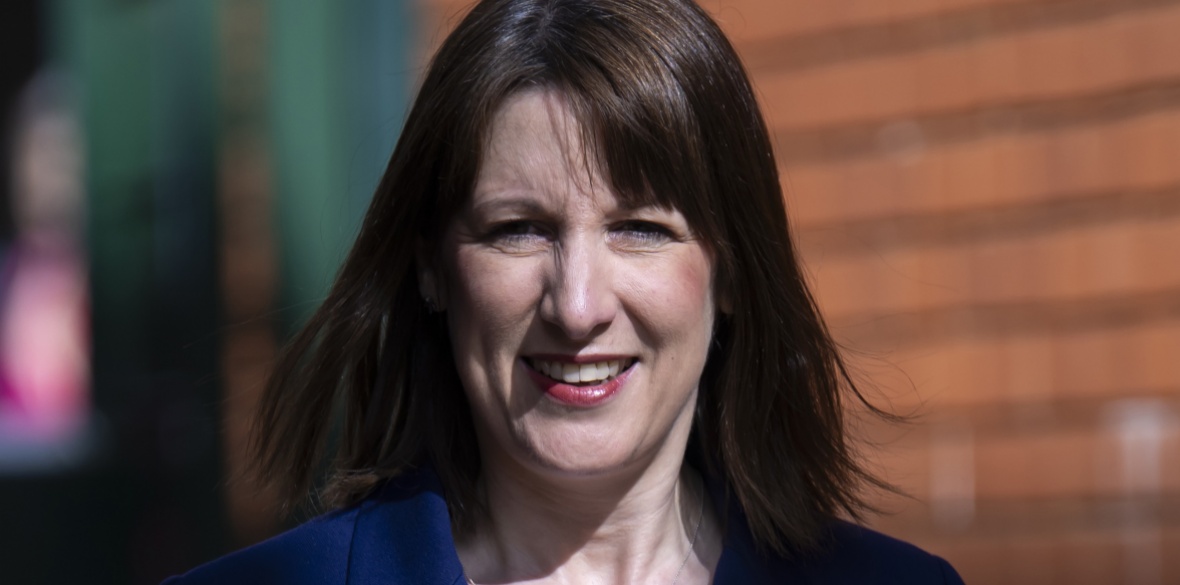
Chancellor of the Exchequer Rachel Reeves arrives to meet students on the carpentry course during a visit to Bury College in Greater Manchester, March 20, 2025
…
Fourteen years of Tory rule have cut services to the bone. The notion that “efficiency savings” can slice off further billions without worsening already degraded services is absurd.
Ironically, the cuts are intended to fund increased military spending — though if there is a department renowned for waste it is the Ministry of Defence. The MoD is repeatedly excoriated by the public accounts committee for the huge sums squandered on projects that end up delayed by years or not delivered at all.
Current Defence Secretary John Healey, when in the shadow cabinet, published a report identifying billions it had overspent on projects and billions more paid for cancelled contracts with its often extortionate suppliers. The report noted that the MoD had even been fined £32.6 million by the Treasury for its “poor accounting practices.” Yet it is this department which is having more billions thrown its way.
As for extortionate suppliers, the evidence is plain that besides tying institutions from hospitals to schools into contracts forcing them to repay PFI debts worth multiples of the original loans, many such agreements also tie them into inflexible and costly servicing contracts.
Outsourcing services is massively inefficient, yet remains the norm, despite Reeves’s one-time promise to deliver “the biggest wave of insourcing in a generation.”
As the Prison Officers Association (POA) points out of outsourced prison maintenance, we end up paying through the nose for “crumbling cells, compromised safety and rodent-infested jails.”
“We do not for one minute accept that the privatised model of prison maintenance is more cost effective than insourcing … it is completely delusional to claim it provides best value for the taxpayer,” POA general secretary Steve Gillan observes.
Clearly value for money is not Reeves’s priority — corporate profits are, including at the Treasury’s expense.
Keir Starmer commits to play the caretaker role for Capitalism through the “hard times”.Keir Starmer explains the moral case for cutting disability benefits. He says work will set you free.
Ofgem controls the charges made to regional energy networks through a set of assumptions and calculations. Photograph: UCG/Universal Images/Getty
Citizens Advice believes Ofgem made flawed interest rate calculation for companies in Great Britain
The companies behind Great Britain’s gas pipes and power lines have pocketed a windfall of nearly £4bn from household bills during the energy and cost crisis, according to a report.
The analysis, by Citizens Advice, argued that energy network owners were able to make the “excess profits” over the past four years after the industry regulator misjudged their costs.
The companies may have made up to £3.9bn more because Ofgem overestimated their borrowing costs as interest rates began to climb, the report calculated. It found that Ofgem allowed regional network companies to recover these costs from household bills even though many were able to secure fixed-rate terms on some of their borrowing which helped them to avoid the impact of rising interest rates.
The flaw in Ofgem’s regulation, which applies from 2021 to 2028, has meant that households were forced to pay billions in undeserved profits to companies during the cost of living crisis while racking up record levels of debt, according to Citizens Advice.
As Los Angeles battles historic wildfires, residents are demanding accountability for why the city’s fire department faced budget cuts while greater disaster preparedness measures were overlooked. These frustrations have fueled questions about the prioritization of aid to Israel and Ukraine.
Just months before the wildfires ravaged the city, LA Mayor Karen Bass approved the budget for the next fiscal year, which included a $17.5 million reduction to the fire department’s funding. The department’s budget slashed to $819.64 million, prompted warnings from Fire Chief Kristin Crowley, who cautioned that the cuts were already impeding emergency response capabilities.
All of this comes amid a revelation that the State of California has sent approximately $610 million in taxpayer funds to Israel, making it the most significant state contributor to Israeli aid in the U.S. This disparity gained attention online after Republican Speaker of the House Mike Johnson suggested imposing conditions on federal disaster relief for Los Angeles.
U.S. House Speaker Mike Johnson has been a staunch advocate of unconditional aid for Israel, notably championing a $74 billion aid package in April 2024 that included $60 billion for Ukraine and $14 billion for Israel, despite mounting public and congressional pressure to curtail such transfers. Specifically, the Leahy Law, named after its author, former Senator Patrick Leahy, prohibits the transfer of military aid to nations credibly accused of committing human rights abuses. In a recent Washington Post op-ed, Leahy urged that the law be applied to Israel, arguing that ongoing rights violations demand accountability and adherence to U.S. legal standards.
Mike Johnson wants to put conditions on aid to those affected by the fires in California – but didn't allow one condition on the more than $100 billion in aid we gave to Ukraine or the more than $20 billion we gave to Israel.
In October 2024, U.S. President Joe Biden drafted a $100 billion aid package for Ukraine and Israel—a striking coincidence, as this is the same amount now proposed to confront the devastating wildfires in Los Angeles. The announcement of a one-time payment of $770 to each wildfire victim by the administration has drawn mixed reactions, with some calling it a necessary gesture while others see it as woefully inadequate. This announcement came mere days after the White House informed Congress of its intention to send an additional $8 billion in military aid to Israel.
Although the aid package isn’t a cash handout to Israelis, the cost of the military aid package would be the equivalent of handing each Israeli over $820. Israel is the largest recipient of U.S. aid in history, amounting to a total of over $250 billion in American taxpayers’ dollars, at least $25 billion of which has been publicly disclosed to have been sent since the beginning of the war in Gaza. At a time when U.S. domestic crises demand urgent attention, the government’s unwavering commitment to foreign aid for Israel continues unabated.
The concern extends beyond monetary figures. Cities across the U.S. struggle to provide safe drinking water, veterans face mounting suicides due to inadequate access to healthcare, and Los Angeles grapples with a homelessness crisis. Experts estimate that $22 billion—roughly equivalent to the aid Israel received in a year—could eliminate homelessness in LA over the course of a decade. Meanwhile, Israelis enjoy clean drinking water year-round and are even expanding their control to include six key water sources in southern Syria, in contravention of international law.
Feature photo | Locals help a firefighter stretch a hose as an apartment building burns, Jan. 8, 2025, in the Altadena section of Pasadena, Calif. Chris Pizzello | AP
Robert Inlakesh is a political analyst, journalist and documentary filmmaker currently based in London, UK. He has reported from and lived in the occupied Palestinian territories and hosts the show ‘Palestine Files’. Director of ‘Steal of the Century: Trump’s Palestine-Israel Catastrophe’. Follow him on Twitter @falasteen47
This article is licensed under a Creative Commons Attribution-NonCommercial-ShareAlike 3.0 International License.
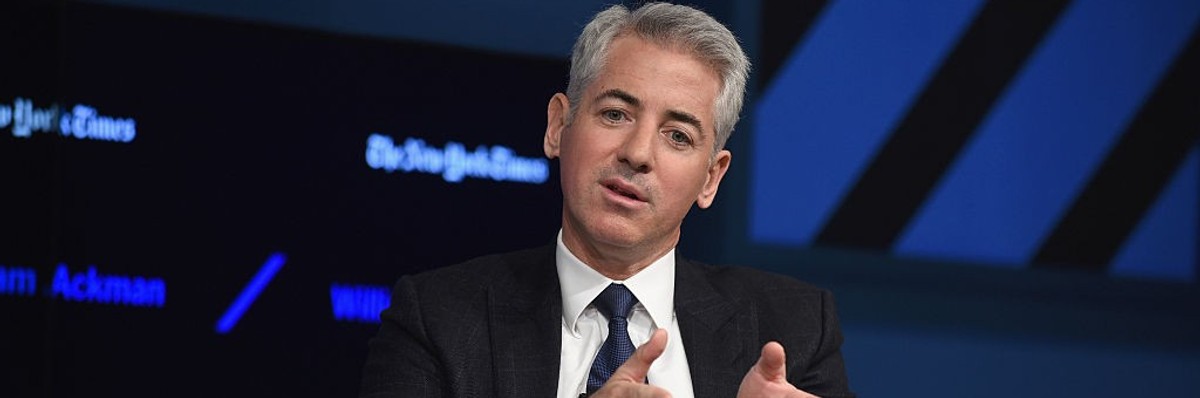
Billionaire hedge fund manager Bill Ackman speaks at The New York Times DealBook Conference at Jazz at Lincoln Center on November 10, 2016 in New York City. (Photo by Bryan Bedder/Getty Images for The New York Times )
Here they are. They have names. They have billions. And they’re the leading American oligarchs backing the ticket that wants to kick the working class and poor people in the face.
No matter who may be supporting them in public opinion polls, Donald Trump and JD Vance are not the saviors of the middle class, the working, class, or the poor. They are not the champions of Blacks, whites, Latinos, men, women or any other demographic group. Their policy proposals won’t even benefit better off but not rich Americans. They are the candidates of casino, real estate, fossil fuel, and tech billionaires. Many are affiliated with Trump 47 or one of the other pro-Trump Super PACs.
I am a union member and have been since I started working as a teenager in the 1960s and I support the Harris-Walz ticket. I think it is a moral transgression in this election to vote for any down ballot Republican candidate that appears on the same line as Trump and Vance. The Democrats must win the House and Senate and local elections to stop the billionaire financed anti-democracy MAGA movement.
Below, in alphabetical order, is a list and description of some of the Trump-Vance team’s key super-wealthy supporters. It is a billionaire’s club.
Hedge fund billionaire Bill Ackman is the chief executive and portfolio manager of Pershing Square Capital Management. Ackman demanded that Trump resign after the January 6 attack on the Capitol, but now endorses Trump. Ackman is a leading crusader against DEI policies and what he perceives of as a wave of antisemitism on college campuses. He played a leading role in forcing Harvard President Claudine Gray to resign, in getting New York City Mayor Eric Adams to use police to breakup protests at Columbia University against Israel’s action in Gaza and contributed to SuperPACs that defeated progressive candidates in Democratic Party primaries because they criticized Israel. Forbes estimates Ackman’s net worth at over $9 billion.
Casino magnates Miriam Adelson and her deceased husband, Sheldon Adelson, were Trump’s biggest donors in 2020. They contributed $90 million to the pro-Trump SuperPAC Preserve America. Adelson is the wealthiest Israeli citizen and one of the fifty wealthiest people in the world. She pledged $100 million to Trump’s 2024 campaign in exchange for his promise that if he is elected President the United States would recognize Israeli sovereignty over the West Bank, torpedoing any possible of an independent Palestinian state.
Marc Lowell Andreessen is a Silicon Valley tech businessman, former software engineer, member of the Facebook Board of Directors, and worth $1.8 billion. In 2016 he endorsed Hillary Clinton for President because of Trump’s anti-immigrant stance, but he is now donating mega-bucks to SuperPACs supporting Trump, hoping to secure policies that favor his investments.
Scott Bessent is founder of the global investment firm Key Square Group with an investment portfolio of $8 billion. Previously Bessent was the Chief Investment Officer of Soros Fund Management, a much more liberal company. At some point, Bessent changed his stripes, and he is now a co-chair of Trump 47, a Republican Party fundraising group in Palm Beach, Florida. Bessent is considered a possible Secretary of the Treasury if Trump is elected.
Robert Thomas Bigelow owns Budget Suites of America and is founder of Bigelow Aerospace. He is a notorious conspiracy theorists providing financial support for investigating UFOs and paranormal phenomena including consciousness after death. Bigelow has originally a DeSantis supporter but switched to Trump when DeSantis dropped out of the race. Bigelow gave Trump a million dollars to help with his legal fees and promised to give $20 million to pro-Trump Super PACs. Bigelow’s net worth is $1.5 billion.
Robert H. Book is chairman of Book Capital Enterprises and Jet Support Services, and a Vice Chairman of Axxes Capital. His net worth is only half a billion dollars so he may not belong on this list. Book, a major philanthropist in support of Israel, was critical of Trump in 2017 for not forcibly condemning neo-Nazis marching in Charlottesville, Virginia. However, in 2020 he gave over a million dollars to the Trump Victory Committee.
Timothy Dunn is the CEO of the fossil fuel company CrownQuest Operating. Dunn contributed to the Trump 2020 campaign and in 2023 he gave $5 million towards the 2024 campaign. He’s an active donor in rightwing Texas politics, giving approxinately $10 million to the conservative Defend Texas Liberty PAC. He co-founded a Christian school where he is on the board of trustees and teaches Sunday school. Dunn opposes abortion, same-sex marriage. and adoptions by same sex couples. He is worth an estimated 2.2 billion.
José Fanjul is a Cuban American a sugar magnate with investments in Domino Sugar and real estate who gave over $800,000 to the Trump 47 Committee and hosted a Trump fundraiser. Fanjul’s company received an estimated $65 million in federal agricultural subsidies that he uses political influence to protect. The family’s business interests are valued at over $8 billion.
Kenneth Griffin is a hedge fund manager who gave $10 million to the House Republican Super PAC and $5 million to the Senate Republican Super PAC. Griffin initially backed Nikki Haley for the 2024 Republican nomination and called Trump a “three-time loser,” but is now prepared to endorse Trump. Griffin is worth about $35 billion.
Harold Hamm, executive chair of Continental Resources, is an oil and gas magnate heavily invested in fracking who is worth $18.5 billion. Hamm is part of the Koch brothers rightwing donor network. He contributed $320,000 to the 2020 Trump campaign and organized a major Trump fundraiser with the fossil fuel industry.
Diane Marie Hendricks and her deceased husband were major supporters of Wisconsin Governor Scott Walker. Her net worth is over $20 billion. From 2014 to 2016, she gave millions of dollars to a Republican Super PAC created by the Koch Brothers and in 2020 Hendricks contributed $1.1 million to Trump’s presidential campaign. She spoke at the 2024 Republican Party National Convention and is also a financial supporter of Georgia representative Marjorie Taylor Greene. Hendricks’ investment in Trump paid off bigtime. She saved $36 million in income taxes from a provision in the 2017 Trump tax cut.
Benjamin Horowitz is a co-founder of the venture capital firm Andreessen Horowitz along with Marc Lowell Andreessen and is personally worth $3.5 billion. He pledged to give money to the 2024 Trump campaign.
Robert “Woody” Johnson is co-owner of the New York Jets football team and an heir to the Johnson & Johnson pharmaceutical company. He is worth an estimated $10 billion. Johnson was a co-financial chair of the Republican Party during Trump’s 2016 campaign and was appointed ambassador to the United Kingdom when Trump was elected. During the 2024 campaign, Johnson has already given over a million dollars to Trump Super PACs.
Doug Leone is a partner at and former head of Sequoia Capital. Forbes magazine estimates he is worth $8.4 billion. In 2021, Leone said Trump lost his support because of the January 6 attack on the Capitol, but he is now back on the Trump bandwagon. He gave $2 million to the Right for America Trump Super PAC and $1 million to the America PAC.
Joe Lonsdale is a technology entrepreneur and investor and co-founder of Palantir worth about half a billion dollars. He donates to Trump through the Super PAC America Pac.
Howard Lutnick is CEO of Cantor Fitzgerald and has a net worth of an estimated $1.5 billion. Lutnick has hosted New York metro area fundraisers for Trump in his home since 2019.
Omeed Malik, who formerly supported Ron DeSantis, changed track and pledged to raise over $3 million and donate at least $100,000 to the Trump campaign. Malik is president of 1789 Capital and CEO of Farvahar Partners. He has an estimated net worth of $6.15 billion.
Home Depot co-founder Bernie Marcus supported Trump for President in 2016 and 2020 and announced he would support Trump again even if he were convicted of crimes. He gave the Trump campaign $25 million in 2020. Marcus, who is worth almost $9 billion, originally supported DeSantis this round and then Haley, but he is now boosting Trump again. He said his donations to the 2024 Trump campaign would be “in line” with past contributions.
Vincent and Linda McMahon are professional wrestling promoters. The McMahons gave $5 million to the Donald J. Trump Foundation. Linda was appointed administrator of the federal Small Business Administration during the Trump administration and spoke at the 2024 Republican National Convention. The McMahon’s have a combined net worth of $3.2 billion.
Timothy Mellon is a descendant of the founder of the Mellon Bank and railroad interests. The bank, under different names, today manages about $50 trillion in assets and the current generation of the family is worth about $15 billion. Mellon is a major Trump supporter. In April 2020, he gave $10 million to Trump’s America First Action Super PAC, and he has pledged $75 million to elect Trump in 2024. He also contributed $25 million to the independent candidacy of Robert Kennedy. Mellon is the definition of rightwing weirdo. He posted online comparing climate scientists to ISIS, is a COVID anti-vaxxer, donated to build a Southern wall, and issued statements that led to him being accused of racism.
Robert and Rebeka Mercer (his daughter and fellow conservative activist) Pappa Mercer was an artificial intelligence proponent and co-chair of the Renaissance Technologies hedge fund. Mercer has a string of companies based in the Caribbean that he uses to avoid paying American income taxes. Among his rightwing activities, he contributed to the Brexit campaign for Great Britain to leave the European Union, works with Koch brother’s groups, financially supported Breitbart News, donated to the Heritage Foundation and the Cato Institute, labels civil rights acts as racist, and helped fund JD Vance’s Ohio Senate campaign. Daughter Rebekah is in charge of the Mercer Family Foundation. She home schooled her children, is on the Heritage Foundation Board of Trustee, was on the 2016 Trump transition team, and works closely with Steve Bannon who she introduced to Trump. Pappa Mercer is probably worth a little less than a billion dollars.
Elon Musk is going all in to elect Trump, providing money through his private pro-Trump Super PAC and free publicity on his social media site including an interview scheduled for posting on August 12. Musk reportedly pledged to contribute $45 million a month to his America PAC, which has already been accused of using data from a subterfuge voting registration drive to aid the Trump campaign. After Musk purchased Twitter, which he rebranded X, there was a surge of antisemitic and racist postings on the platform. Musk himself has also posted or retweeted hateful conspiracy theories, targeted Anthony Fauci, and made fun of people using gender pronouns. It is estimated that Musk is worth over $200 billion.
Chamath Palihapitiya, an early senior executive at Facebook, is a champion of digital currency and a competitive poker player. He co-hosted a San Francisco fund raiser for Trump with David Sacks that raised $12 million and promotes Trump on his podcast. Palihapitiya’s net worth is estimated at $1.2 billion.
Geoffrey Palmer is a Los Angeles-based real estate developer and competitive polo player worth $3.1 billion. His company contributed $5 million to Trump’s 2016 campaign, and he has hosted fundraisers for each of Trump’s campaigns. This round he gave $2 million to Trump’s MAGA Inc. super PAC and $814,600 to the Trump 47 Committee. He was also a major financer of efforts to recall California Governor Gavin Newsom.
John Paulson, net worth $3.5 billion, made his money from the 2008 housing market collapse. He was an early supporter of Trump in 2016, has already raised $50 million for the Trump 2024 campaign, and is another potential Treasury Secretary.
Hedge fund broker Nelson Peltz stated that he regretted voting for Trump after the Capitol attack, but he is now hosting Trump fund raisers at his Palm Beach, Florida mansion, although he says he is not happy about it. Peltz is worth $1.6 billion.
Isaac Perlmutter is an Israeli American billionaire who has had stakes in several companies including Revco drug stores, Remington gun manufacturers, and Marvel Entertainment. He is a friend and unofficial advisor to Trump who helped oversee the Department of Veterans Affairs when Trump was President. Isaac and his wife Laura Perlmutter gave Trump almost $2 million in 2016, and Laura was part of Trump’s inauguration planning committee. In 2024, the Perlmutters have already contributed $10 million to Trump’s Right for America Super PAC. Isaac and Laura Perlmutter live near Mar-a-Lago in Florida and are worth over $4 billion.
Vivek Ramaswamy originally ran against Trump in Republican primaries but then endorsed him and was awarded with a spot at the Republican National Convention. Ramaswamy opposes affirmative action, abortion rights, and birthright citizenship. During his campaign he called the “climate change agenda a hoax” and for raising the voting age to 25. He has endorsed conspiracy theories that the January 6 attack on the U.S. Capitol was a “inside job” and questioning the official story about the September 11th attack on the World Trade Center. He made his money in pharmaceuticals and is worth about a billion dollars.
Todd Ricketts is a co-owner of the Chicago Cubs, a TD Ameritrade board member, and a former Republican Party finance chair. Since 2016 he has been a Trump fundraiser and was chair of the Trump Victory Committee in 2020. The Ricketts family is worth over $4 billion.
Phil Ruffin, a casino magnate, is a longtime associate and business partner of Trump who was with Trump at the 2013 Miss Universe Pageant in Moscow. Ruffin, worth $2.6 billion, contributed $2 million to Trump’s MAGA Inc. Super PAC and more than $800,000 to Trump 47.
Tech investor, podcast host, and venture capitalist David Sacks spoke opening night of the Republican National Convention. on Monday, co-hosted a fundraiser for Trump in San Francisco. Sacks, a former chief operating officer at PayPal, is now a big promoter of crypto currency along with JD Vance. Sacks supported Hillary Clinton in 2016, recently toyed with support for Robert Kennedy, but is now a prominent Trump fund raiser.
Blackstone CEO Steve Schwarzman, a longtime friend of Trump, was chairman of his Strategic Policy Forum when Trump was President. In that role he marshalled billionaires to support Trump tax cuts and economic policies. Schwarzman denounced the January 6 attack on the Capitol Building as an “insurrection” and an “affront to the democratic values we hold dear” and in 2022 he announced he would not support Trump for reelection however Schwarzman is now a Trump supporter and fundraiser again. He is worth $39 billion.
Paul Singer is a hedge fund manager with a net worth of over $6.1 billion. His specialty is buying the debt of poor countries and then forcing them to pay. Singer and the workforce at his company, Elliott Management are a top source of contributions to the National Republican Committee. Singer has contributed to the political efforts of the Koch brothers and gave one million dollars to the Trump 2017 inaugural committee. He originally supported Nicki Haley’s 2024 campaign but has now endorsed Trump.
Jeff Sprecher and his wife, former Georgia Senator Kelly Loeffler are worth over $1 billion. Each contributed over $800,000 to a Trump Super PAC. Sprecher is the former chairman of the New York Stock Exchange.
So far Peter Thiel, co-founder of PayPal and Palantir, has not endorsed Trump again. He contributed a million dollars to the trump 2016 campaign but did not give money in 2020. Thiel, who is gay and part of a same-sex marriage, remains unhappy with Trump and the Republican Party’s focus on hot-button cultural issues. However, he was a major supporter of JD Vance’s Senate campaign and is expected to eventually support the Trump-Vance ticket because of his major investment in crypto currencies. Thiel, the person who introduced Trump to Vance, is worth $4.2 billion.
Richard Uihlein and Elizabeth Uihlein are founders of Uline and Richard is also an heir to Schlitz. They are anti-union, anti-tax, anti-regulation, and anti-gay and transgender rights. Their $10 million contribution to the Trump 2024 Make America Great Again Super PAC is currently the second largest Trump gift. The Uihleins are worth over $6 billion.
Kelcy Warren, the chairman and former CEO of a pipeline company with a net worth of over $6 billion gave over $800,000 to the Trump 47 Committee and $5 million to the MAGA Inc. super PAC.
Cameron and Tyler Winklevoss each gave over $1 million to the Trump 47 Committee and $250,000 to the America PAC. The twins run the cryptocurrency exchange Gemini and are each worth $2.7 billion. When endorsing trump, Tyler Winklevoss called him “pro-Bitcoin, pro-crypto, and pro-business.”
Steve Wynn was vice-chairman of Trump’s 2017 inaugural committee. He is casino and real estate magnate worth $3.4 billion who is accused of sexual misconduct and acting as a foreign agent for China. Wynn gave over $800,000 to the Trump 47 Committee.
Jeffrey Yass is the co-founder trading and technology company Susquehanna International Group, a major investor in TikTok which is under attack because its parent company is owned by China, and Trump’s sham media company. He has a net worth of $27.6 billion. He is a self-proclaimed libertarian, on the executive advisory council of the Cato Institute, and an advocate for charter schools and vouchers. Yass is one of the largest Republican Party deep pockets and contributed to several candidates challenging the results of the 2020 Presidential election.
The recently-approved Rosebank oil field in the North Sea has been touted as a way to boost the UK economy and its energy security. But even with its windfall tax on energy company profits, the project is a good example of how the UK could miss out on billions in taxes over the life of an oilfield.
Energy companies Equinor and Ithaca expect to invest £8.1 billion in Rosebank from development, during its operation and when they decommission the field once they’ve finished extracting its oil. Of this, 78% will be invested in UK-based businesses, and the project will support 1,600 jobs at the height of construction and around 450 UK-based jobs over its entire lifetime.
The UK charges a headline 75% rate of tax on all UK energy production and so, at first glance, a major project like Rosebank would be expected to generate billions in tax payments for the UK Treasury over the years. But, according to my research, it could instead create billions in tax savings for the companies involved.
Of the 75% tax that energy companies are currently charged, profits from oil and gas extraction in the UK are charged a corporate tax of 30%, supplemented by an extra 10% charge. The other 35% in taxes comes from the UK’s windfall tax.
Such levies are typically used to redistribute profits when a company benefits from external circumstances. For example, energy companies have recently seen profits soar as prices rose due to concerns about satisfying global oil and gas demand during Russia’s invasion of Ukraine.
The UK rolled out an additional 25% windfall tax in 2022 for oil and gas companies in response to this profit spike. On January 1 2023, the government increased it to 35% until at least the spring of 2028. The UK government raised £2.6 billion from the windfall tax alone last year.
When the windfall tax is added to the 30% rate and the 10% extra, that makes for a whopping 75% tax on energy companies. This seems like a lot, but the reliefs and other tax breaks open to companies often help a lot of these charges disappear. When a business invests its profits, it can benefit from first-year capital allowances, subtract costs related to daily operations and gain additional investment allowances that can be saved up to reduce taxes on future profits.
Crunching the numbers
If an oil company makes £10 million, for example, current tax rules would claim £7.5 million from this. But if the company reinvests the earnings in oil and gas extraction, it wouldn’t just zero out its tax, it could also set aside an extra £1.6 million against future gains – or £3.4 million if it invests in decarbonisation.
Project this on to Equinor and Ithaca’s multibillion-pound Rosebank investment and it could generate up to £8.4 billion in tax savings for the companies involved, based on my analysis of levies on energy producers,
A spokesperson for Equinor told The Conversation: “These are numbers we don’t recognise.” Adding that estimates by energy consultancy Wood Mackenzie found Rosebank would bring £26.8 billion to the UK through tax payments and investments, he continued: “Over the years, oil and gas taxation in the UK has changed many times. It is impossible to estimate with any certainty exactly how large tax revenue and value creation this project will generate for the UK.” Ithaca did not respond to a request for comment.
Many players in the UK’s oil and gas sector can take advantage of a range of capital and investment allowances, deductions and taxation reliefs. In fact, before the windfall tax, companies often got back more from the UK government than they paid in taxes.
The windfall tax will expire in 2028 or if energy prices fall below a certain level for six months. And so while it has forced some companies pay tax on some recent bumper profits, it won’t always be around to make even that happen.
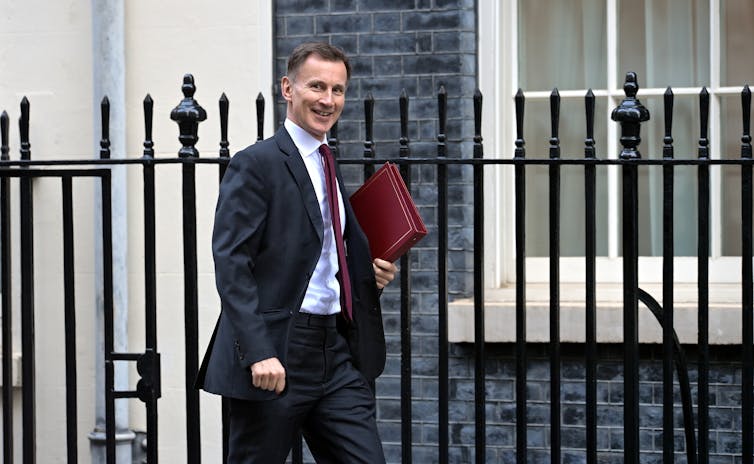
UK chancellor Jeremy Hunt increased and extended a UK windfall tax on oil and gas companies last year. Sean Aidan Calderbank/Shutterstock
Shortsighted or strategy?
Compared to nations like Norway that offer more long-standing corporate tax regimes, the UK’s history is riddled with policies that have been swayed by short-term political urgencies. This sidelines long-term vision and provides a very weak signal to companies considering investment in the UK.
A revolving door of UK prime ministers in recent times hasn’t helped and has also seen investors lose some confidence in the country’s economy. A slew of lucrative tax reliefs might seem like the perfect way to counterbalance recent policy oscillations.
Central to the UK’s energy strategy is an intent to ramp up extraction, ostensibly to enhance national energy security. But will this happen with Rosebank?
When asked about this, the Equinor spokesperson said: “Rosebank will strengthen our contributions to UK energy security. The field is estimated to start producing in 2026/2027 and produce for more than 20 years. The gas will go into the UK pipeline system. The oil will be offloaded offshore. It is a light, sweet crude oil that can be used in refineries in the UK. If the UK needs the oil, when the field starts producing, the UK will get it.”
The UK continues to feed the oil and gas industry with reliefs, while renewable energy projects (but not gas-generation) face the electricity generator levy – a 45% charge on power generated above a £75 per megawatt hour (MWh) threshold. As much of the rest of the world moves towards more sustainable energy solutions, the UK should realign its tax priorities with the broader, greener global vision.