Carbon Capture ‘Not Going to Happen,’ Top Fossil Fuel Advocate Predicts

Spread the love

Original article by Geoff Dembicki republished from DeSmog.
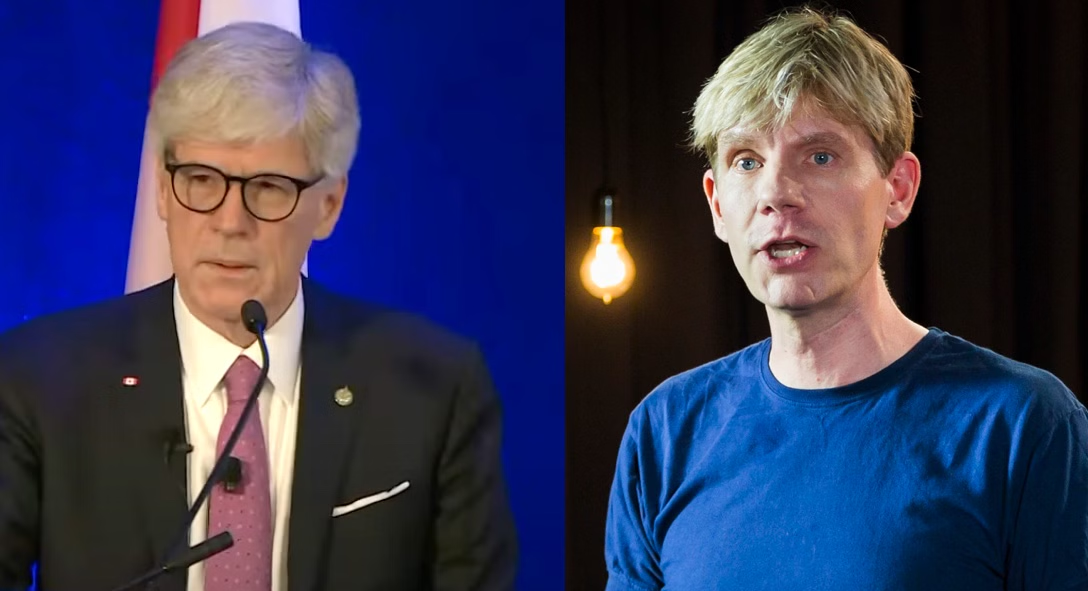
Canada Energy Minister Tim Hodgson (left) and climate crisis denier Bjorn Lomborg (right). Credit: Dan Lofton (CC BY-NC 2.0) and CPAC / YouTube

In audio obtained by DeSmog, Bjorn Lomborg told a Fraser Institute event in Vancouver that the technology is way too expensive to be viable.

Bjorn Lomborg has for years promoted the idea that fossil fuels are crucial for humankind through syndicated newspaper columns, best-selling books and appearances on TV shows including HBO’s Real Time with Bill Maher.

He’s been called a “friend” by Trump administration energy secretary and former fracking executive Chris Wright and helps advise an anti-net zero organization known as the Alliance for Responsible Citizenship (ARC) created by the Canadian conservative podcaster Jordan Peterson.

Yet the Danish political scientist — who acknowledges that climate change is real but denies that it’s a serious crisis — has a dim view of the oil and gas industry’s preferred solution to climate change: carbon capture and storage.

That technology is favored by Alberta premier Danielle Smith and Liberal energy minister Tim Hodgson, both of whom recently floated the idea of a “grand bargain” where Canada’s oil and gas industry gets approval for new pipelines in exchange for moving forward with a $16.5 billion carbon capture project.

It might seem that a prominent fossil fuel advocate like Lomborg would support technology loudly touted by major oil and gas producers and their political allies. But speaking at a private event last week in Vancouver, exclusive audio of which was obtained by DeSmog, Lomborg argued that “carbon capture will always be a net cost” to oil and gas producers and the taxpayers that subsidize it.

“In realistic terms, I don’t think it’s ever going to happen,” he added, referring to the prospect of prices for the technology coming down low enough that it can be rapidly and cost-efficiently deployed worldwide.

On that point Lomborg might actually be in agreement with climate policy experts who are also critical of carbon capture. “There’s a lot of federal money and provincial money that could be thrown at this thing,” Dave Sawyer, principal economist at the Canadian Climate Institute, recently told DeSmog. “We’ve been looking at this option for almost 20 years and it hasn’t happened.”

Speaking at the Fraser Institute

Lomborg was in the west coast Canadian city to speak at a private luncheon hosted by the Fraser Institute, a free-market organization with a long history of disputing the scientific reality of climate change that has received funding from the likes of Exxon and the charitable foundation of oil and gas billionaire Charles Koch.

It’s a leading member of Atlas Network, an influential coalition of more than 500 groups worldwide that promote free-market policies and whose partners in Canada have developed political strategies for fossil fuel expansion. 

“Yes, global warming is real. It’s man-made, but it’s often also vastly exaggerated,” Lomborg claimed at the Fraser Institute luncheon, the same day that the United Nations warned that global temperatures were likely to breach the crucial warming threshold of 1.5 degrees within the next five years. 

During the event he was asked for this thoughts about carbon capture, a technology that Canada’s largest oil and gas companies have for years argued is crucial for achieving “net zero” emissions in their operations.

Those companies, via an industry group called Pathways Alliance, are currently in talks with the federal and Alberta governments to build a multi-billion dollar carbon capture project in the heart of the Canadian oil sands which could be subsidized heavily by taxpayers.

“The problem is you need to store it underground,” Lomborg said, referring to the carbon dioxide captured by the technology. And to do that on a meaningful scale worldwide, he argued, “you have to build at least an infrastructure equivalent to the infrastructure that we built in the last hundred years for oil and gas. And remember back then, we did it because it was incredibly profitable. This time we would just have to pay for it.”

Current costs in Canada could be as high as $150 per tonne of CO2. Lomborg noted that for direct air capture projects — which Pathways Alliance is also proposing and involve sucking carbon emissions from the atmosphere — the costs could be as high as $600 per tonne. At those price points, widespread deployment is “not going to happen,” he said.

Growing rightwing backlash to CCS

Climate experts such as University of Pennsylvania scientist Michael Mann have for years argued that carbon capture and storage is a false solution to the climate crisis that allows oil and gas companies to suck up huge amounts of public money while continuing to pump fossil fuels. “It’s not a meaningful climate solution and it displaces meaningful climate solutions like clean energy, renewable energy,” he told a U.S. House panel in 2022.

But recently there has been growing backlash to the technology from conservatives and fossil fuel advocates, some of whom see it as an egregious government waste.

“We might as well take tax money at gunpoint and burn it,” Peterson, the conservative podcaster, wrote last year on X in response to a CCS project in Wyoming.

At Peterson’s ARC conference in London this February, the climate crisis denier Robert Bryce told DeSmog that carbon capture “will never work at scale.” He added, “Once you get that CO2 super-compressed and you’re pushing it down underground, there are very few places where you can actually sequester it. So it’s a lot of money wasted.”

That skepticism is now translating into federal U.S. policy, with Wright’s Department of Energy recently canceling $3.7 billion in decarbonization awards for carbon capture projects from Exxon and other fossil fuel producers. 

Canada is still pushing ahead, however. Recently appointed Liberal energy minister Hodgson, a previous board member of oil and producer MEG Energy, said during a speech in Calgary in May that “All of us, governments and industry, need to get the Pathways [carbon capture] project done.”

During his Vancouver talk, Lomborg argued that the main reason oil and gas companies are pursuing such prohibitively expensive climate projects is so they can be generously supported by governments.

“What you can do is you can get a lot of subsidies,” he said.

Original article by Geoff Dembicki republished from DeSmog.
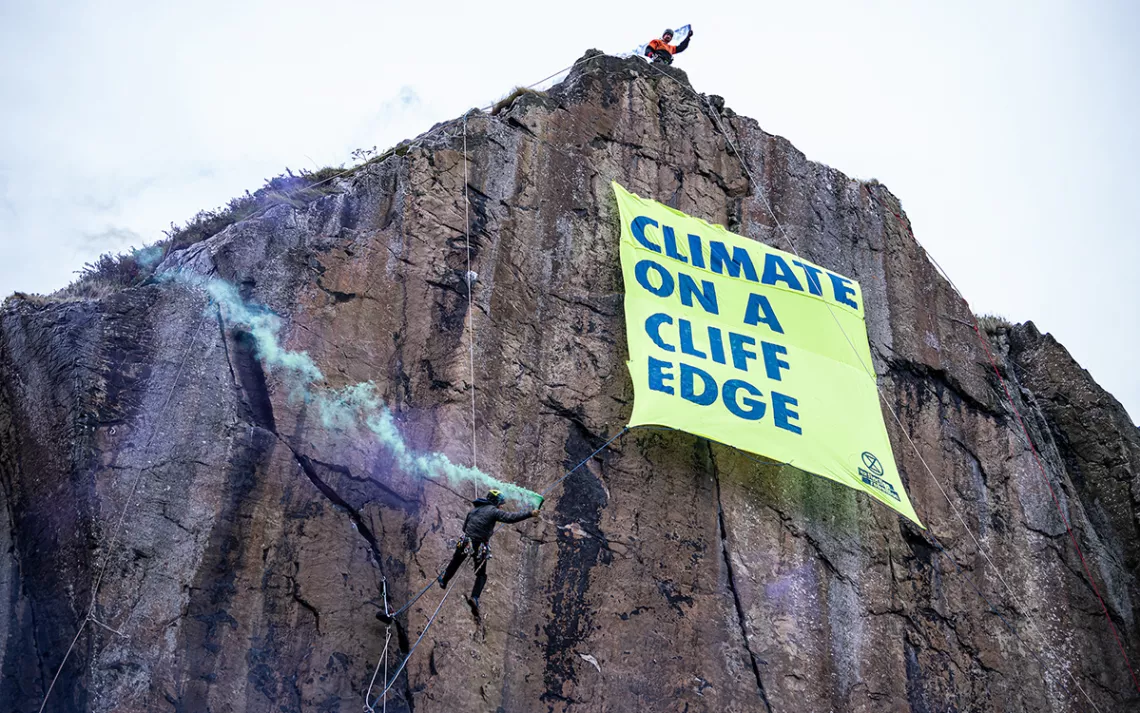
Experienced climbers scale a rock face near the historic Dumbarton castle in Glasgow, releasing a banner that reads “Climate on a Cliff Edge.” One activist, dressed as a globe, symbolically looms near the edge, while another plays the bagpipes on the shores below. | Photo courtesy of Extinction Rebellion and Mark Richards
Orcas comment on killer apes destroying the planet by continuing to burn fossil fuels.
Continue ReadingCarbon Capture ‘Not Going to Happen,’ Top Fossil Fuel Advocate Predicts

Climate Crisis Deniers Explain Why They Like U.S. Energy Secretary Chris Wright

Spread the love

Original article by Geoff Dembicki republished from DeSmog

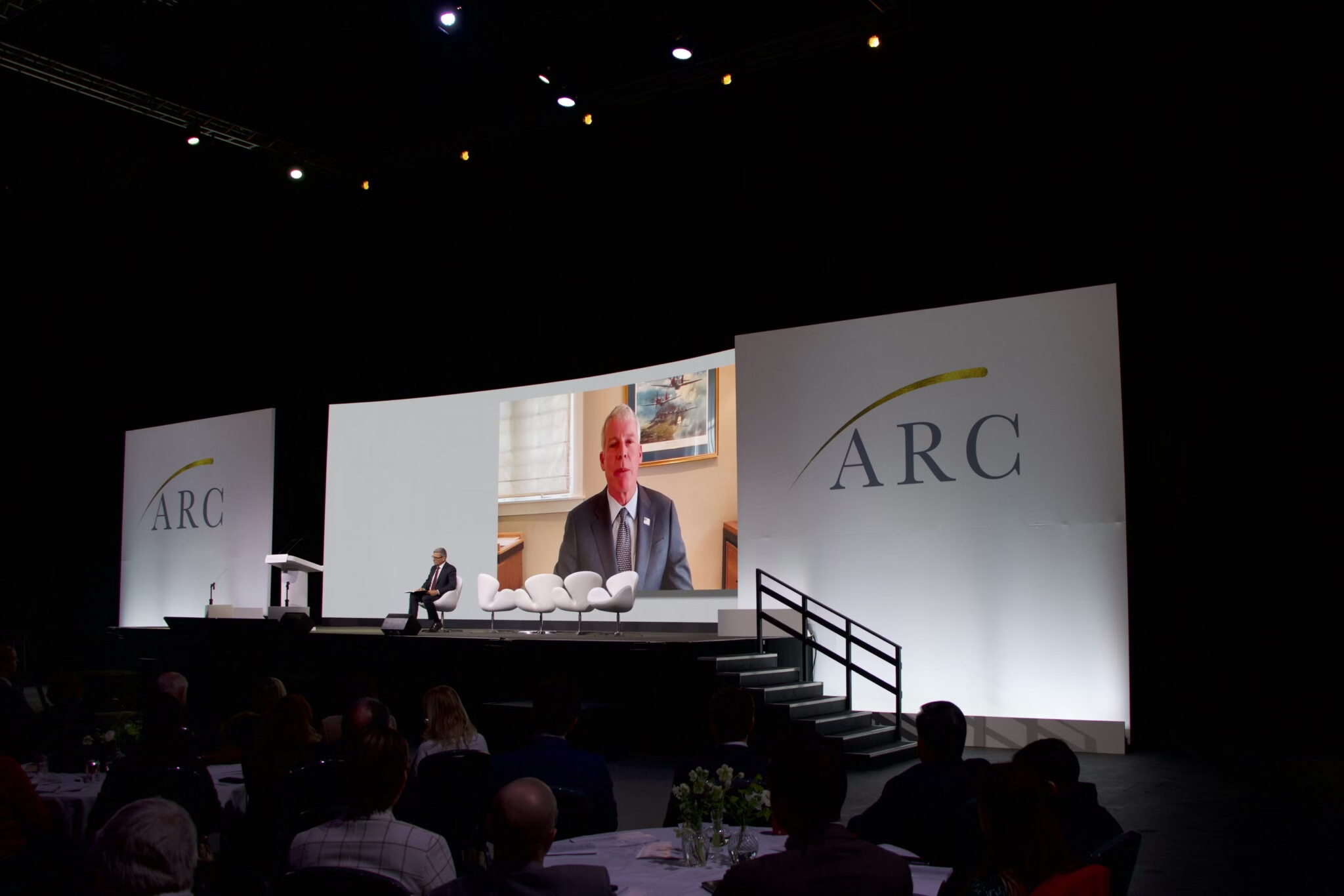
U.S. Energy Secretary Chris Wright speaks to ARC by video. Credit: Marc Fawcett-Atkinson

In exclusive interviews, they called the Trump administration official “terrific,” “very smart,” and someone who “gets it.”

In mid-February, U.S. Energy Secretary Chris Wright described the global effort to stabilize greenhouse gas emissions in dark and conspiratorial terms.

“Net zero 2050 is a sinister goal,” he told the Alliance for Responsible Citizenship (ARC), an international gathering of conservatives convened by Canadian podcaster, author, and anti-climate powerbroker Jordan Peterson. “It’s certainly been a powerful tool used to grow government power [and], top-down control, and shrink human freedom.”

Then in March, Wright did a speech at the 43rd annual CERAWeek where he attacked the Biden administration’s climate policies as a “quasi-religious” agenda “that imposed endless sacrifices on our citizens.”

Those views put Wright, formerly a CEO with the fracking company Liberty Energy, far outside the Paris Agreement consensus among many world leaders and heads of major corporations that climate change is an urgent issue that requires fundamental changes to our global energy system.

But Wright’s reactionary statements are winning him praise from fossil fuel advocates who acknowledge that human-caused climate change is real but deny that it presents existential threats to civilization – what watchdog nonprofits such as the Center for Countering Digital Hate refers to as “the new denial.” 

In exclusive interviews with DeSmog and Canada’s National Observer conducted during the ARC conference, three prominent figures who deny there is a climate emergency explained why they’re excited that Wright holds one of the most consequential cabinet posts in the Trump administration, with one referring to the U.S. energy secretary as “a good friend.”

Bjorn Lomborg speaks about his most recent book during a press briefing at ARC. Credit: Marc Fawcett-Atkinson

Bjorn Lomborg

One particularly influential climate crisis denier is Bjorn Lomborg, a Danish political scientist who for decades has been trying to convince policymakers and the public that there are more important global challenges to address than climate change. This is the subject of his most recent book, Best Things First, which Lomborg was promoting at ARC. Last year, Peterson personally presented a copy of the book to Elon Musk.

“We’ll have to wait and see if he actually reads it,” Lomborg said of Musk in an interview with DeSmog and Canada’s National Observer at the conference.

Lomborg, who is an advisor to ARC, said during a keynote speech that efforts to transition off fossil fuels are a “green fantasy.” Lomborg acknowledges that climate change is real but claims, contrary to decades of scientific and economic evidence, that it will be relatively easy and painless for humankind to adapt.

Those arguments have resonated with Wright, who during a 2020 podcast referred to Lomborg’s previous book False Alarm as “fantastic,” and earlier this year described him as a “friend” on LinkedIn.  

Asked what he thinks about Trump’s pick for energy secretary, Lomborg replied: “Look, Chris Wright is a great guy and he’s very smart. And I’m very happy that we can get a more sense-based approach to how we do energy.”

Part of that, according to Lomborg, is acknowledging — despite low-carbon investment surpassing $2 trillion in 2024 — that a transformative global shift to green energy isn’t happening anytime soon. “We’re not there yet,” he said. “And that, I think, is what Chris Wright can help us to do, which is to say, ‘let’s be realistic now and let’s find smarter ways to have greener energy sources in the future.’”

Scott Tinker does a speech at ARC. Credit: Marc Fawcett-Atkinson

Scott Tinker

During his 13-minute presentation at ARC, Scott Tinker outlined his view that energy has to be affordable, reliable, and clean, criteria that in his view disadvantages renewable energy. “If you want 100 percent clean you don’t get much of these other things,” he told the conference. “There are trade-offs in the real world.”

Tinker runs an organization called Switch Energy Alliance that creates videos about energy and climate change for classrooms, museums, and professional training sessions. The organization says that it wants an “energy-educated future that is objective, nonpartisan, and sensible.”

But Tinker tends to promote the benefits of fossil fuels while downplaying the urgency of addressing global temperature rise. During a podcast interview in March, Tinker said it was “a very strange form of economic colonialism” to argue against developing world countries burning fossil fuels “because we’ll wreck the climate.” We shouldn’t fear a bit of atmospheric warming, Tinker added, urging listeners to instead consider “all the positive things” countries gain from oil, gas, and coal.

Wright has used similar language, telling a gathering of African leaders in March that it would be “a paternalistic post-colonial attitude” for the U.S. to stand in the way of their fossil fuel resources.

The similarities between Wright’s and Tinker’s views aren’t a coincidence. Tinker told DeSmog in an interview at ARC that he and the U.S. energy secretary have known each other for years. “Chris is a good friend,” Tinker said. “We’ve bounced a lot back and forth.”

One other area they seem to agree on is rejecting carbon dioxide’s legal status as a pollutant in the U.S., which helps provide the basis for the Environmental Protection Agency to regulate emissions. That’s been a long-time goal of climate denial organizations such as the CO2 Coalition and Heartland Institute.

“We shouldn’t confuse [CO2] with being a pollutant,” Tinker said.

Robert Bryce speaks at ARC. Credit: ARC / YouTube

Robert Bryce

For years Robert Bryce has been on a mission to convince the world that renewable energy can never replace or out-compete coal, gas, and oil. Previously a senior fellow with the Manhattan Institute— a think tank with a long history of accepting fossil fuel money and questioning the scientific consensus on climate change — Bryce now attacks climate solutions as an author, speaker, and filmmaker.

During his speech at ARC, he claimed that “we are inundated with climate catastrophism,” and argued without evidence that the primary motivation for environmentalists to be opposed to fossil fuels is because their organizations have “enormous” budgets, saying “it’s a big business.”

Bryce is a long-time proponent of nuclear energy, something he shares in common with Wright, who stepped down as a member of the board of directors at the nuclear company Oklo after he was confirmed as energy secretary in February.

“Chris gets it,” Bryce said in an interview with DeSmog. “Chris knows what the score is. He’s a natural gas guy, a hydrocarbon guy. He’s promoting nuclear power. Hopefully this administration, now that they’re actually talking about nuclear, can actually move the ball forward, it’s overdue.”

Bryce and Wright also seem to share opposition to carbon capture and storage, a technology widely favored by oil and gas producers, which tout it as key to reducing emissions from their operations despite it being widely used to pull more oil from the ground. Under Wright, the U.S. Department of Energy is considering cutting billions of dollars’ worth of funding for projects utilizing the technology.

“There is only one reason why any of these hydrocarbon companies are doing carbon capture,” Bryce said. “Subsidies, that’s it.”

“It will never work at scale,” he added. “Once you get that CO2 super-compressed and you’re pushing it down underground, there are very few places where you can actually sequester it. So it’s a lot of money wasted.”

This special investigation between Canada’s National Observer and DeSmog was produced in collaboration with the I-SEA and TRACE Foundation.

Original article by Geoff Dembicki republished from DeSmog

Neo-Fascist Climate Science Denier Donald Trump says Burn, Baby, Burn.
Elon Musk urges you to be a Fascist like him, says that you can ignore facts and reality then.
Continue ReadingClimate Crisis Deniers Explain Why They Like U.S. Energy Secretary Chris Wright

Jordan Peterson Generates Millions of YouTube Hits for Climate Crisis Deniers

Spread the love

Original article by Geoff Dembicki republished from DeSmog.

The conservative influencer has ‘become a central cog in the denial machine,’ says climate scientist Michael Mann.

ByGeoff Dembicki on 5 Sept, 2023 @ 09:46 PDT

Imag eof climate change denier Jordan Peterson.
‘Climate change is the idiot socialist get-out-of-jail-free card,’ Peterson recently tweeted. Image:  Gage Skidmore, Flickr, CC.

Fringe climate crisis deniers who claim that the earth is “cooling” and greenhouse emissions are good for “biological productivity” are getting exposed to millions more people than they normally would on YouTube thanks to conservative influencer Jordan Peterson. 

That’s according to viewership data newly reviewed by DeSmog, which reveals a massive visibility boost for public figures who’ve been active in the climate denial movement for years but whose ideas — such as the claim that plants are growing much better due to increased carbon dioxide in the atmosphere — are now rarely taken seriously by most legacy media outlets.  

They include climate crisis deniers like Judith CurrySteven KooninRichard LindzenAlex Epstein and Bjorn Lomborg. Despite having either a modest YouTube presence or none at all, these figures have collectively garnered nearly five million views after being interviewed on Peterson’s channel, which has 7.31 million subscribers. The New York Times, by comparison, has 4.33 million YouTube subscribers. 

This is especially worrying to climate scientists and disinformation experts because Peterson for years has been actively courting alienated males in their 20s and younger. Traditionally, people who are “doubtful” or “dismissive” of climate change have tended to skew older. Peterson is now planting doubt via his podcast and social media posts about the severity and urgency of global warming in the minds of younger generations.

“‘Climate change,’” he tweeted in June, is “the idiot socialist get-out-of-jail-free card.”

And he is now in the process of putting real political power behind the climate crisis denial movement. In late October and early November, a new group Peterson founded called the Alliance for Responsible Citizenship (ARC) will hold in London, England, its first ever meetings. It has on its advisory board Republican presidential candidate Vivek Ramaswamy, who during GOP debates in August said that “the climate change agenda is a hoax.”

Image of climate change denier Vivek Ramaswamy.
ARC advisor Ramaswamy: ‘the climate change agenda is a hoax.’ Image: Gage Skidmore, Flickr, CC.

Advisors to the group include Lomborg, a Danish political scientist who earlier this year argued on Peterson’s podcast that “climate change is a real problem, but it’s not this catastrophic end of the world.” Lomborg didn’t respond to questions from DeSmog. Other advisors are Texas Republican congressmember Dan Crenshaw; Utah Republican Senator Mike Lee; former Australian prime minister Tony Abbott; and dozens of conservative policymakers, financiers, activists and journalists from the U.S., Canada, the U.K. and Australia.  

The Alliance for Responsible Citizenship is being supported by founders and leaders of the Legatum Group, a Dubai-based investment firm behind The Legatum Institute, a pro-Brexit think tank in London with close ties to the U.K. Conservative Party. The Legatum Group is a leading investor in the rightwing British television network GB News. Read DeSmog’s in-depth report on ARC’s U.K. links here.

Experts argue this makes Peterson a key organizer at the global level for efforts to oppose and delay action on climate change. “I would say that Jordan Peterson has become a central cog in the denial machine,” Michael Mann, director of the Penn Center for Science, Sustainability and the Media at the University of Pennsylvania, told DeSmog. 

“It’s concerning that he’s poisoning the minds of so many influenceable people with his pseudo-intellectual and pseudoscientific drivel, drivel that is being weaponized in the right-wing assault on science and reason,” Mann added, referring to Peterson’s frequent downplaying of climate risks, including the conservative influencer’s insistence that rising levels of carbon dioxide are good for the planet.  

Spreading Denial, Making Money

Peterson’s influence depends to a significant degree on his gigantic YouTube following, which is larger than that of the liberal-leaning news network MSNBC. It also surpasses the following of The Daily Wire, a digital conservative outlet co-founded by Ben Shapiro that has a partnership with Peterson, which last year claimed a yearly revenue of $100 million.   

Google, which owns YouTube, announced a policy in October 2021 prohibiting advertisements on content that “contradicts well-established scientific consensus around the existence and causes of climate change.” Elaborating on the policy in an email to DeSmog, a Google spokesperson wrote that “Debate or discussion of climate change topics is allowed, but when content crosses the line to climate change denial, we stop showing ads on those videos.” 

Yet a Peterson interview from this year entitled “The Great Climate Con,” during which he framed rising greenhouse gas emissions as a positive for making the planet “green in the driest areas,” was accompanied by ads for Birch Gold and Masterworks. Climate scientists say that is a misleading argument because it doesn’t take into account the massively negative effects that intensified droughts, wildfires and heatwaves due to global warming have on plants and ecosystems. 

“Debate or discussion of climate change topics is allowed, but when content crosses the line to climate change denial, we stop showing ads on those videos.”— Google spokesperson

“We’ve reviewed the videos,” the Google spokesperson wrote, “and did not take action on them.”

“What’s the point of having policies if you’re not going to enforce them?” Claire Atkin, co-founder of the anti-disinformation watchdog group Check My Ads, told DeSmog. “YouTube and its ecosystem of marketing tools allow Jordan Peterson to not only spread [misleading statements], but to make money off them.”

Peterson didn’t respond to questions from DeSmog about his current income nor his recent shift towards promoting climate crisis denial online. 

‘Twisted Symbiotic Relationship’

One example of Peterson’s amplifying effect is his interview with Judith Curry, a former Georgia Institute of Technology climatologist who now does consulting work for clients including petroleum companies and natural gas traders. In testimony to Congress in 2015 she claimed incorrectly that recent data “calls into question the conclusion that humans are the dominant cause of recent climate change.” 

While appearing on Peterson’s podcast earlier this year she argued that due to “natural variability” the planet could grow cooler over the next three decades rather than warmer, a position with no credible scientific basis, especially considering that July was the hottest month in recorded human history. Posted to YouTube, where Curry has no official channel, the interview garnered more than 960,000 views. She didn’t respond to questions from DeSmog.

Conservative author and fossil fuel activist Alex Epstein had a modest YouTube following of 15.2 thousand subscribers when he was interviewed by Peterson. “It’s out!” he tweeted after the video was posted. It now has over 1.04 million views, a significant boost considering that the vast majority of videos on his page have under 500 views.  

“I think Jordan Peterson has become more interested in humanistic thinking about fossil fuels,” Epstein wrote in an email to DeSmog. “He has become even more convinced, thanks to my work and others, that the popular movement to rapidly eliminate fossil fuel use is based on invalid thinking methods, false assumptions, and anti-human values.” 

Image of climate change denier Alex Epstein.
Most videos on Epstein’s YouTube page receive fewer than 500 views.  Image: Gage Skidmore, wikimwdia,  Creative Commons Attribution-Share Alike 3.0 Unported license.

During his interview with Peterson, Epstein claimed that “It’s kind of obvious if you have a warmer world with more CO2, it’s a more tropical world with more life. It’s a more green world in the life sense of green. And yet the green movement hates it.” 

Peterson has echoed that statement frequently in his podcast, despite actual scientists saying that greening caused by rising greenhouse gases shouldn’t be celebrated. He claimed during his interview with Steven Koonin, author of a book on climate change science called Unsettled, that “since the year 2000 the world has greened by 15 percent … why the hell isn’t that good news?” That interview has since been viewed more than 1.1 million times. Koonin didn’t respond to a media request. 

“Peterson—who doesn’t appear to know much at all about the science or politics of global warming—has become an influential promoter of illogical ideas,” Benjamin Franta, a senior research fellow in climate litigation at the Oxford Sustainable Law Programme, told DeSmog.

During an interview in 2022 on Joe Rogan’s podcast, for instance, Peterson argued that the climate is too complex a system to be modeled accurately, “and that’s a huge problem when you’re trying to model over 100 years because the errors compound just like interest.” “He sounds intelligent, but he’s completely wrong,” one climate scientist told the Guardian

Though Peterson is among the most visible promoters of climate crisis denial, he’s also part of a wider digital network. Researchers with Climate Action Against Disinformation and the Center for Countering Digital Hate earlier this year found 200 videos on YouTube promoting delay or skepticism around measures to address the climate emergency, garnering nearly 74 million views altogether.    

“[There’s] a twisted symbiotic relationship between these platforms and climate denial content,” Erika Seiber, a climate disinformation spokesperson at the nonprofit Friends of the Earth who is part of the disinfo coalition, told DeSmog. “YouTube runs ads on the content, incentivizing the creation of yet more misleading content, which allows deniers like Peterson to flourish and for their networks to grow.” 

Enabled by Google and YouTube, climate crisis denial could be having real-world influence, disinformation experts say. A poll this summer suggested that 72 percent of U.S. Republican supporters think that the economy should be prioritized over addressing climate change, a 13 point increase from 2018, even as cities sweltered under record heat waves. Conservatives are opposing coastal wind turbines under the pretense of protecting whales. Republican Congressmembers in June passed bills protecting gas stoves in people’s homes. 

“You can see how climate denial content from Peterson and others has informed policy discussions,” Seiber said. “It’s incredibly concerning.”

Original article by Geoff Dembicki republished from DeSmog.
Continue ReadingJordan Peterson Generates Millions of YouTube Hits for Climate Crisis Deniers