‘A Declaration of War’: Israel Accused of Bombing Iranian Consulate in Syria

Spread the love

Original article by BRETT WILKINS republished from Common Dreams under Creative Commons (CC BY-NC-ND 3.0). 

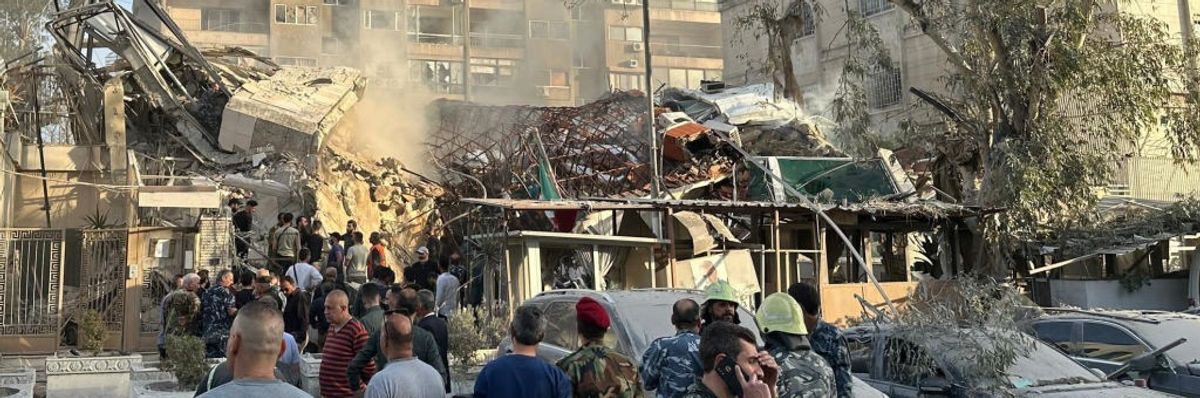
Emergency and security personnel gather at the site of strikes which hit a building next to the Iranian Embassy in Syria’s capital Damascus, on April 1, 2024.
 (Photo: Maher al Mounes/AFP via Getty Images)

One observer said Israel is “trying to provoke a war with Iran to get the U.S. directly involved.”

Iranian and Syrian officials on Monday accused Israel of bombing Iran’s consulate in Damascus, an attack one expert called a “war-abetting escalation” that U.S. President Joe Biden “claimed he was preventing” in the Middle East.

Seven people including Iranian diplomats and Islamic Revolutionary Guard Corps (IRGC) senior commander Gen. Mohammad Reza Zahedi were killed in the airstrike, which according to the BBC occurred at approximately 5:00 pm local time and flattened the multistory building adjacent to the Iranian Embassy in the Syrian capital’s Mezzeh district.

Iranian Foreign Minister Hossein Amir-Abdollahian described the strike as “a violation of all international obligations and conventions.” Faisal Mekdad, his Syrian counterpart, condemned what he called a “heinous terrorist attack.”

https://twitter.com/i/status/1774841744036597877

Israeli officials declined to comment on the attack. Israel has increased airstrikes targeting IRGC and Iran-backed Hezbollah militants inside Syria since the Hamas-led October 7 attacks. Israeli strikes against Hezbollah have also killed hundreds of militants and civilians in Lebanon.

Hamidreza Azizi, a visiting fellow at the German Institute for International and Security Affairs, called the consulate attack a “significant escalation in tensions.”

“This attack is viewed by some in Iran as a declaration of war by Israel against Iran,” Azizi wrote on social media. “It represents a shift from previous engagements, directly hitting Iranian soil represented by its consulate in Syria—as opposed to targeting IRGC officers in Syrian sites.”

“In earlier stages, Israel would refrain from targeting IRGC officers—only proxies and arms shipments,” he continued. “Since the Gaza war, a shift was already there to target high-ranking Iranian commanders. Some sources claim the attack was a response to an assault on an Israeli ship last night at the port of Eilat, attributed to Iraqi militias. This suggests another new rule of engagement by Israel: direct retaliation against Iran for any attacks by its proxies.”

Azizi added that the strike “is also seen as a message to both Iran and [President Bashar] al-Assad’s regime in Syria: Israel’s capability and willingness to escalate its response to the presence of Iranian forces in Syria.”

Numerous experts including Azizi wondered whether Israel informed the United States ahead of the attack. A White House spokesperson said that Biden is aware of reports attributing the strike to Israel and that his “team is looking into it.”

Trita Parsi of the Quincy Institute for Responsible Statecraft said on social media that “this is the exact type of conduct that usually prompts the U.S. to label a country a pariah or rogue state.”

“The U.S. accuses such states of seeking to destroy the ‘rules-based order,'” Parsi noted. “But so far, Biden has acquiesced to Israel’s conduct in this area as well as all other aspects of Israel’s slaughter in Gaza.”

Parsi accused Israel of “seeking to either destroy these norms or create a new normal in which it—much like the U.S.—will be untouchable above these laws and norms.”

He also called the Damascus strike “the kind of war-abetting escalation Biden claimed he was preventing.”

The U.S. has also bombed Syria—as well as YemenIraq, and Somalia—since October 7.

Palestinian Policy Network fellow Tariq Kenney-Shawa said: “What the Biden administration means by ‘taking every measure to avoid regional escalation’ is that they’re making sure only Israel is allowed to escalate. Deploying aircraft carriers, airstrikes in Yemen/Syria/Iraq, all of that is to make sure Israel can provoke but no one can respond.”

While Parsi wondered if Israel attacked Iran’s consulate—its sovereign territory—to elicit a response to justify a larger war, Antiwar.com editor Dave DeCamp went further, accusing Israel of “trying to provoke a war with Iran to get the U.S. directly involved.”

Iranian journalist Mona Hojat Ansari wrote for the Tehran Times that the far-right government of Israeli Prime Minister Benjamin Netanyahu “believes that by plunging the region into a maelstrom of chaos and entangling the United States in another pointless war in West Asia that would drain American resources, it may find a chance to survive as an apartheid establishment.”

“The attack on Iran’s consulate should particularly raise a red flag for Washington,” she added, “as it demonstrates Israel’s readiness to ignite the entire region, even if it means that the U.S. and all its traditional allies in the region would suffer devastating consequences.”

Original article by BRETT WILKINS republished from Common Dreams under Creative Commons (CC BY-NC-ND 3.0). 

Continue Reading‘A Declaration of War’: Israel Accused of Bombing Iranian Consulate in Syria

Israeli Bombing of Gaza Ranks Among ‘Most Devastating’ in History

Spread the love

Original article by BRETT WILKINS republished from Common Dreams under Creative Commons (CC BY-NC-ND 3.0).
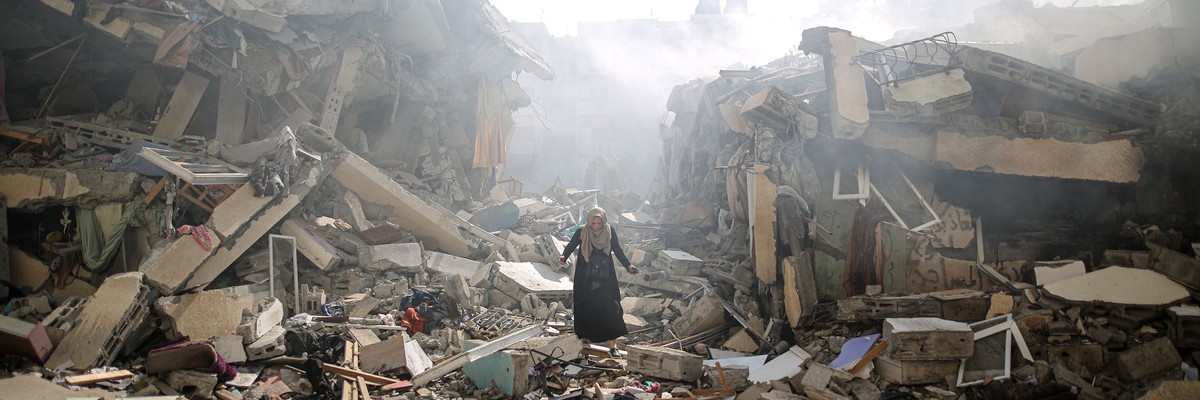
A survivor of Israel’s bombardment of Gaza makes her way through the rubble of the al-Zahra neighborhood on October 19, 2023.  (Photo: Mustafa Hassona/Anadolu via Getty Images)

“Gaza is one of the most intense civilian punishment campaigns in history,” said a U.S. military historian as Israel’s use of arms including 2,000-pound “bunker-buster” bombs pushed the Palestinian death toll over 20,000.

As the Palestinian death toll from Israel’s 10-week annihilation of the Gaza Strip passed 20,000, warfare experts said this weekend that the retaliatory campaign ranks among the deadliest and most destructive in modern history.

Gaza health officials said Friday that 390 Palestinians were killed and 734 others wounded in the besieged strip over the previous 48 hours, driving the death toll from 77 days of near-relentless Israeli attacks to 20,057, with another 53,320 people injured. More than 6,000 women and over 8,000 children have been killed—approximately 70% of all fatalities.

That’s more than twice the number of civilians—and over 14 times as many children—as Russian forces have killed in Ukraine since February 2022.

Thousands more Palestinians are missing and feared buried beneath the rubble of the hundreds of thousands of buildings destroyed or damaged by Israeli bombardment.

“The scale of Palestinian civilian deaths in such a short period of time appears to be the highest such civilian casualty rate in the 21st century,” Michael Lynk, who served as the United Nations special rapporteur on human rights in the Palestinian territories from 2016 to 2022, told The Washington Post on Saturday.

Robert Pape, a U.S. military historian and University of Chicago professor, told The Associated Press that “Gaza is one of the most intense civilian punishment campaigns in history.”

“It now sits comfortably in the top quartile of the most devastating bombing campaigns ever,” he added.

By comparison, the 2017 U.S.-led coalition battle for Mosul, Iraq during the war against the so-called Islamic State—widely viewed as among the most intense urban assaults in recent decades—killed approximately 10,000 civilians, around a third of them from aerial bombardment.

Pape said that by some measures, Israel’s bombing of Gaza is surpassing the Allied “terror bombing” of German cities during World War II.

He noted that U.S. and U.K. airstrikes obliterated about 40-50% of the urban areas of the 51 German cities bombed between 1942-45, and that around 10% of all buildings in Germany were destroyed. In Gaza, approximately 1 in 3 buildings have been destroyed. In northern Gaza, over two-thirds of all buildings have been leveled.

“Gaza is now a different color from space. It’s a different texture,” Corey Scher, who studies natural disasters and wars using satellite remote sensing at the City University of New York’s Graduate Center, told the AP.

Experts point to the types of munitions being used by Israeli forces as a major reason why so many Gazans are being killed and injured. These include U.S.-supplied 1,000-pound and 2,000-pound guided “bunker-buster” bombs, which Israel says are necessary to target Hamas’ underground tunnels.

These massive bombs turn “earth to liquid,” Marc Garlasco, a former Pentagon defense official and war crimes investigator for the United Nations, told the AP. “It pancakes entire buildings.”

Garlasco said that 2,000-pound bombs mean “instant death” for anyone within about 100 feet of the blast, with shrapnel posing a deadly danger for people up to 1,200 feet away.

In a separate interview with CNN, Gerlasco said that the intensity of Israel’s bombardment of Gaza has “not been seen since Vietnam,” when U.S. airstrikes killed up to hundreds of thousands of Vietnamese, Cambodians, and Laotians. The U.S. dropped more bombs on tiny, non-belligerent Laos than all sides combined unleashed during World War II.

“You’d have to go back to the Vietnam War to make a comparison,” Garlasco added. “Even in both Iraq wars, it was never that dense.”

The use of such heavy ordnance in close proximity to critical civilian infrastructure like hospitals has alarmed observers.

“What we have been witnessing is a campaign that was planned, it was a plan, definitely, to close down all the hospitals in the north,” Léo Cans, head of mission for Palestine with Doctors Without Borders, told the Post.

Aided by AI-based target selection systems, Israel Defense Forces (IDF) commanders are approving bombings they know will cause large numbers of civilian casualties. In a bid to assassinate a single Hamas commander, the IDF dropped at least two 2,000-pound bombs on the densely populated Jabalia refugee camp on October 31, killing more than 120 civilians.

Although the United States—which has killed more foreign civilians this century than any other armed force in the world—provides Israel with thousands of 1,000 and 2,000-pound bombs, its own military avoids using such massive ordnance in civilian areas due to the devastation they cause.

“It certainly appears that [Israel’s] tolerance for civilian harm compared to expected operational benefits is significantly different than what we would accept as the U.S.,” Larry Lewis, research director at the Center for Naval Analyses and a former U.S. State Department senior adviser on civilian harm, told CNN.

That includes the risk of killing Israel’s own citizens and others held hostage by Hamas in Gaza.

Lewis added that the Jabalia strike was “something we would never see the U.S. doing.”

That isn’t entirely true; during the 1991 Gulf War the U.S. dropped a pair of 2,000-pound Raytheon GBU-27 Paveway III laser-guided bombs on the Amiriyah air raid shelter in Baghdad, killing at least 408 Iraqi civilians in one of the deadliest single airstrikes in modern history. U.S. officials claimed they thought the shelter, which was used during the Iraq-Iran war, was no longer a civilian facility.

“The use of 2,000-pound bombs in an area as densely populated as Gaza means it will take decades for communities to recover,” John Chappell, advocacy and legal fellow at the Washington, D.C.-based advocacy group Center for Civilians in Conflict, told CNN.

Even more concerning for some experts is Israel’s use of unguided, or “dumb” bombs, against civilian targets in Gaza.

While IDF spokesman Daniel Hagari said that “we choose the right munition for each target so it doesn’t cause unnecessary damage,” the death and destruction in Gaza—and Israeli officials’ own words—tell an entirely different story.

Early in the war, Hagari declared that “Gaza will never return to what it was,” clarifying that “the emphasis is on damage and not on accuracy.”

Meanwhile, numerous Israeli officials advocated the complete destruction of Gaza, with more than a few government figures—including Prime Minister Benjamin Netanyahu and other Cabinet members—making statements supporting genocide against the Palestinian people.

U.S. President Joe Biden—who has affirmed his “unwavering” support for Israel and is seeking $14.3 billion in additional military aid for the country, which already gets almost $4 billion annually from Washington—has implored Israeli leaders to stop the “indiscriminate” bombing of Gaza, even as his administration thwarts international cease-fire efforts and restocks the IDF’s arsenal.

Chappell stressed that “the devastation that we’ve seen for communities in Gaza is, unfortunately, co-signed by the United States.”

“Too much of it is carried out by bombs that were made in the United States,” he added.

Ahmed Abofoul—a Gaza-born, Netherlands-based attorney with ‎the Palestinian human rights organization Al-Haq who has lost 60 of his relatives to Israeli bombing— said in Friday interview with Democracy Now! that “the American government is complicit in this genocide.”

“There is blood of Palestinian children on their hands,” he added. [Biden] said Israel is engaged in indiscriminate bombing. This is a war crime. So, the question is: Why do you then send weapons to Israel? The position of the U.S. is quite hypocritical.”

Original article by BRETT WILKINS republished from Common Dreams under Creative Commons (CC BY-NC-ND 3.0).
Continue ReadingIsraeli Bombing of Gaza Ranks Among ‘Most Devastating’ in History