Tag: bounty

  • Outrage Over ‘Depraved’ Idaho Program Paying Hunters Thousands of Dollars to Kill Wolf Pups

    Spread the love

    Article by Brett Wilkins republished from Common Dreams under Creative Commons (CC BY-NC-ND 3.0).
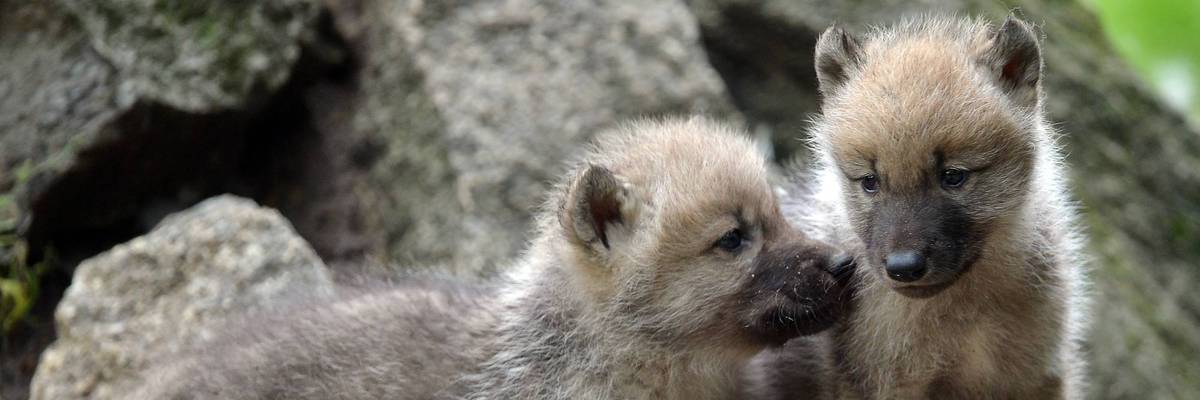
    Canadian wolf pups play in their enclosure at the Berlin Zoo in Germany in 2013.
    (Photo by Britta Pedersen/picture alliance via Getty Images)

    “Let’s call this what it is,” said one conservationist. “It’s a goddamned bounty.”

    Idaho lofficials paid hunters $24,000 to kill a dozen newborn wolf pups this spring, including what appears to have been at least one entire litter massacred in or near its den, according to Friday reporting that has sparked outrage among conservationists and wildlife advocates.

    The killings—which were first reported by the investigative news site Public Domain—took place in late April in Idaho’s northern panhandle. Three hunters received reimbursements of $2,000 per wolf through a state-backed program intended to reduce the Idaho’s wolf population in service of the livestock industry and big game hunters.

    RECOMMENDED…
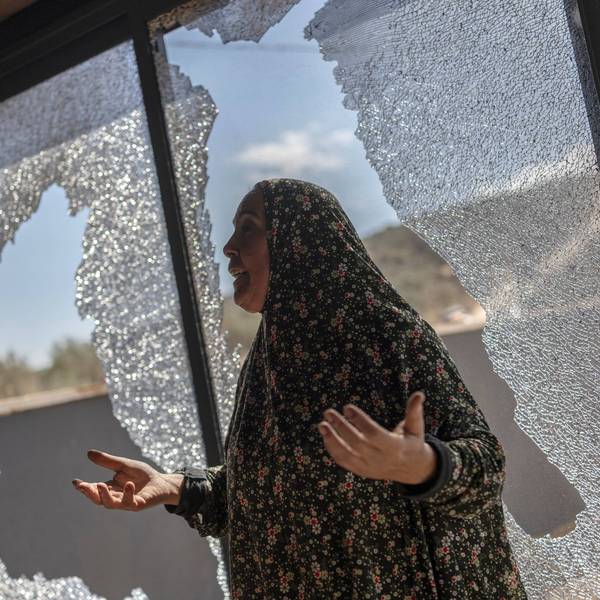
    Palestinian Hanan Hamayei gestures as she stands near the shattered glass of her home following a reported attack by Israeli settlers, in the Israeli-occupied West Bank village of Turmus 'Ayya, on October 19, 2026.

    US Officials Face Fresh Pressure After Another American ‘Brutalized’ by Israeli Settlers in West Bank

    Michigan Congressional Candidate Will Lawrence Hold Election Night Event In Lansing

    ‘Officially a Green Wave Too’: Climate and Eco Champions Triumph in Historic Midterms

    “It’s an abomination,” said Brooks Fahy, executive director of the conservation group Predator Defense. “Let’s call this what it is—it’s a goddamned bounty.”

    “What kind of receipts are you going to show for 12 pups who weigh 12 pounds?” she asked. “It’s ridiculous on its face, and the state of Idaho should be ashamed.”

    The records obtained by Public Domain describe the killings as “still stalk,” suggesting hunters spotted and approached the animals before shooting them. But wolf experts questioned that account, suggesting the hunters may instead have located dens and removed the pups.

    In one instance, a full litter was apparently massacred in or near its den. Doug Smith, a biologist who formerly oversaw Yellowstone National Park’s wolf program, warned in an interview with The Guardian that killing entire litters can fracture or dissolve packs.

    Contrary to popular belief, wolves typically do not protect their young; they usually flee about 50 yards and bark.

    “It’s easy to do,” Smith said of taking a whole litter of pups. “If you can’t reach them, you dig them out with a shovel.”

    “Wolves breed once a year, so the birth of the pups is a very important thing,” Smith said. “The pack’s life hinges on those pups. They’re the glue that holds the pack together.”

    The killings were made possible by Idaho’s increasingly permissive wolf management regime. In 2021, Republican lawmakers passed Senate Bill 1211, which established year-round wolf trapping on private property, eliminated limits on the number of wolf tags an individual could purchase, expanded permissible killing methods, and authorized private contractors to kill wolves.

    That same year, Idaho wildlife officials signed an agreement with the Foundation for Wildlife Management, which reimburses hunters and trappers for expenses associated with killing wolves. Covered costs include fuel, ammunition, vehicle payments, and outdoor clothing. The program is financed through a combination of public money, hunting license revenue, and private contributions.

    The state’s 2023 wolf management plan called for reducing the population to approximately 650 animals during the spring, when wolf numbers typically peak. Idaho’s estimated population nevertheless remained above 1,100 this year, down from a peak of approximately 1,600 in 2019.

    The Idaho controversy comes amid broader concerns about the future of gray wolves in the United States. In September, President Donald Trump signed an executive order directing the Interior Department to consider removing federal Endangered Species Act protections for gray wolves across the continental United States.

    Wolves remain federally protected in most of the Lower 48 states, while Idaho, Montana, and Wyoming have authority over their populations.

    Those are the only three states that received the nation’s lowest grade—a “D”—on the conservationist group Team Wolf’s “State Wolf Management Report Card.”

    Idaho, Montana, Wyoming and Wisconsin all scored a D on humane treatment of wolves.All four are among the worst in the country on animal protection law, Idaho at 48th of fifty.teamwolf.org/report-card

    — (@wombar.bsky.social) 2026-11-06T20:27:16.328Z

    “Trump says you can go out and kill wolves now—how many people took him at his word?” Fahy told Public Domain. “These are sentient creatures. They’re basically dogs. They form family bonds. They mate for life, pretty much. They have a pack structure that is very similar to our social structure. How could we be so wantonly cruel to something that is so similar to us?”

    Article by Brett Wilkins republished from Common Dreams under Creative Commons (CC BY-NC-ND 3.0).
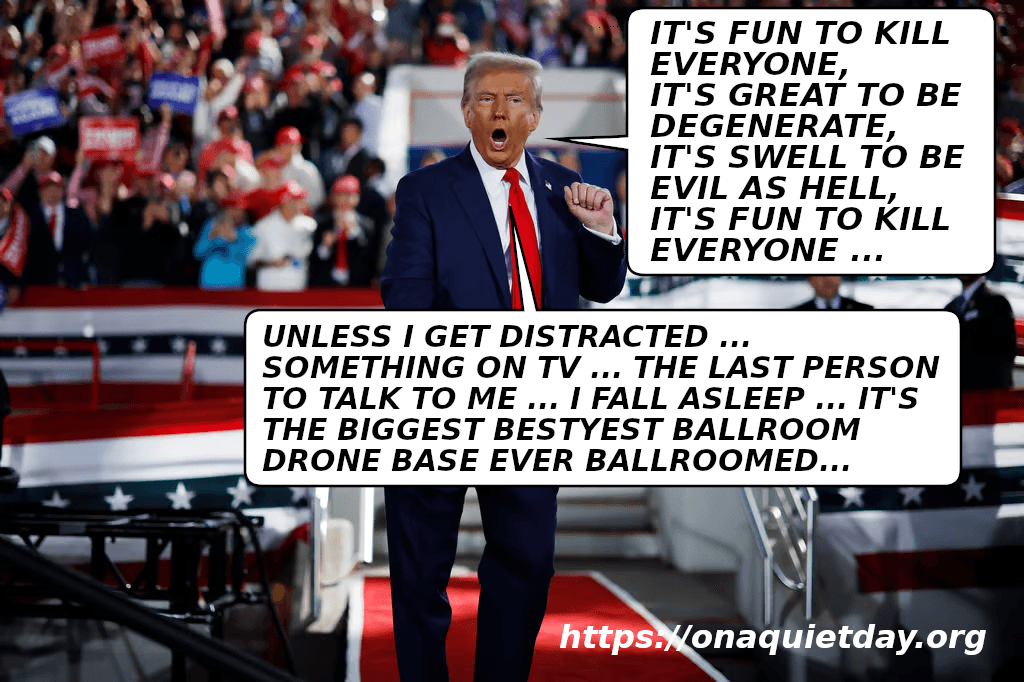
    Donald Trump sings and dances, says that it's fun to kill everyone ... unless he gets distracted or falls asleep.
    Donald Trump sings and dances, says that it’s fun to kill everyone … unless he gets distracted or falls asleep.

  • Venezuela mobilizes 4.5 million militia members as US deploys troops to the Caribbean

    Spread the love

    Original article by Devin B. Martinez republished from peoples dispach under a Creative Commons Attribution-ShareAlike 4.0 (CC BY-SA) license.

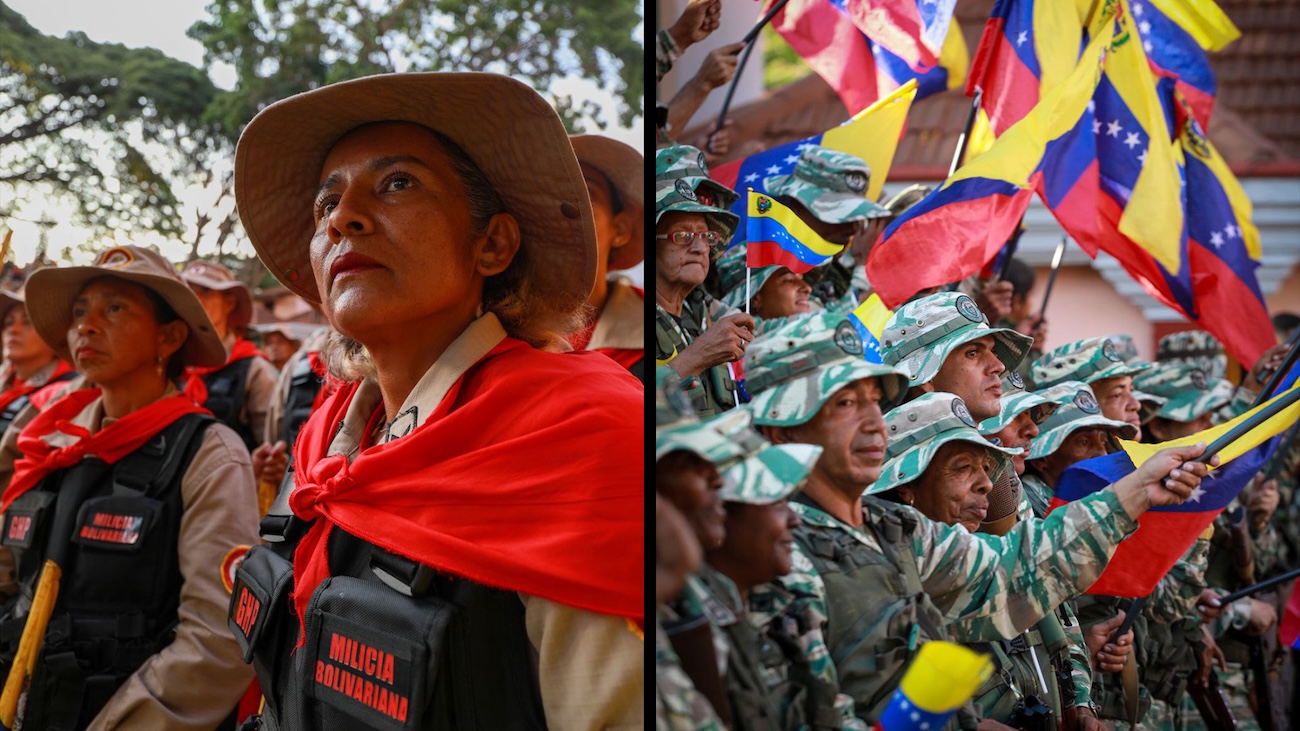
    Mobilization of the Bolivarian Militia in April 2025. Photo: Prensa Presidencial / Telegram

    President Nicolás Maduro announced on Monday, August 18, that he is activating “over 4.5 million militia members across the entire national territory” of the Bolivarian Republic of Venezuela, in response to the US deployment of three Navy guided-missile destroyers and 4,000 military personnel to the Caribbean. The White House has described the deployment as an anti-drug trafficking operation in the region, while some analysts have called it a new threat against Venezuela – the country with the largest oil reserves in the world. 

    The US military deployment comes after Washington raised its bounty on the Venezuelan president from USD 25 million to USD 50 million, alleging links to drug cartels.

    The “extravagant, bizarre, and outlandish threats” of the United States have been firmly rejected by the Venezuelan government.

    Minister of Foreign Affairs Yván Gil described the accusations as a sign of desperation, revealing Washington’s “lack of credibility and the failure of its policies in the region”. He also pointed out that Venezuela has made major gains against drug trafficking after expelling the United States’ Drug Enforcement Agency (DEA) – who many Venezuelans call “the planet’s chief drug traffickers” – from the country in 2005.

    No US agency or international body has produced concrete evidence of drug production and distribution being concentrated in Venezuela or linked to Maduro. In fact, available global drug data makes almost no mention of the Caribbean nation or the alleged “Cartel of Suns” at all. According to the United Nations Office on Drugs and Crime (UNODC), the epicenter of activity is in Colombia, Ecuador, and Peru, with the US identified as the main destination for distribution, recording the highest level of drug consumption in the world.

    UNODC data reports that only 5% of Colombian drugs transit through Venezuela, and that the country is free of coca leaf cultivation, and marijuana and cocaine processing. The Trump administration, on the other hand, has maintained its position that the Venezuelan government is a “narco-terror cartel”.

    Venezuela mobilizes as the US bares its teeth

    Last week, mass protests across Venezuela denounced the “interventionist policies of the US government” following the bounty increase on Maduro and the accusation of cartel ties. However, US Secretary of State Marco Rubio confirmed the deployment of US troops to the region on August 14. On Tuesday, August 19, White House Press Secretary Karoline Leavitt was asked if the administration was open to “boots on the ground” in Venezuela, to which she responded, “[Trump] is prepared to use every element of American power to stop drugs from flooding into our country.”

    This week, Venezuela’s “prepared, activated, and armed” militia members are being deployed “throughout the entire territory, and meticulously, sector by sector”, as part of what the government is calling a peace plan to defend the principles of sovereignty and shared economic development.

    “The Bolivarian National Militia is the people in arms, it is the genuine expression of civic-military union,” said Maduro in 2019, as he announced the incorporation of the militia that Hugo Chávez created – which has surged to nearly 5 million members, according to the government – into the Armed Forces as an official “combat unit”.

    “We are also deployed throughout the Caribbean,” Venezuela’s Interior Minister Diosdado Cabello reminded the public. “Our sea, which is Venezuelan territory.”

    The Venezuelan government is not alone in speaking out against the escalation of tensions in the Caribbean. When asked about the US military deployment during a regular press conference, President Claudia Sheinbaum said Mexico’s message to the region is, “No to interventionism. This is not just a conviction, it’s in the Constitution.”

    To this day, the US does not recognize President Nicolás Maduro as the winner of the July 28 elections in Venezuela, claiming that opposition figure Edmundo González is the true president. In the months following the election, Washington targeted dozens of officials in the Venezuelan National Electoral Council (CNE) and other government departments with sanctions and visa bans, on top of the long-standing US economic blockade of the Bolivarian nation.

    Despite the mounting pressure, Venezuelan officials are confident that the nation can defend its sovereignty. “It’s not about Maduro, it’s about the ordinary people, the people in the neighborhoods, the communities,” says Nahum Fernández, head of government in Caracas.

    “This country belongs to Venezuelans; in the face of any threat, the Venezuelan people will not remain silent.”