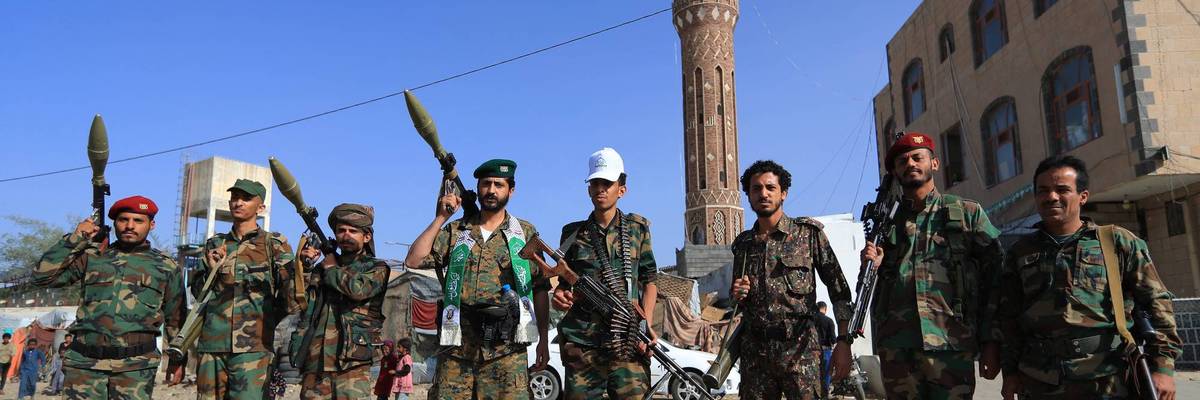
Fighters loyal to the Houthi authorities, gather during a rally to recruit more fighters, in Sanaa on September 10, 2026.(Photo by Mohammed Huwais/AFP via Getty Images)
The increased fighting is putting even more pressure on global energy markets, with the price of Brent crude topping $107 per barrel during Thursday trading
Houthi fighters on Thursday took control of a key port city on the west coast of Yemen, putting them in a stronger position to disrupt commercial shipping—and to potentially send oil prices rocketing even higher.
According to Reuters, the Houthis seized the city of Mocha from Saudi-backed forces before moving toward the Hanish Islands, located to the northeast.
Reuters further reported that Iran’s Islamic Revolutionary Guard Corps provided the Houthi fighters with weapons and guidance ahead of their successful assault.
The Houthis’ seizure of more territory along the Red Sea gives the militant group a greater ability to launch attacks on vessels trying to transport oil through the Bab el-Mandeb Strait.
Petroleum exporters in the region have had to rely more heavily on the Bab el-Mandeb Strait ever since Iran shut down shipping traffic in the Strait of Hormuz in retaliation for President Donald Trump’s illegal war of choice, which he launched in February without authorization from Congress.
Restricting shipments through both straits would put even greater pressure on global oil markets, which have already been under strain since the start of the Iran War.
A Thursday report from Bloomberg noted that Saudi Arabia, whose ships have been targets of Houthi attacks, revealed that its oil output has dropped to 6.24 million barrels per a day, its lowest level of oil production since 1990.
The price of Brent crude topped $107 during Thursday trading, a 6% increase from the day before. Data released Thursday by the American Automobile Association showed that the average price of gas in the US has reached $4.28 per gallon while the average price of diesel has reached a record high of $5.98 per gallon.
Fawaz Gerges, professor at the London School of Economics, said in an interview with The New York Times that the Houthis, despite receiving assistance from Iran, have their own distinct goals and see Trump’s illegal war as a “golden opportunity” to make advances against Yemen’s Saudi-backed government.
Additionally, said Gerges, “Iran directly and indirectly benefits from what the Houthis have been doing,” since “all-out war could have major implications for the global energy supply.”
Brett Erickson, managing partner at Obsidian Risk Advisors, wrote in a social media post that Iran and the Houthis have all the incentive in the world to keep the pressure on global petroleum shipping.
“Brent Crude just spiked over $107 per barrel,” Erickson wrote. “Just a mere month ago, it was trading at $85. That’s a 25.9% increase in a month. And with no off-ramp for Trump until at least the midterms are over, we’re looking at a long period of elevated oil prices now.”
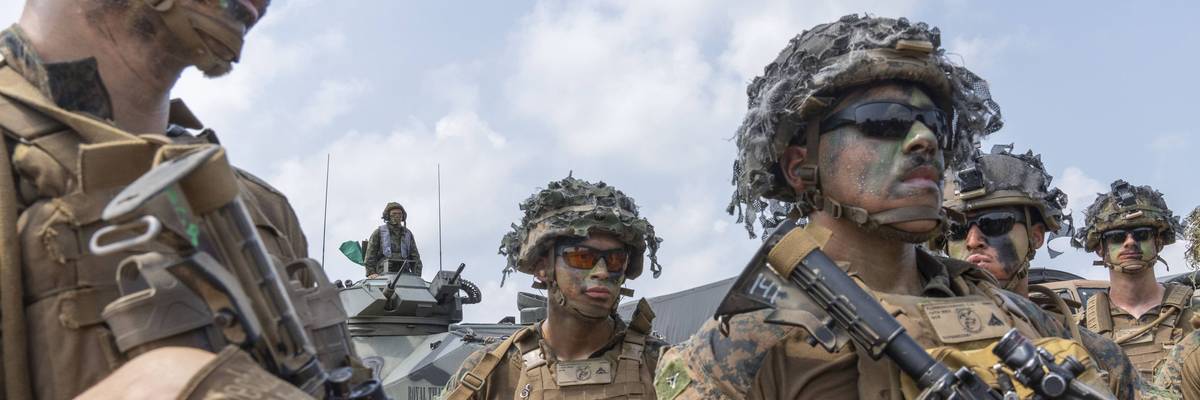
US marines stand on a beach in Sattahip, Thailand after taking part in the 46th Cobra Gold multinational military exercises co-hosted by the Royal Thai Armed Force and the US Indo-Pacific command on February 26, 2026. (Photo by Adryel Talamantes/Anadolu via Getty Images)
“Bringing this war to an end,” said one former US intelligence analyst, “requires recognizing it can still get much, much worse.”
In what has been described as a potential “major escalation” of the Trump administration’s war with Iran, Defense Secretary Pete Hegseth has reportedly approved a request from US Central Command to move more warships and thousands of Marines to the Middle East following Iran’s attacks on vessels in the Strait of Hormuz.
Citing three US officials, The Wall Street Journal reported on Friday that the US was sending “an element of an amphibious ready group and attached Marine expeditionary unit, typically consisting of several warships and 5,000 Marines and sailors.”
According to the Journal, the Japan-based USS Tripoli and its attached Marines are already headed to the Middle East.
While the Journal did not explicitly report that the operation was tied to the volatile situation in the Strait of Hormuz, it noted that “the move comes as Iran’s attacks on the strait have paralyzed traffic through the strategic waterway, disrupting the global economy, driving up gas prices and posing a major military and political challenge for President [Donald] Trump.”
In his first address on Thursday, delivered by a news anchor on Iranian state TV, the country’s new supreme leader, Mojtaba Khamenei, said that “the lever of blocking the Strait of Hormuz must definitely be used” to heighten economic pressure on the US.
Iran’s Islamic Revolutionary Guard Corps (IRGC) has declared that “not a liter of oil” shall pass through the strait, and vowed to attack any ship linked to the US and Israel that may attempt to make the journey.
Iran has reportedly attacked at least six commercial ships in the area since Wednesday, including one marked with a Thai flag that still has three crew members missing. US intelligence sources have also accused Iran of laying mines in the Strait, which Iran has neither confirmed nor denied.
The blockage of the strait, through which about one-fifth of global oil shipments pass each year, has sent the global market into chaos. Prices of Brent crude have surged from under $70 less than a month ago to more than $100 per barrel on the global market, and US gas prices have leaped to $3.63 per gallon on average, up from $2.94 a month ago.
Prices have continued to climb even after the International Energy Agency (IEA) announced its largest-ever coordinated release of oil from nations’ strategic reserves on Wednesday to combat what it called “the largest supply disruption in the history of the global oil market.”
Shashank Joshi, the defense editor at The Economist and a visiting fellow at the Department of War Studies at King’s College London, said that a deployment of such a large Marine force seems to be “a key indicator of a potential ground operation” in Iran.
Trump said earlier this week that he was “nowhere near” sending troops into Iran even as it ramped up threats to block the strait. But privately, he has reportedly been mulling plans to put “boots on the ground” within Iranian territory to accomplish a number of objectives, though officials have characterized them as limited special-operations missions.
Administration officials have reportedly suggested a commando raid on Iran’s nuclear sites to confiscate or sabotage its supply of uranium, according to Axios. They’ve also considered a plan to occupy Kharg Island, which sits 15 miles off Iran’s coast and handles about 90% of its oil exports, serving as an economic “lifeline” for the battered nation.
But Trump has also said that if Iran blocks the strait, “the US Navy and its partners will escort tankers through the strait, if needed.” Chairman of the Joint Chiefs, Gen. Dan Caine, has said the Pentagon is looking at “a range of options” to do this.
In an analysis published Tuesday by Zeteo, Harrison Mann, a former US Army major and executive officer of the Defense Intelligence Agency’s Middle East/Africa Regional Center, suggested that the US may pursue an ambitious plan to “clear Iran’s coastline around the strait” to get tankers moving again.
Mann, who worked under the Biden administration but resigned in protest of its support for the genocide in Gaza, said this plan would require “an indefinite occupation–otherwise missile trucks could just get in position after US forces leave.” Doing this, he added, would require “a full-fledged invasion, possibly beyond even the 10,000 or so rapid-response forces at Trump’s disposal.”
“All of these ground operations risk high casualties while failing to accomplish their missions,” Mann said. “That’s a feature, not a bug. Even if one of these operations met its objectives, troops in peril behind enemy lines demand resupply, evacuation, and revenge, which puts more troops in peril behind enemy lines, and so on.”
Context: A MEU has only ~1200 *ground* troops. You're not invading Iran ("securing the Strait of Hormuz") with that. Adding the 5-10k available airborne troops might be enough to get a proper quagmire started, though. https://t.co/j139Dfb4Zc
The movement of more troops comes as the US public expresses strong disapproval of Trump’s war with Iran. In a Quinnipiac poll published this week, 53% of registered voters said they opposed US military action against Iran, while just 40% approved.
About 74% said they feared that the war would cause oil and gas prices to rise, and 71% feared that the war would last “months” or longer.
Trump’s former chief strategist, Steve Bannon, who remains one of his top allies in media, said on his War Room podcast that deploying such a large military force “sends a signal to Iran, but it also sends a signal to the American people: This is a major escalation.”
Mann said that putting troops on the ground in Iran will only “ensure that Trump can’t back out easily, which is exactly what [Israeli Prime Minister Benjamin] Netanyahu, [US Sen.] Lindsey Graham (R-SC), and their ilk need to fracture Iran.
“Bringing this war to an end,” Mann said, “requires recognizing it can still get much, much worse, refusing to fall for the promise of ‘small special ops raids,’ and calling these courses of action what they are: a prelude to forever war.”
Climate science denier Donald Trump says that more liquid gold is being secured according to his policy of global privateeringDonald Trump explains why he established his Bored of PeaceOrcas discuss rotting brain. Front Orca says “Wish someone would lock him up”.