Trump plans anti-anti-fascist summit as capitalist crisis deepens

Spread the love

Article by Dave McKee republished from People’s World under http://creativecommons.org/licenses/by-nc-nd/3.0/us/.
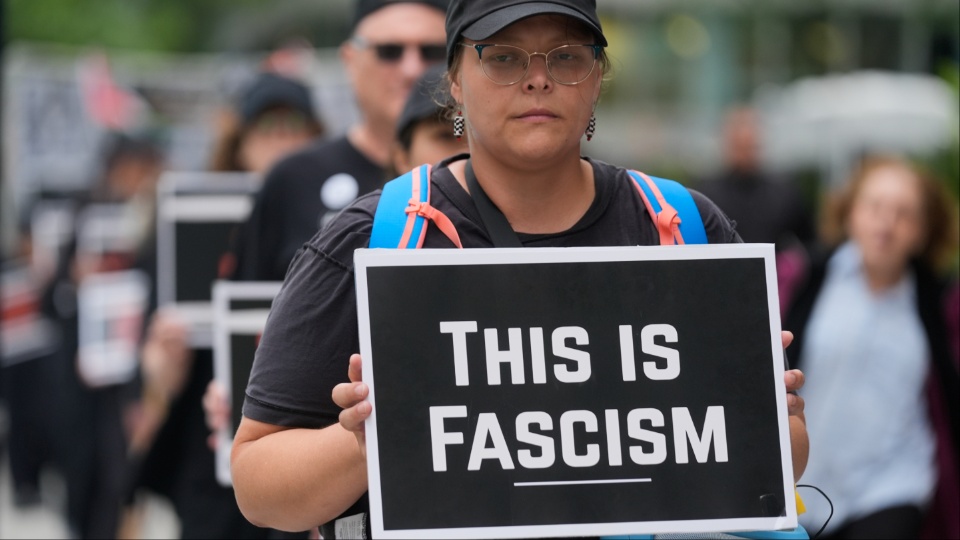
AP

In what can only be described as an acceleration and expansion of the bellicose and dangerous far-right populist movement around the globe, the U.S. government of Donald Trump is reportedly seeking to build an international coalition to oppose the anti-fascist left.

Washington says U.S. counterterrorism officials are organizing a summit in the summer to discuss and develop “strategies to counter the anti-fascist movement.”

White House and State Department officials have described such groups as a “serious threat to national security,” lumping together “anarchists, Marxists, and violent extremists.” The State Department claimed these organizations have waged “a terrorist campaign in the United States and across the Western world for decades, involving bombings, beatings, shootings, and riots in the service of their extreme agenda.”

The move comes as Trump has faced significant domestic opposition to many of his policies. This includes a sustained two-month popular uprising in Minnesota against violent anti-migrant sweeps by ICE, which ultimately forced the president to back down and withdraw the federal agents.

Labelling virtually all opposition as “terrorist” is an alarming escalation in Trump’s rhetoric, and it suggests a significant shift in counterterrorism priorities. The fact that the U.S. is trying to internationalize this effort—invitees to the summit include Canada, Britain, Germany, France, Italy, Hungary, Brazil, Mexico, Argentina, India, and Indonesia—suggests that such a shift may be underway in other countries as well.

Reuters reported that sources within U.S. counterterrorism say the summit will encourage intelligence sharing and common strategies. Other reports suggest that Washington is considering multiple international conferences, beginning in May with a workshop with foreign law enforcement officials in The Hague to “teach them about the dangers of far-left groups and how to counter them.”

The U.S. push comes as right-wing political forces in Canada are also agitating to label dissent as “terrorist.” In a move eerily reminiscent of the McCarthy era, Conservative MP Garnett Genuis has reportedly asked federal departments and agencies to determine whether any of their employees or members have current or prior association with anti-fascist and anti-racist left movements.

Right-wing politicians and media typically use the term “antifa” to refer to a sweeping range of organizations and movements that oppose fascist, racist, and far-right groups. With such a broad interpretation, virtually any political grouping, however large or small, can be described as “terrorist” or “a threat to national security” and subject to state repression.

In no small part, this is the desperate response of a system that is in crisis and decay. As capitalism’s social contradictions sharpen—evidenced by recurring and deepening social and economic crises, increased inter-imperialist rivalry and competition, and the accelerating drive to militarism and war—an increasingly broad section of the population becomes drawn into opposition and resistance.

Cutting off the organizational and political leadership of this growing movement against capitalism, even if it is nascent, is of utmost importance to the ruling class. If the commanders of capitalism, at least those in the U.S., are indeed planning ahead through their “anti-anti-fascist summit,” then working people had better start doing the same.

The working-class movement needs to get to work on developing its own independent political action plan and building up organizations and alliances that can carry it out. This includes working to win more people over to political positions like opposing NATO and other imperialist military alliances, rejecting corporate trade deals and tripartite “social dialogue” with the bosses and their governments, and insisting on the necessity of class struggle.

It also means combatting anti-socialist and anti-communist propaganda, including within labor and “left” movements. Narratives that deny the achievements of the Soviet people, or which draw false distinctions between the Cuban people and the Cuban government, or which equate communism with fascism and terror—these kinds of lies are all designed to divide and weaken the working-class movement, and to reinforce the dictatorship of capital over working people.

It’s true that capitalism is not always fascist. But it’s also true that fascism is always capitalist, and when capitalism is in crisis, it is anti-anti-fascist. This is what we are seeing now, and this is why the working class, which alone has the power to transform society, must get organized.

People’s Voice

As with all op-eds published by People’s World, the views expressed here are those of the author.

We hope you appreciated this article. At People’s World, we believe news and information should be free and accessible to all, but we need your help. Our journalism is free of corporate influence and paywalls because we are totally reader-supported. Only you, our readers and supporters, make this possible. If you enjoy reading People’s World and the stories we bring you, please support our work by donating or becoming a monthly sustainer today. Thank you!

Article by Dave McKee republished from People’s World under http://creativecommons.org/licenses/by-nc-nd/3.0/us/.

Donald Trump sings and dances, says that it's fun to kill everyone ...
Donald Trump sings and dances, says that it’s fun to kill everyone …
Orcas discuss Donald Trump and the killer apes' concept of democracy. Front Orca warns that Trump is crashing his country's economy and that everything he does he does for the fantastically wealthy.
Orcas discuss Donald Trump and the killer apes’ concept of democracy. Front Orca warns that Trump is crashing his country’s economy and that everything he does he does for the fantastically wealthy.
Continue ReadingTrump plans anti-anti-fascist summit as capitalist crisis deepens

Eighty years on: Remembering the defeat of fascism – or witnessing its return?

Spread the love

Original article by Biljana Vankovska republished from peoples dispatch under a Creative Commons Attribution-ShareAlike 4.0 (CC BY-SA) license.

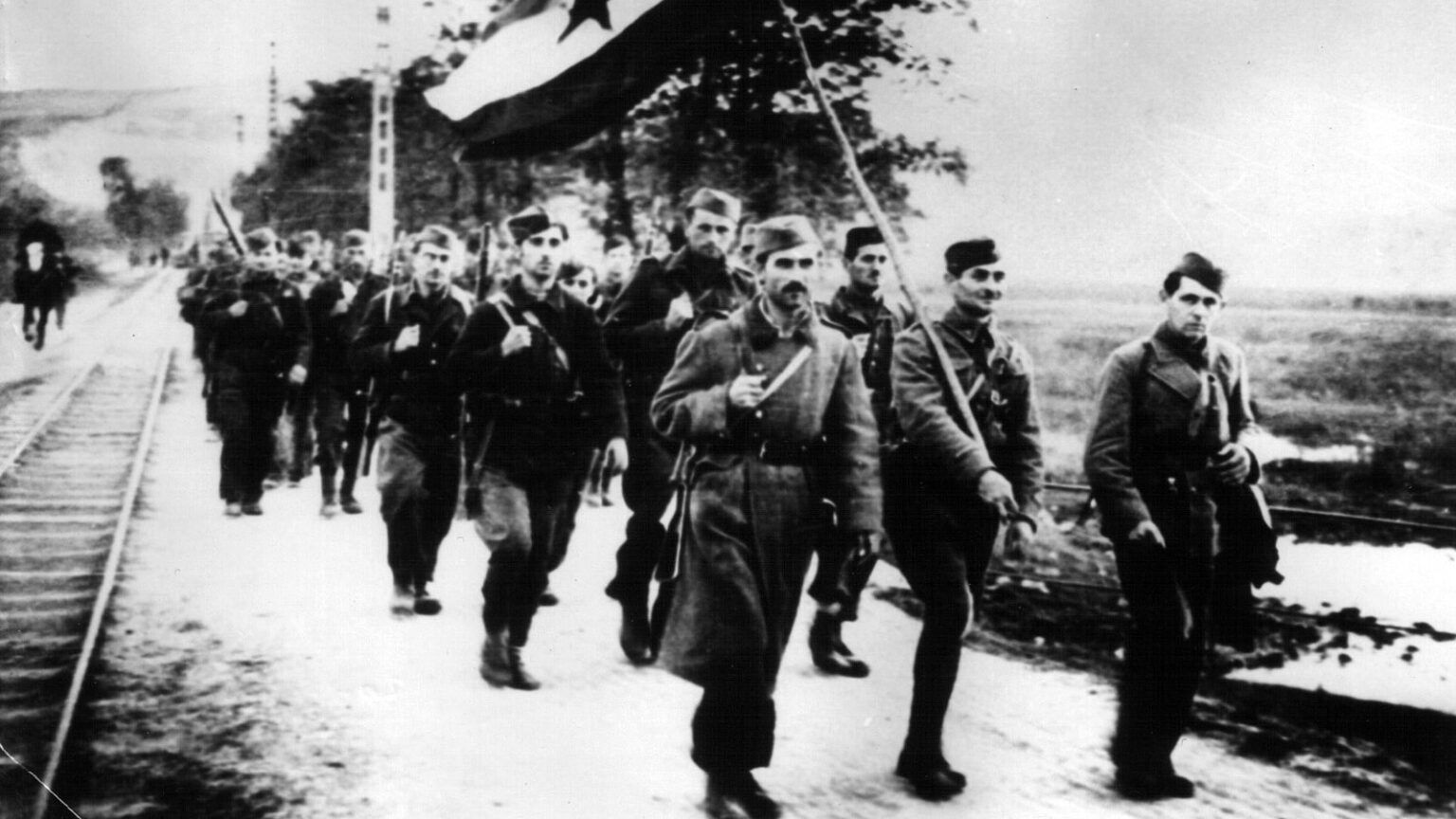
Entrance of the 7th Vojvodina Brigade of Yugoslav partisans in liberated Novi Sad, 23 October 1944. Photo: Wikimedia Commons

Neo-fascism merely adapted, disguised, and reshaped itself according to the times. In some states, we now see historical revisionism – and even glorification of local fascist or Nazi collaborators.

As we approach a major anniversary – 80 years since the defeat of fascism – a strange silence hangs over my country, Macedonia, and the broader region we now call the territory of former Yugoslavia. National authorities have been under sustained external (Western) pressure for years: May 9 must no longer be associated with the victory over fascism. Year after year, in both public memory and the education system, May 9 has been rebranded as Europe Day.

Older generations still remember, but what do younger ones know about Yugoslavia’s enormous human sacrifice, second only to the USSR, in the struggle against Evil? Almost nothing. We, the older ones, might suffer from the absence of dementia – we stubbornly remember the times when our fathers and grandfathers gave their lives for ideals that today’s youth barely even hear about.

This imposed forgetfulness on younger generations, however, goes so far that TV segments show young people unable to answer the simple question: Who was Josip Broz Tito? In Macedonia, more and more students know nothing about October 11, 1941, the Day of the Macedonian Uprising against fascism. Yet they excel in competitions where they display near-perfect knowledge of Europe. The irony is painful: the roots of patriotism and links to the most glorious moments of our not-so-distant past are not only being severed but portrayed as harmful.

A mythical and quasi-religious connection is being nurtured toward a mirage called Europe – meaning, of course, the European Union – which is idealized as a promised land, waiting with open arms. But this is no coincidence. Through its entire state-building apparatus, the EU seeks to rewrite history and implant it in the minds of new generations. In that version of history, any connection to the brutal colonial past is erased. More importantly, a veil is drawn over the fact that Europe’s imperial ambitions led to two world wars. The Second World War, whose anniversary we now mark quietly – even clandestinely, behind the EU’s back – was the anticlimax of capitalism, its degeneration into Nazism and fascism. This was not merely the result of individuals like Hitler or Mussolini, but of structural conditions that emerged from the womb of the post-World War I capitalist crisis.

The EU, falsely presenting itself as the embodiment of “Europe”, has been busy remodeling its image – until the start of the special military operation in Ukraine, it even tried to portray itself as a normative power, winning hearts and minds through soft power. It was even awarded the Nobel Peace Prize for past deeds. Yet its present and future seem to signal the revival of the very seed of evil it once claimed to oppose. The latest deep cycle of capitalist crisis first resulted in a divorce from democratic principles, but now it does not hide its hyper-imperialist and militaristic aspirations – for the sake of “self-defense” from an imagined Russian threat. Colloquially, many of us use the new word “Rusophrenia”: a belief that Russia is about to collapse and to take over the world at the same time. This term describes well the irrational view of Russia that is now entrenched in Western public opinion. It helps legitimize the new wave of militarization, even at the expense of the social well-being of Western citizens.

The rehabilitation of fascism began with its erasure from memory. Then came the glorification of the Euromaidan in Ukraine – the so-called pro-European revolution of 2014. A strange amnesia is spreading through the so-called Western world. As said, May 9 was kidnapped, and with it, textbooks, symbolic acts, and commemorations were gradually stripped of any connection to the true military victors of World War II: the Red Army and the Soviet people, who sacrificed more than 27 million lives. (Yugoslavs sacrificed more than a million people.)

It was the Soviets who liberated Berlin – twice. The final time, it was done by Mikhail Gorbachev, at a cost that Russia continues to pay today. Even the UN Secretary-General now avoids naming the Red Army soldiers who freed prisoners from the most notorious concentration camps.

It is Moscow and its allies who now stand as the only ones acting in the spirit of Orwell’s assertion that “in a time of universal deceit, telling the truth is a revolutionary act”. That truth will ring out loudly during the parade and major celebration on Red Square.

What is happening in what used to be Yugoslavia? In countries where generations were raised on narratives of brotherhood and unity, on the heroism of partisans who fought on the right side of history? First came the erosion of sovereignty and the right to self-determination. As the new religion – NATO and the EU are the only alternative and always right – was internalized, governments began distancing themselves from that part of our history. They turned instead to ancient glories or to painting a glowing future in union with the West.

To be red, to be a partisan, to be anti-fascist – gradually became suspicious, even dangerous. Our government now prides itself on alliances with the West (though it’s increasingly unclear – whose West? America’s or Europe’s?), and in distancing itself from those we once fought alongside. Former occupiers are now called “administrators”. Busts of partisans gather dust.

Anti-fascism has become uncomfortable to display – lest our Western allies recognize themselves in the mirror. So, silence prevails. Europe, the EU, is still celebrated – even as it re-militarizes, tramples basic values and human rights, and tacitly supports genocidal regimes. Confusion reigns over what to celebrate, what to remember, and why. Because, in an Orwellian world, war is peace, and peace is war.

Commemoration and historical memory matter. But just as vital is the ability to see, with eyes wide open, that the serpent’s egg still lives – and could hatch again into what millions across the world gave their lives to defeat eighty years ago. The bitter truth is that fascism was never fully defeated – except on the battlefield in 1945. Social scientists know well that the roots of fascism cannot be destroyed by arms alone. Neo-fascism merely adapted, disguised, and reshaped itself according to the times. In some states, we now see historical revisionism – and even glorification of local fascist or Nazi collaborators.

That is why the Russian initiative at the United Nations is significant. On 17 December 2024, during the 79th session of the UN General Assembly, the Russian Federation proposed a resolutionCombating glorification of Nazism, neo-Nazism and other practices that contribute to fueling contemporary forms of racism, racial discrimination, xenophobia and related intolerance. It was co-sponsored by 39 states from various regions. At last, it received 119 votes in favor, while 53 voted against. Regrettably, my country was among the latter – even though its very right to self-determination and statehood within Yugoslavia was born of the anti-fascist struggle. Perhaps for global politics, it is even more telling to examine who else voted against the resolution: Ukraine, the US, the UK, Germany, Italy, Belgium, Norway, the Netherlands, Finland, Sweden, Japan, Canada… Look at the new geopolitical map of the world, and it all becomes self-evident and telling.

According to some sources, Soviet Marshal Georgy Zhukov said, “We have liberated Europe from fascism, but they will never forgive us for it.”

They haven’t, as we now clearly see.

Biljana Vankovska is a professor of political science and international relations at Ss. Cyril and Methodius University in Skopje, a member of the Transnational Foundation of Peace and Future Research (TFF) in Lund, Sweden, and the most influential public intellectual in Macedonia.

This text was originally published by the Valdai Club and reproduced by Globetrotter.

Original article by Biljana Vankovska republished from peoples dispatch under a Creative Commons Attribution-ShareAlike 4.0 (CC BY-SA) license.

Publication should be regarded as worthy of debate rather that endorsement of the views of the author by the https://onaquietday.org blog.

Continue ReadingEighty years on: Remembering the defeat of fascism – or witnessing its return?