How Carbon Capture and Storage Projects Are Driving New Oil and Gas Extraction Globally 

Spread the love

Original article by Michael Buchsbaum and Edward Donnelly republished from DeSmog.

The oil industry’s push to portray carbon capture as a climate solution at COP28 obscures how the technology is really being used.
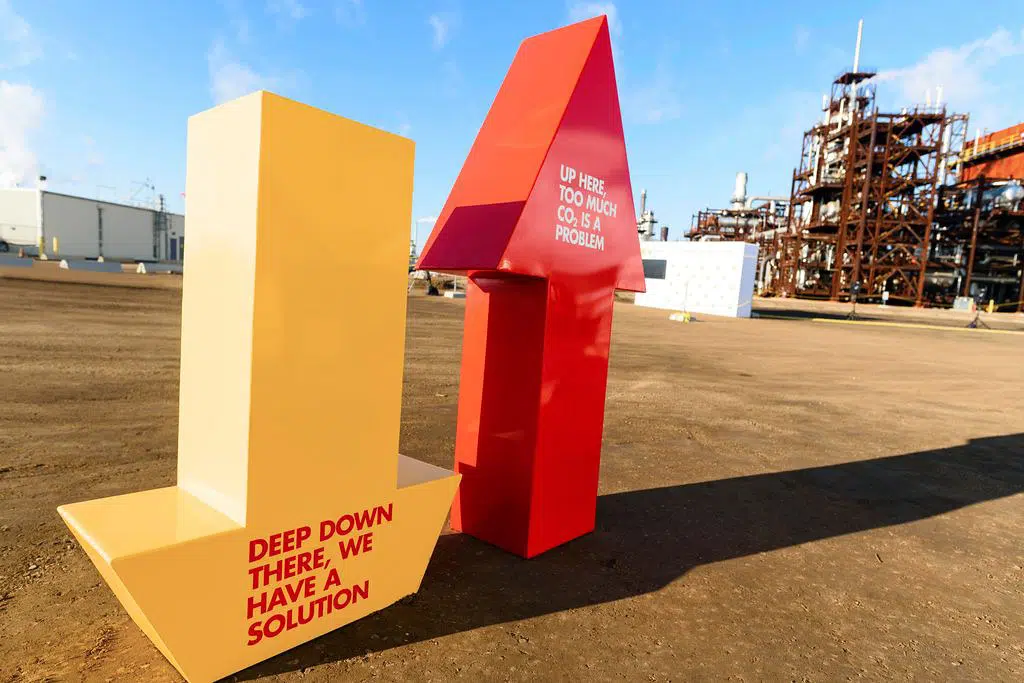
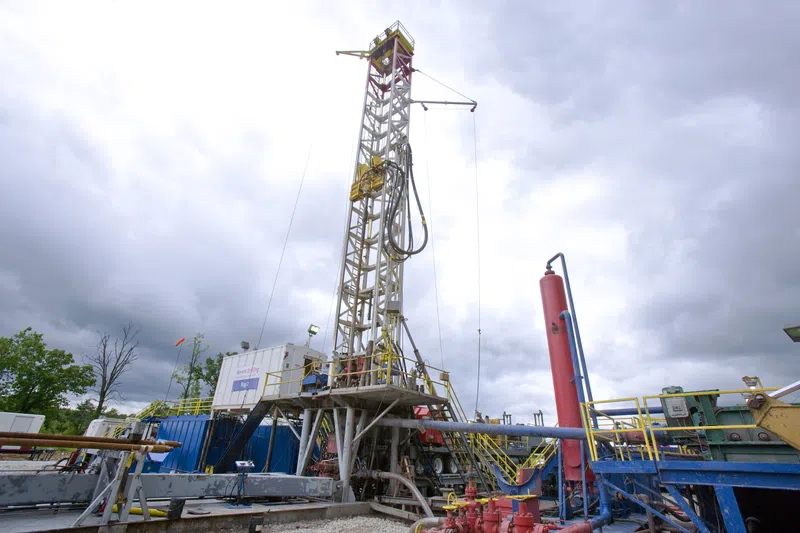
Shell and its joint venture partners have a Quest carbon capture and storage (CCS) project at its Scotford Complex near Fort Saskatchewan, Canada. Credit: Government of Alberta, CC BY-NC-ND 2.0

When Sultan Ahmed Al Jaber opens the 28th annual UN climate conference in Dubai in November, he will be juggling two roles – convincing the world of the United Arab Emirates’ leadership in reducing greenhouse gas emissions, while preserving the very industry that’s causing them. 

In addition to his job as summit president, Al Jaber heads the Abu Dhabi National Oil Company (ADNOC), which plans to increase its oil and gas output by 11 percent by 2027. The company says that more oil will mean less emissions, however — provided the industry builds enough facilities to capture carbon dioxide (CO2), the main gas causing the climate crisis.  

“We must be laser-focused on phasing out fossil fuel emissions, while phasing up viable, affordable zero carbon alternatives,” Al-Jaber said at a pre-COP 28 event in Bonn in June. The statement was widely interpreted as a pitch for carbon capture. 

On September 6, ADNOC finalized a deal to build a carbon capture and storage (CCS) project in the UAE’s Habshan oil and gas field, extending the company’s existing CCS operations at a steel plant. Now projected to become one of the largest carbon capture plants in the Middle East, ADNOC says the facility will have the equivalent climate impact of removing 500,000 cars from the road.

In fact, the project will be used to squeeze even more oil from the ground. Most of the CO2 ADNOC already captures is pumped into existing oil wells, forcing residual crude to the surface in a process known as “enhanced oil recovery” or “EOR”.

It is a trend reflected across the sector: Of the 32 commercial CCS facilities operating worldwide, 22 use most, or all, of their captured CO2 to push more oil out of already tapped reservoirs. This fleet accounts for approximately 31 million tonnes of the world’s roughly 42 million tonnes of operational carbon capture capacity, according to figures published by the industry-backed Global CCS Institute, U.S. Energy Information Administration and other sources. 

But the fact that existing carbon capture projects are mostly used to bring more oil to the surface has not stopped oil and gas companies championing the technology as a climate solution in the run-up to COP28.

In January, ExxonMobil Tweeted a video interview with a safety and environment supervisor at its LaBarge CCS project in Wyoming. 

“Welcome to La Barge — the industrial facility that has captured the most CO2 emissions on earth to date,” says a caption at the start of the clip.

Nowhere does the video mention that most of the CO2 captured from the LaBarge gas processing plant is being injected underground to extract more oil.  Research by the Institute for Energy Economics and Financial Analysis, a nonprofit energy think tank, shows that 97 percent of CO2 captured by the La Barge facility has been sold for EOR since the plant began operations in 1986. In times when EOR was not profitable, CO2 was simply vented into the atmosphere.

While CCS is proving a boon for the fossil fuel industry, a DeSmog review of 12 of the world’s biggest projects has found a litany of missed carbon capture targets; cost overruns; and multi-billion-dollar bills to taxpayers in the form of subsidies. 

DeSmog’s research also raises questions over an oft-cited claim that industry captures 41 million tonnes of CO2 annually — or 0.1 percent of the world’s approximately 37 billion tonnes of energy-related CO2 emissions.

Beyond the consistent underperformance of many CCS projects, DeSmog found that most either strip out CO2 in the process of refining fossil fuels, or use their captured CO2 to push more oil out of the ground — or both. The result: existing CCS projects are enabling the release of a much greater amount of overall CO2 emissions into the atmosphere than they are storing underground. 

For examples, see a summary of the 12 projects DeSmog analysed here.

From Oilman’s Dream to “Climate Solution”

The process of using carbon dioxide to produce more oil, now known industry-wide as enhanced oil recovery, or “CO2-EOR”, was born in the oil fields of Texas in the early 1970s. 

Petroleum engineers from leading oil producers such as Shell, Exxon, and Chevron had discovered that injecting CO2 at high pressure into “mature” or “previously developed” oil reservoirs helped increase the flow of otherwise stubborn hydrocarbons — in essence squeezing more volume out of aging wells. 

Though initial tests found that each ton of injected CO2 could push out an additional two or more barrels of oil, the lack of readily available CO2 made the technique expensive. That changed when companies began siphoning off CO2 emitted from several Texas gas processing plants, and piping it to an oil field to boost productivity. To ensure a steady supply, industry agents scoured the region and purchased the rights to mine naturally occurring CO2 deposits in Colorado, New Mexico, and Arizona — eventually building hundreds of miles of dedicated pipelines to transport the gas to oil-field injection points. 

By the late 1970s, amid growing concerns over what was then known as the “greenhouse effect,” industry executives began to propose that capturing CO2 and burying it underground could allow the world to continue generating power from fossil fuels far into the future. In 1992, the Paris-based International Energy Agency (IEA) and other energy organizations established a research program to support developers seeking to prove CCS at scale. 

By the time of the first U.N. climate conferences in the mid-1990s, the oil industry had begun marketing carbon capture as a technological “silver bullet” capable of making coal “clean,” and rendering oil and gas as “low carbon” — a strategy employed by oil majors to this day.

However, capturing CO2 is not the same as avoiding its climate impacts. If that CO2 is then used to directly produce more oil, or if CCS “abatement” is used to suggest that additional oil and gas production is climate-friendly — or in some cases both — then those CCS projects are invariably acting as a net harm to the climate, by actually increasing overall CO2 pollution. 
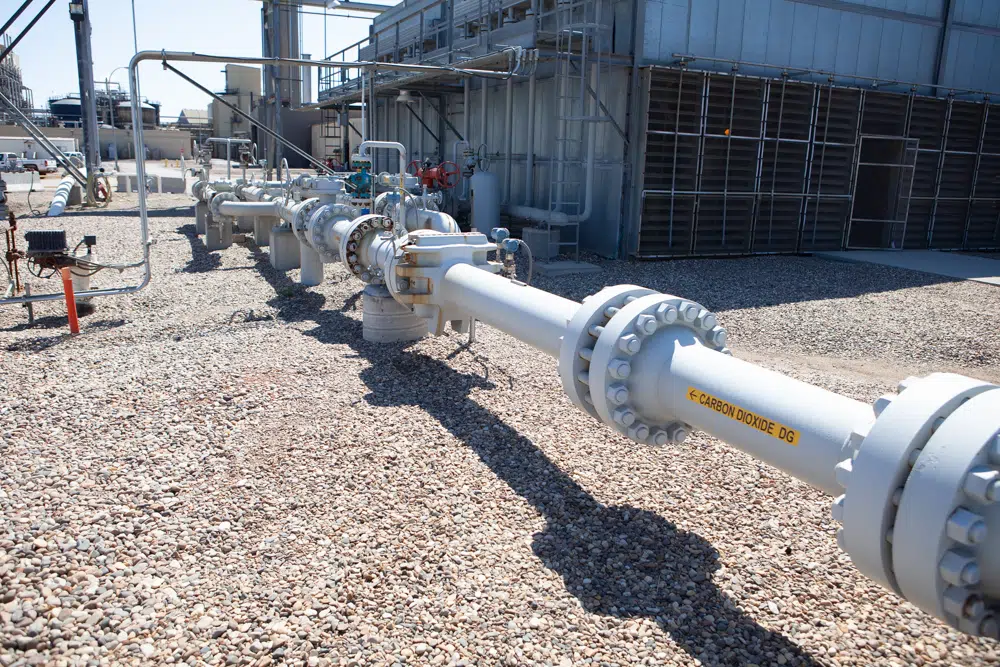
Carbon dioxide runs through pipes at a North Dakota CCS plant. Credit: Buchsbaum Media.

For example, the fossil fuel industry often points to Norway’s pioneering Sleipner CCS facility — which has captured and buried approximately one million tons of CO2 per year under the North Sea since 1996 — as proof that carbon capture works. But that figure does not account for all the additional CO2 that’s emitted when fossil gas produced by the plant is burned by end-users. 

Energy expert Michael Barnard, estimates that even though Sleipner has stored about 23 million tons of CO2 from 1996-2019, burning the gas refined by the plant over that time has released some 581 million tons of CO2 into the atmosphere — or more than 25 times the amount that was sequestered. (For more details on Sleipner, see DeSmog’s review of 12 CCS facilities).

Profit Driver

Now an established technique worldwide, producers generally use CO2-EOR to recover oil from older “depleted” fields, where less sophisticated recovery methods have left up to two-thirds of the original oil behind. If the geology and economics are favorable, using EOR techniques can extend the productive life of developed oil fields for several more decades. 

To put the significance of this approach to the oil industry into perspective, according to the U.S. National Energy Technology Laboratory, of the 600 billion barrels of oil that have been discovered in the U.S., approximately 400 billion are unrecoverable by conventional means. But half of that unrecoverable oil — or 200 billion barrels — could be squeezed to the surface through CO2-EOR.

Today, the oil industry pumps some 80 million tonnes of CO2 underground each year to extract more oil, much of it in the U.S. — the world’s leading oil and gas producer, and biggest user of CCS-EOR, which drives six percent of the country’s daily output. In some cases, the technique can squeeze up to four or five additional barrels from otherwise declining fields for every ton of injected CO2. Though geology plays a role, one of the main factors inhibiting even greater EOR volume is the lack of cheaply available CO2. 

Despite many EOR projects simply being intended to extend oil production, companies often label them as climate-friendly “carbon capture” facilities since about half the CO2 injected underground remains there, depending on local geological conditions. 

However, climate claims made on the basis of CCS projects also often ignore the fact that much of the CO2 the industry “captures” for EOR purposes is mined from naturally occurring underground deposits, and reburying this gas in an oil field does nothing to reduce the amount of emissions humans are releasing into the atmosphere by burning fossil fuels. 

Government Backing

While costs for proven zero-carbon emitting renewable energy technologies are plummeting, CCS projects have remained dependent on subsidies and tax breaks that often incentivise some of the world’s richest and most polluting companies to capture CO2 to produce more oil. 

Governments worldwide have awarded at least $19 billion in subsidies to CCS projects over the last 20 years, according to data compiled by Oil Change International, a research and advocacy organization. This number includes more than $4 billion in failed projects, including the troubled Kemper Facility, a now-abandoned “clean coal” and EOR scheme. (For details, please see DeSmog’s review of 12 CCS projects).
Carbon capture technology used at a coal mine in 2014. Credit: Peabody Energy, Wikimedia Commons (CC BY-2.0)”>Wikimedia Commons Wikimedia Commons (CC BY-2.0)”>CC BY-2.0

By far and away, the United States has extended the most government support for CCS, estimated at $15 billion since 2010. Canada, Australia, and the European Union have also poured billions into the technology. Norway’s state-owned Statoil, now Equinor, was also an early CCS adopter, and the government continues to pour billions into new, more sophisticated projects. Likewise, state-owned companies in China, as well as Brazil’s Petrobras, Saudi Arabia’s Aramco, and the United Arab Emirates’ ADNOC are receiving support to develop and expand their existing CCS operations.  

U.S. Doubles Down

Despite the fact that almost three-quarters of existing CCS projects are used to pump more oil, new climate policies on both sides of the Atlantic are driving more government support. 

In August last year, U.S. President Joe Biden’s Inflation Reduction Act (IRA) – which contained sweeping climate provisions — significantly expanded tax credits for investments in CCS beyond an existing $12 billion in government support. Under the revised “45Q” credits section, companies can now claim $60 per ton of CO2 captured for EOR — up from $35 before the Act was passed — and $85 per ton of CO2 captured for geological storage, up from $50.  

Additionally, the IRA reduces the requirements for eligible CCS projects while locking in a seven-year extension to qualify for the tax credit, meaning that developers have until January 2033 to begin construction. 

The industry-backed Global CCS Institute reckons these tax breaks and other enhancements could increase CCS deployment in the U.S. 13-fold to more than 110 million tonnes per year by 2030.

Since there has been no cap set as to how much the U.S. government can pay through new carbon capture credits, Bloomberg New Energy Finance and Credit Suisse caution these subsidies could balloon to a vast $50 to $100 billion in CCS giveaways over the next decade.

Flurry of Deals

More than 50 new CCS projects were announced within months of the passage of the IRA — spurred on by even more support from the Biden administration.

In July, ExxonMobil, which boasts more CCS experience than any other company, spent over $5 billion to acquire independent oil and gas producer Denbury Resources and its 1,300 miles of CO2 pipeline infrastructure. In projects almost entirely devoted to EOR, Denbury has been injecting over four million tonnes a year of carbon captured from industrial and natural sources into various oil fields in 10 onshore sequestration sites across the Gulf region of the U.S. 

Buying Denbury allows ExxonMobil to not only advance its various carbon capture deals, but also gives it a great potential revenue source as polluting companies increasingly resort to buying carbon credits to meet climate targets. With an expanding CO2 pipeline network already in place, ExxonMobil can now offer itself up as an emissions disposal company and cash in on the associated tax credits. 

Looking ahead, ExxonMobil says that CCS and other “carbon management” schemes could develop into a $4 trillion global market by 2050.

‘Preserve our Industry’

The deal-making continued in August, when the White House and the Emirati government endorsed a new partnership between ADNOC and Texas-based Occidental Petroleum to “supercharge and accelerate decarbonization solutions” in the UAE, the United States, and around the world. Both partners are currently running large-scale carbon capture projects specifically aimed at producing “low carbon” oil. 

One of the technologies the partnership will explore is “direct air capture,” which involves sucking air through giant fans and filtering out CO2 with a chemical-lined filter. The CO2 can then be stored underground or piped to petroleum wells to help extract oil. Bonus funds in Biden’s IRA are now available to prove this experimental technology is viable.

Currently the world’s first large-scale direct air capture plant in Iceland stores about 4,000 tonnes of CO2 a year, about 0.001 percent, of global carbon capture capacity, according to data from the Global CCS Institute. That’s less than four second’s worth of global emissions. However, these modest beginnings have not tempered oil industry enthusiasm for the technique. 

“We believe that our direct capture technology is going to be the technology that helps to preserve our industry over time,” Occidental Petroleum Chief Executive Vicki Hollub told a major fossil fuel conference in Houston in March. The company is already the U.S. leader in carbon capture operations, and Hollub says new advances could serve as a lifeline for the oil industry, extending operations “60, 70, or 80 years in the future,” she noted. 

Direct air capture plants could soon be used to trap CO2 for enhanced oil recovery operations in the US, the UAE and beyond. In 2021, ADNOC announced plans to produce “low carbon” petroleum, and last year Occidental signed its first contract for “net-zero oil”.

European Commission President Ursula von der Leyen requested a Dutch foreign official to examine CCS as a climate solution. Credit: WikiMedia Commons, CC BY-NC-ND 2.0“>WikiMedia Commons

Europeans Follow Suit

Aggressive support for CCS from the Biden administration has found echoes across the Atlantic. In March, the European Commission proposed that the EU should target 50 million tonnes per year of CO2 capture capacity by 2030, from almost zero today. The target forms part of the draft Net-Zero Industry Act, a key piece of climate legislation aiming to drive the clean energy transition. 

European Commission president Ursula von der Leyen has since instructed Wopke Hoekstra, a former Dutch foreign minister who has worked for Shell, to examine CCS as a climate solution before he takes over as climate commissioner in October.

Against this backdrop of positive policy signals, the oil industry has announced a spate of ambitious carbon capture plans in Europe, a continent with little existing CCS infrastructure outside of Norway – almost all of which plan to store CO2 under the North Sea.

In the UK, the North Sea Transition Authority, which regulates the country’s oil and gas industry, this month awarded 21 licenses to 14 companies to store captured CO2 into blocks for formerly productive oil and gas fields under the seabed. The combined CCS plan aims to store 30 million tonnes of CO2 annually by 2030.

Around the world, hundreds of new carbon “abatement” projects reliant on CCS to clean up fossil-fueled electrical generation, steel and cement output, as well as hydrogen production, are now scheduled to come online by the end of the decade.

This, in turn, has triggered a scramble by companies seeking to enter the rapidly emerging CO2 logistics, handling, shipping and disposal markets.

Despite all this activity, announced global schemes to capture and bury CO2 constitute only a tiny fraction of what would be needed to slow climate change, critics say. Based on the current project pipeline, the International Energy Agency predicts that by 2030, the world’s annual carbon capture capacity from both new construction and retrofits could amount to a total of 205 million tonnes of CO2, only about 0.5 percent of current global energy-related emissions. 

Moreover, the core of the IEA’s Net Zero scenario, as well as similar roadmaps for avoiding the worst impacts of climate change, rests on rapidly accelerating the shift to renewables from fossil fuels, regardless of whether a portion of CO2 emissions are “abated” through capture and storage. 

Aware of the risks of the oil industry presenting CCS as a catch-all climate solution at COP28, some governments are pushing back. In July, ministers from Germany, France, Denmark, the Netherlands and more than a dozen other nations published a joint letter warning that CCS and “abatement technologies must not be used to green-light continued fossil fuel expansion.” Instead, such technologies “must be considered in the context of steps to phase out fossil fuel use, and should be recognised as having a minimal role to play in decarbonization.”

With the Emirati hosts seemingly determined to champion carbon capture, and the oil industry planning to market ever more barrels of “net-zero” oil, the battle over the future of a 50-year-old technology may have only just begun. 

Click here for case studies from a DeSmog review of 12 of the world’s leading CCS projects, and their impact on the climate. 

Original article by Michael Buchsbaum and Edward Donnelly republished from DeSmog.

Fossil Fuel Companies Made Bold Promises to Capture Carbon. Here’s What Actually Happened.

Italian Oil Giant Eni Knew About Climate Change More Than 50 Years Ago, Report Reveals

One Billion People Will Die Without Oil Production, Kuwait Official Claims

UK/Fossil Fuel Firms Flock to Conservative Party Conference

Oil Lobby Claims More Production Won’t Raise Emissions, But Ignores Crucial Data

Continue ReadingHow Carbon Capture and Storage Projects Are Driving New Oil and Gas Extraction Globally 

Climate scientists: concept of net zero is a dangerous trap

Spread the love
Thijs Stoop/Unsplash, FAL

James Dyke, University of Exeter; Robert Watson, University of East Anglia, and Wolfgang Knorr, Lund University

Sometimes realisation comes in a blinding flash. Blurred outlines snap into shape and suddenly it all makes sense. Underneath such revelations is typically a much slower-dawning process. Doubts at the back of the mind grow. The sense of confusion that things cannot be made to fit together increases until something clicks. Or perhaps snaps.

Collectively we three authors of this article must have spent more than 80 years thinking about climate change. Why has it taken us so long to speak out about the obvious dangers of the concept of net zero? In our defence, the premise of net zero is deceptively simple – and we admit that it deceived us.

The threats of climate change are the direct result of there being too much carbon dioxide in the atmosphere. So it follows that we must stop emitting more and even remove some of it. This idea is central to the world’s current plan to avoid catastrophe. In fact, there are many suggestions as to how to actually do this, from mass tree planting, to high tech direct air capture devices that suck out carbon dioxide from the air.

The current consensus is that if we deploy these and other so-called “carbon dioxide removal” techniques at the same time as reducing our burning of fossil fuels, we can more rapidly halt global warming. Hopefully around the middle of this century we will achieve “net zero”. This is the point at which any residual emissions of greenhouse gases are balanced by technologies removing them from the atmosphere.

This is a great idea, in principle. Unfortunately, in practice it helps perpetuate a belief in technological salvation and diminishes the sense of urgency surrounding the need to curb emissions now.

We have arrived at the painful realisation that the idea of net zero has licensed a recklessly cavalier “burn now, pay later” approach which has seen carbon emissions continue to soar. It has also hastened the destruction of the natural world by increasing deforestation today, and greatly increases the risk of further devastation in the future.

To understand how this has happened, how humanity has gambled its civilisation on no more than promises of future solutions, we must return to the late 1980s, when climate change broke out onto the international stage.

Steps towards net zero

On June 22 1988, James Hansen was the administrator of Nasa’s Goddard Institute for Space Studies, a prestigious appointment but someone largely unknown outside of academia.

By the afternoon of the 23rd he was well on the way to becoming the world’s most famous climate scientist. This was as a direct result of his testimony to the US congress, when he forensically presented the evidence that the Earth’s climate was warming and that humans were the primary cause: “The greenhouse effect has been detected, and it is changing our climate now.”

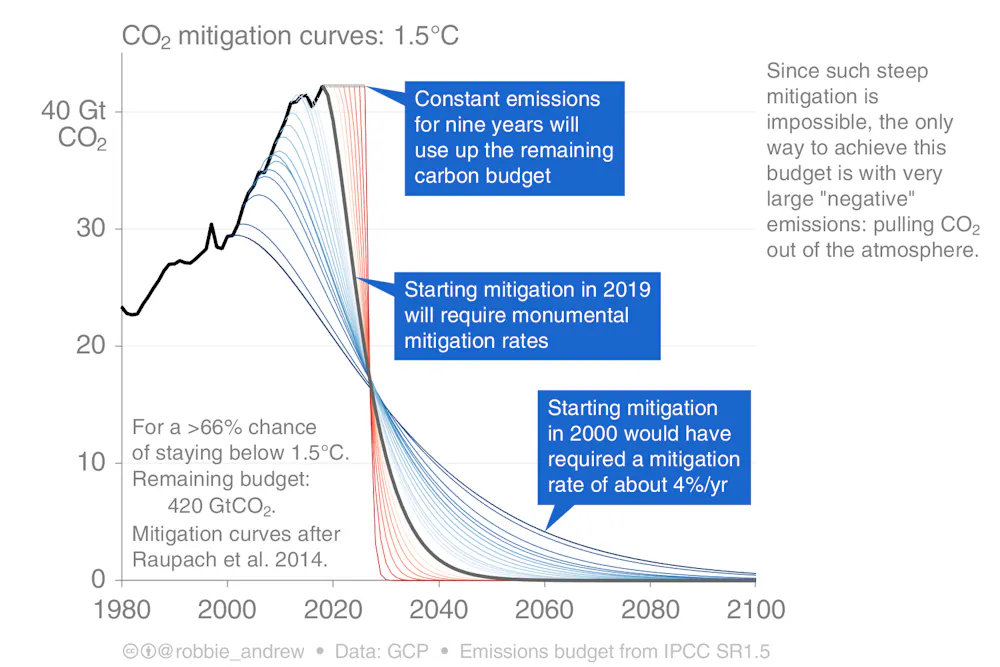
If we had acted on Hansen’s testimony at the time, we would have been able to decarbonise our societies at a rate of around 2% a year in order to give us about a two-in-three chance of limiting warming to no more than 1.5°C. It would have been a huge challenge, but the main task at that time would have been to simply stop the accelerating use of fossil fuels while fairly sharing out future emissions.

Alt text
Graph demonstrating how fast mitigation has to happen to keep to 1.5℃.
© Robbie Andrew, CC BY

Four years later, there were glimmers of hope that this would be possible. During the 1992 Earth Summit in Rio, all nations agreed to stabilise concentrations of greenhouse gases to ensure that they did not produce dangerous interference with the climate. The 1997 Kyoto Summit attempted to start to put that goal into practice. But as the years passed, the initial task of keeping us safe became increasingly harder given the continual increase in fossil fuel use.

It was around that time that the first computer models linking greenhouse gas emissions to impacts on different sectors of the economy were developed. These hybrid climate-economic models are known as Integrated Assessment Models. They allowed modellers to link economic activity to the climate by, for example, exploring how changes in investments and technology could lead to changes in greenhouse gas emissions.

They seemed like a miracle: you could try out policies on a computer screen before implementing them, saving humanity costly experimentation. They rapidly emerged to become key guidance for climate policy. A primacy they maintain to this day.

Unfortunately, they also removed the need for deep critical thinking. Such models represent society as a web of idealised, emotionless buyers and sellers and thus ignore complex social and political realities, or even the impacts of climate change itself. Their implicit promise is that market-based approaches will always work. This meant that discussions about policies were limited to those most convenient to politicians: incremental changes to legislation and taxes.


This story is a collaboration between Conversation Insights and Apple News editors

The Insights team generates long-form journalism and is working with academics from different backgrounds who have been engaged in projects to tackle societal and scientific challenges.


Around the time they were first developed, efforts were being made to secure US action on the climate by allowing it to count carbon sinks of the country’s forests. The US argued that if it managed its forests well, it would be able to store a large amount of carbon in trees and soil which should be subtracted from its obligations to limit the burning of coal, oil and gas. In the end, the US largely got its way. Ironically, the concessions were all in vain, since the US senate never ratified the agreement.

Aerial view of autumn foliage.
Forests such as this one in Maine, US, were suddenly counted in the carbon budget as an incentive for the US to join the Kyoto Agreement.
Inbound Horizons/Shutterstock

Postulating a future with more trees could in effect offset the burning of coal, oil and gas now. As models could easily churn out numbers that saw atmospheric carbon dioxide go as low as one wanted, ever more sophisticated scenarios could be explored which reduced the perceived urgency to reduce fossil fuel use. By including carbon sinks in climate-economic models, a Pandora’s box had been opened.

It’s here we find the genesis of today’s net zero policies.

That said, most attention in the mid-1990s was focused on increasing energy efficiency and energy switching (such as the UK’s move from coal to gas) and the potential of nuclear energy to deliver large amounts of carbon-free electricity. The hope was that such innovations would quickly reverse increases in fossil fuel emissions.

But by around the turn of the new millennium it was clear that such hopes were unfounded. Given their core assumption of incremental change, it was becoming more and more difficult for economic-climate models to find viable pathways to avoid dangerous climate change. In response, the models began to include more and more examples of carbon capture and storage, a technology that could remove the carbon dioxide from coal-fired power stations and then store the captured carbon deep underground indefinitely.

This had been shown to be possible in principle: compressed carbon dioxide had been separated from fossil gas and then injected underground in a number of projects since the 1970s. These Enhanced Oil Recovery schemes were designed to force gases into oil wells in order to push oil towards drilling rigs and so allow more to be recovered – oil that would later be burnt, releasing even more carbon dioxide into the atmosphere.

Carbon capture and storage offered the twist that instead of using the carbon dioxide to extract more oil, the gas would instead be left underground and removed from the atmosphere. This promised breakthrough technology would allow climate friendly coal and so the continued use of this fossil fuel. But long before the world would witness any such schemes, the hypothetical process had been included in climate-economic models. In the end, the mere prospect of carbon capture and storage gave policy makers a way out of making the much needed cuts to greenhouse gas emissions.

The rise of net zero

When the international climate change community convened in Copenhagen in 2009 it was clear that carbon capture and storage was not going to be sufficient for two reasons.

First, it still did not exist. There were no carbon capture and storage facilities in operation on any coal fired power station and no prospect the technology was going to have any impact on rising emissions from increased coal use in the foreseeable future.

The biggest barrier to implementation was essentially cost. The motivation to burn vast amounts of coal is to generate relatively cheap electricity. Retrofitting carbon scrubbers on existing power stations, building the infrastructure to pipe captured carbon, and developing suitable geological storage sites required huge sums of money. Consequently the only application of carbon capture in actual operation then – and now – is to use the trapped gas in enhanced oil recovery schemes. Beyond a single demonstrator, there has never been any capture of carbon dioxide from a coal fired power station chimney with that captured carbon then being stored underground.

Just as important, by 2009 it was becoming increasingly clear that it would not be possible to make even the gradual reductions that policy makers demanded. That was the case even if carbon capture and storage was up and running. The amount of carbon dioxide that was being pumped into the air each year meant humanity was rapidly running out of time.

With hopes for a solution to the climate crisis fading again, another magic bullet was required. A technology was needed not only to slow down the increasing concentrations of carbon dioxide in the atmosphere, but actually reverse it. In response, the climate-economic modelling community – already able to include plant-based carbon sinks and geological carbon storage in their models – increasingly adopted the “solution” of combining the two.

So it was that Bioenergy Carbon Capture and Storage, or BECCS, rapidly emerged as the new saviour technology. By burning “replaceable” biomass such as wood, crops, and agricultural waste instead of coal in power stations, and then capturing the carbon dioxide from the power station chimney and storing it underground, BECCS could produce electricity at the same time as removing carbon dioxide from the atmosphere. That’s because as biomass such as trees grow, they suck in carbon dioxide from the atmosphere. By planting trees and other bioenergy crops and storing carbon dioxide released when they are burnt, more carbon could be removed from the atmosphere.

With this new solution in hand the international community regrouped from repeated failures to mount another attempt at reining in our dangerous interference with the climate. The scene was set for the crucial 2015 climate conference in Paris.

A Parisian false dawn

As its general secretary brought the 21st United Nations conference on climate change to an end, a great roar issued from the crowd. People leaped to their feet, strangers embraced, tears welled up in eyes bloodshot from lack of sleep.

The emotions on display on December 13, 2015 were not just for the cameras. After weeks of gruelling high-level negotiations in Paris a breakthrough had finally been achieved. Against all expectations, after decades of false starts and failures, the international community had finally agreed to do what it took to limit global warming to well below 2°C, preferably to 1.5°C, compared to pre-industrial levels.

The Paris Agreement was a stunning victory for those most at risk from climate change. Rich industrialised nations will be increasingly impacted as global temperatures rise. But it’s the low lying island states such as the Maldives and the Marshall Islands that are at imminent existential risk. As a later UN special report made clear, if the Paris Agreement was unable to limit global warming to 1.5°C, the number of lives lost to more intense storms, fires, heatwaves, famines and floods would significantly increase.

But dig a little deeper and you could find another emotion lurking within delegates on December 13. Doubt. We struggle to name any climate scientist who at that time thought the Paris Agreement was feasible. We have since been told by some scientists that the Paris Agreement was “of course important for climate justice but unworkable” and “a complete shock, no one thought limiting to 1.5°C was possible”. Rather than being able to limit warming to 1.5°C, a senior academic involved in the IPCC concluded we were heading beyond 3°C by the end of this century.

Instead of confront our doubts, we scientists decided to construct ever more elaborate fantasy worlds in which we would be safe. The price to pay for our cowardice: having to keep our mouths shut about the ever growing absurdity of the required planetary-scale carbon dioxide removal.

Taking centre stage was BECCS because at the time this was the only way climate-economic models could find scenarios that would be consistent with the Paris Agreement. Rather than stabilise, global emissions of carbon dioxide had increased some 60% since 1992.

Alas, BECCS, just like all the previous solutions, was too good to be true.

Across the scenarios produced by the Intergovernmental Panel on Climate Change (IPCC) with a 66% or better chance of limiting temperature increase to 1.5°C, BECCS would need to remove 12 billion tonnes of carbon dioxide each year. BECCS at this scale would require massive planting schemes for trees and bioenergy crops.

The Earth certainly needs more trees. Humanity has cut down some three trillion since we first started farming some 13,000 years ago. But rather than allow ecosystems to recover from human impacts and forests to regrow, BECCS generally refers to dedicated industrial-scale plantations regularly harvested for bioenergy rather than carbon stored away in forest trunks, roots and soils.

Currently, the two most efficient biofuels are sugarcane for bioethanol and palm oil for biodiesel – both grown in the tropics. Endless rows of such fast growing monoculture trees or other bioenergy crops harvested at frequent intervals devastate biodiversity.

It has been estimated that BECCS would demand between 0.4 and 1.2 billion hectares of land. That’s 25% to 80% of all the land currently under cultivation. How will that be achieved at the same time as feeding 8-10 billion people around the middle of the century or without destroying native vegetation and biodiversity?

Growing billions of trees would consume vast amounts of water – in some places where people are already thirsty. Increasing forest cover in higher latitudes can have an overall warming effect because replacing grassland or fields with forests means the land surface becomes darker. This darker land absorbs more energy from the Sun and so temperatures rise. Focusing on developing vast plantations in poorer tropical nations comes with real risks of people being driven off their lands.

And it is often forgotten that trees and the land in general already soak up and store away vast amounts of carbon through what is called the natural terrestrial carbon sink. Interfering with it could both disrupt the sink and lead to double accounting.

As these impacts are becoming better understood, the sense of optimism around BECCS has diminished.

Pipe dreams

Given the dawning realisation of how difficult Paris would be in the light of ever rising emissions and limited potential of BECCS, a new buzzword emerged in policy circles: the “overshoot scenario”. Temperatures would be allowed to go beyond 1.5°C in the near term, but then be brought down with a range of carbon dioxide removal by the end of the century. This means that net zero actually means carbon negative. Within a few decades, we will need to transform our civilisation from one that currently pumps out 40 billion tons of carbon dioxide into the atmosphere each year, to one that produces a net removal of tens of billions.

Mass tree planting, for bioenergy or as an attempt at offsetting, had been the latest attempt to stall cuts in fossil fuel use. But the ever-increasing need for carbon removal was calling for more. This is why the idea of direct air capture, now being touted by some as the most promising technology out there, has taken hold. It is generally more benign to ecosystems because it requires significantly less land to operate than BECCS, including the land needed to power them using wind or solar panels.

Unfortunately, it is widely believed that direct air capture, because of its exorbitant costs and energy demand, if it ever becomes feasible to be deployed at scale, will not be able to compete with BECCS with its voracious appetite for prime agricultural land.

It should now be getting clear where the journey is heading. As the mirage of each magical technical solution disappears, another equally unworkable alternative pops up to take its place. The next is already on the horizon – and it’s even more ghastly. Once we realise net zero will not happen in time or even at all, geoengineering – the deliberate and large scale intervention in the Earth’s climate system – will probably be invoked as the solution to limit temperature increases.

One of the most researched geoengineering ideas is solar radiation management – the injection of millions of tons of sulphuric acid into the stratosphere that will reflect some of the Sun’s energy away from the Earth. It is a wild idea, but some academics and politicians are deadly serious, despite significant risks. The US National Academies of Sciences, for example, has recommended allocating up to US$200 million over the next five years to explore how geoengineering could be deployed and regulated. Funding and research in this area is sure to significantly increase.

Difficult truths

In principle there is nothing wrong or dangerous about carbon dioxide removal proposals. In fact developing ways of reducing concentrations of carbon dioxide can feel tremendously exciting. You are using science and engineering to save humanity from disaster. What you are doing is important. There is also the realisation that carbon removal will be needed to mop up some of the emissions from sectors such as aviation and cement production. So there will be some small role for a number of different carbon dioxide removal approaches.

The problems come when it is assumed that these can be deployed at vast scale. This effectively serves as a blank cheque for the continued burning of fossil fuels and the acceleration of habitat destruction.

Carbon reduction technologies and geoengineering should be seen as a sort of ejector seat that could propel humanity away from rapid and catastrophic environmental change. Just like an ejector seat in a jet aircraft, it should only be used as the very last resort. However, policymakers and businesses appear to be entirely serious about deploying highly speculative technologies as a way to land our civilisation at a sustainable destination. In fact, these are no more than fairy tales.

Crowds of young people hold placards.
‘There is no Planet B’: children in Birmingham, UK, protest against the climate crisis.
Callum Shaw/Unsplash, FAL

The only way to keep humanity safe is the immediate and sustained radical cuts to greenhouse gas emissions in a socially just way.

Academics typically see themselves as servants to society. Indeed, many are employed as civil servants. Those working at the climate science and policy interface desperately wrestle with an increasingly difficult problem. Similarly, those that champion net zero as a way of breaking through barriers holding back effective action on the climate also work with the very best of intentions.

The tragedy is that their collective efforts were never able to mount an effective challenge to a climate policy process that would only allow a narrow range of scenarios to be explored.

Most academics feel distinctly uncomfortable stepping over the invisible line that separates their day job from wider social and political concerns. There are genuine fears that being seen as advocates for or against particular issues could threaten their perceived independence. Scientists are one of the most trusted professions. Trust is very hard to build and easy to destroy.

But there is another invisible line, the one that separates maintaining academic integrity and self-censorship. As scientists, we are taught to be sceptical, to subject hypotheses to rigorous tests and interrogation. But when it comes to perhaps the greatest challenge humanity faces, we often show a dangerous lack of critical analysis.

In private, scientists express significant scepticism about the Paris Agreement, BECCS, offsetting, geoengineering and net zero. Apart from some notable exceptions, in public we quietly go about our work, apply for funding, publish papers and teach. The path to disastrous climate change is paved with feasibility studies and impact assessments.

Rather than acknowledge the seriousness of our situation, we instead continue to participate in the fantasy of net zero. What will we do when reality bites? What will we say to our friends and loved ones about our failure to speak out now?

The time has come to voice our fears and be honest with wider society. Current net zero policies will not keep warming to within 1.5°C because they were never intended to. They were and still are driven by a need to protect business as usual, not the climate. If we want to keep people safe then large and sustained cuts to carbon emissions need to happen now. That is the very simple acid test that must be applied to all climate policies. The time for wishful thinking is over.


For you: more from our Insights series:

To hear about new Insights articles, join the hundreds of thousands of people who value The Conversation’s evidence-based news. Subscribe to our newsletter.The Conversation

James Dyke, Associate Professor in Earth System Science, University of Exeter; Robert Watson, Emeritus Professor in Environmental Sciences, University of East Anglia, and Wolfgang Knorr, Senior Research Scientist, Physical Geography and Ecosystem Science, Lund University

This article is republished from The Conversation under a Creative Commons license. Read the original article.

Continue ReadingClimate scientists: concept of net zero is a dangerous trap

World cannot meet climate targets relying on carbon capture and storage

Spread the love

[Hopefully globalwitness will not mind me quoting them at length. Rishi Sunak’s UK government has been promoting CCS recently.]

https://www.globalwitness.org/en/campaigns/fossil-gas/world-cannot-meet-climate-targets-relying-carbon-capture-and-storage/

Fossil fuels

United Kingdom

Unable to ignore the catastrophic emissions produced by burning fossil fuels, the fossil fuel industry has turned to carbon capture and storage (CCS) as a solution that allows them to carry on business as usual.

But with serious concerns about this unproven technology, Global Witness and Friends of the Earth Scotland have commissioned world-renowned climate scientists at the Tyndall Centre in Manchester to assess the role of fossil fuel-based Carbon Capture and Storage (CCS) in the energy system, and its ability to help to achieve the Paris Agreement goal of limiting global average temperature increases to 1.5°C.

This ground-breaking research finds that CCS cannot be relied on to deliver global 2030 emissions reductions, whilst the majority of CCS that exists is being used to extract more oil. It finds:

Current status of fossil fuel-based CCS in the energy system

  • The scale of deployment of CCS to date is significantly less than proponents have predicted, with only 26 CCS plants currently in operation globally.
  • Global operational CCS capacity is currently 39MtCO2 per year, this is about 0.1% of annual global emissions from fossil fuels and less than Scotland’s territorial emissions in 2018.There is no operational CCS capacity in the UK or the EU at all.
  • 81% of carbon captured to date has been used to extract more oil via the process of Enhanced Oil Recovery (EOR). This means CCS is being predominantly used for carbon-emitting oil extraction that wouldn’t have otherwise been possible.
  • Current CCS projects usually target 90% capture at peak capacity. The Petra Nova facility missed capture targets by around 17% between starting in 2017 and its mothballing in May 2020.

Key implications for delivering Paris Agreement goal to limit warming to 1.5°C

  • Fossil fuel-based CCS is not capable of operating with zero emissions. Many projections assume a capture rate for CCS of 95%, however, capture rates at that level are unproven in practice.
  • Fossil fuel-based CCS will continue to entail residual, process and supply chain greenhouse gas emissions. There must be consideration of whether fossil fuel hydrogen with CCS is sufficiently low-carbon relative to remaining carbon budgets.
  • Even if the technology is to become economically and technically viable at scale, optimistic forecasts do not anticipate significant CCS capacity until at least the 2030s.
  • A focus on CCS will not help achieve 2030 CO2 emission reduction targets being adopted by Governments, which have to be met if we are to prevent a climate catastrophe. The research emphasises the real danger of reliance on CCS in energy for delivering these vital emission reductions, given they cannot be expected to any degree until at least 2030.

On the basis of this research, Friends of the Earth Scotland and Global Witness believe the promotion of CCS in energy is a distraction from the rapid growth of renewable energy and energy efficiency required. We urge instead reliance on technologies that can deliver the emissions reductions required by 2030 if we are to deliver on the Paris Agreement goals.

Download a summary brief of the report produced by Global Witness and Friends of the Earth Scotland: Downloads

The full report is available to download from the Tyndall Centre website and below.

Full Report: A Review of the Role of Fossil Fuel Based Carbon Capture and Storage in the Energy System

https://www.globalwitness.org/en/campaigns/fossil-gas/world-cannot-meet-climate-targets-relying-carbon-capture-and-storage/

Continue ReadingWorld cannot meet climate targets relying on carbon capture and storage

Watchdog Group Launches Counter Attack on ‘Dangerous Carbon Capture Hype’

Spread the love

Original article by Julia Conley at Common Dreams republished under Creative Commons (CC BY-NC-ND 3.0).

“Carbon capture and storage is a lifeline for the fossil fuel industry and a dangerous distraction from the pressing need to move off oil and gas,” said one advocate.

The national climate watchdog group Food & Water Watch on Monday unveiled a new interactive multimedia resource where users can learn more about “false narratives” regarding carbon capture and storage, an unproven technology pushed by fossil fuel companies eager to avoid what scientists and energy experts say is the actual solution to the climate emergency: Ending the burning of coal, gas, and oil to bring down carbon emissions.

Visitors to the group’s new “resource hub” first encounter a title card reading, “The Carbon Capture Solution” before the last word is crossed out and replaced with “Scam.”

The site, titled Carbon Capture Scam, includes video storytelling, expert testimonials, analysis, infographics, and other content that help explain to readers why carbon capture and storage (CCS) is simply “a lifeline for the fossil fuel industry” rather than a real solution that will reduce carbon emissions in the atmosphere and planetary heating.

CCS refers to technologies that are designed to trap and remove carbon emissions from smokestacks and the atmosphere, such as a $1 billion project at Petra Nova coal plant in Texas and one at the San Juan Generating Station in New Mexico, both of which were found to be unfeasible.

“What carbon capture and storage is, is a complex set of machines that is attached to a smokestack where carbon dioxide is being emitted, and it captures that CO2,” said biologist Sandra Steingraber in a video featured on the site. “Problem one, it’s going to increase the energy, just to run the machinery, by 20%.”

Other emissions aside from carbon also increase with the use of CCS technology, added Steingraber, such as smog, formaldehyde, and benzene.

“These are chemicals that we know cause heart attack and stroke, that shorten lifeaspans, that are linked to childhood asthma, and are also linked to preterm birth—preterm birth being the number one cause of disability in the United States,” said Steingraber.

The Carbon Capture Scam, Explained by Dr. Sandra Steingraber

Despite evidence that CCS is more expensive than its proponents admit as well as being energy-intensive and actually contributing to a net increase in emissions, the Environmental Protection Agency last week unveiled new power plant rules that rely heavily on the unproven technology and include plans to build thousands of miles of new pipelines to carry the emissions proponents say will be trapped and stored.

The Bipartisan Infrastructure Law and Inflation Reduction Act also allocated billions of dollars to expand CCS.

“The fossil fuel industry has spent millions of dollars promoting carbon capture and policy makers at all levels have taken the bait, doling out billions of dollars to support its development. But CCS is a lifeline for the fossil fuel industry and a dangerous distraction from the pressing need to move off oil and gas,” said Food & Water Watch executive director Wenonah Hauter on Monday.

“Our Carbon Capture Scam web hub exposes the industry lies behind CCS through detailed research, and gives people an opportunity to take action and fight back against CCS and for a truly clean, renewable energy future,” she added.

Lawmakers from both sides of the aisle have joined the fossil fuel industry in attempting “to lull consumers into thinking there’s an easier fix than ending fossil fuel use,” reads Carbon Capture Scam.

“Stop spreading false hope about direct carbon capture,” said climate scientist Peter Kalmus, who is quoted on the site. “It won’t help prevent catastrophic damage in the short term, it would require tremendous energy, and it may never scale up. Keep researching, but don’t bet on it happening. [Definitely] don’t bet the whole planet.”

Instead of investing in CCS, Carbon Capture Scam says, Congress must stop peddling “dangerous carbon capture hype,” end its industry-approved “delay tactics,” and ramp up efforts to shift to a renewable energy system.

“Renewable energy and energy efficiency are reliable, cost-effective, and ready for widespread deployment,” reads the website. “Given huge advances in production and storage, we could meet 100% of our energy needs with clean, renewable energy—today. All we need is the political will to make it happen.”

Original article by Julia Conley at Common Dreams republished under Creative Commons (CC BY-NC-ND 3.0).

Continue ReadingWatchdog Group Launches Counter Attack on ‘Dangerous Carbon Capture Hype’