Defend Our Juries calls on supporters to skip street bail at next protest against Palestine Action ban
DEFEND our Juries has urged protesters to skip the “charade“ of street bail and withhold their details from police at the next mass demonstration against the Palestine Action ban.
The tactic aims to shift processing from the streets to police stations.
The protest group says the move will make it “practically impossible“ for police to arrest everyone, and opened up sign-ups today for a demonstration in London on September 6. Defend Our Juries said that it would only go ahead if 1,000 people had signed up. Over 2,500 people had already expressed interest in joining before the sign-ups opened.
Demonstrators will hold signs saying “I oppose genocide. I support Palestine Action,” in protest against the group’s ban following its designation as a terrorist organisation last month.
Membership of or support for the group is now a criminal offence, punishable by up to 14 years in prison.
Some 522 people were arrested at the last mass protest on August 9.
Defend Our Juries argues that this was only possible due to the use of “street bail,” which denies people access to immediate and free legal advice.
Spokesperson Tim Crosland said that if hundreds insist on their right to legal advice at a police station, “the charade will be exposed,” and it will be harder for officers to arrest all those taking part.
“Any law that is so obviously wrong that it meets mass public opposition quickly becomes unenforceable, as it was with the poll tax in 1990, and the government will have to scrap it,” he said.
Palestine Action joke that appeared in the UK satirical publication ‘Private Eye’.Keir “I support Zionism without Qualification” Starmer supporting genocide.
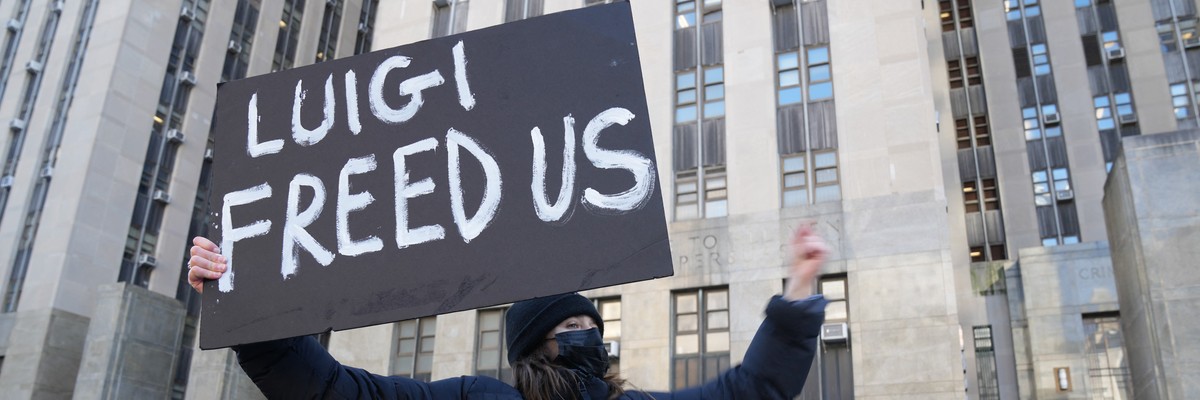
A woman named Mary holds a sign in support of Luigi Mangione outside the Criminal Court building in lower Manhattan as Luigi Mangione, the suspect in the United Healthcare CEO killing, waived extradition to New York on December 19, 2024. (Photo: Bryan R. Smith/AFP via Getty Images)
To honor Brian Thompson, and to ensure his death is not in vain, we can engage in the needed conversation about the extreme depravity of our healthcare system which his death revitalized.
Early this month Luigi Mangione, 26, University of Pennsylvania graduate, allegedly gunned down CEO of UnitedHealthcare, Brian Thompson, 50. The public response has been varied, with many supporting Mangione. Some fear the positive regard of Mangione is indicative of a shift into a new era where violence is glorified and humanity is lost. As a sociology professor who teaches Poverty, Wealth, and Privilege, I disagree. This failure of subsets of the public to broadly denounce the actions of Mangione does not herald a cultural shift in appreciation of violence.
Instead this unusual display of class consciousness reflects two things. First, the reaction is due to the shift in who bore the cost of violence. Class under-resourced; Black, Indigenous, Latinx and people of color; women; and queer and trans people are the normal recipients of societal violence. Wealthy, cishet, white men in positions of power are not. Wealthy, white communities are conditioned to expect protection, and the revocation of that sheltering is rare.
Second, the working classes are weary from surviving an unnecessarily violent and unjust society. We live amid staggering class, race, and gender-based stratification and life and death stakes everyday. The ruling class profits from our blood, sweat, and tears. And yet, when one of the elite passes, they want us to give them more. They ask us to give them our love. Yet, they remain calloused to our pain and ignore our pleas for fairness.
We, as a community, might ask, how are the elite and their apologists not appalled by a harm-rich system that normalizes the idea that humans are only as valuable as their economic worth?
Recently, a magician performed at a kid’s birthday party. Magic tricks work through deception. A magician distracts the audience to hide what else they are doing. Similar dynamics play out in our public life. The wealth gap continues to grow, yet we voted in a billionaire to be president. The public is shamed for failing to appropriately sympathize with Brian Thompson and his family, yet everyday targeted attacks and systemic neglect accumulate to harm and render disposable historically and strategically marginalized communities, such as class under-resourced, BIPOC, women, and trans and queer people.
Let us stop this charade. Our healthcare system is not pro-health. The World Health Organization (WHO) names universal healthcare as a worldwide goal. The United States has not complied. Most Americans are insured through private companies. Many Americans struggle to pay for healthcare, they postpone receiving care, and are in medical debt. The healthcare system has practices, such as using AI to deny a high number of healthcare claims, which put profits over people. There is something deeply inhumane and harmful about this disregard for health in a healthcare system. It may not be illegal, but it is savage.
The elite and their apologists ask, “How could they not be appalled by Thompson’s murder?” Instead we, as a community, might ask, how are the elite and their apologists not appalled by a harm-rich system that normalizes the idea that humans are only as valuable as their economic worth? Decades ago, Larry Summers, currently on the board of directors of OpenAI, famously wrote that people who produce less are more expendable. This classist ideology pervades our healthcare system.
To honor Brian Thompson, and to ensure his death is not in vain, we can engage in the needed conversation about the extreme depravity of our healthcare system which his death revitalized. A path forward that reforms a calloused healthcare system can provide benefits to all of us. Those among us who deeply mourn Brian’s death can take solace that it can impart a legacy of positive, sustainable, and overdue social change. Those among us who view Mangione’s action as predictable, if not understandable, can appreciate the same reform.
To be sure, there are people who claim that human fallibility is a predestined curse that we cannot overcome, that we are born sinners and that we cannot do better than prioritize greed over care of each other, even within our healthcare system. There will be those of us who feel that disproportionate wealth is a triumph and that our healthcare should reflect the position we hold in our socioeconomic system. However, 73 countries have universal healthcare, including China, Russia, Mexico and Canada. Us Americans are also worthy.
Wealthy and powerful people are the most protected against societal harms, and they also have disproportionate control over them. We need the CEOs, billionaires, and other power elites to do better. The system does not have a great way to hold those in charge accountable for bad behavior. Can they figure out a way to hold themselves accountable? Can they reorganize to prioritize care, a virtue, over greed, a vice, in our healthcare system? If they are immune to this self-correcting recovery, we need to organize around collective action, such as voting, for example for single-payer healthcare, because our lives depend on it. We don’t want anyone dying in the street. We also don’t want anyone dying or in pain due to a broken so-called healthcare system.