Tag: Cilia Flores

  • Nicolás Maduro is not guilty

    Spread the love

    Article by Stephanie Weatherbee Brito and Vijay Prashad republished from BT BreakThrough News under Creative Commons (CC BY-NC-ND 4.0).

    Mobilization in Caracas demanding the return of Nicolás Maduro. Photo: Francisco Trias

    The implications of this case extend far beyond Venezuela. The entire process against Nicolás Maduro and Cilia Flores threatens to establish the US court system as one with global and unlimited jurisdiction.

    Venezuelan President Nicolás Maduro is not guilty. This is a statement of law and fact, since Maduro has not been convicted of any crime. He has pleaded not guilty to every charge brought against him, and the accusations made by the United States remain precisely that: accusations. Under the presumption of innocence – recognized in the United States Constitution and in Article 14 of the International Covenant on Civil and Political Rights – the burden rests entirely upon the prosecution to prove guilt. It is not Maduro who must prove his innocence, but it is the United States government that must prove his guilt.

    On January 3, 2026, United States forces illegally entered Venezuela, attacked targets in and around Caracas, seized President Maduro and his wife and an elected official, Cilia Flores, and transported them to the United States. Two days later, shackled and injured, Maduro appeared before a federal court in Manhattan. “I am innocent. I am not guilty,” he told the court. Both defendants entered pleas of not guilty and are now imprisoned in Brooklyn while awaiting a trial provisionally scheduled for June 2027.

    The charges against Maduro

    The United States alleges that Maduro participated in conspiracies to import cocaine, possess machine guns and destructive devices, and collaborate with organizations Washington has designated as terrorist groups. These charges developed out of an indictment announced during Donald Trump’s first presidency in March 2020. The case was substantially expanded after Maduro was kidnapped through a fourth superseding indictment. An indictment, however, is not evidence tested before a court. It is a document prepared by prosecutors and approved through a grand-jury proceeding at which the defense is normally neither represented nor permitted to challenge the government’s account.

    The prosecution relies heavily upon the idea that Maduro directed the so-called Cartel de los Soles, or Cartel of the Suns. But even organizations deeply hostile to the Venezuelan government acknowledge that this is not a cartel in the conventional sense. The name has long been used as an umbrella expression for disparate Venezuelan officials allegedly involved in criminal activity, long before Maduro entered political life. It does not describe an organization with a demonstrated membership, command structure, headquarters or chain of authority comparable to Mexico’s Sinaloa Cartel. When Washington designated the Cartel de los Soles a foreign terrorist organization in 2025, the Associated Press noted that it was “not a cartel per se.”

    This matters because the prosecution’s language performs much of its political work. Allegations concerning individual acts of corruption are assembled into the image of a unified organization, the organization is then attributed to the Venezuelan state, and responsibility for everything allegedly done by anyone within that loose network is placed upon Maduro. The indictment must still demonstrate that Maduro knowingly joined the specific conspiracies charged. Political authority over a state in which crimes occur does not by itself establish personal criminal responsibility for those crimes.

    Case is dead on arrival

    Venezuela is not a major producer of coca leaf or cocaine. The principal cocaine-producing countries remain Colombia, Peru and Bolivia. Venezuela has been used as a transit territory, particularly for cocaine originating in neighboring Colombia. But transit through a country does not prove that its president commands the traffic, and nor does it substantiate the extravagant political image of Venezuela as the central source of the drugs entering the United States. The US Drug Enforcement Administration’s own 2025 threat assessment concentrated overwhelmingly upon Mexican organizations and their supply chains. The global cocaine trade operates primarily through production in the Andean region, maritime export corridors, Central America and Mexico, not through a single organization supposedly commanded from the Venezuelan presidential palace. The International Criminal Court’s investigation into the situation in Venezuela, for example, is an investigation into alleged crimes within its jurisdiction. It is not a conviction of Maduro and has not produced an individual judgment of guilt against him.

    The US government is expected to rely upon cooperating witnesses, including former Venezuelan intelligence chief Hugo Carvajal and former general Clíver Alcalá. Both men pleaded guilty to serious offenses in the United States. Their evidence cannot be treated as disinterested truth. Cooperating defendants may hope to obtain sentencing benefits by assisting prosecutors. Their claims must therefore be corroborated and subjected to cross-examination. Until that happens, their statements do not establish Maduro’s guilt. In fact, it is better to see their statements as proof of their own attempt to lighten their sentences and launder their soiled reputations.

    The circumstances under which Maduro was brought before the US court create an even deeper problem. Washington did not request extradition through an agreed legal process. It employed military force within another sovereign country without Venezuela’s consent or authorization from the United Nations Security Council. Article 2(4) of the UN Charter prohibits the threat or use of force against the territorial integrity or political independence of a state, subject to narrow exceptions such as self-defence. Arresting a person accused of drug offenses is not one of those exceptions. International-law specialists described the operation as an unlawful use of force, while governments including Brazil, Mexico, and China condemned the violation of Venezuelan sovereignty.

    Maduro’s lawyers have argued that the prosecution violates the immunity enjoyed by an incumbent head of state. Venezuela continued to recognize Maduro as its constitutional president when the United States seized him – a fact tacitly recognized by the United States when it calls Delcy Rodriquez the Acting President. Washington cannot necessarily extinguish the international legal status of another country’s head of state merely by withholding diplomatic recognition. The defense has consequently requested dismissal of the indictment on immunity grounds and has separately challenged the narco-terrorism count for lacking an adequate jurisdictional connection to the United States. Oral argument on these questions is scheduled for November 2026.

    The case of former Honduran president Juan Orlando Hernández exposes the selectivity of Washington’s supposed war against narco-states. Hernández was a close US ally during his presidency from 2014 to 2022. After leaving office, he was extradited – not abducted through a military invasion – and tried in the same federal district in New York where Maduro is now being prosecuted. In March 2024, a jury convicted Hernández after a three-week trial. Prosecutors presented evidence that he had accepted millions of dollars from traffickers, protected cocaine shipments with the Honduran police and military, and helped move more than 400 tons of cocaine towards the United States. He was sentenced to 45 years in prison. Unlike the claims against Maduro, these allegations were tested through testimony, cross-examination and a jury verdict. Yet on December 1, 2025, President Donald Trump pardoned Hernández and secured his release, claiming that the former president had been treated unfairly.

    The contrast could hardly be more revealing. Trump pardoned a former president whose participation in cocaine trafficking had been established in a US courtroom, while threatening and eventually invading Venezuela to seize a president against whom no verdict had been rendered. Hernández belonged to Washington’s political camp; Maduro did not. One was released despite his conviction, while the other was captured despite his legal innocence. This disparity does not by itself disprove the accusations against Maduro, but it demolishes the claim that Washington acted from a consistent concern about narcotics. The determining distinction was political alignment, not the strength of the evidence.

    The implications of this case extend far beyond the specific circumstances of Maduro and Cilia Flores or their consequences for Venezuela. Allowing a foreign state to override the jurisdiction of another country’s legal system, pursue an accusation for which there is no evidence, and proceed with a trial that lacks a basis in international law effectively establishes the US court system as one with global and unlimited jurisdiction. The ambivalence of governments around the world toward this case is therefore alarming, as it risks signalling consent and normalizing such gross overreach. This is particularly relevant for Mexico, which is already facing a series of accusations and extradition demands from the United States with clear political implications. The outcome of Maduro’s trial could set an important precedent for how Mexico – and other countries – are treated in similar circumstances.

    Nicolás Maduro is not guilty therefore expresses the only defensible conclusion at this stage. He was seized through an act of military force, placed before the courts of the state that had pursued his overthrow for years, and charged based on a politically constructed theory that has yet to survive adversarial examination. He remains innocent unless and until admissible evidence proves otherwise beyond a reasonable doubt. Sovereignty is not an ornament, an indictment is not a verdict, and an accusation issued by a powerful state does not become truth merely because that state possesses the weapons to seize the accused.

    Stephanie Weatherbee Brito is the co-coordinator of the International Peoples Assembly (IPA). 

    Vijay Prashad is an Indian historian and journalist. He is the author of forty books, including Washington Bullets, Red Star Over the Third World, The Darker Nations: A People’s History of the Third World, The Poorer Nations: A Possible History of the Global South, and How the International Monetary Fund Suffocates Africa, written with Grieve Chelwa. He is the executive director of Tricontinental: Institute for Social Research, the chief correspondent for Globetrotter, and the chief editor of LeftWord Books (New Delhi). He also appeared in the films Shadow World (2016) and Two Meetings (2017).

    Article by Stephanie Weatherbee Brito and Vijay Prashad republished from BT BreakThrough News under Creative Commons (CC BY-NC-ND 4.0).

    Climate science denier Donald Trump confirms that he knows nothing about democracy and that more liquid gold is being secured according to his policy of global privateering.
    Climate science denier Donald Trump confirms that he knows nothing about democracy and that more liquid gold is being secured according to his policy of global privateering.
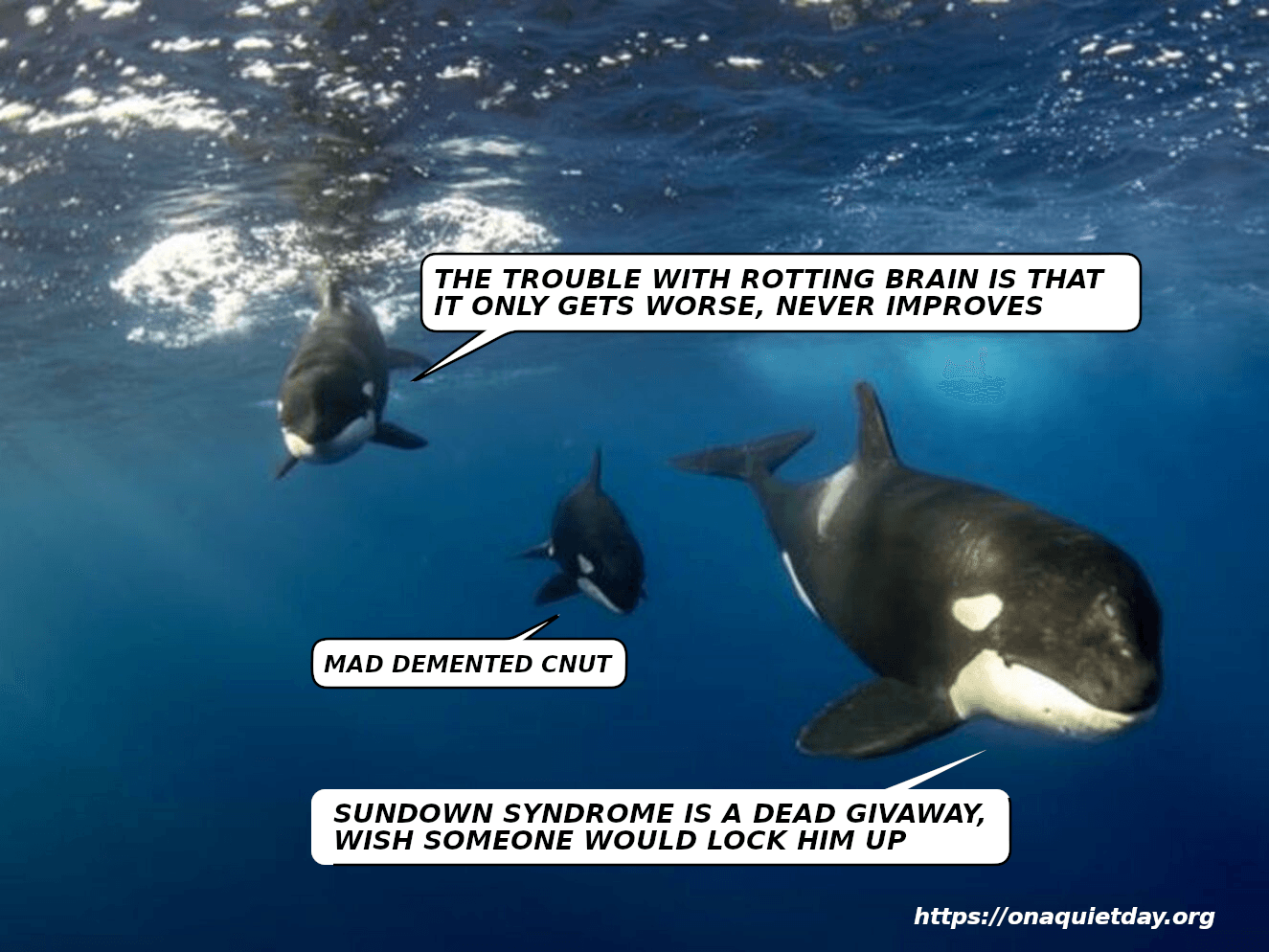
    Orcas discuss rotting brain, front Orca says Sundown Syndrome is a dead givaway and he wishes someone would Lock Him Up
    Orcas discuss rotting brain, front Orca says Sundown Syndrome is a dead givaway and he wishes someone would Lock Him Up
  • New wave of solidarity with Venezuela sweeps across Italy

    Spread the love

    Original article by Ana Vračar republished from peoples dispatch under a Creative Commons Attribution-ShareAlike 4.0 (CC BY-SA) license.

    Source: Cambiare Rotta/Facebook

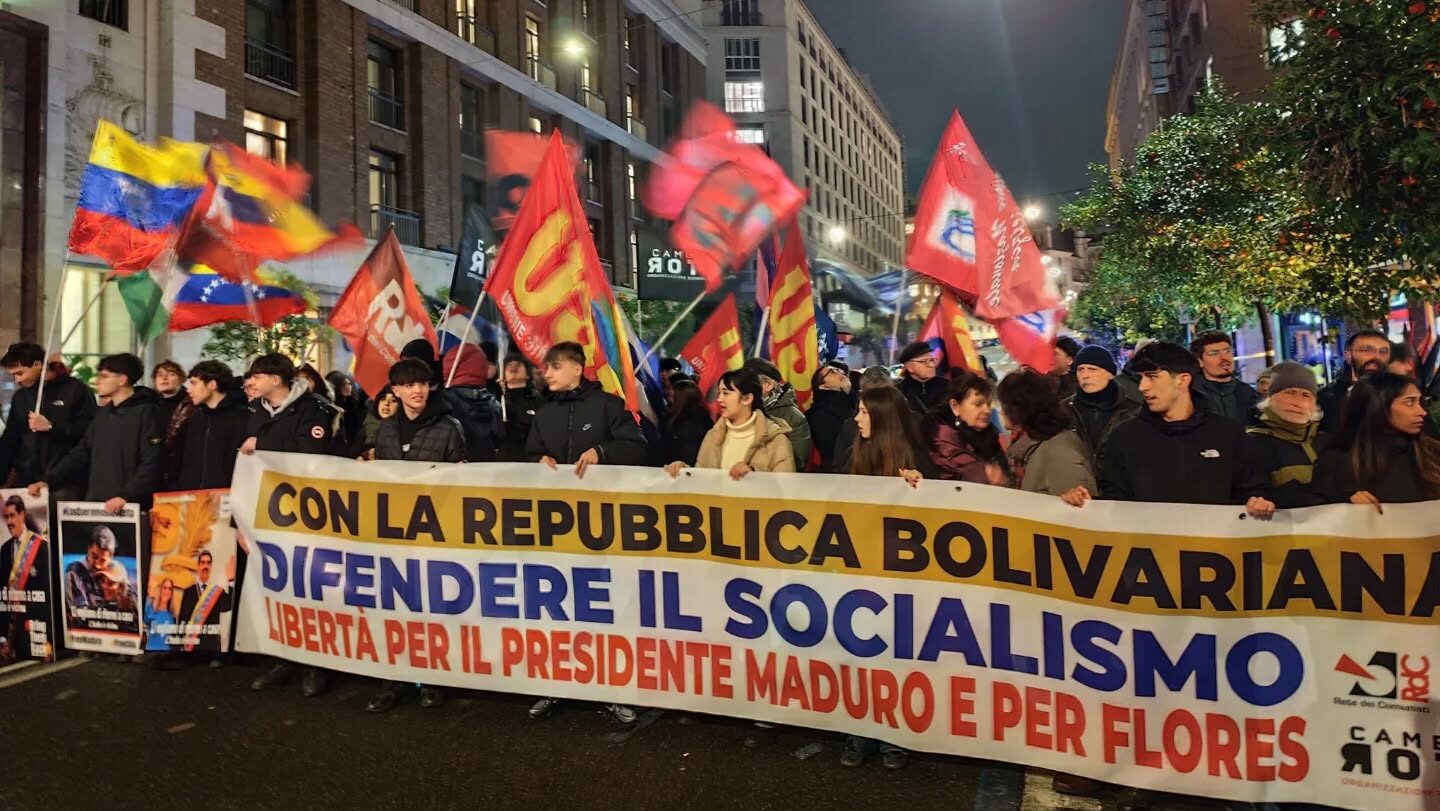
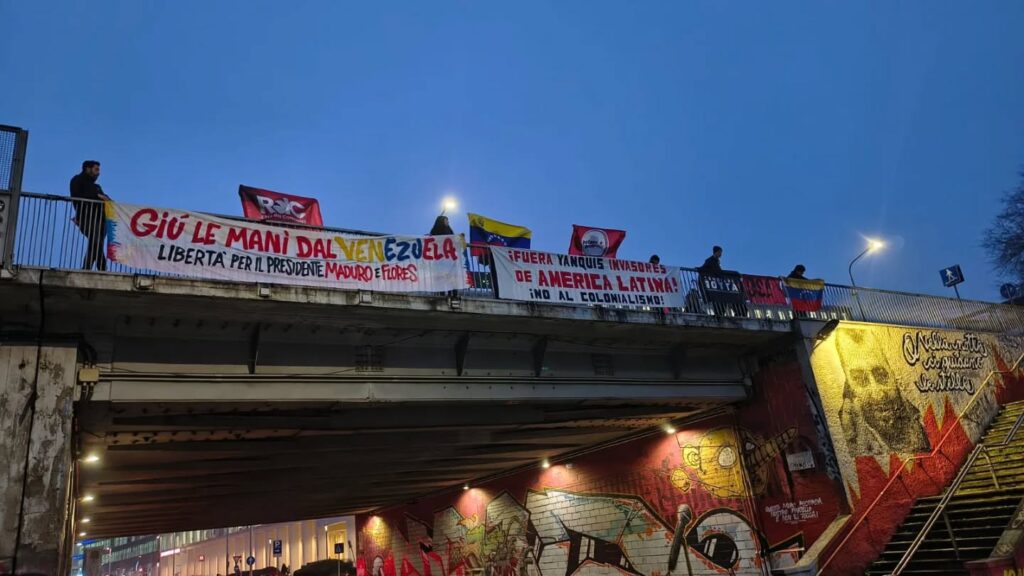
    Dozens of cities in Italy organized actions in solidarity with Venezuela, demanding the release of President Nicolás Maduro and Cilia Flores

    One month after the US attack on Venezuela, dozens of Italian cities once again took to the streets in support of the Bolivarian process, demanding the release of President Nicolás Maduro and Cilia Flores. Organized under the international slogan “Bring them home!”, the decentralized actions represent a stepping stone toward a national assembly in Rome on Sunday, February 8, as well as permanent mobilization against war and rearmament.

    Students and youth made up a significant portion of participants in Tuesday’s demonstrations. “In response to the United States’ military action, a clear expression of its desire to reassert control over the continent, we once again stand alongside the Bolivarian Revolution […] against US imperialism and to demand the immediate release of Maduro and Flores,” the organizations Cambiare Rotta and OSA wrote on the day.

    Read more: One month after the attack on Venezuela: the resurgence of imperialist “diplomacy”

    Left groups also denounced the Trump administration’s threats and attacks against other countries in Latin America, particularly Cuba and Colombia, warning that the strategy is rooted in a model of imperialism that harms people all over the world. Marta Collot, spokesperson for the left party Potere al Popolo, emphasized that the protests were also aimed at opposing a “model based on extractivism that seeks to seize the resources of other countries.”

    “The ambitions of the US are not limited to Venezuela, but extend to all the countries of Nuestra América, which are to be turned into mere territories for resource extraction, from oil to rare earths, from vast freshwater reserves to a ‘disposable’ workforce,” Potere al Popolo wrote ahead of the protests. Venezuela, with its socialist transformation, “has always been a thorn in their [the West] side, against which they have directed all weapons of hybrid warfare, from economic and military aggression to cognitive warfare,” the party added.

    Source: Cambiare Rotta/Facebook

    “We condemn this attack, which was not only an attempt to seize Venezuela’s oil, a nationalized oil, but also an effort to restore US hegemony over Latin America, which the US continues to regard as its backyard,” activists from Potere al Popolo Turin said on the day.

    “But Latin America does not bow to US imperialist ambitions,” they added. “It resists, as shown by the massive crowds in Caracas, where the Venezuelan people are not celebrating, as our subservient media would have us believe, but are instead fighting loudly for the release of President Maduro and the primera combatiente.”

    Read more: Trump’s ultimatum to Cuba: no fuel until surrender!

    “We are here to say it once again: hands off Venezuela,” Collot said. “Today we are facing a paradox in which Trump not only allows himself to kidnap President Maduro, but also threatens half the world, from socialist Cuba to Iran, Colombia, and even Greenland.”

    “All of this must end,” she concluded. “We need to reverse course and focus on policies that genuinely support workers and peoples, promote solidarity, and oppose the war-driven agenda that is pushing us toward the brink of World War III.”

    Original article by Ana Vračar republished from peoples dispatch under a Creative Commons Attribution-ShareAlike 4.0 (CC BY-SA) license.

    Donald Fuhrump says that Amerikkka doesn't bother with crimes or charges anymore, not being 100% Amerikkkan and opposing his real estate intentions is enough.
    Donald Fuhrump says that Amerikkka doesn’t bother with crimes or charges anymore, not being 100% Amerikkkan and opposing his real estate intentions is enough.
    Elon Musk urges you to be a Fascist like him, says that you can ignore facts and reality then.
    Elon Musk urges you to be a Fascist like him, says that you can ignore facts and reality then.
    Orcas discuss Donald Trump and the killer apes' concept of democracy. Front Orca warns that Trump is crashing his country's economy and that everything he does he does for the fantastically wealthy.
    Orcas discuss Donald Trump and the killer apes’ concept of democracy. Front Orca warns that Trump is crashing his country’s economy and that everything he does he does for the fantastically wealthy.
  • ‘Thug’ Marco Rubio Tells Senate How US Plans to Keep Stealing Venezuelan Oil

    Spread the love

    Original article by Jessica Corbett republished from Common Dreams under Creative Commons (CC BY-NC-ND 3.0).

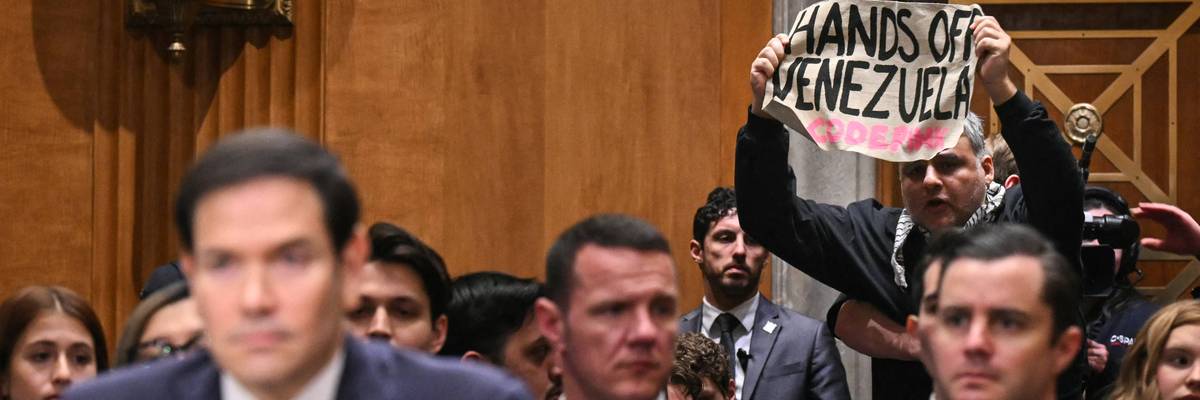
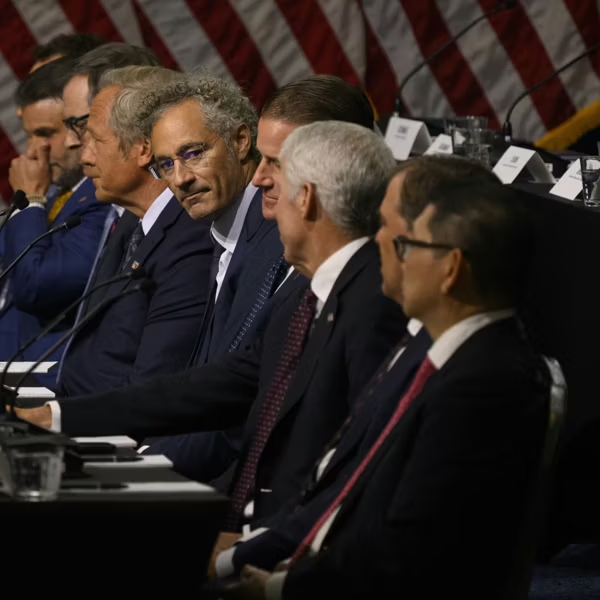
    A protestor holds up a sign as US Secretary of State Marco Rubio testifies during a Senate Foreign Relations Committee hearing about US policy toward Venezuela on Capitol Hill in Washington, DC on January 28, 2026. (Photo by Saul Loeb/AFP via Getty Images)

    “Rubio’s dangerously expansive vision to transform the United States into a colonizing power in the Americas must be challenged,” one watchdog leader said of the US secretary of state.

    In addition to asserting that “there is no war against Venezuela,” despite US forces killing scores of people there while abducting its president earlier this month, Secretary of State Marco Rubio on Wednesday laid out for a Senate panel how the Trump administration intends to continue controlling the South American nation’s oil and related profits.

    Legal experts have argued that US President Donald Trump’s blockade of Venezuela’s oil, abduction of Venezuelan President Nicolás Maduro and his wife, Cilia Flores—who have both pleaded not guilty to federal narco-terrorism charges—and bombings of boats allegedly smuggling drugs in the Caribbean Sea and Pacific Ocean all violate international law.

    RECOMMENDED…

    Sen. Chris Murphy

    ‘This Is an Insane Plan’: Democrats Fume After Briefing on Trump Plot to Steal Venezuela’s Oil

    Oil statute in Venezuela

    ‘Straight-Up Piracy and Extortion’: Trump Says He Will Control Money From Sale of Venezuelan Oil

    “The ongoing military actions in the Caribbean and South America, including the abduction of Venezuela’s president, are wrong, illegal under US and international law, and unconstitutional,” Robert Weissman, co-president of the group Public Citizen, said before the Senate hearing. “Congressional Republicans have blocked war powers resolutions that would end the US aggression in Venezuela, an extremely dangerous abdication of congressional responsibility to check presidential unlawfulness.”

    “Marco Rubio’s central role in the planning and execution of the scheme to violate the sovereignty of Venezuela and steal the country’s oil merits a deep investigation by Congress, and potentially the removal of Rubio as secretary of state,” Weissman continued. “Rubio’s dangerously expansive vision to transform the United States into a colonizing power in the Americas must be challenged.”

    Testifying to the Senate Foreign Relations Committee—on which he previously served—Rubio said that “Maduro is an indicted drug trafficker, not a legal head of state,” described his abduction as “an operation to aid law enforcement,” and declared that “the United States is prepared to help oversee Venezuela’s transition from a criminal state to a responsible partner.”

    Rubio, the acting national security adviser, insisted that Trump wasn’t planning for any more military action in Venezuela—but also would not rule out such action, potentially without congressional authorization, in “self-defense” against an “imminent” threat.

    Trump has repeatedly made clear through public statements that his Venezuela policy is focused on its petroleum reserves, seemingly to enrich the fossil fuel leaders who helped him return to power. American forces have seized several tankers in the Caribbean Sea linked to the country—which critics have condemned as “piracy”—and the first US sale of Venezuelan oil went to the company of a trader who donated millions to the president’s 2024 campaign, which Sen. Cory Booker (D-NJ) last week called “yet another example of his unchecked corruption.”

    https://cdn.jwplayer.com/players/kdKoYUm0-xS4RtpB7.html

    Describing US control of Venezuela’s nationalized petroleum industry, Rubio told the committee:

    Objective number one was stability… And one of the tools that’s available to us is the fact that we have sanctions on oil. There is oil that is sanctioned that cannot move from Venezuela because of our quarantine. And so what we did is we entered into an arrangement with them, and the arrangement is this: On the oil that is sanctioned and quarantined, we will allow you to move it to market. We will allow you to move it to market at market prices—not at the discount China was getting. In return, the funds from that will be deposited into an account that we will have oversight over, and you will spend that money for the benefit of the Venezuelan people…

    This is not going to be the permanent mechanism, but this is a short-term mechanism in which the needs of the Venezuelan people can be met through a process that we’ve created, where they will submit every month a budget of this is what we need funded. We will provide for them at the front end what that money cannot be used for. And they have been very cooperative in this regard. In fact, they have pledged to use a substantial amount of those funds to purchase medicine and equipment directly from the United States.

    In an exchange with Senate Foreign Relations Committee Ranking Member Jeanne Shaheen (D-NH), Rubio said that an “audit process” has not yet been set up but will be, adding that “we’ve only made one payment” and it “retrospectively will be audited, but it was important we made that payment because they had to meet payroll. They had to keep sanitation workers, police officers, government workers on staff.”

    Shaheen noted that the oil reportedly sold for $500 million, but only $300 million went to Venezuela’s government, now led by Maduro’s former deputy, Delcy Rodríguez, and asked Rubio about the remaining $200 million. The secretary said that the rest of the money was in a temporary account in Qatar that will ultimately become a US Treasury blocked account.

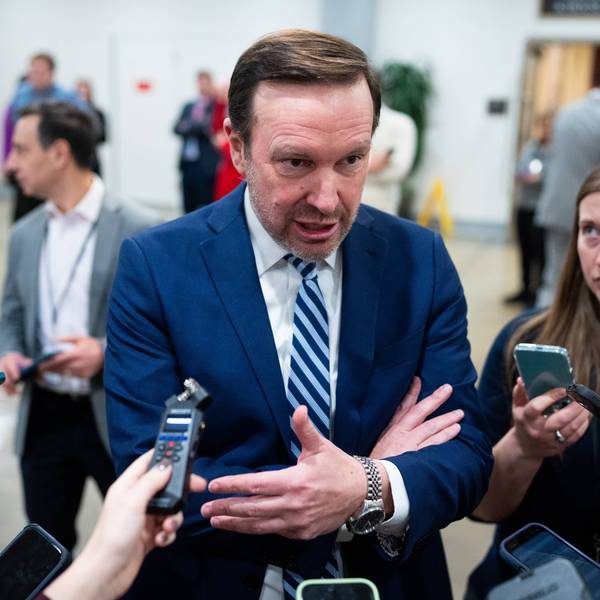
    Summarizing the Trump administration’s plans, Sen. Chris Murphy (D-Conn.) said: “I think the scope of the project that you are undertaking in Venezuela is without precedent. You are taking their oil at gunpoint; you are holding and selling that oil; putting, for now, the receipts in an offshore Middle Eastern account; you’re deciding how and for what purposes that money is gonna be used in a country of 30 million people. I think a lot of us believe that that is destined for failure.”

    Highlighting that “a month later, we have no information on a timetable for a democratic transition, Maduro’s people are still in charge, most of the political prisoners are in jail—and by the way, those that have been let out have a gag order on them from the government—the opposition leader is still in exile,” Murphy added, “this looks, already, like it is a failure.”

    At one point during the nearly three-hour hearing, Leonardo Flores, a Venezuelan-American with the anti-war group CodePink, shouted, “Marco Rubio, you and Trump are thugs!”

    US Capitol Police removed Flores from the hearing. As he was being led away, the protester said that “sanctions are a form of collective punishment of Venezuelan citizens. That’s a war crime. Hands off Venezuela! Hands off Cuba!”

    Asked by Sen. Brian Schatz (D-Hawaii) on Wednesday, “Will you make a public commitment today to rule out US regime change in Cuba,” Rubio—the son of Cuban immigrants—replied: “Regime change? Oh no, I think we would like to see the regime there change. That doesn’t mean that we’re gonna to make a change, but we would love to see a change. There’s no doubt about the fact that it would be of great benefit to the United States if Cuba was no longer governed by an autocratic regime.”

    Since the abduction operation, there have been “free Maduro” protests in both Venezuela and Cuba, which lost 32 citizens in the Trump administration’s attack on Caracas. Speaking to thousands of people gathered outside the US Embassy in Havana earlier this month, Cuban President Miguel Díaz-Canel said that “the current US administration has opened the door to an era of barbarism, plunder, and neo-fascism.”

    “No one here surrenders,” he continued, taking aim at not only Trump but also Rubio. “The current emperor of the White House and his infamous secretary of state haven’t stopped threatening me.”

    Original article by Jessica Corbett republished from Common Dreams under Creative Commons (CC BY-NC-ND 3.0).

    Donald Fuhrump says that Amerikkka doesn't bother with crimes or charges anymore, not being 100% Amerikkkan and opposing his real estate intentions is enough.
    Donald Fuhrump says that Amerikkka doesn’t bother with crimes or charges anymore, not being 100% Amerikkkan and opposing his real estate intentions is enough.
    Elon Musk urges you to be a Fascist like him, says that you can ignore facts and reality then.
    Elon Musk urges you to be a Fascist like him, says that you can ignore facts and reality then.
    Orcas discuss Donald Trump and the killer apes' concept of democracy. Front Orca warns that Trump is crashing his country's economy and that everything he does he does for the fantastically wealthy.
    Orcas discuss Donald Trump and the killer apes’ concept of democracy. Front Orca warns that Trump is crashing his country’s economy and that everything he does he does for the fantastically wealthy.

  • Trump Isn’t the First to Be Gifted a Nobel Prize He Didn’t Win—Joseph Goebbels Got One Too

    Spread the love

    Original article by Brett Wilkins republished from Common Dreams under Creative Commons (CC BY-NC-ND 3.0). 

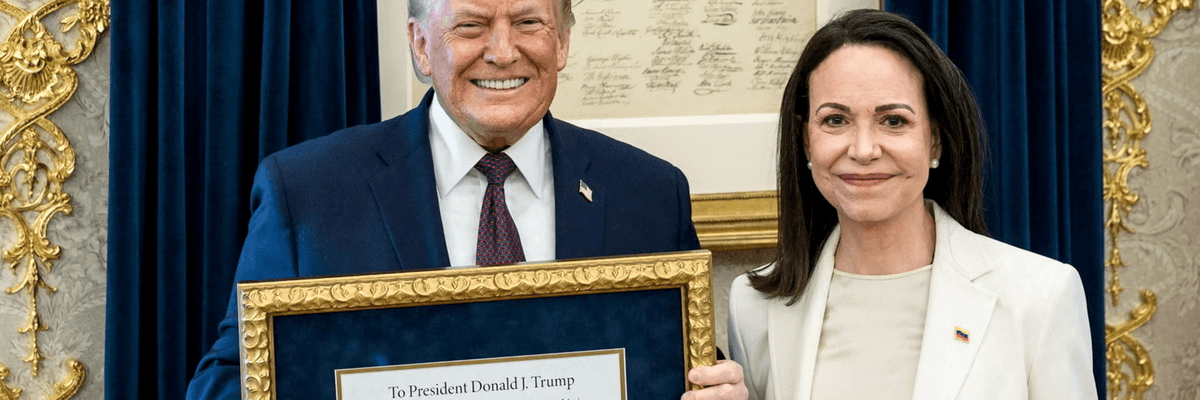
    US President Donald Trump holds a framed Nobel Peace Prize medal given to him by Venezuelan opposition leader María Corina Machado—the actual 2025 winner—at the White House in Washington, DC on January 15, 2026. (Photo by the White House)

    In 1943, the Norwegian writer Knut Hamsun gave his Nobel Prize for Literature to the infamous Nazi criminal.

    Venezuelan opposition leader María Corina Machado’s gifting of her 2025 Nobel Peace Prize to US President Donald Trump raised eyebrows around the world Friday—but it wasn’t the first time that the winner of the prestigious award gave it away.

    Last month, the Norwegian Nobel Committee awarded the peace prize to the 58-year-old opposition leader “for her tireless work promoting democratic rights for the people of Venezuela and for her struggle to achieve a just and peaceful transition from dictatorship to democracy.”

    RECOMMENDED…

    President Trump Meets With Israeli PM Netanyahu At His Palm Beach Estate

    Trump Bemoans Not Winning Nobel Peace Prize During Netanyahu Hot Mic

    President Trump Speaks At Inaugural Pennsylvania Energy And Innovation Summit

    ‘Corruption, Pure and Simple’: Probe Identifies Rich Donors Benefiting From Trump Presidency

    Machado joined a notorious group of Nobel Peace laureates who either waged or advocated for war, as she backed Trump’s aggression against her country. This has included a massive troop deployment, military and CIA airstrikes, bombing of boats allegedly transporting drugs, and the abduction earlier this month of Venezuelan President Nicolás Maduro and his wife, Cilia Flores.

    Trump has ordered the bombing of nine other countries during his two terms, more than any other president in history. US forces acting on his orders have killed thousands of civilians in Afghanistan, Iran, Iraq, Libya, Nigeria, Pakistan, Somalia, Syria, Venezuela, and Yemen. While running for president in 2016, Trump vowed to “bomb the shit out of” Islamic State militants and “take out their families,” and then followed through on his promise.

    Despite being passed over by Trump for installation in any leadership role in Venezuela so far, Machado presented Trump with her framed Nobel medal along with a certificate of gratitude during a Thursday meeting at the White House. Trump subsequently posted on his Truth Social network that “María presented me with her Nobel Peace Prize for the work I have done. Such a wonderful gesture of mutual respect.”

    In 1943!!!“Nobel Literature laureate Knut Hamsun famously gave his Nobel medal and diploma to Nazi propaganda minister Joseph Goebbels as a gesture of admiration for the Nazi regime, following his support for the occupation….”

    — Molly Jong-Fast (@mollyjongfast.bsky.social) 2026-01-16T18:56:54.507Z

    That gesture prompted the Norwegian Nobel Committee to issue a statement noting that the prize cannot be given away.

    “Even if the medal or diploma later comes into someone else’s possession, this does not alter who was awarded the Nobel Peace Prize,” the committee said. “A laureate cannot share the prize with others, nor transfer it once it has been announced. A Nobel Peace Prize can also never be revoked. The decision is final and applies for all time.”

    The committee’s statement was extraordinary—but this is not the first time that a Nobel winner gave away their prize. In 1943, Norwegian author Knut Hamsun gifted his 1920 Nobel Prize for Literature—awarded for his novel Markens Grøde (Growth of the Soil)—to Nazi Propaganda Minister Joseph Goebbels after a trip to Germany. Other Nobel laureates have donated or sold their medals.

    The progressive media outlet Occupy Democrats said on social media: “Clearly, the similarities between Trump and Goebbels extend beyond just a mutual admiration for fascism. Both men possess(ed) the kind of spiritually sick, egotistical temperament that allows one to accept a prize that someone else has earned.”

    “Obviously, Donald Trump does not deserve the Nobel Peace Prize,” the outlet continued. “He has bombed Iran, Yemen, Nigeria, innocent fishing boats in the Caribbean, Venezuela, and is in the process of turning the United States into a war zone. That said, Machado doesn’t deserve it either.”

    “Anyone spineless enough to surrender the prize to an evil man like Trump in the hopes of obtaining power is not someone we should be celebrating,” Occupy Democrats added.

    Last month, Wikileaks founder and multiple Nobel Peace Prize nominee Julian Assange sued the Nobel Foundation—the Swedish organization that manages administration of the approximately $1.2 million-per-winner prize—in a bid to prevent Machado from receiving the money.

    Machado’s win also sparked protests outside the Norwegian Nobel Institute in Oslo.

    Elon Musk urges you to be a Fascist like him, says that you can ignore facts and reality then.
    Elon Musk urges you to be a Fascist like him, says that you can ignore facts and reality then.
    Donald Fuhrump says that Amerikkka doesn't bother with crimes or charges anymore, not being 100% Amerikkkan and opposing his real estate intentions is enough.
    Donald Fuhrump says that Amerikkka doesn’t bother with crimes or charges anymore, not being 100% Amerikkkan and opposing his real estate intentions is enough.
    Orcas discuss how Trump was re-elected and him being an obviously insane, xenophobic Fascist.
    Orcas discuss how Trump was re-elected and him being an obviously insane, xenophobic Fascist.

    2009 Nobel Peace Prize

    The 2009 Nobel Peace Prize was awarded to United States president Barack Obama (b. 1961) for his “extraordinary efforts to strengthen international diplomacy and cooperation between peoples”.

  • Venezuela and the journey from Monroe’s Doctrine to Trump’s Jungle Law

    Spread the love

    This article by Diana Cariboni republished from OpenDemocracy under a Creative Commons Attribution-NonCommercial 4.0 International licence. 

    Donald Trump holds a press conference after US forces captured Venezuelan leader Nicolas Maduro and launched a ‘large-scale strike’ on the Latin American country | Jim Watson / AFP via Getty Images)

    As the days pass, shock subsides over the kidnapping of Venezuelan president Nicolás Maduro and his wife, Cilia Flores, which was ordered by Donald Trump and carried out by the US military. That the victim is a dictator has helped to justify the illegal use of brute force.

    There is a long history of US military intervention in Latin America. It’s been the expression of the most enduring principle that has governed relations in the American continent.

    Everything Trump did in the first year of his second presidential term was old news: tariff wars, interventions in the internal affairs of other countries, threats, extortion and the revival of the old Monroe Doctrine.

    What is new is the brazenness, the absence of even the slightest legal justification, or even the effort to frame actions within some interpretation of international law, however twisted it may be. There is no talk of democracy, freedom or human rights for millions of Venezuelans.

    This is an unexplained and uncontested exercise of power. “What’s next, Mr President, Colombia?” journalists asked Trump like subjects asking their emperor. “It sounds good to me,” he replied. Mexico, Colombia, Cuba, Greenland… “American dominance in the Western Hemisphere will never be questioned again.”

    The threat is material – Maduro in handcuffs, the naval deployment in the Caribbean, the boats bombed for months – and at the same time diffuse. No one knows what the logic or the alleged motive for the next action will be.

    The effect of Trump’s actions, already tested with the so-called “peace deal” for Palestine in the aftermath of the Israeli genocide in Gaza, is to sow confusion and division, and paralysis. The era of this new power has begun with little to oppose it, and with international laws useless like broken toys. And we are all warned.

    Maduro was extracted from his bunker in eight minutes, which was enough time to kill 32 Cuban guards who were protecting him. The rest of the regime remains intact, now as the executive arm of Trump’s designs, which have articulated only one priority: oil.

    When asked about elections, democracy or the release of some 800 political prisoners, Trump and his secretary of state, Marco Rubio, reply that all this “is premature”. The nature of the events indicates the coup was orchestrated with a part of the regime whose head was Maduro.

    Nothing remains of Venezuela’s Bolivarian revolution, not even dignity. Delcy Rodríguez, Maduro’s vice-president and one of the most vocal figures in his administration, has been appointed interim president, with Trump’s acquiescence. She and her brother Jorge, the president of the National Assembly, Diosdado Cabello, the minister of the interior, and Vladimir Padrino López, the head of the armed forces, have become administrators of a Trump protectorate – a new, perhaps provisional, status quo that sets Venezuela and all of Latin America sailing into uncharted waters.

    The eternal misunderstanding

    In a speech to the US Congress 202 years ago, US president James Monroe laid the foundations for his new country’s relationship with the other republics emerging across the American continent amid struggles against the European colonial powers.

    That relationship would be one of US dominance and Latin American subordination, although the Monroe Doctrine was presented as a warning against new European colonial adventures in America.

    “America for Americans” – Monroe’s phrase that coined the eternal misunderstanding – postulated that America, the continent, was for them, who called themselves “Americans”. In that single remark, the rest of the American peoples were left in an inferior category, confined to their nationalities or to a subordinate belonging to the same single continent (Latin Americans, South Americans, Central Americans or Caribbeans). Never simply Americans.

    Other US presidents followed Monroe’s lead. More than five decades after his doctrine came Rutherford Hayes’s corollary of 1880, on the need for the US to have exclusive control in Central America and the Caribbean, and therefore of any interoceanic canal, followed by Theodore Roosevelt’s corollary of 1904, which postulated the freedom of the US to intervene by force in any country on the continent if it considered that its interests were affected.

    Just a few weeks ago, on the anniversary of the Monroe Doctrine, Trump published his own corollary, which contains nothing new, though the foreign power to keep away now is no longer Europe but China. The novelty lies in what began in Venezuela.

    The question of democracy

    In December, the UN reported that Venezuela’s human rights situation was continuing to deteriorate. In 2021, the International Criminal Court’s prosecutor opened a formal investigation into crimes against humanity, such as torture, disappearances and executions at the hands of the state.

    Like Delcy Rodríguez now, Maduro became interim president in 2013 after the death of leader Hugo Chávez. Shortly afterwards, he won the elections by a narrow margin and, from 2015 onwards, took an openly authoritarian turn when he refused to recognise the result of parliamentary elections that left him without a majority in the National Assembly.

    Opponents of the regime tried different approaches to overthrow it. To name just a few: peaceful demonstrations, violent actions, calls for a military uprising, attempts to get neighbouring governments to blockade the country, support for economic sanctions by the US and the European Union, complaints to international organisations, boycotts of elections they considered rigged, negotiations with the regime mediated by third countries, and massive participation in elections. None of this moved the needle.

    Despite the opposition’s victory in the 2024 presidential elections, Maduro was once again proclaimed president, through fraud.

    Then Trump reappeared, with a military deployment unseen in decades, indiscriminate bombing of ships in the Caribbean and the Pacific, and persecution and stigmatisation of Venezuelan migrants as terrible criminals and mentally ill people ravaging US cities.

    The main opposition leader, María Corina Machado, who recently won the Nobel Peace Prize, clung to this strategy like a lifeline in the storm. She argued that the military siege, the accusations of narco-terrorism against Maduro and his circle, and the imminent military action by Washington would bring down the regime and open the door to a transition. Shortly after Maduro’s kidnapping, Machado proclaimed: “Today we are prepared to assert our mandate and take power.”

    Trump’s response could not have been colder. He removed her from the scene, claiming she lacked the necessary “respect” and “support” for the moment.

    In an interview with Fox News on Monday, Machado tried again to court Trump and said she wanted to give him her Nobel Peace Prize, which the US president has long coveted and considers himself deserving of. Days later, Trump indicated to Fox News that he might meet with her in Washington, saying: “I understand she’s coming in next week sometime, and I look forward to saying hello to her.” The Norwegian Nobel Institute was forced to clarify that its peace prizes cannot be transferred to third parties.

    There were celebrations by Venezuelans in exile in cities across the western hemisphere when Maduro’s overthrow was announced, but not within Venezuela. Maduro no longer governs there, but the same regime does, under Trump’s shadow.

    This article by Diana Cariboni republished from OpenDemocracy under a Creative Commons Attribution-NonCommercial 4.0 International licence. 

    Elon Musk urges you to be a Fascist like him, says that you can ignore facts and reality then.
    Elon Musk urges you to be a Fascist like him, says that you can ignore facts and reality then.
    Donald Fuhrump says that Amerikkka doesn't bother with crimes or charges anymore, not being 100% Amerikkkan and opposing his real estate intentions is enough.
    Donald Fuhrump says that Amerikkka doesn’t bother with crimes or charges anymore, not being 100% Amerikkkan and opposing his real estate intentions is enough.
    Orcas discuss how Trump was re-elected and him being an obviously insane, xenophobic Fascist.
    Orcas discuss how Trump was re-elected and him being an obviously insane, xenophobic Fascist.