Rightwing groups penned a conservative wish list of proposals for the next conservative president to gut environmental protections
An alliance of rightwing groups has crafted an extensive presidential proposal to bolster the planet-heating oil and gas industry and hamstring the energy transition, it has emerged.
Against a backdrop of record-breaking heat and floods this year, the $22m endeavor, Project 2025, was convened by the notorious rightwing, climate-denying thinktank the Heritage Foundation, which has ties to fossil fuel billionaire Charles Koch.
Called the Mandate for Leadership: The Conservative Promise, it is meant to guide the first 180 days of presidency for an incoming Republican president. Climate experts and advocates criticized planning that would dismantle US climate policy.
The nearly 1,000-page transition guide was written by more than 350 rightwingers and is full of sweeping recommendations to deconstruct all sectors of the federal government– – including environmental policy.
Very rich US right-wing interests intent on destroying a transition to sustainable energy. UK’s Prime Minister Rishi Sunak and UK Labour leader Keir Starmer are aligned with and not in any way opposing these interests. There is little doubt that climate denier – I think that it’s just beyond his abilities to understand tbh – Trump will go along with this. Charles Koch is involved with this initiative.
The British government’s current policies are about as far from being consistent with Britain’s net zero plan as it is possible to be, argues RICHARD HEBBERT
…
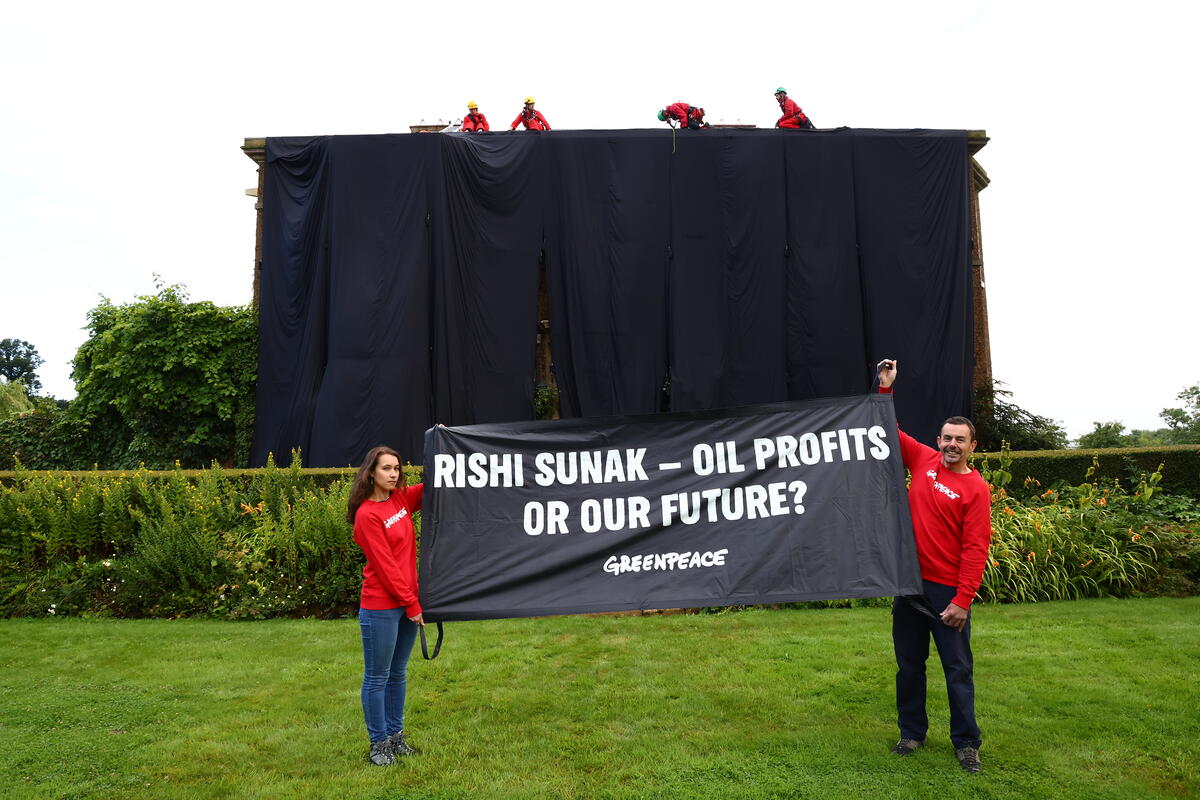
Last week Sunak announced that his government is granting over 100 new licences for oil and gas exploration in the North Sea, claiming in a peculiarly Orwellian statement that to do so is “consistent with the UK’s net zero plan.”
It isn’t. How could it possibly be?
Nor should we forget that the Tory government has approved the opening of a new coalmine in Cumbria and effectively banned on-shore windfarms — one of the quickest, cheapest and cleanest forms of renewable energy.
The British government cannot be ignorant of the manifest signs that the Earth’s climate is racing towards catastrophe, even quicker than has been previously forecast and yet it wilfully looks the other way.
The global average ocean surface temperature is expected to rise even further in the coming months as El Niño strengthens.
Climate scientists on Friday said the rapidly rising temperature of the planet’s oceans is cause for major concern, particularly as policymakers in the top fossil fuel emissions-producing countries show no sign of ending planet-heating oil and gas extraction.
The European Union’s climate agency, Copernicus Climate Change Service, reported this week that the average daily global ocean surface temperature across the planet reached 20.96°C (69.7°F), breaking the record of 20.95°C that was previously set in 2016.
The record set in 2016 was reported during an El Niño event, a naturally occurring phenomenon which causes warm water to rise to the surface off the western coast of South America. The weather pattern was at its strongest when the high ocean temperature was recorded that year.
El Niño is forming this year as well, but has not yet reached its strongest point—suggesting new records for ocean heat will be set in the coming months and potentially wreak havoc in the world’s marine ecosystems.
Samantha Burgess, deputy director of Copernicus, told the BBC that March is typically when the oceans are at their hottest.
“The fact that we’ve seen the record now makes me nervous about how much warmer the ocean may get between now and next March,” she told the outlet.
The warming oceans are part of a feedback loop that’s developed as fossil fuel emissions have increasingly trapped heat in the atmosphere.
Rising levels of carbon dioxide in the atmosphere are warming the oceans, leaving them less able to absorb the emissions and contributing to intensifying weather patterns.
“Warmer sea surface temperatures lead to a warmer atmosphere and more evaporation, and both of these lead to more moisture in the atmosphere which can also lead to more intense rainfall events,” Burgess told “Today” on BBC Radio 4. “And warmer sea surface temperatures may also lead to more energy being available for hurricanes.”
The warming ocean could have cascading effects on the world’s ecosystems and economies, reducing fish stocks as marine species migrate to find cooler waters.
“We are seeing changes already in terms of species distributions, prevalence of harmful algae blooms popping up maybe where we would not necessarily expect them, and the species shifting from warmer southern locations up into the colder regions as well which is quite worrying,” Helen Findlay, a biological oceanographer at the Plymouth Marine Laboratory in the United Kingdom, toldThe Evening Standard.
“We are also seeing more species coming up from the south, things like European anchovy or recently examples of Mediterranean octopus coming up into our waters and that is having a knock-on impact for the fish that we catch, and consequences of economics,” she added.
Certain parts of the world’s oceans provoked particular alarm among scientists in recent days, with water off the coast of Florida hitting 38.44°C—over 101°F—last week.
The National Oceanic and Atmospheric Administration told the BBC that ocean temperatures in that area typically hover between 23°C and 31°C at this time of year.
Since scientists first began measuring ocean temperatures using satellites and research buoys about four decades ago, the global average sea surface temperature has gone up by roughly 0.6°C.
On social media, climate scientists urged news outlets to explicitly connect the rising ocean temperatures to fossil fuel companies and the policymakers who are enabling them to continue fueling the climate emergency—such as British Prime Minister Rishi Sunak, who announced more than 100 new oil and gas licenses in the North Sea this week.
Ocean heat record smashed, with grim implications. This with warming of just 1.2° when scientists warn we are heading towards 3°. And in the week that the UK announces a bonanza for oil and gas. Will BBC Join the dots? @BBCJustinR https://t.co/V8rlv6IYx4
The New York Times this week reported “terrifying Earth breakdown but barely [mentioned] the cause is the fossil fuel industry,” said National Aeronautics and Space Administration climate scientist Peter Kalmus.
“The more we burn fossil fuels, the more excess heat will be taken out by the oceans, which means the longer it will take to stabilize them and get them back to where they were,” Burgess told the BBC.
If we have not been warned of the dangers of climate change this summer, we never will be. Extreme heat, forest fires and floods have been all over news reports. Yet the oil and gas industry remains largely in denial.
The International Energy Agency (IEA) says steep cuts in oil and gas production are necessary to reach the Paris (COP 21) goal of keeping global warming at 1.5℃. However, only a tiny fraction of the industry, accounting for less than 5% of oil and gas output, has targets aligned with the IEA’s “net zero” requirements.
The current secretary general of production cartel Opec, Haitham al-Ghais, expects global oil demand to rise by about 10% to 110 million barrels a day by 2045, a volume incompatible with the Paris goals. The UK government has just offered a helping hand, granting around 100 new North Sea licences. What are we to make of this mismatch?
The new denialism
Typical of the new breed of climate denialism is a recent report by the Energy Policy Research Foundation (ERPF), a body funded by the US government and various undisclosed corporate interests and foundations. It sees the IEA’s requirements as a “seal of approval … to block investment in oil and gas production by western companies”. The report views meeting the targets as too costly, too harsh on poor countries and too bad for the energy security of the west.
In fact, it is wrong on each account. Many eminent economists and scientists use the concept of the social cost of carbon (SCC), which is defined as the cost to society of releasing an additional tonne of CO₂. Expert estimates from 2019 put this at between US$171 and US$310 (£133 to £241). If we go with, say, US$240 per tonne, the social cost of continued carbon equivalent emissions comes out at almost US$8.5 trillion every year.
A recent study has factored into the calculation climate feedback loops. This is where one problem caused by global warming leads to others, such as melting permafrost unleashing stores of methane.
When the study estimated the economic damage that this could cause, it produced an SCC in excess of US$5,000. That implies annual costs of more like US$170 trillion a year, which makes the US$4 trillion investment into clean energy that the IEA thinks necessary to meet the Paris climate goals look like a drop in the ocean.
It may help to break this down to one barrel of oil. A special IEA report for COP28 estimates that on average, each barrel of oil emits 0.53 tonnes of CO₂ equivalent in greenhouse gas across its life cycle, 20% of which comes from production.
Going back to our average SSC per tonne of US$240, that points to a social cost of US$126 per barrel. With oil currently at US$85 per barrel, the societal damage from producing, transporting, refining and consuming it is far greater – and that’s before including climate feedbacks.
Meanwhile, the arguments by the EPRF and like-minded supporters about energy security are laughable. The history of the oil and gas industry is a history of wars and geopolitical tensions. Transitioning to cleaner fuels can only increase our energy security and reduce the need to police remote autocracies.
The argument that poor countries need to continue burning carbon for development reasons is no better. In its latest report from 2022, the Intergovernmental Panel on Climate Change (IPCC) said climate change would probably see an increase in “losses and damages, strongly concentrated among the poorest vulnerable populations”.
Equally, the World Health Organization estimates that: “Between 2030 and 2050, climate change is expected to cause approximately 250,000 additional deaths per year from malnutrition, malaria, diarrhoea and heat stress.”
How to respond
The denialists offer no alternatives to cutting carbon emissions, and often simply ignore climate change altogether. The recent ERPF report mentions climate change only four times. It is as if heatwaves, forest fires, flooding, rising sea levels and the demise of natural habitat caused by climate inaction were happening on another planet.
We still have time to limit global warming below 1.5℃. It is true that we will need oil and gas for many years, and that there are currently no alternatives for certain sectors such as air travel, shipping and some industries. Nonetheless, there is still much that can be done now to make a substantial difference.
To incentivise the transition to cleaner energy, governments need to end fossil fuel subsidies, which the IMF estimates amounted to US$5.9 trillion in 2020 alone. We also need to put a proper price on carbon – only 40 countries have attempted this so far, and none has it anywhere near the estimated social cost of emitting carbon.
Countries that resist charging their own polluters should face a carbon border adjustment mechanism, which is a tariff that effectively puts the polluter on the same footing as local players. If all the actors in the fossil fuel supply chain had to face the cost of the damage they cause, the need to phase out long-term investments in fossil fuels would become more obvious.
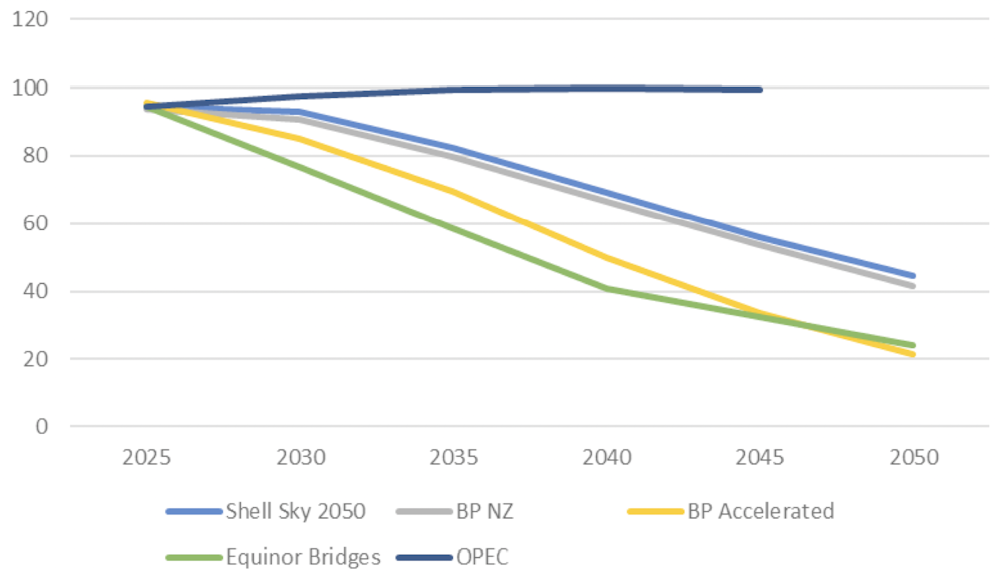
The IEA requirements for “net zero” are just one of the pathways towards meeting the Paris goal of 1.5℃ warming. Others are explored by some of the more credible actors in the petroleum industry, such as Shell, BP and Norway’s Equinor, but all require a substantial decline in oil demand and production by 2050.
Required production cuts
I left the IEA’s scenario off the graph because it published so few datapoints, but it is broadly in line with the others. Meanwhile, the Opec data is for reference and not a net zero scenario. BP, Shell, Equinor and Opec
Instead of criticising efforts to slow climate change and sponsoring ridiculous reports calling for more fossil fuels, the oil industry should eliminate leakages, venting and flaring of methane, and electrify as many processes as possible using renewable power. It should also employ carbon capture, usage and storage technologies over the next ten years – yes this will increase the price of fossil fuels, but that is exactly what we need to make clean sources of energy competitive across the board and speed up the energy transition.
The sooner the industry starts facing up to the realities of climate change, the more chance it has to survive. The companies and even countries that produce fossil fuels will have to face and pay the cost for the damage they cause. Those costs are already massive and will grow. Those that survive will do so only as a provider of clean and sustainable energy.
Don’t have time to read about climate change as much as you’d like?
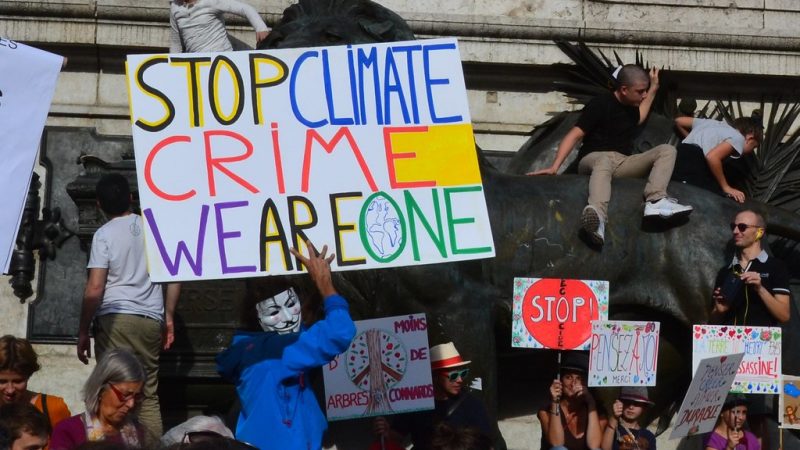
Protest banner reads Stop Climate Crime. We are One.
Radical action is essential to stop the transition from global warming to global boiling
Extreme weather events have increased in frequency and intensity over the past decade, with the last month seeing a rare combination of problems across North America, the Mediterranean and Middle East, northern China and South Korea. For the British, there has been the separate added shock of seeing tourists fleeing wildfires, especially in Greece.
These events are all part of the early stages of climate breakdown, which will get progressively worse unless the world makes a revolutionary and rapid transition to a low carbon economy, yet there is little evidence that political leaderships are even remotely prepared for this. At least UN secretary general António Guterres is using different language, not least his use of “global boiling” rather than “global warming” for his warnings of what is to come.
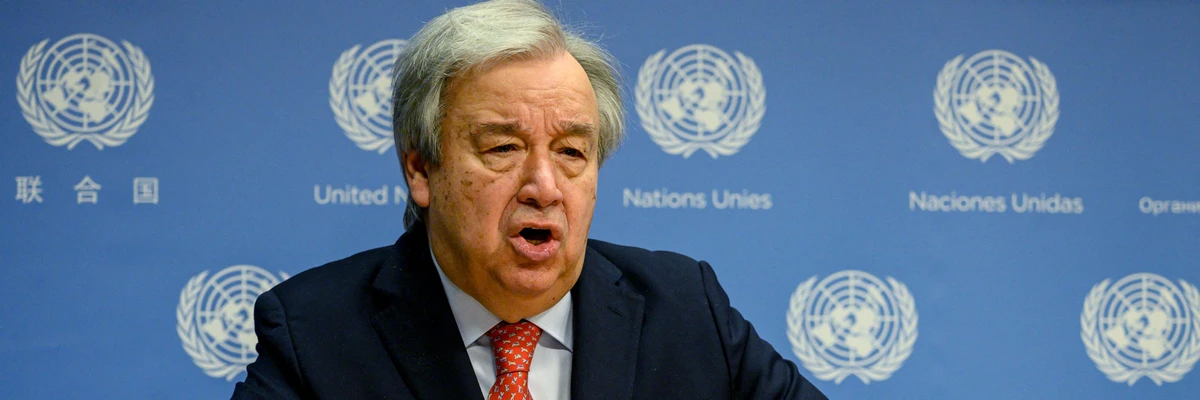
United Nations Secretary-General António Guterres discusses climate change at U.N. headquarters in New York City on July 27, 2023.
He is an exception, and public opinion overall is still not aware of the huge changes required. All the warnings from climate scientists, coupled with the evidence of our own eyes, seems to count for little as we move towards an unstable, chaotic and overheating planet.
Why is this? More importantly, why is it that radical decarbonisation isn’t happening, even though we know it’s possible? And, most important of all, how can things be turned round in time?
Let’s start with the inaction. Here, three elements interact. First, we are talking about fundamental changes in how we live, not just in the UK or western Europe but across the whole world. The result would be a cleaner, safer and healthier world, but it would involve years of huge change – which is a lot for ordinary people to take in. We shouldn’t underestimate this. Poorer communities, in particular, will find it very difficult to cope with the changes, while richer elites everywhere in the world will likely maintain the naive belief that their wealth will keep them secure.
Second, what must be done runs directly counter to the way the economy currently works. The market fundamentalist system is rooted in competition and the false belief that the millions of people left behind will benefit from trickle-down from the rich and be content. It believes that while central government, in partnership with wealth, may hold the ultimate levers of control, it should have a minimal role in how the market works. Cooperation is anathema to this way of thinking, but cooperation is essential to prevent global boiling.
Neoliberals see this market fundamentalist approach as necessary for an ordered and stable society, and believe that if the millions of marginalised people do not upset the apple cart, all will be well. At root is a belief that the elite knows best.
In Britain, there was the unexpected risk of a seriously radical Labour government taking over in 2017. Fortunately for the neoliberals, that was narrowly avoided and since then the threat from the Labour left has been well and truly suppressed.
Despite this, the system still has wider concerns over potentially violent responses from the margins. In many countries, and especially Britain, new laws have been brought in and others strengthened, and police and security forces are much better equipped and trained to handle public dissent. Heavy prison sentences for even small acts of nonviolent direct action are now there to be used.
The problem is that a market economy system simply cannot act fast enough to handle climate breakdown. The system knows this, so finds it preferable to support the view of any “experts”– of whom there are plenty – who still deny there is a problem.
The anti-climate breakdown forces are exceptionally well entrenched in society and have the easy job of convincing people that no action is required
This brings us to the third point: the relentless propaganda from the fossil fuel industry and associated think tanks over half a century to deny the problem, even when their own scientists are saying otherwise. In a fairer world there would be an offence of global corporate manslaughter, but in the real world there isn’t.
Overall, the anti-climate breakdown forces are exceptionally well entrenched in society and have the easy job of convincing people that no action is required – just when they are being told that action will be personally costly. Politicians will play on this, especially when elections are in the offing. This can even reap electoral favour. The current behaviour of Britain’s Sunak government is a case in point, with Sunak declaring that climate policy must be “proportional and pragmatic”, following a by-election win in a constituency where the Tory candidate had opposed extension of the ULEZ low-emissions scheme.
So where do we go from here? One way to look at it is to view the current issue as two very broad global trends that are on course to converge, and when they finally meet there will be a chance of radical change because there will be no alternative.
One of these trends, as we have seen, is a system set in its ways and highly unlikely to change. Carbon emissions will continue rising, temperatures will head well above 1.5°C and those with the power will reap the rewards, at least in the short term.
The other trend is much more positive and has three elements.
Climate science has come on by leaps and bounds in the past half century. The science community is far more confident of its expectations of climate breakdown and is, at last, saying so bluntly. That welcome change also has greater force because of the manner in which the beginnings of climate breakdown are frequently exceeding the warnings of predictive models.
The second trend is, at last, a growing public awareness that things must change, and change quickly. The power of the movements in many countries is remarkable, so much so that far more people are willing to risk prison for the sake of the future.
Finally, numerous impressive developments in renewable energy technology have brought down the cost of electricity by huge margins, bringing it well below grid parity in price with fossil fuels.
That leaves just two huge questions, on which so many futures depend, particularly for our children and grandchildren. When will the convergence happen, and how quickly can changes then be made?
If it takes another 20 years to the early 2040s, then the task will be almost insurmountable, with action only happening after numerous appalling catastrophes, and bitter anger from the marginalised billions. If change comes before the mid-1930s then prospects will be brighter, but the later the convergence the greater the challenge.
It is therefore a matter of the sooner the better, so the rest of the 2020s has to be a time of intense activism whenever and wherever possible. Whether it is by persuasion, argument, nonviolent direct action or other means, it might then be possible to convince enough people that radical action is essential before the transition from global warming to global boiling risks becoming irreversible.
Whatever you’re interested in, there’s a free openDemocracy newsletter for you. HAVE A LOOK