https://www.nature.com/articles/d41586-026-02154-8
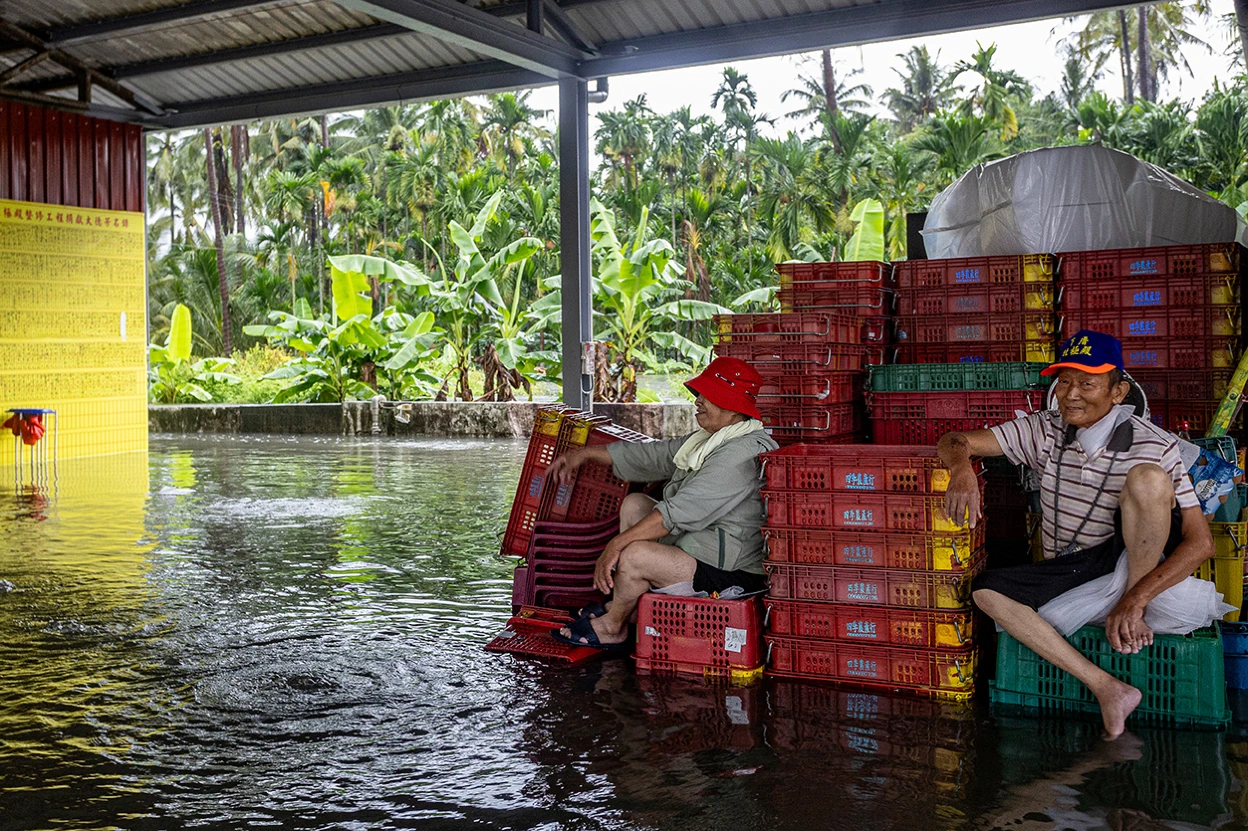
Increasing instability of the ocean, ice and atmosphere threatens farming, finance and society. We all need to wake up to that fact.
I have studied climate tipping points1 for more than 20 years, and I’m increasingly concerned that scientists have overlooked the most dangerous aspect of these for societies. The potential collapse of major parts of the Earth system — from ice sheets to ocean circulations — will profoundly alter the warming planet and tip it irreversibly into a different state2. But the greatest risks might not lie at that endpoint.Is a monster web of ocean currents headed for collapse? The race is on to find out
How we get there — how the tipping unfolds — is more important, and there is an urgent need to understand the process. This is missing from current analyses because the scales in time and space it occurs on fall between those of climate and weather. Tipping analyses focus on huge climate changes, often globally, over decades. Weather events are fast and local. But look at the interplay between the two and it’s clear that the transition between one climate state and another is not smooth but extremely volatile.
Climate tipping, therefore, will manifest as a period of increasingly dramatic weather volatility, rather than a sharp shift in average conditions. A fluctuating climate will bring swings and crashes in crop yields, flash flooding and erratic storms. It will stress economies by disrupting supply chains and amplifying insurance losses. Societies are unprepared, because weather volatility related to tipping points is absent from risk assessments.
This problem is urgent. Earth subsystems, including oceans, the cryosphere and biosphere, already seem to be destabilizing. The planet is heading for climate free fall.
Climate is destabilizing
By definition3, tipping points are reached when a series of interlinked changes amplify one another until the whole system becomes unstable and shifts uncontrollably into a different state. Loss of sea ice at the poles, for example, reduces the amount of sunlight reflected into space, further heating Earth’s surface, which then accelerates ice loss. These vicious cycles of change define a tipping point, at which the climate cannot return to its former patterns.Are we all doomed? How to cope with the daunting uncertainties of climate change
Before that point, the climate system becomes increasingly unstable. It fluctuates considerably — a rise in variability is a well-established property of such ‘non-linear dynamical systems’ approaching a critical threshold4,5. That society will face these fluctuations and that they will intensify through the tipping transition hasn’t been realized by scientists and policymakers, so far.
Earth will experience an increasingly erratic climate: more and stronger fluctuations in flows of melt water, ocean circulations and the extent of sea ice. These changes will lead to more frequent and intense extremes in temperature, precipitation and storms — leading not only to more heatwaves and droughts, but also to more cold spells and floods.
The scale of the consequences might not be obvious at first — ice sheets and ocean currents are so large that their responses to warming are relatively slow and delayed. Once a critical temperature threshold for instability is crossed, it takes time for such systems to collapse, but the collapse is inevitable (see ‘Tipping into trouble’).
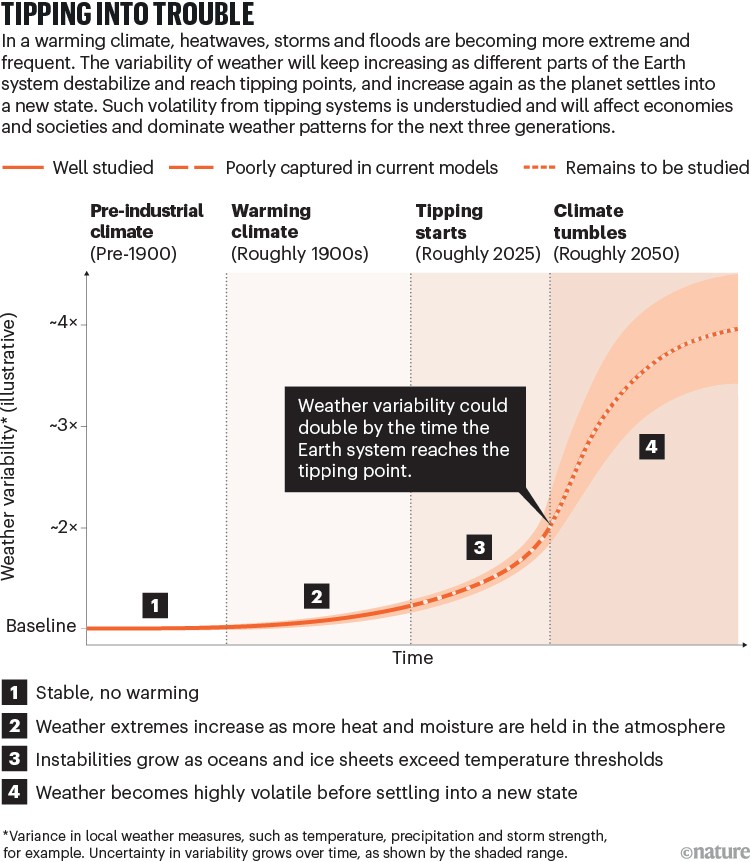
Ice sheets in West Antarctica6 and Greenland7 have already passed their tipping temperature. Arctic sea ice will do so in a few years. For the Atlantic Ocean, scientists simply don’t know8. The period between passing the tipping temperature and reaching the tipping point is when fluctuations increase dramatically.
Research into early warning of tipping points has identified increased climate variability as a signal of reduced stability and used it to estimate the time remaining before widespread tipping begins. But variability caused by instability as a mechanism of climate impact has been widely neglected.
Modern economies are adapted to relatively stable climatic baselines. Agricultural productivity, infrastructure design, insurance pricing and financial risk management all rely not only on expected mean conditions but also on the predictability of variability.
…
Article continues at https://www.nature.com/articles/d41586-026-02154-8 & further requirements to see the whole article …


