Elon Musk’s Embrace of Far-Right Energizes Transatlantic Climate Denial 

Spread the love

Original article by Adam Barnett republished from DeSmog.

“I think you really are the best hope for Germany,” Elon Musk told the thousands attending the far-right Alternative for Germany party’s rally on January 25. France 24 English/YouTube

The tech billionaire is invigorating groups in the U.S. and Europe aiming to sabotage climate action, a DeSmog media analysis shows.

In December, a Chicago-based organization called the Heartland Institute, which for decades has attempted to undermine the scientific consensus on climate change, devoted an episode of its daily podcast to Elon Musk. 

As recently as 2022, Heartland figures had ridiculed the Tesla CEO as a member of the “billionaire climate elite” based on Musk’s claim that as a top manufacturer of electric vehicles, his company was “doing the most to solve climate change.”

But perhaps, the podcast guests speculated, Musk was finally “abandoning the climate cult.” 

The episode was recorded after Musk had given upwards of $277 million to get Donald Trump elected president, argued that “we don’t need to rush” on addressing climate change, and vowed to cut $2 trillion of federal government spending. One guest on the show was cautiously optimistic, saying: “I’m coming around on Musk.” 

Heartland, which didn’t respond to a request for comment, isn’t the only anti-climate group embracing Musk these days. 

DeSmog journalists in the European Union, the UK and the United States reviewed public materials from prominent climate deniers referencing Musk over recent months. Taken as a whole, these podcasts, opinion pieces, social media posts, newsletters, YouTube videos, and interviews with legacy media reveal an unmistakable trend: Musk’s public embrace of right-wing populists is invigorating a transatlantic movement aiming to spread doubt about the reality of climate change and sabotage action on the crisis.

His interventions ahead of Germany’s elections on Sunday have energized the far-right Alternative for Germany, or AfD, which says that climate policy “threatens our freedom,” a January poll suggests

His courtship, along with Trump, of hardline leaders in Europe threatens to torpedo hopes of progressive climate action by the EU, think tanks warn

And in the U.S., Musk’s ongoing war against the federal bureaucracy “erodes our collective ability to adapt to climate impacts,” Amanda Fencl, director of climate science for the nonprofit Union of Concerned Scientists, has warned.

Some longtime climate deniers are thrilled, however, recognising that even a brief endorsement from Musk to his 217.9 million followers on X — the social media platform formerly called Twitter, which he bought in 2022 — can confer instant visibility and excitement. 

“We welcome Elon Musk into the climate red pill group,” Climate Depot executive director Marc Morano stated in December, using a phrase popular among Trump supporters that refers to rejecting liberal viewpoints.  

Musk, contacted via Tesla, did not respond to a detailed list of questions about his shifting climate views.

‘Windmills of Shame’ 

When Germans vote for a new government on Sunday, the EU’s most populous country is widely predicted to shift to the right. Leading the polls at about 29 percent of voters is the centre-right Christian Democratic Union, or CDU, which intends to prioritise economic growth over accelerated climate measures endorsed by the ruling Greens and Social Democrats, or SPD.

Less certain is the influence that the surging far-right AfD will have on the next German government. On X, Musk has openly endorsed and platformed the party, which wants to ditch Germany’s climate commitments.

As migration and economic stagnation dominate German politics, the AfD is now polling close to 21 percent — potentially doubling the 10 percent of votes it won in the last national elections in 2021. The party states that the level of human contribution to global warming is “not scientifically proven,” and opposes state support for renewable energy and electrification of heat and transport, while advocating for Germany’s gas and coal power sectors.

The CDU says that it will not form a coalition government involving the AfD, and maintains its commitment to Germany’s 2045 net-zero emissions target. But despite its opposition status, the AfD is already shaping national political discourse — and even decision-making. 

While the CDU and Germany’s other mainstream parties have traditionally refused to vote with the AfD due to its extreme stances on immigration and Germany’s Nazi past, the CDU broke this so-called “firewall” last month by voting with the AfD on a resolution to restrict migration. 

Musk has sided with the AfD on its hard-line immigration stance and nationalist messaging. In December, Musk openly endorsed the party, shocking liberal Germans by writing on X that “only AfD can save Germany.” He went on to join a 9 January livestream with the AfD co-leader Alice Weidel, who has attracted controversy for Islamaphobic remarks, such as in a 2018 Bundestag speech when she said “burqas, headscarf girls, publicly-supported knifemen, and other ‘good-for-nothings’ will not secure our prosperity, economic growth, and the social state.” 
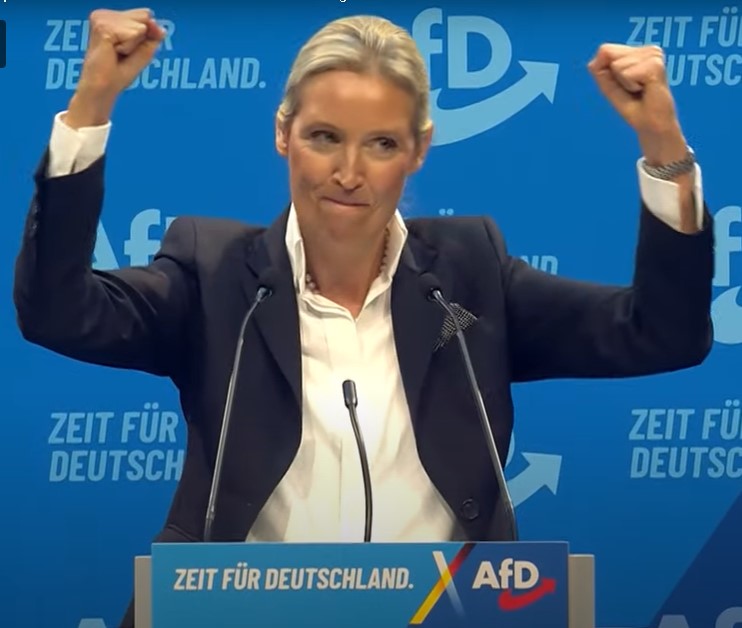
AfD co-leader Alice Weidel. Credit: France 24 English/YouTube

In terms of climate policy, Weidel has suggested that if the AfD takes power in Germany, it could dismantle wind turbines, recently calling them “windmills of shame,” The wind sector produced a third of the country’s electricity last year. 

During their conversation, both Musk and Weidel expressed support for nuclear power — with Musk also saying he was a “big fan” of solar energy — and Weidel stating that Germany’s CO2 footprint was “obnoxiously very very high.” Both steered clear of the AfD’s official climate-denialist party platform

Then, less than two weeks later, Musk sparked a global furore by raising his arm to the crowd at Trump’s January 20 inauguration in a gesture that many likened to a Nazi salute. The Amadeu Antonio Stiftung, a German organisation which advocates against right-wing extremism and anti-Semitism, saw no ambivalence in Musk’s move, describing it as a “Hitler salute.” Musk responded to the outpouring of criticism by posting on X: “The ‘everyone is Hitler’ attack is sooo tired.”

Five days after Trump was sworn-in, Musk ramped up his support for the AfD by addressing a party rally via videolink. He urged supporters to “take pride” in being German over “some sort of multiculturalism that dilutes everything”, and told them that there’s “too much of a focus on past guilt” — remarks condemned by Polish prime minister Donald Tusk. 

YouTube Influencer

Musk had previously enjoyed support from Germany’s centrist parties. When Tesla opened a multi-billion dollar electric car factory in the State of Brandenburg in 2022, the move was billed as a boost to both the country’s manufacturing sector and climate credentials. But during his January livestream with Weidel, Musk expressed his disdain for the bureaucratic procedures needed to build the Tesla factory, which he said amounted to “25,000 pages”.

Musk’s public support for the AfD can be traced back to his interactions with Naomi Seibt, a 24-year-old German influencer who built a sizeable social media following attacking “climate alarmism” and cultivating a brand as the anti-green doppelganger of Swedish climate activist Greta Thunberg. Her rise to prominence was aided by the Heartland Institute, which featured her in a YouTube video it published in February 2020. Seibt has since told Reuters that the organisation had paid her $4,000 a month for three months as a “scholarship.” (Seibt no longer appears to be affiliated with the group). 

German influencer Naomi Seibt appears on the Heartland Institute’s YouTube channel on February 11, 2020. Credit: Heartland Institute/YouTube

When Seibt posted on X last June that she’d voted for the AfD in the EU elections, which saw the formerly fringe party rise to 16 percent of the total vote — its best-ever result — Musk began sending her private messages asking for more information, according to Seibt. “And then he started following me,” Seibt told the BBC, noting that “it took him many months to decide to support the AfD.”

Musk’s backing could boost a party that’s heavily critical of the country’s decarbonization efforts. A January poll of German voters from the U.S.-based Democracy Institute think tank suggested that 28 percent of respondents say they are “more likely” to vote AfD due to Musk’s support, while 23 percent said it made their support “less likely.”

Germany’s center-right and center-left leadership have condemned Musks’s interventions. Friedrich Merz, head of the CDU, told The Wall Street Journal last week that Musk would face consequences for boosting the AfD. Chancellor Olaf Scholz, a member of the centre-left SPD, last month called Musk’s support for European far-right parties “disgusting.”   

The new Trump administration is already mirroring the billionaire’s embrace of the AfD. Last week, U.S. Vice-President JD Vance met with Weidel, the AfD co-chief, on the sidelines of a security conference in Munich, while snubbing Scholz. 

With the U.S. playing a major role in German trade and security, this budding transatlantic alliance could bode poorly for climate action in Europe’s biggest economy.

Neither Seibt nor the AfD responded to questions.

Courting the European Far-Right

Musk’s electrifying impact on the AfD builds on his years of dabbling in far-right politics in other European countries. 

In December 2023, Musk appeared as a guest of honour at an annual convention in Rome hosted by the Brothers of Italy, the right-wing populist party of Italian Prime Minister Giorgia Meloniwho had said earlier that year that “ultra-ecological fanaticism” was an economic threat. 

Santiago Abascal, leader of Spain’s far-right Vox party, also attended the 2023 convention. He had recently predicted that Spanish citizens would hang their current Socialist Prime Minister, Pedro Sánchez, by his feet, remarks that were so controversial that some Brothers of Italy members asked for his invitation to be withdrawn, the Spanish newspaper El País reported.

But whereas Abascal’s presence threatened to create divisions at the event, “Elon Musk’s case is somewhat different, arousing only enthusiasm and selfie fervor,” noted El País. “The tycoon is nowadays the darling of almost all those on the ultra-right who seek media and economic backing, and a cutting-edge image.”

A month later, in January 2024, Musk again signalled his interest in European politics.

With German farmers protesting the end of government diesel fuel subsidies and a new tax on agricultural vehicles, Anthony Lee, who had stood for the European Parliament as a candidate for Free Voters, a German conservative populist party, gave an interview to right-wing Dutch influencer Eva Vlaardingerbroek. Lee told Vlaardingerbroek that politicians “want our land to build industry, houses. Houses for refugees, whoever, I don’t care what for.” 

After Musk reacted to the video on X, writing “Support the farmers!” Lee said in a video message that “I think it’s just awesome that Elon Musk himself tweeted this…This is only possible because we stand together.” The video was viewed over 200,000 times. Lee did not respond to a request for comment.

A year later, Musk was rubbing shoulders at Trump’s inauguration with a who’s-who of right-wing European politicians, including Spain’s Abascal, France’s Éric Zemmour and Reform UK leader Nigel Farage, all of whom have questioned the science and urgency of climate change. 

Analysts with the independent European Policy Center think tank in Brussels sees the inauguration guestlist as a worrying sign that Trump and Musk are helping strengthen “ideological ties between significant radical forces on both sides of the Atlantic.” They are concerned about the impact a second Trump administration may have on a host of EU-wide initiatives, including a raft of climate reforms known as the European Green Deal. 

“The most concerning possibility,” the analysts argue, is “Trump’s probable exploitation of far-right leaders or governments to block EU policies or advance his agenda.” 

Musk’s Shift to ‘Climate Skeptic’ 

For years, Musk enjoyed a reputation as a crusading green energy entrepreneur on a mission to render the internal combustion engine obsolete, celebrated by climate activists and cleantech investors alike — despite growing signs of his right-ward political leanings. As recently as last August, the online news outlet E&E News ran a story speculating that “Musk might be the only person Trump listens to on climate.”

But Musk’s politics and business interests seemed to decisively converge during a 2024 meeting of Tesla executives in Palo Alto, California, where he shelved plans to develop a more budget-friendly compact car that could be marketed to lower-income customers around the world, according to a report in the Washington Post. This had previously been a key part of Tesla’s plan to “accelerate the world’s transition to sustainable energy.” 

Instead, Musk approved a plan worth billions of dollars to purchase computer chips that could improve Tesla’s luxury vehicles, the Washington Post report said. Musk had shifted from calling for “a popular uprising” against the fossil fuel industry in 2016 to stating that there were more important global problems to address. 

In a livestream with Trump last year, Musk stated that ​​“we don’t need to rush” in fixing climate change.

This also happens to be the message of Bjørn Lomborg, a longtime Danish climate crisis denier (and apparent “friend” of Trump administration energy secretary Chris Wright) whose 2023 book Best Things First argued that there were more important global priorities to address than climate change. According to a recent edition of Lomborg’s newsletter, the Canadian conservative influencer Jordan Peterson shared a copy of Lomborg’s book with Musk in 2024.

Within U.S. denial networks, some leaders link Musk’s shift to the flourishing of anti-climate messages on Twitter after the billionaire purchased the platform, and renamed it X. “I mean, there are thousands, if not hundreds of thousands of climate skeptics on X/Twitter, and they’re constantly posting content that we put out here,” the Heartland Institute’s Anthony Watts argued on the group’s podcast. “Musk has had to have seen some of this stuff.”

Musk’s former critics in climate denial circles now see him as the best bet for implementing their most extreme ideas. Musk’s so-called Department of Government Efficiency has been attempting to shut down key climate-related agencies like the United States Agency for International Development, or USAID. 

On the website of the conservative group CFACT, prominent denier Paul Dreissen — who previously accused Musk of holding “sanctimonious” views on “the alleged climate crisis” — has offered policy suggestions to the billionaire as he wages war on the federal bureaucracy: End subsidies for renewable energy; terminate funding for environmental and climate justice programs; and require applicants for climate research funding to “provide computer codes and analyses so that reviewers can view and evaluate their work.”

Parts of Musk’s plan seem to rely on two recentpro-industry Supreme Court decisions to unwind regulatory authority long held by federal agencies — an overarching goal of the Heritage Foundation’s Project 2025 initiative, retooled with Musk’s Silicon Valley spin. 

If successful, these cuts will dismantle decades of clean air and water protections, and hamstring the country’s ability to respond proactively to the worsening climate crisis, said Fencl, the director of climate science at the Union of Concerned Scientists. 

Hurricane Helene made landfall in Florida in October 2024, but caused deadly and destructive flooding hundreds of miles from the coast due to extreme rain. At least 219 people died, and the damages are estimated at $78.7 billion. Credit: PBS NewsHour/YouTube.

“Our infrastructure systems are not going to withstand the climate impacts we’re expecting, and taking away the government’s spending in these spaces really erodes our collective ability to adapt to climate impacts,” Fencl said.

Raising the UK’s Political Temperature

Since throwing his fortune and social media influence behind Trump, Musk has teased the possibility of attempting a similar campaign in the UK.

In December, Musk met with Reform UK leader Farage, who also co-founded and formerly led the Brexit Party, at Trump’s Mar-a-Lago resort in Florida. 

The two were in talks about Musk offering a £100 million (over $125 million) donation to Reform, The Times of London reported. Farage has said he finds it “extraordinary that people call carbon dioxide a pollutant, and Reform UK’s latest party manifesto recycles a long-debunked claim that “scientists disagree as to how much” human activity is causing climate change. So such a donation would have been a major investment by Musk in transatlantic climate denial.

Then, in January, Musk used X to call for the release of Tommy Robinson, a far-right British influencer serving an 18-month contempt of court sentence for making false accusations about a Syrian schoolboy. When Farage rejected his calls to join forces with Robinson, Musk tweeted that, “the Reform Party needs a new leader. Farage doesn’t have what it takes.” 

Farage was not sufficiently swayed by Musk’s comments to support Robinson’s return, although he struck a conciliatory note by saying the tech mogul didn’t know “the full story” about the provocateur’s criminal past. By the end of January, Farage was signalling to the press that his rift with Musk was over, telling The New York Times that the billionaire was still open to donating to Reform UK. “We’ve got very similar goals on some areas, slightly different emphases in others,” Farage said, adding that Musk was sharing valuable information about how Trump won over swing voters during the U.S. election. 

Farage is also collaborating with the Heartland Institute, which has claimed credit for working with hard-right parties in Austria and Hungary to attempt to stall the EU’s Nature Restoration Law, which sets targets for restoring damaged ecosystems, as well as other green policies. Farage helped  launch the pro-Trump institute’s new UK-Europe branch in December.

Farage’s newly formed Reform UK won just five of the 650 seats in the lower house of parliament in last year’s elections, and  was unsuccessful  in generating a backlash against the country’s net-zero emissions goal. Nevertheless, the party appears to be pushing the historically weakened Tories to the right on climate change — echoing Farage’s previous strategy to rally support for the 2016 Brexit referendum. 

Regardless of how much tangible backing Musk might provide to right-wing figures in the UK, his winning bet on Trump, and assault on federal government spending, has inspired Farage and his allies with a sense of the possible. “There’s a heck of a lot we’ve learned from that we will implement over the next few years,” Farage told The New York Times.

Some European leaders are looking for ways to neutralize Musk’s efforts to sway voters. 

In January, as Musk posted false allegations that UK Prime Minister Kier Starmer had let child sex abusers escape justice, France called on the European Commission to take action against Musk and X for election interference. According to The Financial Times, Musk was also investigating how to get Starmer out of office before the country’s next election, and replace his center-left government with right-wingers.

Members of the European Parliament, who are elected representatives of their respective nations, are also criticizing the Commission for failing to use its authority under the EU’s Digital Services Act to investigate and fine Musk and X, as well as other major social media platforms, for spreading disinformation.

Asked about Musk’s tirade during a public event in January, Starmer did not name the billionaire directly in his response. “Those that are spreading lies and misinformation as far and as wide as possible, they’re not interested in victims,” said Starmer. “They’re interested in themselves.”

Additional reporting by Emily Gertz

Original article by Adam Barnett republished from DeSmog.

Nigel Farage explains the politics of Reform UK: Racism, Fake anti-establishmentism, Deregulation, Corporatism, Climate Change Denial, Mysogyny and Transphobia.
Elon Musk urges you to be a Fascist like him, says that you can ignore facts and reality then.
Continue ReadingElon Musk’s Embrace of Far-Right Energizes Transatlantic Climate Denial 

Oil and Gas Investments of Donald Trump’s New UK Ambassador

Spread the love

Original article by Adam Barnett republished from DeSmog

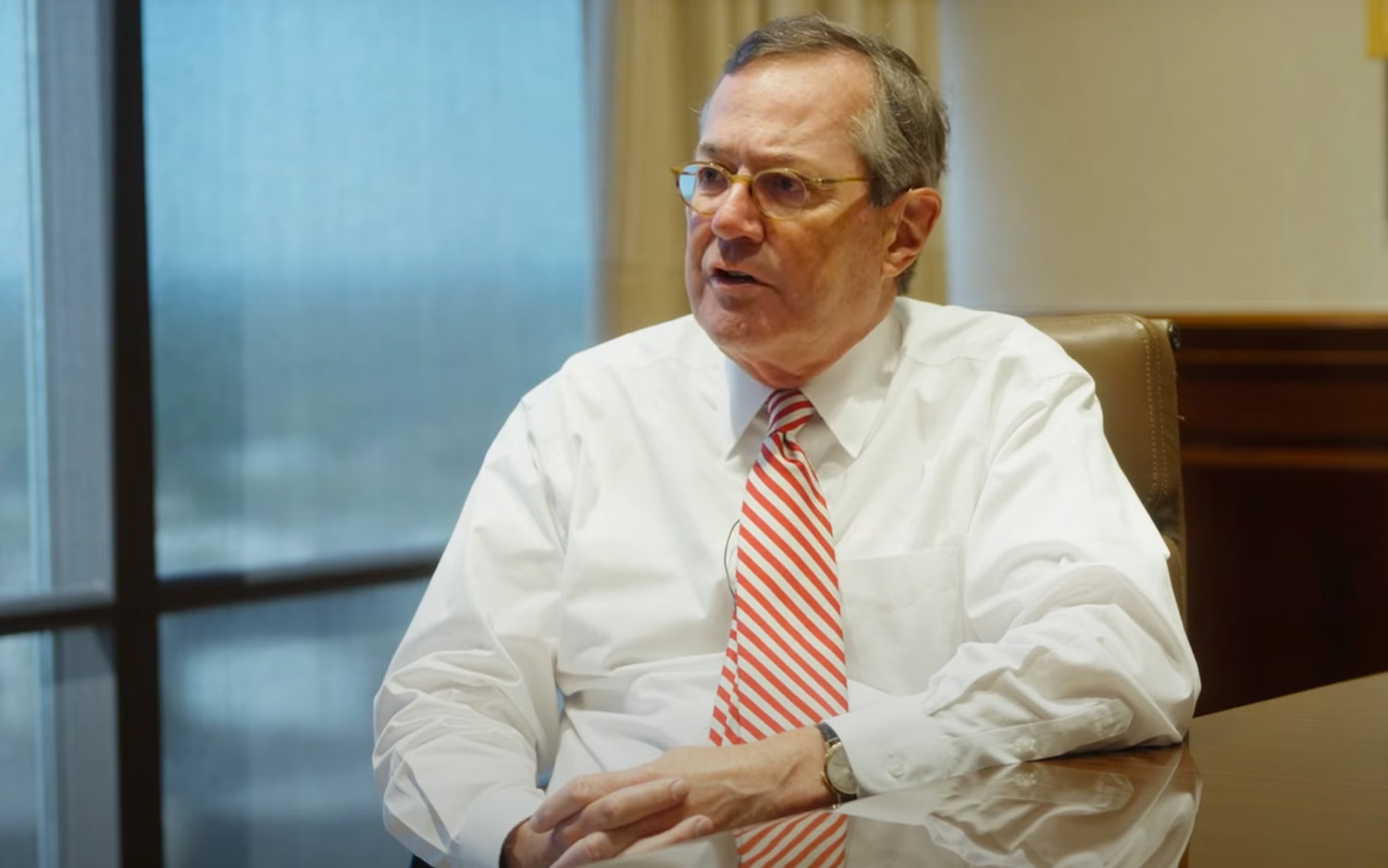
Warren Stephens. Credit: The Golfer’s Journal / YouTube

Campaigners warn that the UK will face “pressure from American fossil fuel interests” to slow its energy transition.

U.S. president-elect Donald Trump’s pick to be UK ambassador runs a firm with investments in several oil and gas companies, DeSmog can reveal.

Billionaire Warren Stephens, a major Trump donor who was nominated on Monday to be the next UK ambassador, is chairman, president, and CEO of Stephens Inc., one of the largest privately-owned investment banks in the U.S..

The firm’s portfolio includes at least five companies that make their money from oil and gas exploration and production, including one, Stephens Natural Resources, which is “solely owned” by the Stephens family business. 

“President-elect Trump’s promise to boost U.S. fossil fuel production is reflected in his choice of UK ambassador, raising concerns about the potential impact on the UK’s own climate leadership”, said Fossil Free Parliament campaigner Carys Boughton. 

Tessa Khan, executive director of the environmental campaign group Uplift, told DeSmog the appointment was a sign that “the UK is going to be under pressure from American fossil fuel interests to slow its transition away from oil and gas”.

Trump has vowed to “drill, baby, drill” for oil and gas in the U.S. while his presidential campaign received the backing of major fossil fuel interests. The president-elect has called climate change a “hoax” and is expected to once again pull the U.S. out of the flagship 2015 Paris Agreement, which established a global ambition to limit warming to 1.5C above industrial levels. 

The Stephens hire comes just weeks after the UK Labour government unveiled an ambitious new climate target to cut emissions by 81 percent by 2035. The move was criticised by Conservative Party leader Kemi Badenoch, who this week flew to Washington DC reportedly to build ties with senior Republicans ahead of a second Trump presidency.  

As DeSmog revealed last week, Badenoch has hired advisors who have criticised climate action and have links to fossil fuel-funded think tanks. Badenoch, who describes herself a “net zero sceptic” has also received donations from the head of Net Zero Watch, a climate science denial group.

Oil and Gas Investments

Stephens Inc.’s investments in oil and gas include Stephens Natural Resources, a company run by Warren’s uncle Witt Stephens. 

The company, which trades as Stephens Production, “has a rich history of drilling and producing both oil and natural gas”, according to its website, and “continues to expand its production and reserves in the continental U.S. and offshore Gulf of Mexico”. 

The company is “solely owned” by the Stephens family, whose investment stretches back to 1953, according to the website. 

Stephens Inc.’s other current investments, which date back to the mid-2010s, include Four Corners Petroleum, an oil exploration and production company based in Colorado. 

Stephens Inc. lists RK Supply in its portfolio, a “leading distributor of piping, oil and gas valves, fittings, and other oilfield service equipment” based in Texas. It also lists Dakota Midstream, a company that “provides infrastructure support to oil and gas exploration and production”, based in Colorado. 

Another company in the Stephen Inc. portfolio, Texas-based Basin Oil & Gas, buys “non-operating oil and gas interests”, and is developing carbon capture and sequestration projects. Carbon capture is a favoured climate solution of the oil and gas industry, and is often used simply to extract more fossil fuels. 

Stephens Inc. lists a firm called Capture Point in its portfolio, which specialises in enhanced oil recovery – a method for extracting hard-to-get oil. Capture Point told DeSmog that Stephens Inc. was not an investor in the company, though did not respond when asked if Stephens Inc. was previously an investor. 

All the companies cited were approached for comment. 

Trump Tensions

Stephens’s appointment comes at a critical time for the UK’s energy transition, and highlights the differences between the new Labour government and the incoming Trump administration. 

Prime Minister Keir Starmer last month attended the COP29 climate summit in Baku, Azerbaijan, pledging that the UK would restore its role “as a climate leader on the world stage”. In its 2024 election manifesto, Starmer’s Labour Party pledged to ban all new licenses for oil and gas exploration in the North Sea. However, after five months in office, the government has yet to implement that promise. 

“While the UK government has pledged to turn the UK into a ‘clean energy superpower’, it has not enacted its manifesto commitment to ban new licenses, nor provided a plan for a just transition away from fossil fuels”, Carys Boughton told DeSmog. 

“Trump’s choice of ambassador will gift the fossil fuel industry yet more influence within UK politics, which is particularly concerning while the government is still wavering on the future of fossil fuels. 

“It is therefore yet more important that the government take action to restrict fossil fuel industry influence – to protect its developing climate and energy policy from the industry’s polluting interests.”

As DeSmog has reported, Trump’s would-be energy secretary Chris Wright, chief executive of fracking company Liberty Energy, has praised Danish climate crisis denier Bjorn Lomborg as a friend. Wright’s nomination was welcomed by the CO2 Coalition, a climate science denial group which has received funding from the Koch Industries oil dynasty. 

Analysis by the climate outlet Heated found that all of Trump’s cabinet picks have made misleading statements about climate change. 

Science denial and an enthusiasm for fossil fuels are also views shared by Trump’s UK supporters. In September, DeSmog reported that Trump ally Nigel Farage, the Clacton MP and leader of Reform UK, was a keynote speaker at an event in Chicago run by the Heartland Institute, where he called on the U.S. to “drill, baby, drill” for more fossil fuels. 

“It’s no surprise that this appointment – like the rest of Trump’s administration – is shot through with oil and gas interests”, Uplift’s Tessa Khan, told DeSmog.

“Fossil fuel companies will prove extremely influential in the incoming U.S. government, and they want nations across the world to remain hooked on oil and gas for years to come just so they can keep profiting.

“The UK is going to be under pressure from American fossil fuel interests to slow its transition away from oil and gas. To succumb would be against the UK’s national interest”.

Original article by Adam Barnett republished from DeSmog

Continue ReadingOil and Gas Investments of Donald Trump’s New UK Ambassador

Alberta Premier Danielle Smith Pledges to ‘Triple Down’ on Her Climate Denial

Spread the love

Original article by Danielle Paradis republished from DeSmog

Alberta Premier Danielle Smith surveys damage after the Jasper wildfire. Credit: Danielle Smith / YouTube

Speaking at the UCP annual general meeting, the Premier took shots at the federal government and vowed not to “budge an inch.”

Alberta Premier Danielle Smith pledged to “triple down” on conservative principles, including energy extraction and anti-trans policies at the Alberta United Conservative Party’s annual general meeting in Red Deer today in front of an energetic crowd of 6,000 people.

“We will build new pipelines, oil and gas facilities, petrochemical plants, hydrogen plants, and more because Alberta is an energy superpower, and we will not apologize for it,” said the premier, who was defiant against the federal government and any attempts to regulate energy and greenhouse gas emissions.

Taking a shot at the federal government Smith decried federal attempts at regulating carbon emissions during her speech.

“Justin Trudeau, Steven Guilbeault and their band of woke MPs have done everything they can to shut down Canada’s and Alberta’s most economically important industry as quickly as possible,” said Smith.

In a particularly spicy moment, the Premier dismissed federal environment and climate change minister Guilbeault’s “tantrums” and “green schemes,” suggesting that Alberta would not “budge an inch … EVER.” 

Smith threatened to continue to block any legislation that affects the energy industry.  

“We have already invoked the Sovereignty Act against Justin Trudeau’s reckless and unaffordable 2035 net-zero electricity regulations, which we will not enforce in Alberta,” she said.

Related: Alberta Conservatives Pass Climate Denial Resolution 12 to Celebrate CO2 Pollution

Premier Smith denounced federal attempts at regulating carbon emissions during her speech at the UCP’s annual general meeting. Credit: Danielle Paradis

Premier Smith is facing a leadership review as a part of the AGM and met with members at an accountability session where they discussed past policy proposals including the proposal to ban solar farms on agricultural land.

Last year, the Alberta government imposed a seven-month moratorium on renewable energy projects after this policy proposal passed.

According to the Canadian Press, a webinar used as a part of the government’s engagement process said that Alberta is looking to prohibit wind and solar farms on irrigated land.

In the afternoon, the members will debate a policy resolution that would “recognize the importance of CO2 to life and Alberta’s prosperity” by abandoning “Net-Zero” targets and recognizing that CO2 is a “foundational nutrient to life.”

Original article by Danielle Paradis republished from DeSmog

Continue ReadingAlberta Premier Danielle Smith Pledges to ‘Triple Down’ on Her Climate Denial

Alberta Conservatives Pass Climate Denial Resolution 12 to Celebrate CO2 Pollution

Spread the love

Original article by Danielle Paradis and Taylor Noakes republished from DeSmog

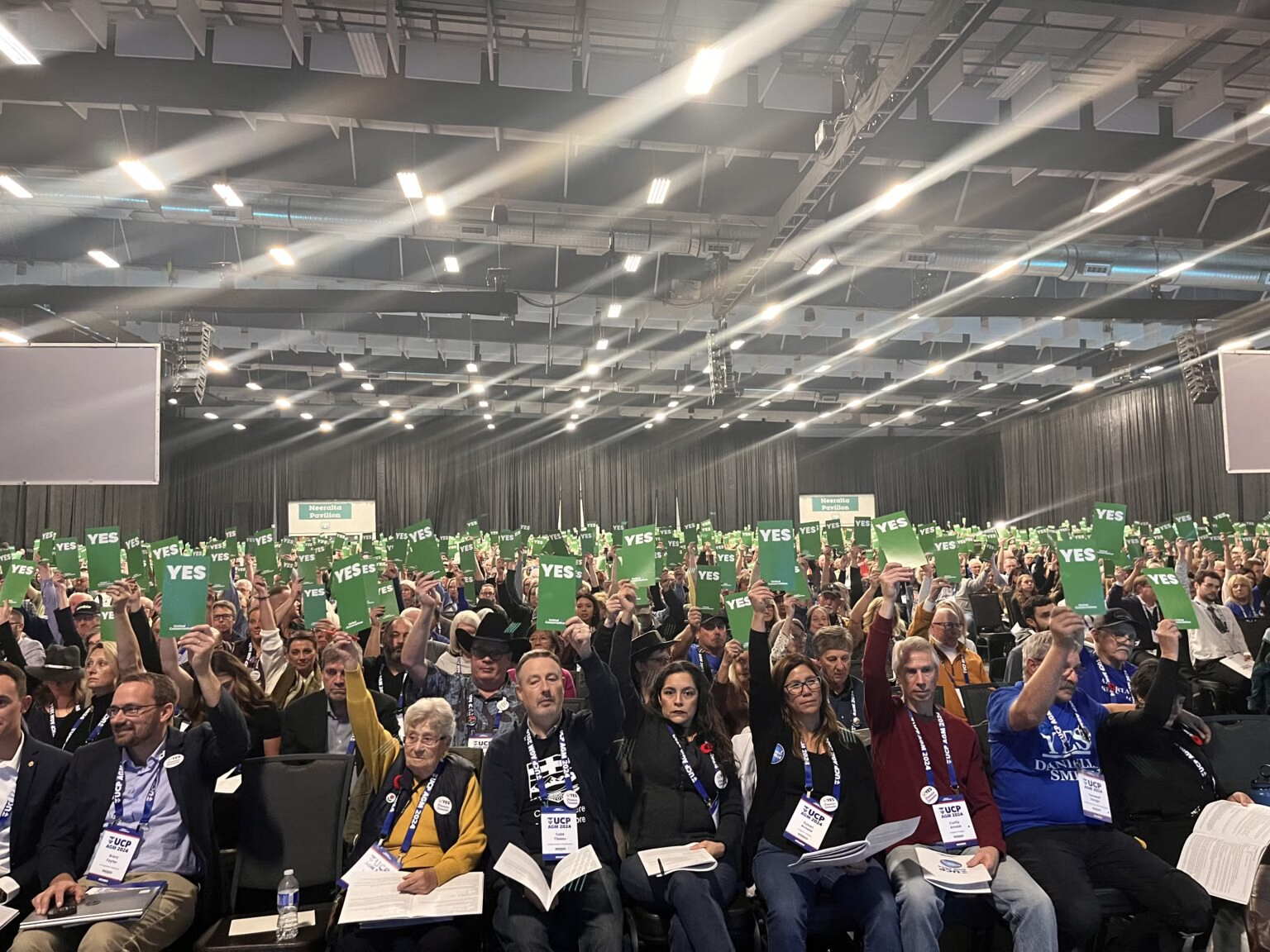
UCP members voted in favor of a resolution to “recognize the importance of CO2 to life and Alberta’s prosperity.” Credit: Danielle Paradis

Alberta’s United Conservative Party has passed a resolution to rebrand carbon dioxide — the chief gas whose overabundance in Earth’s atmosphere is causing the climate emergency — in a brazen display of climate science denial that harkens back to the 1990s fossil fuel industry playbook.

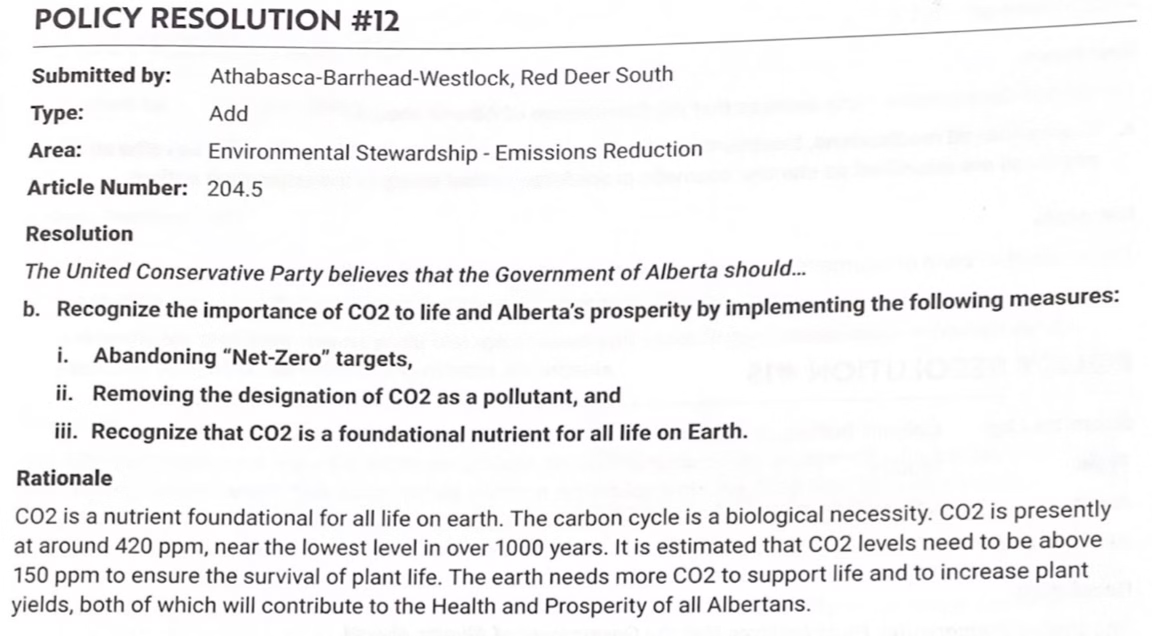
Resolution 12, which falls under the “environmental stewardship and emissions reduction” area of the policy discussion, will “recognize the importance of CO2 to life and Alberta’s prosperity.” 

In approving the resolution, the UCP resolved to abandon the province’s net zero targets, remove the designation of CO2 as a pollutant, and further “recognize that CO2 is a foundational nutrient for all life on Earth.”

“We must prioritize policies that protect our economy and our way of life. CO2 is an essential nutrient for mass, driving growth and boosting plant production. According to the CO2 Coalition, higher CO2 levels have led to healthier crops and improved food security worldwide,” said a UCP member speaking in favour of the policy who cited the notorious CO2 Coalition

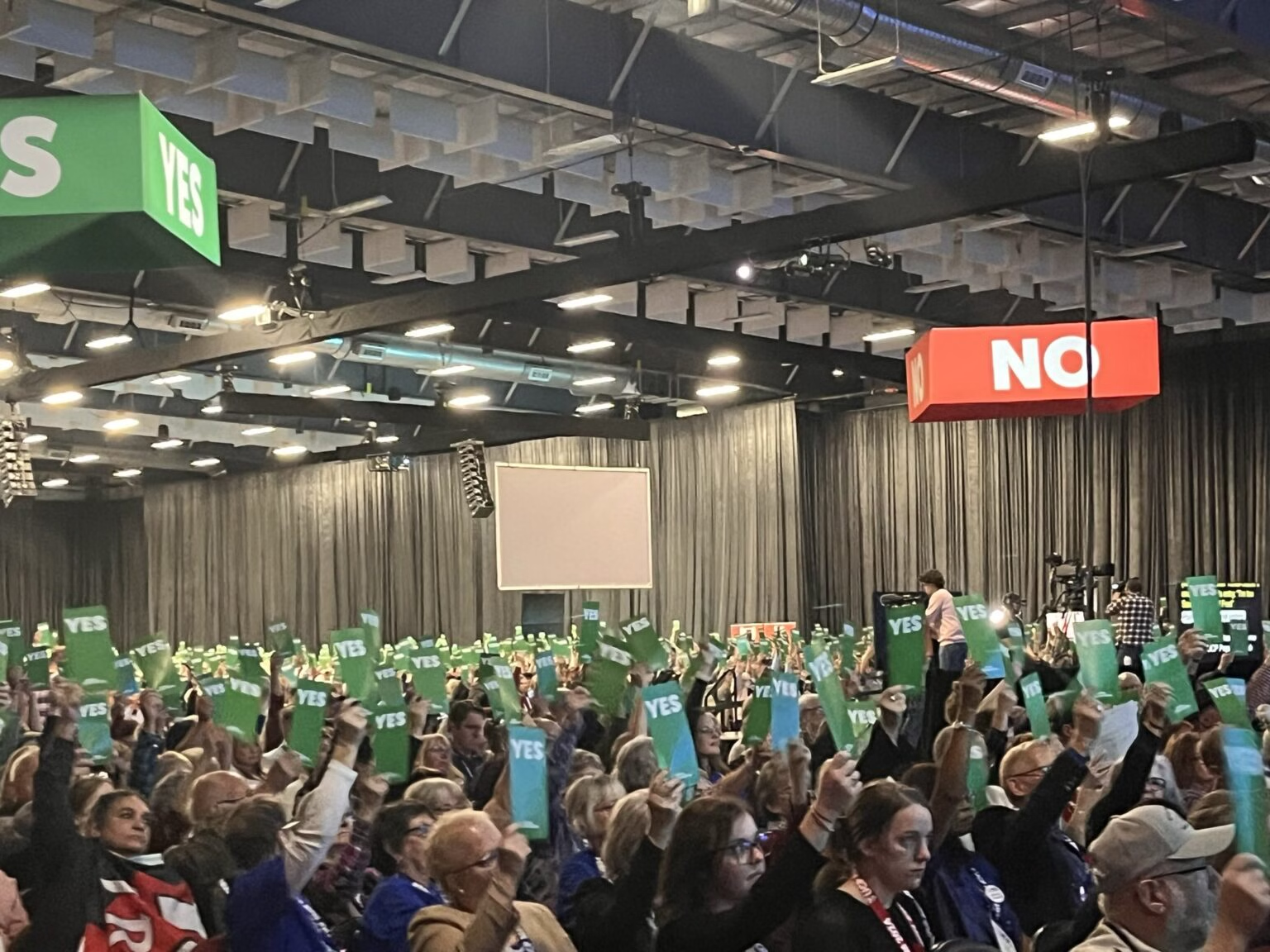
The resolution passed by a wide majority. 

UCP members vote in favor of Resolution 12. Credit: Danielle Paradis

A member who spoke against the bill, saying that just like like someone can drink too much water and experience water poisoning, too much CO2 can be bad. He was booed by the crowd. 

The policy discussion took place in Red Deer, Alberta, where 6,085 UCP members and observers debated 33 policy resolutions at their annual general meeting. Earlier in the day, Alberta Premier Danielle Smith pledged to “triple down” on conservative priorities, including further expanding oil production and attacking Canadian climate policies.

As several outlets have reported previously, Resolution 12 flies in the face of the scientific consensus on climate change, and the party’s rationale for the resolution states a widely debunked claim that “the Earth needs more CO2 to support life and to increase plant yields.”

Carbon dioxide is the gas principally responsible for exacerbating the greenhouse effect, the consequence of which is global warming. Whereas carbon is a foundational building block of life on Earth, carbon dioxide is an asphyxiating gas whose atmospheric proportions are so high they’re disrupting the normal function of the carbon cycle. 

The resolution was submitted by the members of the legislative assembly (MLA) representing the provincial ridings of Athabasca-Barrhead-Westlock (Glenn van Dijken), and Red Deer-South (Jason Stephan). 

The argument that carbon dioxide is a “gas of life” has been a common yet easily refutable talking point popularized by climate change deniers and other right-wing extremists. One such group, the anti-wind energy group Wind Concerns, referred to carbon dioxide as a “gas of life” in an interview with DeSmog last year. Their leader, Mark Mallett, took credit for contributing to the anti-renewable energy moratorium instituted by Alberta UCP Premier Danielle Smith.

Climate scientists have long confirmed that increased CO2 in the atmosphere does not, as climate change deniers insist, create better growing conditions for plants.

The argument that carbon dioxide is beneficial for the environment appears to have first been made by the Greening Earth Society (GES) in the mid-late 1990s. GES was a creation of the Western Fuels Association, and it was later determined the two groups were one and the same. GES published the World Climate Report, a non-academic and non-peer-reviewed journal that served as a platform for climate change denial. They were transparent in acknowledging their funding from fossil fuel companies, and appear to have originated several talking points now common amongst climate change deniers, including those that advocate for increased atmospheric carbon dioxide, which would result in faster plant growth and greater agricultural yields.

In the “rationale” section of the resolution, the United Conservative Party document argues that “CO2 is a nutrient foundational to all life on Earth.”

While plants need both light and carbon dioxide to thrive, the over-supply of CO2 in recent decades is leading to plants being deprived of their nutrients. One biologist was quoted in a 2017 Politico article describing this as akin to “the greatest injection of carbohydrates into the biosphere in human history,” and that injection is diluting the nutrients in the food supply.

While the resolution notes that the “carbon cycle is a biological necessity,” it doesn’t appear the resolution’s sponsors are aware that increasing carbon dioxide in the atmosphere throws the carbon cycle off balance. This is precisely what’s causing the climate emergency: too much carbon dioxide in the atmosphere combined with the destruction of natural carbon storage is destroying the carbon cycle as we know it. The proposed resolution is as contradictory as it is scientifically illiterate.

The resolution also states that current CO2 levels are around 420 PPM, which is described as being “near the lowest level in over 1000 years.” Where this idea comes from is not clear, but it is not supported by verifiable scientific evidence. To the contrary, CO2 levels were 34 percent lower than today in the year 1024, at about 280 PPM. CO2 levels have climbed steadily since the beginning of the Industrial Revolution, though they have grown most aggressively since 1950. NASA estimates that, despite wide fluctuations over time, CO2 levels had not exceeded 300 PPM over the last 800,000 years, but have stayed above that level since 1950.

The argument that more CO2 will support life, increase yields, and “contribute to the health and prosperity of all Albertans” — as stated in the resolution — is not supported by scientific evidence. The opposite is a far likelier outcome. As the principal driver of the climate crisis and global warming, increasing CO2 levels will exacerbate droughtswildfires, and floods, among other disasters, in turn resulting in loss of life and major disruptions to global supply chains. The consequent economic disturbances and their aftereffects will worsen the affordability crisis and result in increasingly negative economic outcomes for all, not just Albertans. Rather than stimulate Alberta’s agricultural sector, climate change will destroy it, and the evidence this is already happening is quite clear.

Another policy resolution is focused on the provincial government’s “scrap the cap” program. The policy builds on a previous resolution to repeal the carbon tax and instead: “Prohibit any consumer carbon tax or carbon pricing scheme or carbon cap and trade system from being implemented in Alberta.” 

The resolution also proposes to support “any federal or interprovincial government’s efforts to “axe the tax” (the federal conservative campaign) by eliminating the federal carbon pricing backstop from being imposed on Albertans and Canadians.” 

Other resolutions over the weekend have focused on print-based identification, and a requirement for in-person voting “to deal with all the voter fraud.”

Original article by Danielle Paradis and Taylor Noakes republished from DeSmog

Continue ReadingAlberta Conservatives Pass Climate Denial Resolution 12 to Celebrate CO2 Pollution

Nigel Farage’s Anti-Climate Record

Spread the love

Original article by Sam Bright republished from DeSmog

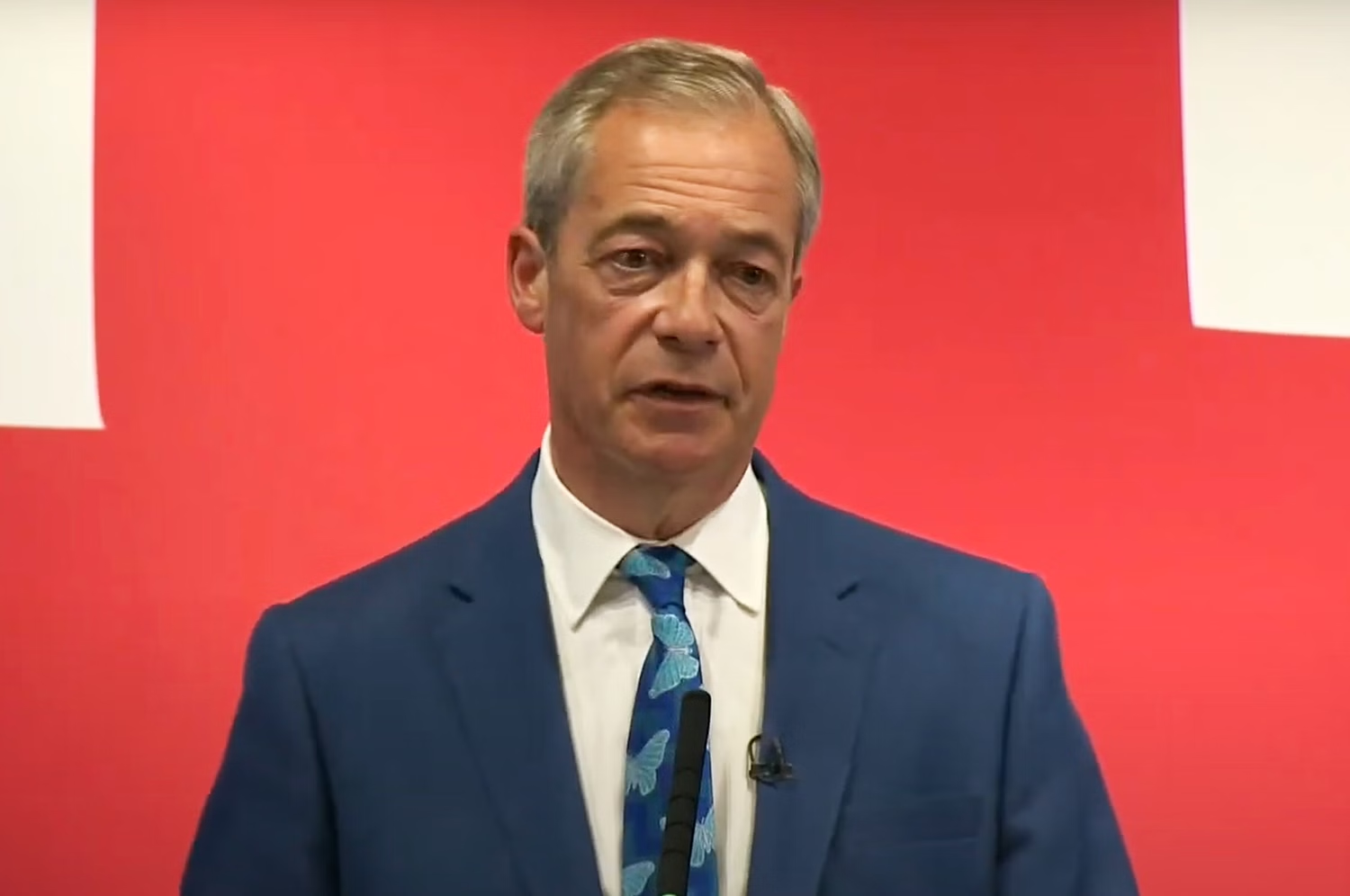
Reform UK Leader Nigel Farage speaking at a Reform UK press conference on 3 June 2024. Credit: Reform UK / YouTube

The Reform UK leader is a vocal opponent of net zero policies, and has questioned the basis of established climate science

Pro-Brexit campaigner Nigel Farage has announced that he will be standing to be an MP at the upcoming general election and will be replacing Richard Tice as leader of the populist party Reform UK

Farage, who says that he hopes to become “the voice of opposition” in Parliament, has long been a vocal opponent of climate action and a critic of climate science – campaigning for a referendum on the UK’s 2050 net zero emissions target.

When he was the leader of the UK Independence Party (UKIP), the party’s 2015 and 2017 election manifestos pledged to rip up green measures, repeal the UK’s Climate Change Act, withdraw from the 2015 Paris Agreement – the flagship deal to tackle global emissions – and support fossil fuel extraction.

These reflected Farage’s personal views on climate action. In 2015, he told the libertarian website Spiked: “I think wind energy is the biggest collective economic insanity I’ve seen in my entire life. I’ve never seen anything more stupid, more illogical, or more irrational.”

Farage is a presenter on GB News, the right-wing broadcaster that has regularly provided a platform to climate science denial and attacks on green reforms since it launched in June 2021. 

Speaking on GB News in August 2021, Farage said that he was “very much an environmentalist” and that he couldn’t “abide things like plastics in our seas, pollution in our rivers.” However, on the issue of climate change, he added: “What annoys me though, is this complete obsession with carbon dioxide almost to the exclusion of everything else, the alarmism that comes with it, based on dodgy predictions and science.”

The world’s foremost climate science body, the UN’s Intergovernmental Panel on Climate Change (IPCC), has stated it is “unequivocal that human influence has warmed the atmosphere, ocean and land”, while scientists at NASA have found that the last 10 years were the hottest on record. Earth’s average surface temperature in 2023 was the warmest since records began in 1880.

The IPCC has also stated that carbon dioxide “is responsible for most of global warming” since the late 19th century, which has increased the “severity and frequency of weather and climate extremes, like heat waves, heavy rains, and drought”.

Farage has been a vocal critic of net zero. He has claimed that the policy is an “act of self harm” and has called for it to be scrapped. 

He has said: “It will not bring economic benefits. It will make everybody a whole lot poorer. And yet the lemmings in Parliament are taking us towards an economic cliff,” adding: “I can’t think of an issue on which the public and politicians are more divided.”

In fact, politicians are markedly less in favour of climate action than the general public. New polling by YouGov for the Energy and Climate Intelligence Unit (ECIU) has shown that almost two-thirds (62 percent) of the public believe the best way to achieve energy security is to reduce the use of fossil fuels and instead expand the use of renewable energy, compared to 48 percent of MPs. 

The Climate Change Committee, which advises the government on its net zero policies, has estimated that the cost of achieving net zero will be less than 1 percent of UK GDP, while the government independent spending watchdog – the Office for Budget Responsibility – has said that, “the costs of failing to get climate change under control would be much larger than those of bringing emissions down to net zero”.

Farage has also claimed that, “If green technology is going to work, it ought to work without ordinary folk subsidising it” – referring to the government grants and investment dedicated to developing clean energy sources. The UK government has given £20 billion more in support to fossil fuel producers than their renewable energy peers since 2015.

Farage has also spread conspiracy theories about anti-pollution measures being used to control people’s lives. 

In a video posted on Twitter, he argued that Mayor of London Sadiq Khan’s calls to reduce air pollution by cutting car engine use would pave the way to “climate lockdowns”. 

He said: “Mark my words this isn’t going to end with 20mph zones and low-traffic neighbourhoods. No no. This is the beginning of climate lockdowns. We will have, in years to come, days where we’re told we can’t drive, we can’t do this, you can’t do that while Sadiq Khan is leading the way. Remember you heard it here first. Climate lockdowns.”

The Institute for Strategic Dialogue has highlighted how climate lockdown claims are part of “a conspiratorial narrative which claims that global elites are using climate change as a pretext to restrict individual freedoms and civil liberties.”

Farage and Reform UK

Farage used his announcement to state his belief that Labour will win the general election, which will be held on 4 July, and that the Conservative Party has “crushed itself”. With the Tories predicted to lose in a landslide, Farage appears to believe that he can lead a new right-wing movement.

The Reform leader was already a key figure in the party prior to today’s announcement, effectively owning the party as well as serving as its president. Reform operates as a private company without a democratic structure, so Farage’s majority shareholding meant that could have appointed himself as leader at any time. 

Despite Farage failing to be elected as an MP when he stood in seven previous general elections, and Reform only winning two councillors in May’s local elections, polls indicate that Farage may succeed in becoming the MP for Clacton.

If this is the case, Farage will be advocating in Parliament for the anti-climate policies that have been proposed by his party. 

Reform has called for the UK’s net zero emissions target to be scrapped, and has proposed holding a referendum on the policy – a campaign launched by Farage in 2022. 

The party’s policy agenda states that: “Westminster’s net zero plans send our jobs and money overseas, making us net poorer and net colder”, adding that net zero policies are “net stupid”. 

The party’s former leader Tice, who will now become its chairman, is a prominent climate science denier. Tice has claimed that “there is no climate crisis”, and has also expressed the view that “CO2 isn’t a poison. It’s plant food”.

Of the £2.5 million that Reform UK has received in donations since the 2019 election, around 92 percent (£2.3 million) of that income has been given by fossil fuel interests, polluting industries, or climate science deniers.

Original article by Sam Bright republished from DeSmog

Continue ReadingNigel Farage’s Anti-Climate Record