U.S. President Donald Trump participates in a bilateral meeting with El Salvador’s President Nayib Bukele in the Oval Office of the WHite House in Washington, D.C. on April 14, 2025. (Photo: Brendan Smialowski/AFP via Getty Images)
Refusals to comply with Supreme Court decisions equal a constitutional crisis.
I was at an event last week where a prominent GOP pollster who often appears on CNN was discussing the details of U.S. President Donald Trump’s political profile as we approach the 100-day mark of his administration. The back and forth was interesting to me and my fellow political nerds. However, during the presentation, my inner voice sounded like Independent Vermont Sen. Bernie Sanders: “This is not normal.”
Unfortunately, far too many political insiders are acting as if Trump is a normal if a little eccentric president. They think that they can negotiate with him on issues and influence his staff to move him in their direction. No matter what Trump does, they see it as just a negotiating tactic.
April 14, 2025 should go down in American history as the day when Trump’s steps in the direction of authoritarianism made it clear to all that this is not a normal presidency. After Monday’s events, there can be no more debate about what Trump is and where he is taking America.
Let’s break down what happened. In a meeting with President Nayib Bukele of El Salvador, President Trump openly defied a 9-0 Supreme Court decision that said that Kilmar Abrego Garcia, a Maryland resident wrongly deported to El Salvador, must be returned to the United States. As The New York Times put it:
The meeting in the Oval Office on Monday was a blunt example of Mr. Trump’s defiance of the courts. The president and his top White House officials said the decision over Mr. Abrego Garcia, a 29-year-old father of three, would have to be made by [El Salvador President] Mr. Bukele.
If this was not enough, President Trump went on to outline plans for sending American citizens convicted of crimes to El Salvador. More from The New York Times:
President Trump just said he was open to sending American citizens convicted of violent crimes to President Bukele’s prison in El Salvador. Trump had a similar response when Bukele first offered to jail convicted American criminals in February.
“I’m all for it,” Trump said, adding that his attorney general was studying whether the idea was legally feasible. “If it’s a homegrown criminal, I have no problem, no,” he said, adding: “I’m talking about violent people. I’m talking about really bad people.”
Another sign that we are in a constitutional crisis happened just outside the Oval Office on Monday. President Trump had barred The Associated Press from covering certain White House events because they had refused to use his preferred nomenclature for what the White House refers to as the “Gulf of America.” Last week, a federal judge ordered the White House to restore AP access to White House events. The federal judge who ruled in this case was Trevor McFadden, a Trump appointee. In his decision, McFadden wrote that:
No, the Court simply holds that under the First Amendment, if the Government opens its doors to some journalists—be it to the Oval Office, the East Room, or elsewhere—it cannot then shut those doors to other journalists because of their viewpoints… The Constitution requires no less.
On Monday, the White House blocked the AP reporter from attending the Oval Office press conference with President Trump and Bukele. Again, Trump failed to obey a court order.
Now, barring a reporter from the Oval Office may not seem to be a big deal. However, it is the government telling the media what it can report on. Plus, the courts ruled directly in the AP’s favor. The lines are clearly drawn here.
President Trump in the Oval Office on Monday openly defied decisions of the judicial branch. One was a 9-0 ruling of the Supreme Court and the other ruling was by a federal judge he appointed. As a nation, we are clearly in a constitutional crisis. This is not something theoretical or something that might happen sometime in the future. The crisis is at hand. The fabric of the American republic is being torn in two.
What we need is bold opposition from Democratic leaders in the House and Senate. If the current leadership is unwillingly to respond, they need to step aside. The first action that each of us can take to protect the American experiment is to stop pretending that Trump is a normal president.
Neo-Fascist Climate Science Denier Donald Trump says Burn, Baby, Burn.Elon Musk urges you to be a Fascist like him, says that you can ignore facts and reality then.Image of the original Fascists Mussolini and Hitler
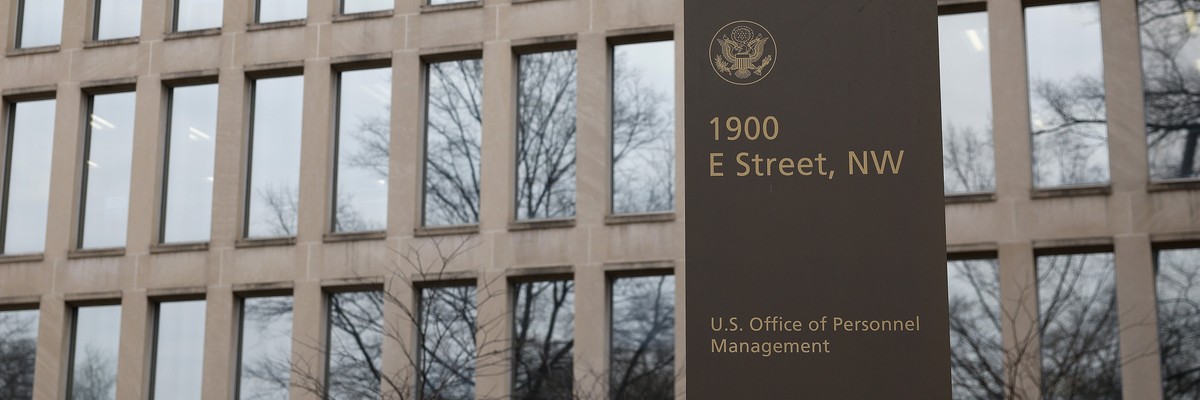
The Theodore Roosevelt Federal Building headquarters of the U.S. Office of Personnel Management is seen on February 03, 2025 in Washington, D.C. (Photo: Kevin Dietsch/Getty Images)
“Definitely never seen this type of response to a FOIA request,” quipped one journalist.
When CNN put in a Freedom of Information Act request with the Office of Personnel Management for information related to security clearances for billionaire Elon Musk and other personnel at the so-called Department of Government Efficiency who have been allowed access to sensitive or classified government networks, the outlet got an unexpected response.
“Good luck with that, they just fired the whole privacy team,” an OPM email address wrote back, according to Tuesday reporting from CNN. An OPM official told the outlet that the federal government’s human resources agency did not layoff the entire privacy team, but did not comment further on the matter.
“Definitely never seen this type of response to a FOIA request,” quipped CBS News journalist Jim LaPorta reacting to the news on X.
According to CNN, OPM’s privacy team “is tasked with ensuring the agency’s data privacy practices meet legal requirements and protect the trust of the public.” Members of the agency’s communications staff and employees who handle FOIA requests were also terminated, per CNN, which cited two unnamed sources.
Federal agencies are required to furnish information requested via FOIA unless the information falls within an exemption.
These firings at OPM, which is the chief human resources agency of the federal government, constitute “a move that limits outside access to government records related to the security clearances granted to Elon Musk and his associates,” according to CNN, citing unnamed sources “familiar with the matter.”
OPM was one of the first federal agencies to be infiltrated by Musk’s associates at the Department of Government Efficiency and has been at the forefront of the Trump administration’s purge of federal workers.
Last month, OPM sent out the now infamous “Fork in the Road” memo, which offered a widely decried deferred resignation program for nearly all federal employees. The message resembled—including the verbatim wording of the subject line—an email that Musk sent Twitter employees in 2022, when he took over the social media platform now known as X.
CNN’s coverage also noted that the move to fire members of OPM’s privacy and communication teams echoes Musk’s decision to fire the media relations department at Twitter.
On X, Washington Post video journalist Jorge Ribas wrote the word “‘transparency’” in response to CNN’s reporting about the FOIA request, in an apparent nod to Musk’s assertion that DOGE is attempting to be transparent in carrying out its operations.
Elon Musk urges you to be a Fascist like him, says that you can ignore facts and reality then.Power-mad orange gasbag Donald Trump says Burn, Baby, Burn.
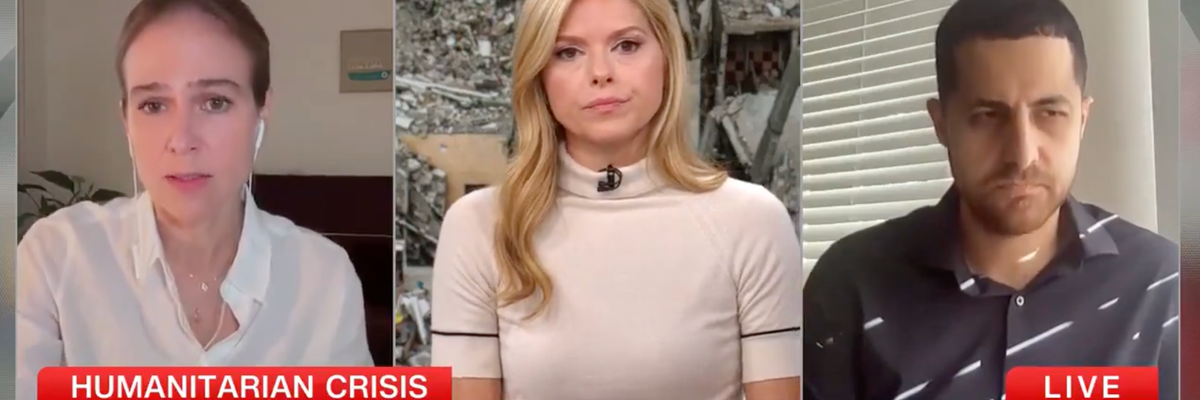
Dr. Tanya Haj-Hassan (left) pushes back on CNN anchor Kate Bolduan’s (center) description of the Gaza genocide as a “humanitarian crisis” during an October 7, 2024 interview. (Photo: CNN screen grab)
“History books will be written on this and countries will have to reckon—media agencies will have to reckon—with their major role in the genocide,” said Dr. Tanya Haj-Hassan.
Human rights advocates on Friday highlighted a rare instance in which a U.S. corporate media outlet allowed a pro-Palestinian voice to set the record straight about Israel’s crimes against humanity in Gaza.
Earlier this week, CNN “News Central” aired a panel segment on the anniversary of the October 7, 2023 Hamas-led attack on Israel and Israel’s retaliatory war. Anchor Kate Bolduan noted that around 1,200 people were killed during the Hamas attack—although she did not say that at least some of them were slain by Israeli forces in “friendly fire” incidents and under the Hannibal Directive—and that 250 others were kidnapped.
Bolduan also acknowledged that nearly 42,000 Palestinians have been killed and another 2 million displaced by Israeli forces, calling the situation in Gaza a “desperate humanitarian crisis.”
“A humanitarian crisis is what you deal with when you have a hurricane, what you deal with when you have an earthquake.”
The anchor asked panel participant Dr. Tanya Haj-Hassan—an American pediatric intensive care physician who volunteered for two weeks at Al-Aqsa Martyrs Hospital in Deir al-Balah in the central Gaza Strip—for her thoughts on the matter.
“In all honesty, a humanitarian crisis is what you deal with when you have a hurricane, what you deal with when you have an earthquake,” Haj-Hassan replied. “This is not a humanitarian crisis.”
“Kate, and I’m going to say it very clearly for your viewers to hear, this is genocide,” the doctor stressed.
"This is not a humanitarian crisis, Kate, and I'm going to say it very clearly for your viewers to hear: This is genocide […] Media agencies will have reckon with their major role in the genocide." — Dr. Tanya Haj-Hassan to CNN pic.twitter.com/PTVSe0lOFY
When 70% of the population that are killed are women and children, when the population is starved of food, of water, of medicine, when you have attacks, repeated attacks on all the hospitals, the clinics, the aid distribution sites, the humanitarian aid agencies that tried to help, more [United Nations] workers have been killed in Gaza than in U.N.’s history. When you have over 900 families that have been exterminated, that have been taken off of the civil registry, killed, when you have over 17,000 children that have lost one or both parents, when you have bakeries, aid distribution sites, churches, mosques, schools, and in the last three days—in the last 24 hours in fact—a hospital today that was bombed, as you just reported, the hospital where I personally was working, and I can tell you, they are working every second of every day to try and sustain life.
“And so it’s really hard to hear it over and over and over again, framed in the way that it’s being framed in the media, which, frankly, Kate, is very misleading,” Haj-Hassan said. “It is very misleading. Three hundred and sixty-five days of this. Death tolls that are so far outdated we have… no idea how many people are killed.”
“But I am… genuinely afraid about what we’re going to find out when the dust settles. History books will be written on this,” she added. “And countries will have to reckon—media agencies will have to reckon—with their major role in the genocide of an entire population and in the destruction of humanitarian law and rule of order.”
Some observers noted the absence of voices like Haj-Hassan’s in U.S. mainstream media coverage of Gaza, which is overwhelmingly pro-Israel and almost never airs the word “genocide”—even as Israel is on trial for the crime at the International Court of Justice (ICJ).
The New York Times, for example, ordered journalists covering the war in Gaza to eschew terms including “genocide,” “ethnic cleansing,” and even “occupied territory,” even though Israel has indisputably occupied Palestine for over half a century and the ICJ recently ruled that the Israeli occupation is a crime of apartheid that must end immediately.
“The media may be forgiven for missing a carefully hidden story. For missing some details,” Quincy Institute for Responsible Statecraft executive vice president Trita Parsi said Friday on social media. “But when a genocide is there for everyone to see and you help conceal it, forgiveness is not in the cards.”
Another social media user offered mild praise for Bolduan—who has been criticized by Israel supporters for previous interviews in which Palestine defenders accused Israel of genocide—writing that the anchor “didn’t seem happy” to hear what Haj-Hassan was saying.
“Hard to say whether it was because the truth is so horrible or because CNN doesn’t want to report that truth—but she did let her say it,” the user said of Bolduan.
Allegations of Israeli genocide remain highly contentious—even taboo—in the United States, which provides the key Mideast ally with tens of billions of dollars in military aid and diplomatic cover including multiple vetoes of United Nations Security Council cease-fire resolutions that were overwhelmingly supported by other countries.
In the United States, Palestinians, Palestinian Americans, and human rights groups are asking the 9th U.S. Circuit Court of Appeals to revisit a lawsuit they filed accusing President Joe Biden, Secretary of State Antony Blinken, and Defense Secretary Lloyd Austin of complicity in the Gaza genocide.
In July, a three-judge panel of the federal court dismissed the lawsuit, in which the U.S. District Court for the Northern District of California previously found that “the current treatment of the Palestinians in the Gaza Strip by the Israeli military may plausibly constitute a genocide in violation of international law,” but dismissed the case on jurisdictional grounds.
Across corporate media, journalists and pundits introduced conspiracy theories to discredit the pro-Palestine student protest movement, particularly that they are funded by foreign countries or “outside agitators.”
Joe Scarborough and Hillary Clinton on MSNBC‘s Morning Joe (5/9/24) to talk about “misinformation,” agreeing that student protesters are “extremists…funded by Qatar.”
MSNBC‘s Joe Scarborough (5/9/24) went on a rant about the college students who have been staging the protests, suggesting to guest Hillary Clinton that they were influenced by China or Qatar:
I’m going to talk about radicalism on college campuses. The sort of radicalism that has mainstream students getting propaganda, whether it’s from their professors or whether it’s from Communist Chinese government through TikTok, calling the president of the United States “Genocide Joe.” Calling you and President Clinton war criminals.
Eventually, he called the students “extremists—I’m sorry—funded by Qatar.”
Clinton responded: “You raised things that need to be vented about.”
Scarborough’s claim that Qatar funds the students likely comes from a Jerusalem Post article (4/30/24), which called the protests “despicable.” The story reported, “Qatar has invested $5.6 billion in 81 American universities since 2007, including the most prestigious ones: Harvard, Yale, Cornell and Stanford.” Of course, funding universities is not the same as funding student protests; the university administrations that actually received the Qatari funding have often been quite hostile to the protesters.
‘Mr. Putin’s message’
Nancy Pelosi, interviewed by Dana Bash on CNN (1/28/24), accused protesters of being “connected to Russia” because “to call for a ceasefire is Mr. Putin’s message.”
House Speaker Emeritus Nancy Pelosi (D–Calif.) suggested on CNN’s State of the Union (1/28/24) that Russia has played a role in the protests:
And what we have to do is try to stop the suffering and gossip….. But for them to call for a ceasefire is Mr. Putin’s message…. I think some of these protesters are spontaneous and organic and sincere. Some I think are connected to Russia.
CNN’s Dana Bash asked, “you think some of these protests are Russian plants?” Pelosi responded: “I don’t think they’re plants; I think some financing should be investigated.”
Like MSNBC, Fox News (5/2/24) has also pushed the narrative suggesting that China is behind the protests: “China may be playing a significant role in the anti-Israel protests by using TikTok to foment division on college campuses,” Alicia Warren wrote.
Gordon Chang, a senior fellow at the far-right, anti-Muslim Gatestone Institute, told Fox that “China is using the curation algorithm of TikTok to instigate protests.”
The presence of pro-Palestinian advocacy on TikTok has been cited by lawmakers as a justification for censoring the social media platform (FAIR.org, 5/8/24). But the messages on TikTok, which is popular among younger people, may simply reflect public opinion among that demographic. According to the Pew Research Center, “Younger adults are much less supportive of the US providing military aid to Israel than are older people.”
In a story headlined, “Campus Protests Give Russia, China and Iran Fuel to Exploit US Divide,” the New York Times (5/2/24) described “overt and covert efforts by the countries to amplify the protests.” The story included some speculation about foreign influence: “There is little evidence—at least so far—that the countries have provided material or organizational support to the protests,” Steven Lee Myers and Tiffany Hsu wrote. If there was any evidence, they did not present it.
The journalists blamed the protests for having “allowed” these “foreign influence campaigns…to shift their propaganda to focus on the Biden administration’s strong support for Israel.”
‘Professional outside agitators’
ADL’s Jonathan Greenblatt on CNN (4/29/24): “There’s no rule that says the school needs to tolerate students or, again, outside activists dressing like they’re in Al Qaeda.”
Beyond foreign influence, another conspiracy theory pushed by corporate media about student protesters is that they are influenced by “outside agitators.” While people who are not students have joined the protests, the term has long been used to delegitimize movements and portray them as led by nefarious actors.
New York City Mayor Eric Adams was an early source of this claim, announcing at a press conference (4/30/24) that Columbia students have “been co-opted by professional outside agitators.” He made a similar statement in mid-April as well (4/21/24).
On MSNBC (5/1/24), NYPD deputy police commissioner Kaz Daughtry defended the claim, holding up a bicycle lock with a substantial metal chain that police had found at Columbia. “This is not what students bring to school,” he said. In fact, Columbia sells the bike lock at a discount to students (FAIR.org, 5/9/24).
CNN‘s Anderson Cooper (4/29/24) asked the Anti Defamation League’s Jonathan Greenblatt about the outside agitators, “How many of them are actually students?” “A lot of them are not students,” Greenblatt replied, adding unironically: “You can’t even tell who’s an outside agitator and who’s an actual student.”
CNN senior political commentator David Axelrod tweeted (4/30/24): “It will be interesting to learn how many of those arrested in Hamilton Hall at Columbia are actually students.”
“I really believe they are brainwashed,” Donald Trump (Fox News, 4/30/24) said of student protesters.
Former president Donald Trump made a similar claim on Fox (4/30/24). “I really think you have a lot of paid agitators, professional agitators in here too, and I see it all over. And you know, when you see signs and they’re all identical, that means they’re being paid by a source,” he told Fox host Sean Hannity. He continued: “These are all signs that are identical. They’re made by the same printer.”
It’s worth noting that a political movement is not like an intercollegiate athletic competition, where it’s cheating for non-students to play on a college team; it’s not illegitimate for members of the broader community to join an on-campus protest, any more than it’s unethical for students to take part in demonstrations in their neighborhoods.
“If you’re a protester who’s planned it, you want all outsiders to join you,” Justin Hansford of the Thurgood Marshall Civil Rights Center told PolitiFact (5/6/24). “That’s why this is such a silly concept.”
That didn’t stop the New York Post (5/7/24) from publishing an op-ed by former New York Lt. Gov. Betsy McCaughey headlined “Pursue Anti-Israel ‘Outside Agitators’ Disrupting Colleges—and End the Nonsense for Good.” McCaughey wrote, “Ray Kelly, former NYPD commissioner, nailed it Sunday when he said the nationwide turmoil ‘looks like a conspiracy.’” It looks like a conspiracy theory, anyway.
Tents situation
NYPD deputy police commissioner Kaz Daughtry (Fox 5 New York, 4/23/24): “Look at the tents. They all were the same color. They all were the same type of tents.”
One key piece of evidence offered for the “outside agitators” claim was the uniformity of many of the encampments’ tents. When Fox 5 New York (4/23/24) invited two NYPD representatives to discuss the protests, NYPD’s Daughtry said: “Look at the tents. They all were the same color. They all were the same type of tents.” He continued: “To me, I think somebody’s funding this. Also, there are professional agitators in there that are just looking for something to be agitated about, which are the protests.”
“Somebody’s behind this, and we’re going to find out who it is,” Daughtry said.
That students might be observing the world and their role in it, and acting accordingly, was not considered.
Newsweek (4/23/24) quoted Daughtry’s claim with no rebuttal or attempt to evaluate its veracity, under the headline, “Police Investigating People ‘Behind’ Pro-Palestinian Protests.” Fox News anchor Bret Baier (4/23/24) also cited the tents as a smoking gun: “We do see, it is pretty organized. The tents all look the same. And it’s expanding.”
The problem with this conspiracy theory is that the look-alike tents at most encampments were not expensive at all. As HellGateNYC (4/24/24) pointed out, the two-person tents seen at Columbia cost $28 on Amazon (where they’re the first listing that comes up when you search “cheap camping tent”), and the ones at NYU were even cheaper, at $15. While many Columbia students receive financial aid, the basic cost of tuition, fees, room and board at the school is $85,000 a year. What’s another $15?
‘Soros paying student radicals’
Fox News (4/26/24): “Progressive anti-Israel agitators across the country…are associated with groups tied to far-left groups with radical associations backed by dark money and liberal mega-donor George Soros.”
And finally, some news outlets alleged that the student protesters are funded by financier George Soros. For example, Fox (4/26/24) reported that a group that funds National Students for Justice in Palestine (NSJP) received a donation from an unnamed nonprofit that is funded by Soros. Fox was apparently referring to the Tides Foundation, a philanthropy that Soros has given money to; Tides gave $132,000 to WESPAC, a Westchester, N.Y., peace group that serves as a financial sponsor to NSJP in Palestine (PolitiFact, 5/2/24; Washington Post, 4/26/24). In standard conspiratorial reasoning, this three-times-removed connection means that, as Fox put it, protests attended by SJP members are “backed by dark money and liberal mega-donor George Soros.”
The New York Post (4/26/24) published a similar piece, headlined “George Soros Is Paying Student Radicals Who Are Fueling Nationwide Explosion of Israel-Hating Protests.”
On NewsNation (5/1/24), House Speaker Mike Johnson (R-La.) also suggested Soros may be connected, saying that the FBI should investigate:
I think the FBI needs to be all over this. I think they need to look at the root causes and find out if some of this was funded by—I don’t know—George Soros or overseas entities. There’s sort of a common theme and a common strategy that seems to be pursued on many of these campuses.
Soros is a billionaire philanthropist who survived the Holocaust. He has come to represent an antisemitic trope among right wingers of a puppet master controlling events behind the scenes (see FAIR.org, 3/7/22). To put it simply, these supposedly antisemitic protesters are now on the receiving end of antisemitism.
Featured image: New York Post graphic (4/26/24) alleging that Jewish billionaire George Soros is bankrolling “Israel hate camps.”
NOAA (4/15/24) found temperature levels in every ocean high enough to cause coral bleaching.
Record levels of heat in the ocean are causing once-colorful coral reefs around the world to bleach a ghostly white. In April, the National Oceanic and Atmospheric Administration (NOAA) announced the planet’s fourth mass coral-bleaching event on record—the second in the last decade.
While they might look like plants, corals are actually invertebrate animals related to jellyfish. They get their vibrant colors from tiny algae that live on them and provide them with food. But when ocean temperatures become too hot, corals get stressed and expel the algae, losing their food source and color. Starving coral can recover if their environments improve, but the International Panel on Climate Change (IPCC) predicts that even with the Paris Agreement’s allotted warming of 1.5°C over pre-industrial levels, 70–90% of the world’s coral reefs will still die.
Because coral reefs provide such vibrant ecosystems for sea life, mass coral death will impact economies and food security for humans as well. By protecting coasts, sustaining fisheries, generating tourism and creating jobs, it is estimated that coral reefs provide ecosystem services worth trillions of dollars each year (MIT Science Policy Review, 8/20/20; GCRMN, 10/5/21).
ABC News (7/25/23) reported last year that “ocean temperatures have a strong connection to climate change”—but didn’t mention what climate change is connected to.
In the past year alone, we’ve seen staggering and unprecedented ocean temperatures amid widespread heatwaves. Last summer, water temperatures of more than 100°F were recorded off the coast of Florida (ABC, 7/25/23). Scientists say the El Niño weather phenomenon, solar activity and a massive underwater volcanic eruption have played a role in recent supercharged ocean temperatures, but the biggest cause of this coral crisis is undisputed: climate change. The IPCC reports that it’s “virtually certain” ocean temperatures have risen unabated since 1970, absorbing more than 90% of excess heat from the climate system. We also know that the burning of fossil fuels changes the climate more than any other human activity does.
Therefore, in order to give the public the most complete understanding of what’s going on—and how we can fix it—reporting on coral bleaching should not only link the phenomenon to climate change, but link climate change to its main culprit: the fossil fuel industry. While much reporting deserves credit for clearly making this connection, some reports from major outlets were still behind, implying the climate crisis might be some sort of act of God, rather than something humans have caused—and have the power to mitigate.
Good news about bad news
Coral bleaching is bad news, but I’d like to take a rare moment to highlight the good news, too: A lot of reporting on this crisis was thorough, setting a solid example of how the increasing number of climate change-related phenomena should be reported on.
Vox (4/26/24) spells it out: “Ultimately, the only real solution is reducing carbon emissions. Period.”
Vox (4/26/24) dedicated a whole piece to climate change’s effects on coral, making that fossil fuel connection. Senior environmental reporter Benji Jones wrote:
Ultimately, the only real solution is reducing carbon emissions. Period. Pretty much every marine scientist I’ve talked to agrees. “Without international cooperation to break our dependence on fossil fuels, coral bleaching events are only going to continue to increase in severity and frequency,” [NOAA marine scientist Derek] Manzello said.
The New York Times (4/15/24) made the fossil fuel connection, too, in an article by Catrin Einhorn: “Despite decades of warnings from scientists and pledges from leaders, nations are burning more fossil fuels than ever and greenhouse gas emissions continue to rise.”
NPR dedicated an episode of All Things Considered (4/17/24) to scientists’ work to breed heat-tolerant corals and algae, in hopes that they can help restore reefs. The piece, by Lauren Sommer and Ryan Kellman, outlined this work’s promise—and its limitations. Heat-tolerant algae may not share as many nutrients with the coral, potentially causing the coral to grow more slowly and reproduce later. Regulators will need to assess whether these lab-grown corals are safe for wild populations and their ecosystems as a whole. Logistically, the sheer amount of heat-tolerant coral needed to replace affected reefs is vast, and it’s only a temporary solution.
“It’s not our ‘get out of jail free’ card,” said Australian coral biologist Kate Quigley:
Maybe that gets us to 2030, 2050, for a very few number of species that we can work with. If we don’t have an ocean to put them back in that’s healthy, no amount of incredible technology or money is worth it.
The episode ended with an acknowledgment that these scientific mitigations are meant only to buy time while humans work to halt climate change, which will require “cutting heat-trapping emissions from the largest source—burning fossil fuels—and switching to alternative energy sources like solar and wind.”
All Things Considered’s coverage of the scientists’ work was impactful because it took time to explain that creating these heat-tolerant corals was an important mitigation, but that the ultimate solution is to cut fossil fuels. Without the latter, the former would be in vain.
Capable of accountability
As a media critic for an organization that’s been at this since 1986, to me it’s heartening when news outlets’ work actually improves. It’s definitely not yet time to pop the champagne—there’s still a chronic lack of clear reporting linking climate disasters to fossil fuels, as FAIR has noted in coverage of last year’s wildfires (7/18/23, 8/25/23), climate protests (9/29/23), the potential breakdown of a crucial Atlantic current (7/31/23), overstating the potential of new carbon-capture technology (1/4/24) and more. But these few coral-focused pieces offer hope that some outlets might be improving their climate reporting practices to include accountability. At the very least, it proves they are certainly capable.
Aside from the effects of the climate crisis becoming harder and harder to ignore each year, there is a commendable movement to train journalists on how best to report on climate through a number of initiatives and organizations. There’s a lot of work to do, but these stories indicate progress since Big Media was applauding Big Oil’s efforts to clean up the Exxon Valdez oil spill in 1989 (Extra!, 3–4/90) and giving platforms to “scientists” on Big Oil’s payroll who asserted climate change was not occurring (Extra!, 11–12/04, 5–6/07).
The new denial
CNN (5/9/24) waited until the the 24th paragraph (out of 24) to tell readers that we “need to curb climate-warming carbon emissions.”
Climate denial today is more nefarious. Due to the unanimity and widespread knowledge of the scientific consensus, respectable outlets can no longer parrot views that the Earth isn’t warming. What they can do is bury or gloss over information on its primary cause, who profits off of it, and what needs to be done to prevent it from getting much worse.
In a piece on the potential of artificial reefs to mitigate this crisis that linked coral bleaching to climate change, CNN‘s Michelle Cohan (5/9/24) waited until the very last paragraph to mention the need to “curb climate-warming carbon emissions.” There’s nothing untrue about that statement, but it doesn’t tell you where those emissions come from, and leaves open the interpretation that “curbing” emissions can come from carbon capture and storage—a strategy that is largely industry greenwashing (FAIR.org, 1/4/24).
Despite likely short-form word limits, a solutions-oriented piece like this does a disservice to readers—and the scientists working on saving corals—by giving such an incomplete sketch of the necessary long-term change. It would benefit from a clear explanation that a) we need to phase out fossil fuels and b) alternative energy sources already exist, are reliable, and are more affordable than fossil fuels already. It’s not arduous or wordy to do so. All Things Considered did most of it in one sentence.
An ABC piece (4/15/24) by Leah Sarnoff and Daniel Manzo covered the coral-bleaching event, but only mentioned climate change in passing toward the end. Otherwise, “warming oceans” were just depicted as something that happened, with no clear connection or cause.
In an article expressing the dire condition of the reefs, the Washington Post‘s Rachel Pannett (4/18/24) likewise made the link to climate change only once: “Climate change is the greatest threat to the Great Barrier Reef, and coral reefs globally,” said Roger Beeden, the chief scientist of the Great Barrier Reef Marine Park Authority. There was another quote from a research director with the Australian nonprofit Climate Council, who merely noted that the bleaching of the Great Barrier Reef is “a disaster at our doorstep.”
It’s important to express the dire condition the reefs are in, and the devastating risks it poses to ocean and human life. But by only mentioning “climate change” in passing, and not discussing its causes, it comes across as a natural but unfortunate phenomenon. Not highlighting its causes means not highlighting its solutions, either. The result is a potentially paralyzing doomsday narrative that is more likely to dampen than galvanize necessary climate action—especially against fossil fuels.
‘Heat stress’
The word “climate” never appears in this Washington Post piece (4/15/24).
Another Washington Post piece (4/15/24), by Amudalat Ajasa, mentioned the “heat stress” on corals, but not even climate change, let alone the culpability of fossil fuels. This piece quoted NOAA’s Manzello, saying that this global event should be a wake-up call, but didn’t elaborate on what that wake-up call would be for. Wake up to do what? This piece didn’t explain.
The piece also took a grave tone, describing the ghastly reefs off the coast of Florida, Australia and the Caribbean island of Bonaire. It quoted Francesca Virdis, a chief operating officer at Reef Renewal Bonaire: “It’s hard to find a silver lining or a positive note with everything happening.”
The article explained the role of El Niño—a naturally occurring climate pattern that warms areas of the Pacific every 2–7 years—and the hope that it will soon let up and give way to La Niña, its cooler counterpart, but did not explain that the phenomenon plays a smaller role than ongoing, human-caused warming. The aforementioned Vox piece also discussed the role of El Niño, but was sure to specify that reefs have been collapsing long before this current crisis.
The feeling of alarm is justified, but journalists should remind readers that the coral bleaching crisis—and climate change as a whole—are not totally uncontrollable acts of nature. We know what is to blame. While it may be too late to avoid breaching the 1.5°C limit even if we cut emissions tomorrow, the sooner we cease burning fossil fuels, the more catastrophic impacts we’ll avoid.
The message is urgent and dire, but there’s plenty that humans—especially those in power—can do, and there’s plenty journalists can do to make the public aware.
FEATURED IMAGE: NOAA photos of a coral before and after bleaching. (This particular coral recovered from the event.)
FAIR’s work is sustained by our generous contributors, who allow us to remain independent. Donate today to be a part of this important mission.