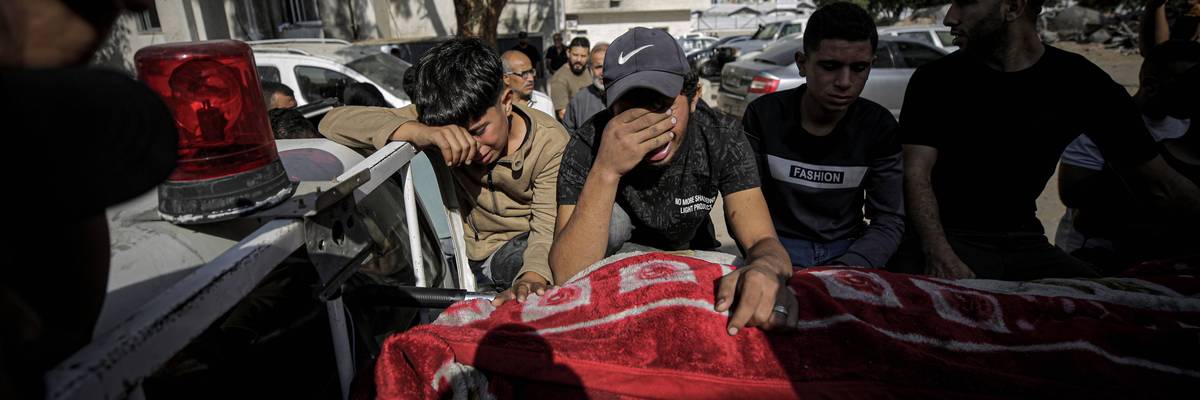
Relatives mourn as the bodies of those killed in an Israeli airstrike targeting the Es-Sabra neighborhood in southern Gaza City are brought to Al-Shifa Hospital in Gaza City, Gaza Palestine on October 9, 2026. (Photo by Saeed M. M. T. Jaras/Anadolu via Getty Images)
“Accountability cannot be swept under the rubble.”
A coalition of more than 100 humanitarian, human rights, and civil society organizations on Friday said that the Gaza ceasefire agreement signed one year ago exists in “name only” amid continued Israeli attacks on the enclave.
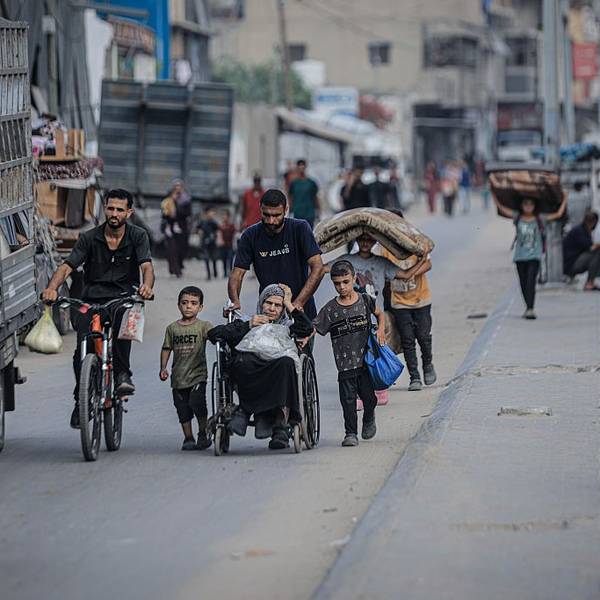
The groups noted that Israeli military operations over the last year have killed at least 1,400 Palestinians, including more than 300 children, despite a supposed ceasefire being in effect.
The Israeli military has also pushed Palestinians “into an increasingly small and overcrowded area” by moving forces beyond the withdrawal line agreed to in the ceasefire plan, the groups said.
In addition to outlining the toll on civilian life, the groups also pointed to extensive damage to civilian infrastructure, pointing to recently published satellite images showing “neighborhoods reduced to rubble, homes flattened, and agricultural land razed.”
Jan Egeland, secretary general of the Norwegian Refugee Council, called it “utterly shameful” that so little had improved for Gaza residents since the ceasefire went into effect last year.
“Families are still being forced to make impossible choices,” said Egeland, “between sheltering in damaged and dangerous buildings or living in tents facing unbearable temperatures. Israeli restrictions are still preventing the required equipment or materials, which are the only ways for communities to begin rebuilding their lives.”
Inger Ashing, CEO of Save the Children, said the reality on the ground in Gaza shows that “a ceasefire is meaningless if children are still being killed and families are still unable to rebuild their lives.”
“Governments that backed this agreement must use their influence to stop the killing and ensure children can access food, healthcare, shelter, and education,” Ashing emphasized. “Gaza’s children have a right to safety and a future. Governments have the power to help secure both, and they must use it.”
Agnes Callamard, secretary general of Amnesty International, similarly called upon the international community to take responsibility not only for helping Palestinians, but also punishing Israel for violating the ceasefire plan.
“Accountability cannot be swept under the rubble,” said Callamard. “The recovery and future of Gaza cannot be separated from a framework grounded in international law, justice, and the rights of victims. The persistent failure to hold Israel accountable and press Israel to comply with the International Court of Justice’s binding orders continues to fuel the atrocity crimes on a mass scale against Palestinians.”
The groups’ assessment of the ceasefire deal was echoed by Shayna Lewis, deputy director of Win Without War, who said on Friday that “the genocide continues” one year after the agreement was signed.
Lewis pointed the finger directly at US President Donald Trump for the continued suffering, arguing that the ongoing bloodshed in Gaza is his “peace plan in action.”
“The ceasefire agreement failed to include any real accountability mechanisms that might restrain the Israeli government’s aggression in Gaza,” Lewis said. “Moreover, his administration refuses to hold [Israeli Prime Minister Benjamin] Netanyahu’s government to its word on ending bombings, withdrawing troops, or expanding humanitarian access.”
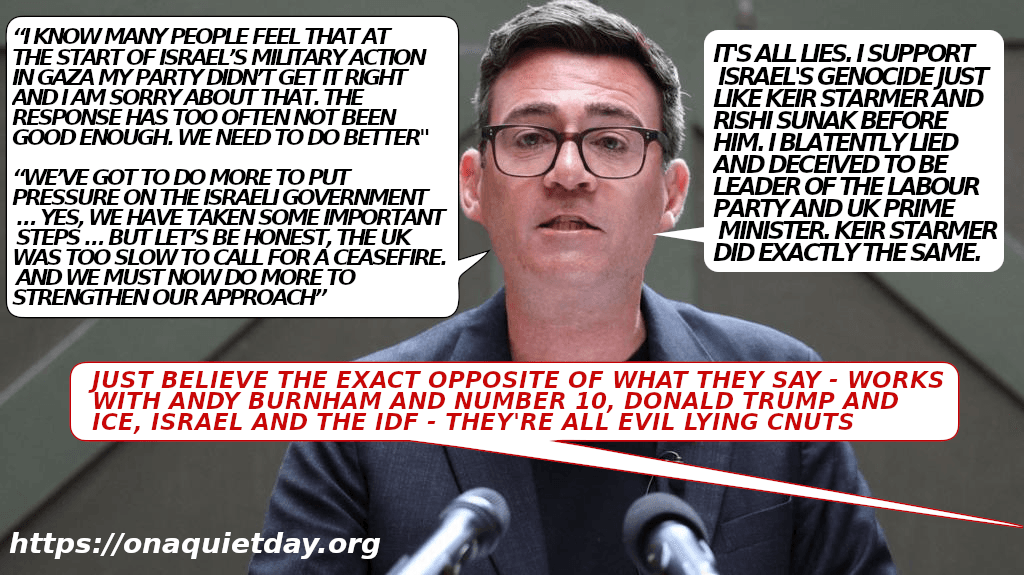
Keir Starmer objects to criticism of the IDF. He asks how could anyone object to them starving people to death, forced marches like the Nazis did, bombing Gaza’s hospitals and universities, mass-murdering journalists, healthworkers and starving people queuing for food, killing and raping prisoners and murdering children. He calls for people to stop obstructing his genocide for Israel. New Labour UK Prime Minister Andy Burnham continues Labour party policy of active support and complicity in Israel’s genocide.UK Prime Minister Andy Burnham admits to blatently lying and engaging in deception to become leader of the UK Labour Party and Prime Minister.Ed Miliband says that he and the Labour Party are full of shit criminalising people holding signs as terrorists despite anything he says.
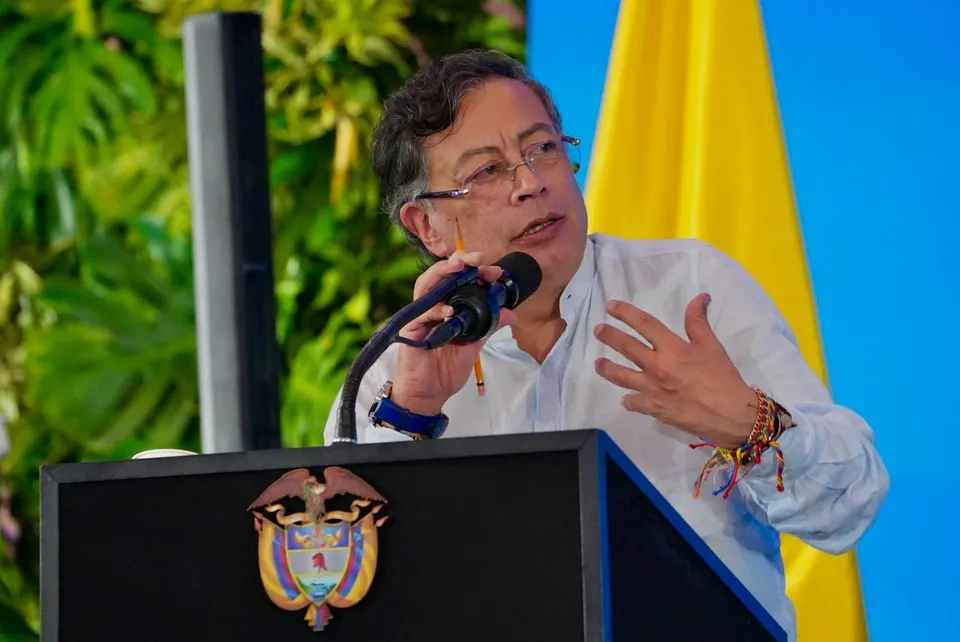
Colombian President Gustavo Petro speaks at the First Conference on the Transition Beyond Fossil Fuels | Colombian Ministry of the Environment
Nearly 60 countries launch coalition to accelerate the energy transition against the backdrop of the blockade of the Strait of Hormuz
SANTA MARTA, COLOMBIA — As the US and Israeli war against Iran puts oil at the centre of global concerns, a new intergovernmental coalition is seeking to accelerate the energy transition outside the UN’s climate change convention (COP) system, which has been trying – and failing – to phase out fossil fuels for three decades.
The coalition’s 57 members, who account for almost half of global GDP, met last week in the Colombian coastal city of Santa Marta for the First Conference on the Just Transition Away from Fossil Fuels, co-hosted by the governments of Colombia and the Netherlands.
Colombian President Gustavo Petro said the initiative was established after COP30 ended in November with no concrete resolution on phasing out the use of fossil fuels, which account for 75% of global greenhouse emissions. Since then, it has only been made more urgent by the oil crisis created by the Iran war.
“The ongoing disruptions due to the hostilities in the Strait of Hormuz have underlined that reducing fossil fuel dependencies is critical. It is essential to keep our planet livable, to safeguard energy security, and to build economic resilience to volatile fossil fuel markets,” states the conference’s final communiqué.
Rather than duplicating COPs’ efforts to establish new greenhouse gas reduction targets, the coalition agreed “to advance and accelerate the implementation of agreed goals” by applying pressure and strengthening international alliances within the multilateral negotiations adopted by consensus, the text says.
The conference was significant for its discussions on what “the consequences of decarbonisation” mean for oil exporters, said Susana Muhamad, Colombia’s ambassador for the initiative to create aFossil Fuel Non-Proliferation Treaty. It was the first time such conversations have been had at “a diplomatic forum on climate issues”.
“The fact that a country like Nigeria [which depends on crude oil exports] is here at a high level is very important, because they are not necessarily saying we are going to stick with oil until the end, whatever the cost,” she told openDemocracy. “They are recognising the vulnerability of being economically dependent on those exports.”
This need for economic freedom from oil was recognised by President Petro. “Can capitalism adapt to an energy system that is not fossil-based?” he asked an auditorium of delegates from participant countries, including Brazil, Mexico, Nigeria, the United Kingdom, France and the European Union as a bloc, as well as small island states in the Caribbean and the South Pacific.
Noticeably absent were representatives of the United States and China – the world’s two biggest carbon emitters – as well as Russia and India, all of whom were deliberately not invited to avoid the kind of deadlocks and obstructionism that led to the blocking of efforts to create a roadmap to phase out fossil fuels at COP30.
“When you make a plan, you first call your closest friends, and then you send the invitation to the rest,” Juan Carlos Monterrey Gómez, Panama’s Ministry of the Environment’s special representative for climate change, told openDemocracy.
Monterrey Gómez said the initial focus was instead on strengthening a group of countries committed to phasing out fossil fuels. “With this first group, we can have an honest conversation, without administrative roadblocks. This conversation has never taken place before, and that is historic.”
Other attendees had mixed feelings about the invite list.
While Claudio Angelo, an international policy coordinator at the Climate Observatory, a network of Brazilian environmental organisations, agreed that inviting Donald Trump’s climate-denying US administration would have been “unnecessary”, he told openDemocracy: “China should be here, as it supplies renewable energy technology to the whole world.”
‘Oil is nobody’s friend’
As well as the official delegates, the conference was attended by representatives of social movements, academia, multilateral institutions, parliaments, trade unions, Indigenous and Afro-descendant peoples, women and diverse communities, the private sector, farmers, NGOs, children and young people.
In the days leading up to the event, Santa Marta hosted scientific and civil society debates, where activists and Indigenous peoples urged governments to accelerate the energy transition.
Their calls came as a new report by 350.org, a global grassroots movement to accelerate the transition away from fossil fuels, found that consumerspay three times for fossil fuels: through public subsidies, on their bills, and through the natural disasters that are a direct consequence of the climate crisis.
“Oil is nobody’s friend,” said Angelo, noting that the international community has viewed the energy transition more favourably as solar and wind technologies have become more accessible over the past decade. Installed capacity of renewable energy was 50% higher last year than in 2023 and almost all new energy demand is being met by renewable sources, according to thefinal communiqué of the meeting.
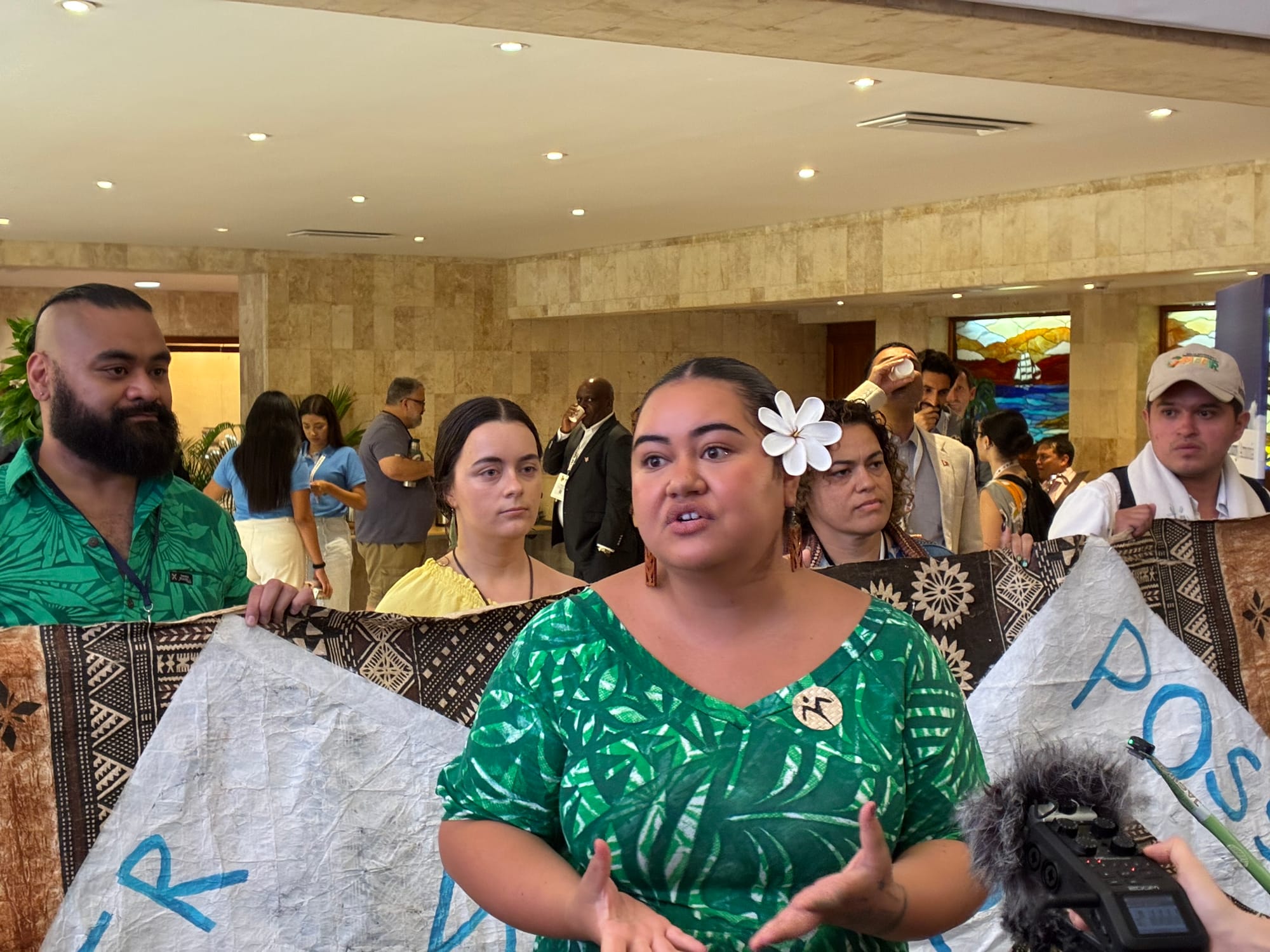
Samoan activist Brianna Fruean at a demonstration held at the conference venue | Julián Reingold/openDemocracy
For Colombian environment minister Irene Vélez Torres and Stientje van Veldhoven, the Dutch minister for climate and green growth, the event marked the beginning of a new era of global environmental democracy.
“This new method of dialogue between civil society, parliamentarians and governments represents a new multilateral collective force that is not bound by consensus and is led by women,” Torres said at the conference’s close. Veldhoven agreed, saying the meeting was the first step towards a proactive coalition of governments that do not negotiate, as happens at the UN, but rather collaborate with one another.
At the conference, civil society and governments agreed on steps to address the inequalities in the energy transition, which is taking place primarily in the Global North, rather than in countries where it is most needed but that lack the financing for green energy. These included drafting national road maps for the phase-out of fossil fuels, in addition to the global road map that will be discussed at COP31 this year.
“This is a contribution towards resolving common and interdependent problems through dialogue, discussion and cooperation, rather than through military means,” said Muhamad, who was Colombia’s Environment Minister until early 2025.
Harjeet Singh, the founder and director of the India-based Satat Sampada Climate Foundation that advocates for global climate justice, said the war in Iran has opened people’s eyes to the vulnerability inherent in dependence on fossil fuels.
“In a recent statement, India’s road and transport minister said that the era of diesel and petrol vehicles is over. It’s all about clean fuels, biofuels and electric vehicles,” Singh told openDemocracy.
But this realisation is meaningless without “international cooperation in green finance”, he said, noting that India self-funds 80% of its climate initiatives despite being a part of the Global South – and needs trillions more dollars for its transition away from fossil fuels.
Democracy, climate denialism and the future
Carlos Nobre, a researcher at the University of São Paulo and a member of the scientific panel for aGlobal Energy Transition, highlighted the risk that citizens might elect leaders who deny climate change. This is a particularly pressing worry in Amazonian countries such as Brazil, Colombia and Peru, where far-right parties that deny the climate crisis or are committed to expanding fossil fuels stand a chance of winning presidential elections taking place this year.
“It is not just that the far right seeks to maintain dependence on fossil fuels, but that they also intend to push ahead with deforestation and the removal of protections for indigenous peoples. We must not head towards ecocide, that is, ecological suicide,” said Nobre in an interview with openDemocracy.
Colombia remains the world’s deadliest country for environmental activists – an issue that must be addressed at the election on 31 May and can serve as a gateway to discussing wider environmental policies, says Liberal Party congressman Juan Carlos Losada, a member of Colombia’s Parliamentarians for a Fossil-Fuel-Free Future network.
Losada believes the candidate of the ruling left-wing Historic Pact coalition, Iván Cepeda, “will clearly prioritise the defence of human rights at a local level, and other issues will fall under that umbrella”. Polls currently suggest Cepeda will lead the election’s first round, although most analysts believe he is unlikely to reach the 50% threshold needed to win outright.
The other presidential candidates say “that if they come to power, they’ll go all out to extract every last bit of what exists,” Losada said, referring to the right’s proposals to intensify coal mining and introduce fracking.
“The debate on energy security has changed, and fossil fuels are seen as part of the insecurity issue,” said Brazilian Ana Toni, the executive director of COP30, noting: “It’ll be interesting to see how different actors act from now on.”
Speaking to openDemocracy at a press conference, Toni acknowledged the contradictions facing even climate-conscious governments, such as Brazil’s. “I don’t know if this conference is going to change the mind of Petrobras and its exploration plans,” she said, referring to Brazil’s state-owned oil company, whichlast year obtained permission for new exploration 500 kilometres from the mouth of the Amazon, days before world leaders met to debate the climate crisis at COP30.
“But it is changing the mind of many people in many countries,” she argued, noting that a move away from fossil fuels is becoming more popular as wars, supply shocks and extreme weather events expose the risk of oil and gas dependence. “When we talk about the transition, we do it not just because of climate change but also because of energy and economic security, and peace.”
These risks will be on full display at next year’s conference, where delegates will visit one of the countries most threatened by rising sea levels: Tuvalu, a South Pacific island nation that is co-hosting the second conference with Ireland.
“We, the small Pacific Islands, have no choice but to be ambitious,” said Brianna Fruean, a climate activist from Samoa, at a rally during the Colombian conference. “The next summit in Tuvalu will put faces to our countries and bring world leaders to the frontline of the climate crisis.”
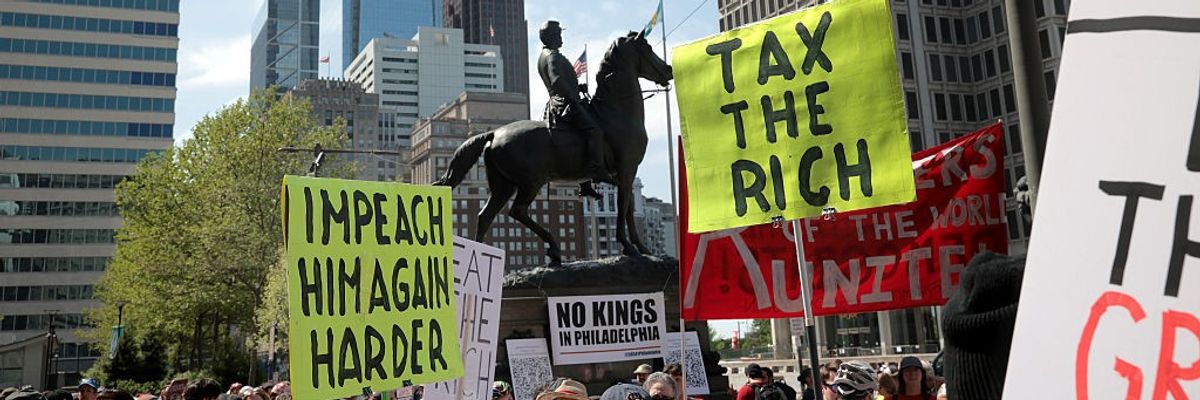
Supporters rally ahead of a Sen. Bernie Sanders (I-Vt.) May Day rally at City Hall on May 1, 2025 in Philadelphia, Pennsylvania. (Photo by Kayla Bartkowski/Getty Images)
“As the US braces for more extreme heat, wildfires, and hurricanes, the Trump administration has been systematically defunding our communities to give handouts to billionaires,” said one organizer.
A broad coalition of progressive organizations on Thursday announced that they are uniting for a mass mobilization event aimed at taking on the billionaire class.
The upcoming Make Billionaires Pay marches, scheduled to occur nationwide on September 20, link together multiple crises—ranging from authoritarianism to the climate emergency to US President Donald Trump’s mass deportations—by pointing the finger at the ultra-wealthy oligarchs who have been supporting them all.
Candice Fortin, US campaign manager for climate action organization 350.org, said that billionaires are the connective tissue that links together the major problems currently facing the United States and the world.
“This isn’t a new story—billionaires have always prioritized profit over people,” Fortin said. “This is a system working exactly as it was designed, but now without even the pretense of justice. As the US braces for more extreme heat, wildfires, and hurricanes, the Trump administration has been systematically defunding our communities to give handouts to billionaires. They’re dismantling our democracy, attacking immigrants, and feeding the war profiteers.”
Tamika Middleton, managing director for Women’s March, also emphasized that today’s crises are closely linked together.
“Women, migrants, queer and trans people, and communities of color have long been at the center of overlapping crises, from climate disaster to economic injustice to gender-based violence and forced displacement,” she said. “These are not separate struggles; they stem from a global system designed by billionaires who exploit our struggles to maintain power.”
Organizers said that these planned actions will focus on advocating for taxing extreme wealth, ending Trump’s mass deportation program, and transitioning from fossil fuels to renewable energy.
The marches are being convened by Desis Rising Up and Moving (DRUM), Women’s March, Climate Defenders, and 350.org, and more than 100 other organizations have endorsed them so far.
The flagship march is set to take place in New York City at the same time the 2025 United Nations General Assembly will be taking place. Other marches are set to occur simultaneously across the country.
Orcas discuss Donald Trump and the killer apes’ concept of democracy. Front Orca warns that Trump is crashing his country’s economy and that everything he does he does for the fantastically wealthy.Donald Trump urges you to be a Climate Science denier like him. He says that he makes millions and millions for destroying the planet, Burn, Baby, Burn and Flood, Baby, Flood.Elon Musk urges you to be a Fascist like him, says that you can ignore facts and reality then.
Thousands of demonstrators rally against the Trump administration in Chicago, Illinois, on April 19, 2025. (Photo: Jacek Boczarski/Anadolu via Getty Images)
“When any of our organizations are unjustly targeted, we will stand as a unified coalition,” the groups said. “An attack on one is an attack on all.”
A coalition of 75 civil rights groups on Monday responded to U.S. President Donald Trump’s “escalating threats and actions” targeting nonprofit organizations by launching “The Pact: A Civil Rights Coalition Unity Commitment.”
Led by the Leadership Conference on Civil and Human Rights, the groups represent “millions of people of every background in every ZIP code across America, exist to serve our communities, protect rights, and advance opportunity for all,” the pact explains. “Today we face a campaign by the government to silence and isolate us, stop us from doing our jobs, and hurt the people we serve.”
“The administration has made clear it will attack organizations that speak truth to power, defend the vulnerable, petition and sue the government, preserve and share knowledge, and fight for our freedoms,” notes the statement, which came amid rumors of an attack on climate groups’ tax-exempt status and after a GOP-led effort in Congress attacking anti-genocide campaigners. “They want us to fight alone, hoping we’ll stay silent as others are targeted. Not us.”
“The administration has made clear it will attack organizations that speak truth to power, defend the vulnerable, petition and sue the government, preserve and share knowledge, and fight for our freedoms.”
“Today, we commit to stay united in our shared vision for opportunity, prosperity, dignity, belonging, and for the rights and justice necessary to ensure them,” the coalition declared. “We represent people who are Black, White, Latino, Asian, and Indigenous, from cities, suburbs, and rural communities, people with disabilities, LGBTQ+ people, workers, women, immigrants, and people of all ethnicities, faiths, ages, and backgrounds.”
Signatories are focused on issues including quality healthcare, fair wages and working conditions, “freedom to learn our full history and celebrate our cultures,” quality education, affordable housing, a just justice system, clean air and water, voting rights, discrimination protection, family care, hunger prevention, reproductive freedom, and privacy.
The coalition includes the American Federation of Teachers, Arab American Institute, Bend the Arc: Jewish Action, Brennan Center for Justice, Common Cause, Disability Rights Education and Defense Fund, Lambda Legal, Lawyers’ Committee for Civil Rights Under Law, League of United Latin American Citizens, National Women’s Law Center, Oxfam America, Public Citizen, Reproductive Freedom for All, and others.
“The government is targeting organizations that help people assert their rights and access basic services,” the pact states. “They want to operate without oversight or consequences as they dismantle and privatize public services, attack government workers, and concentrate even more profit and power in the hands of the wealthy.”
“We have witnessed outrageous attacks on our work,” the statement continues, citing investigations of nonprofits, terminated grants, law firms fearing retribution, threats to revoke tax-exempt status, and the weaponization of civil rights laws. “We will not be divided. We will not be intimidated into silence or abandoning our communities.”
The coalition members pledged:
When any of our organizations are unjustly targeted, we will stand as a unified coalition. An attack on one is an attack on all.
We will share knowledge, resources, and support with any organization threatened by abuses of power.
We will not abandon our missions or self-censor out of fear. The people we serve depend on us now more than ever.
In addition to the pact, the groups shared a pledge that supporters can sign, a mobilization calendar, and an open letter to the American people, which says that “the Trump administration is intentionally attacking any business; law firm; college, university, or school; and organization or government watchdog that disagrees with its policies or challenges its abuses and corruption. And it is scaring into silence legitimate, lawful demands and legal challenges, which are fundamental to our civil rights and our democracy.”
“Throughout our history, Americans have resisted power grabs that threaten our rights and freedoms,” the letter stresses. “Today, we must resist again—together.”
Neo-Fascist Climate Science Denier Donald Trump says Burn, Baby, Burn.Elon Musk urges you to be a Fascist like him, says that you can ignore facts and reality then.
Prime Minister Keir Starmer (centre) hosts the European leaders’ summit to discuss Ukraine, at Lancaster House, London, March 2, 2025
PEACE campaigners slammed the continued rise in British military spending today as Sir Keir Starmer said Britain was ready to send troops to police a Ukrainian peace.
The Prime Minister hosted a summit at London’s Lancaster House today with European leaders, Canadian Prime Minister Justin Trudeau, Turkish Foreign Minister Hakan Fidan, Nato secretary-general Mark Rutte and the presidents of the European Commission and European Council, all showing their support for Ukrainian President Volodymyr Zelensky, who also attended.
The summit followed an extraordinary row between Mr Zelensky, US President Donald Trump and Vice-President JD Vance last week at the White House.
The US was not represented at the summit — underlining the deepening rift between European leaders and Washington.
Sir Keir told leaders it was time for them to step up and continue to support Kiev and meet a “once in a generation moment” for the security of Europe.
After the meeting he said a “coalition of the willing” could be sent to Ukraine to police a ceasefire, with British “troops on the ground and planes in the air,” but acknowledged that not all countries present had been willing to commit. He did not say which had and which hadn’t.