U.S. Ambassador Robert Wood raises his hands to veto a draft resolution during a United Nations Security Council meeting at the U.N. headquarters in New York City on November 20, 2024. (Photo: Michael M. Santiago/Getty Images)
The U.S. government, said one human rights lawyer, “proves once again to the world that it is fully committed to the continuation of the genocide in Palestine.”
The Biden administration faced fierce criticism on Wednesday after using its veto power at the United Nations Security Council to block a resolution demanding an immediate, unconditional, and permanent cease-fire in Israel’s assault on the Gaza Strip.
The vetoed measure also called for all parties to implement a U.N. Security Council (UNSC) resolution passed in June—which would lead to the release of all hostages—and to enable Gaza civilians’ immediate access to basic services and humanitarian assistance.
Jess Peake, who directs the International and Comparative Law Program at the University of California, Los Angeles, condemned the U.S. decision as “absolutely unforgivable” while Nina Turner, a senior fellow at the Institute on Race, Power, and Political Economy, declared that “this is absurd.”
Mai El-Sadany, executive director of the Tahrir Institute for Middle East Policy in Washington, D.C., called it “yet another shameful abuse of the UNSC veto by the U.S. to perpetuate a war that violates U.S. law and U.S. international legal commitments.”
“Today’s message is clear to the Israeli occupying power—you may continue your genocide… with complete impunity.”
Human rights attorney Craig Mokhiber, who last year resigned as the New York director for the Office of the High Commissioner for Human Rights over the United Nations’ response to Gaza, said Wednesday that “the U.S. has just vetoed another cease-fire resolution in the U.N. Security Council, and, in doing so, proves once again to the world that it is fully committed to the continuation of the genocide in Palestine.”
Mokhiber also called for action at the United Nations General Assembly (UNGA), where there is no U.S. veto power.
“Even as we seek accountability for Israeli perpetrators, we must also seek accountability for complicit U.S. actors,” he said. “Israeli/U.S. impunity threatens the entire world. And the U.N. must now move to take concrete action in the UNGA.”
The 14-1 vote at the UNSC marked the fourth time the United States has blocked a Gaza resolution since Israel began its retaliation for the Hamas-led October 7, 2023 attack. All five permanent members of the Security Council—the U.S., the United Kingdom, Russia, France, and China—have veto power. The other seats are filled on a rotating basis and lack that authority.
The 10 nonpermanent members—Algeria, Ecuador, Guyana, Japan, Malta, Mozambique, Sierra Leone, Slovenia, South Korea, and Switzerland—were behind the push to pass this draft resolution. Those who supported it represent “the collective will” of the international community, Algerian Ambassador Amar Bendjama said after the vote, according to U.N. News.
“It is sad day for the Security Council, for the United Nations, and the international community as a whole,” Bendjama said, stressing that it has been “five months since the adoption of Resolution 2735, five months during which the Security Council remained idle—remained hand-tied.”
“Today’s message is clear to the Israeli occupying power—you may continue your genocide… with complete impunity. In this chamber—you enjoy immunity,” he added. “To the Palestinian people, another clear message—while the overwhelming majority of the world stands in solidarity with your plight, others remain indifferent to your suffering.”
Israel faces a South Africa-led genocide case at the International Court of Justice over its assault on Gaza, which as of Wednesday has killed at least 43,985 Palestinians, according to local officials. Another 104,092 people have been wounded, and most of the enclave’s 2.3 million residents have been repeatedly displaced as Israeli forces have devastated civilian infrastructure.
U.S. Ambassador Robert Wood said Wednesday that “we made clear throughout negotiations we could not support an unconditional cease-fire that failed to release the hostages.”
“This resolution abandoned that necessity,” he argued. “For that reason, the United States could not support it.”
The U.S. government has been widely accused of complicity in genocide for arming Israeli forces over the past 13 months—including by progressives in Congress. Sen. Bernie Sanders (I-Vt.) on Wednesday planned to force a vote on resolutions that would block American weapons sales to Israel on the grounds that they violate federal law.
Anti-AfD protest in Magdeburg. (Photo: via Standing Up Against Racism)
The German government has defied EU law by imposing border controls, while Green politicians decry “the poison of Islam” in parliament. Meanwhile, the far-right AfD has surged in recent state elections. What’s driving Germany’s sharp shift to the right?
Germany is entering a period of reaction. This is not only evident from the rise of the far-right Alternative for Germany (Alternative für Deutschland, AfD), but also from the hardline policies of the governing coalition’s so-called centrist parties. The Social Democrats (SPD), Greens, and Liberal Democrats (FDP) have introduced unprecedented measures against migrants and critics of state policies. In September 2024, Federal Interior Minister Nancy Faeser (SPD) imposed border controls, defying European criticism and undermining the EU’s Schengen Agreement. Political scientist Christopher Wratil of the University of Vienna said that Berlin can “no longer claim others are not complying with EU law,” adding that the government is acting “as if the AfD were already in power.” Soon after Faeser’s announcement, Green parliamentary leader Katharina Dröge referred to “the poison of Islam” (das Gift des Islams) during a Bundestag session.
Germany challenged on multiple fronts
To explain this drastic rightward shift, it is necessary to understand the international situation confronting Germany’s ruling class. There are three main fronts on which the German state is currently bogged down.
Firstly, in Ukraine, where NATO’s confrontation with Russia is stalling, if not collapsing entirely. As the second-largest backer of the Zelensky regime, Berlin remains fully committed to winning the war. The government’s July 2024 decision to approve the stationing of US Tomahawk cruise missiles on German soil confirms this. Sanctions on Russia have strained the German economy, especially energy-intensive industries, but the state has absorbed much of the burden through subsidies. The Federation of German Industries, representing 100,000 companies, continues to back the government’s policies. However, popular support for the war is crumbling, as recent EU and state elections show. The two parties most critical of arms deliveries to Ukraine – the AfD and the Sahra Wagenknecht Alliance for Reason and Justice (Bündnis Sahra Wagenknecht, BSW) – made record gains, while the governing coalition suffered heavy losses.
The second front, not yet erupted into open conflict, is East Asia, in the confrontation with China. German capital faces the same dilemma as its US counterpart: while business with China remains lucrative, Chinese producers are outpacing American and European competitors, challenging Western hegemony. Germany has been more reserved than the US in taking a confrontational stance, but the government’s plan to invest 10 billion euros into a 30-billion-euro Intel chip production project in Germany shows its intent to reduce reliance on China. Meanwhile, the Green foreign minister, who called Xi Jinping a “dictator” in 2023, has led a cross-party effort to instrumentalize Taiwan against Beijing. The Ministry of Defense’s recent decision to send a warship through the Taiwan Strait is the latest move in this confrontational policy.
The third front is West Asia, where Germany remains the most outspoken advocate of Israel’s genocidal offensive in Gaza. Unlike the other fronts, there are no economic concerns holding German capital back from fully supporting Israel. This unified stance on Zionism and opposition to the so-called axis of resistance has allowed the government to swiftly implement policies against the Palestinian solidarity movement. While smearing protesters as antisemitic, basic rights such as freedom of assembly and speech are thrown out of the window. Homes are raided, activists arrested, solidarity organizations banned, and laws tightened—most recently with the liberal FDP calling to strip non-EU citizens of the right to assembly. Yet, the Western-backed offensive in Gaza has also stalled, with Israel unable to eliminate Hamas. Domestically, Germany uses force to suppress dissent, but it cannot do so internationally. States from the Global South are openly challenging Germany’s unconditional support for Israel. Namibia accused Berlin of supporting genocide while shirking responsibility for colonial crimes. Nicaragua has filed a case against Germany in the International Court of Justice, accusing it of violating the 1949 Genocide Convention. Others, like Malaysian Prime Minister Anwar Ibrahim, have directly confronted German politicians: “Where have we thrown away our humanity? Why this hypocrisy?”
The escalations on these fronts, along with rising domestic discontent, are fueling insecurity among Germany’s ruling class. A shift to the right is seen as necessary to capture broad sections of the population, keep them integrated into the system, and conjure scapegoats. The consistent messaging around the “Russian threat” and “Islamic terrorism” is used to justify massive military spending, cuts to social programs, and sweeping surveillance laws, including the right to secretly invade private homes. Meanwhile, migrants are blamed for housing shortages and the collapse of the healthcare system.
The collapse of the governing parties in eastern Germany
Elections for two state governments in eastern Germany made international headlines in August 2024 after the far-right AfD made massive gains, even becoming the strongest political force in Thuringia, where it led by almost 10%. There are several reasons for the far-right’s success.
Firstly, there is the historical trajectory of the post-1989 era. Over 30 years have passed since the socialist German Democratic Republic (GDR) was incorporated into the Federal Republic, yet West German promises of “blossoming landscapes” remain unfulfilled. The privatization of the East German economy was the largest wealth transfer in European history: millions lost their jobs and were deprived of their rightful shares in the public property they had built. This left East Germans with little to pass to their children. Almost all key positions in the state and economy were taken by West Germans. Deindustrialization led to higher unemployment, lower incomes, and longer working hours compared to the West. The result was a mass exodus, with nearly 4 million people moving westward since 1989 to escape the bleakness.
The East German population has essentially been relegated to second-class citizens in the Federal Republic. This has fostered a general distrust of Western political parties, whose approach has often been to “educate” rather than represent the East: “Your system lost, you have lost, so we will show you how it’s done.” The natural rejection of this condescending, paternalistic attitude has long been reflected in voter support for anti-establishment parties like The Left (Die Linke) and, more recently, the far-right AfD.
While The Left enjoyed broad support in the early 2000s for opposing the neoliberalization of the labor market, it gradually fell out of favor after joining regional and city governments, where it helped implement the same neoliberal policies it once opposed (such as the privatization of public housing in Berlin). This created a political vacuum in which the AfD was able to present itself as the only oppositional force, despite being a neoliberal party. The AfD taps into the economic and social challenges people face, blaming migrants or incompetent politicians in Berlin rather than the economic system itself. It has been especially successful among skilled laborers and small business owners—those most threatened by, or fearful of, social degradation.
This dynamic, which had already been unfolding for several years – was accelerated by the escalation of the Ukraine war in 2022. The question of arms deliveries to Kiev now played a central role in political debates.
The EU elections in June 2024 – in which the whole country participated – showed that Germans are dissatisfied with the governing coalition (SPD, Greens, and liberal FDP). Voters are now turning to the conservative CDU and far-right AfD, both of which call for tougher social cuts in response to current crises. The AfD gained nearly 5%, becoming the second-largest German party in the EU parliament, surpassing even the SPD. While the AfD has criticized further arms deliveries to Ukraine, it does not oppose NATO or the ongoing militarization in Germany. Many likely voted for the AfD due to its demagoguery on Ukraine, particularly calls to end the war with Russia. Polls from September 2024 show more Germans now oppose further arms deliveries to Ukraine (51%) than support them (38%), and 52% believe diplomatic efforts for peace have been insufficient. The BSW, a new party that split from The Left in 2023, centered this issue in its campaign and secured 6% of the national vote in the EU elections.
The two state elections in August 2024 further revealed that consensus around the Ukraine war effort is breaking down, especially in eastern Germany. All three governing parties lost votes, while the AfD and BSW made record gains. The Left, which had been the strongest party in Thuringia and supported arms deliveries to Ukraine, lost nearly 18% and was overtaken by the BSW. The AfD is now the largest party in Thuringia, winning almost a third of the vote. In Saxony, the AfD came close, with 30.6% compared to the CDU’s 31.9%. Notably, the CDU leader in Saxony has broken from the party’s line, calling for an end to arms deliveries and diplomatic negotiations with Russia.
The successes of the AfD and BSW have left the two eastern German states without a clear path forward. All parties currently refuse to form coalitions with the far-right AfD. While mainstream parties have derided the BSW as the “long arm of the Kremlin,” they also acknowledge the need to contend with this new party. Wagenknecht has stated that the BSW will only join coalitions with parties that oppose the stationing of US Tomahawk cruise missiles in Germany—a largely symbolic stance, as state governments have no control over this decision. More concerning for centrist parties is the disintegration of the political landscape, which could allow the opposition to block decisions requiring a two-thirds majority, including the election of constitutional judges. There is a palpable angst that minority parties in federal and state parliaments could “shut down” Germany’s constitutional courts.
Dark prospects
The upsets in eastern Germany are driven, at least in part, by dissent over NATO’s war effort against Russia. Both the AfD and BSW, from different perspectives, argue that supplying more weapons to Ukraine is not in Germany’s “national interest.” This domestic dissent, coupled with military setbacks in Donbass, is clearly causing doubts within the governing coalition. Just days after the elections in Thuringia and Saxony, Chancellor Olaf Scholz (SPD) expressed support for diplomatic negotiations with Moscow to “discuss how we can move from this war situation towards peace more quickly.”
While the German ruling class grapples with the Ukraine dilemma, its commitment to militarizing society remains strong. In this endeavor, the AfD does not stand in its way. Although the far-right party differs on issues like the war against Russia, relations with the USA, and the future of the EU, it poses no threat to German capital. On the contrary, centrist parties can mask themselves as an anti-fascist bulwark, rallying much of the population (including many on the left) around the slogan of “stopping the AfD,” while simultaneously enacting similarly racist and inflammatory policies toward migrants.
Asylum seekers are once again being deported back to Afghanistan, in flagrant disregard of the EU’s own human rights convention. Even “liking” certain social media posts warrants deportation, according to Interior Minister Nancy Faeser (SPD). At the same time, the German government is ramping up its “brain drain” strategy against the Global South. Just a few days after ordering controls on all of Germany’s borders, Faeser signed an agreement with the Kenyan government to make it easier for Germany to poach Kenyan professionals. A similar agreement with Uzbekistan followed a week later.
Germany’s increasingly aggressive neo-colonial policies abroad and its ever-more repressive policies at home are thus two sides of the same coin.
‘Hastings three’ pursued criminally next week for General Dynamics protest
Three local men, one of them a pensioner, go on trial next Tuesday, 27 August, at Hastings Magistrates Court on charges of aggravated trespass for taking part in a peaceful demonstration at a local arms factory in February.
The ‘Hastings3’ took part in the cross-community demonstration outside the General Dynamics site on Sidley Little Road on 29 February, supported by representatives of Jewish groups, Quakers, trade union bodies, parent groups and political parties. Demonstrators held placards, sung songs calling for a ceasefire in Gaza and handed out leaflets – but several were roughly arrested and dragged off to police vans.
Laurance Holden, 71, Clem McCullough, 31, and Thomas Delves, 24 will plead not guilty to the charges, which carry a maximum penalty of a fine of up to £2500 and a jail term of three months.
Hastings & District Palestine Solidarity Campaign chair Katy Colley said:
The pursuit of these men is clearly political and designed to deter peaceful protests. We have been demonstrating at General Dynamics consistently since the genocidal assault on Gaza began 10 months ago to draw attention to the merchants of death in our hometown complicit in these atrocities.
General Dynamics makes all the casings for the bombs being dropped on Gaza – their Hastings sites makes avionic and communication systems for fighter jets and combat vehicles used by the Israeli military.
Over 40,000 men women and children have been brutally slaughtered in what the world court has deemed a ‘plausible genocide’.
There is a clear legal imperative to stop arming Israel, as was underlined this week when British diplomat Mark Smith resigned on this point, saying it was clear to everyone that Israel was “flagrantly and regularly” perpetrating war crimes in plain sight.
And yet our government continues to issue export licenses to companies like General Dynamics, allowing Israel to continue its barbaric and murderous campaign against the trapped civilian population in Gaza.
The Hastings Three are brave, principled people who do not want our town to be complicit in war crimes. They are with the majority. Poll after poll show that most people want an end to arms sales to Israel immediately. We stand with them, the side of the people, the side of the law and the side of justice.
Dozens of supporters are expected to attend a protest rally at the Magistrates court from 9am in support of the three, and a benefit concert is being held in the evening to raise money for people in Gaza as well as money for court costs.
[S?]imon Hester, Chair of the Hastings & District TUC, said:
Protesting against genocide is not a crime. The Hastings and District Trades Union Council supports the Hastings 3 and demands an immediate end to arms sales to Israel.
Kathy Shapiro of Hastings Jews for Justice added:
Hastings Jews for Justice is outraged that the Hastings 3 are facing trial.
It is General Dynamics that should be on trial, not concerned citizens. As Jews of conscience we will continue to exercise our right and moral obligation to speak out against this criminal complicity until there is an arms embargo of Israel, a permanent ceasefire in Gaza, and justice and freedom for Palestinians.’
Leah Levane, Co-Chair of Jewish Voice for Labour (JVL), said:
The more than 10 months of carnage in Gaza demands a serious response. The ICJ decision makes stopping arms trading with Israel and obligation and these three people have been arrested for protesting in favor of International Law.
I am disappointed, to put it mildly, that the Court’s precious and expensive time is being used to try three men whose acts show their commitment to International Law as well as to justice for Palestinians and, of course, peace.’
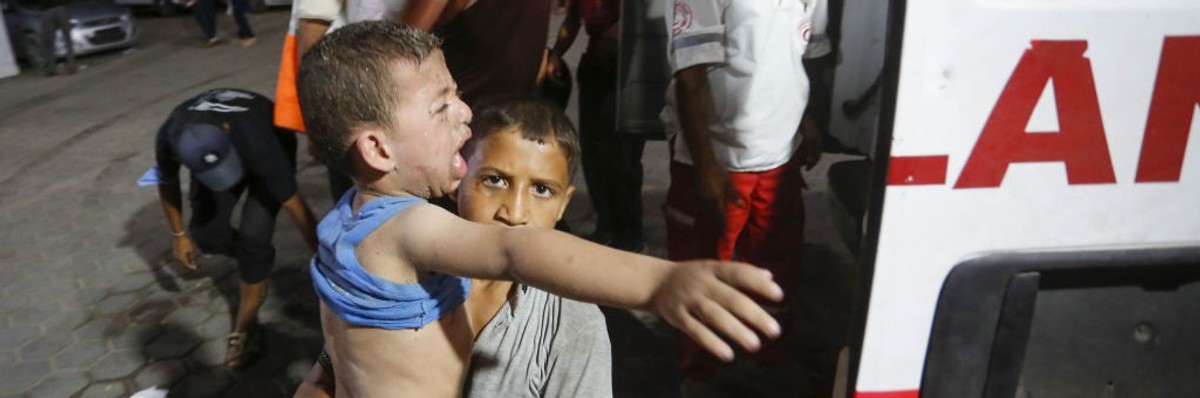
Injured Palestinians, including children, are brought to Al-Aqsa Martyrs Hospital for treatment after an Israeli attack on July 9, 2024 in Deir Al-Balah, Gaza. (Photo: Ashraf Amra/Anadolu via Getty Images)
While the report stresses that “Israel has an inherent right to defend itself,” a related press release doesn’t mention Gaza. One expert said, “I guess they left out the genocide they’re arming and funding.”
The Biden administration broadly and the State Department in particular have faced intense criticism throughout the U.S.-backed Israeli war on the Gaza Strip, and Wednesday was no exception, as an annual genocide report was sent to Congress.
The State Department report is required under the Elie Wiesel Genocide and Atrocities Prevention Act of 2018, named for a Holocaust survivor who wrote about his experiences at the Auschwitz and Buchenwald Nazi concentration camps.
A department press release explains that the report “details U.S. interagency efforts to address genocide, war crimes, and crimes against humanity around the world. It also chronicles whole-of-government work over the past year to promote atrocity prevention programs, protect civilians at risk, and hold perpetrators accountable in places where some of the most heinous crimes have been committed.”
“Our government cannot continue cherry-picking what war crimes and genocide they choose to acknowledge.”
The Intercept‘s Prem Thakker shared the department’s full three-paragraph statement about the report on social media and pointed out that the two nations mentioned are Sudan, where there is a civil war, and Ukraine, which is battling a Russian invasion.
Notably missing—though mentioned in the report—is Israel’s nine-month assault on Gaza, which has been enabled by U.S. diplomatic and weapons support, and is the subject of a South Africa-led genocide case before the International Court of Justice.
Responding to Thakker’s posts, Assal Rad, an expert in Middle East history, said, “I guess they left out the genocide they’re arming and funding.”
Justice Democrats declared: “This is shameful. Our government cannot continue cherry-picking what war crimes and genocide they choose to acknowledge—especially not when we’re the ones funding it.”
The 23-page report includes three paragraphs on Israel and Gaza:
Hamas is a brutal terrorist organization that has vowed to annihilate Israel and repeat the October 7, 2023 massacre, during which it murdered almost 1,200 Israelis, took more than 240 people hostage, and committed horrific acts of sexual violence. In response, Israel has engaged in military actions in Gaza with the stated intent of defending itself against future Hamas attacks. By the end of the reporting period, tens of thousands of Palestinians were killed and over a million displaced as a result of Israel’s military actions.
Israel has an inherent right to defend itself consistent with international law, in response to the October 7 attack, and the United States has made clear that Israel has a moral obligation and a strategic imperative to protect civilians, investigate allegations of any wrongdoing, and ensure accountability for any abuses or violations of international human rights law and violations of [international humanitarian law, or IHL]. As President [Joe] Biden stated in his 2024 State of the Union address: “Israel has an added burden because Hamas hides and operates among the civilian population. But Israel also has a fundamental responsibility to protect innocent civilians in Gaza. This war has taken a greater toll on innocent civilians than all previous wars in Gaza combined.” Secretary [of State Antony] Blinken has urged Israel to do everything possible to avoid civilian casualties and has consistently reiterated at the highest levels that Israel’s military operations in Gaza must comply with IHL.
The Department of State provides a variety of assistance for those impacted in Israel, the West Bank, and Gaza through U.N. Women, U.N. Food and Agriculture Organization, U.N. Development Program, U.N. Population Fund, U.N. Children’s Fund, Office for the U.N. High Commissioner for Human Rights, other U.N. agencies, and international organizations that operate in Israel and Gaza. Additionally, the Department of State hosted U.N. Special Representative of the Secretary-General on Sexual Violence in Conflict Pramila Patten in March to discuss her report and recommendations following her fact-finding visit to Israel and the West Bank regarding allegations of [gender-based violence].
As of Wednesday, Israel’s war has killed at least 38,243 people in Gaza and injured another 88,243, according to health officials in the Hamas-governed Palestinian enclave. Thousands more remain missing and presumed dead. Israeli forces have devastated civilian infrastructure, leaving a trail of bombed-out homes, hospitals, schools, and mosques.
In a letter published in the medical journal The Lancet last week, three public health experts wrote that “applying a conservative estimate of four indirect deaths per one direct death to the 37,396 deaths reported, it is not implausible to estimate that up to 186,000 or even more deaths could be attributable to the current conflict in Gaza.”
Matt Miller called out by @samhusseini for his ‘creepy smirking’ when he mentions the 10s of 1000s of Palestinian ppl massacred by the israelis pic.twitter.com/92vo7AQURI
Israel has also limited the flow of humanitarian aid into Gaza. Although the United Nations has not formally declared a famine, 10 top U.N. experts said Tuesday that “we declare that Israel’s intentional and targeted starvation campaign against the Palestinian people is a form of genocidal violence and has resulted in famine across all of Gaza.”
Since October, multiple U.S. government employees, including State Department officials, have resigned over the administration’s complicity in genocide, including weapons support—which the department previously addressed in a May report to Congress.
The May report—the release of which was blasted as a “Friday news dump”—says that it “is reasonable to assess” that U.S. weapons “have been used by Israeli security forces since October 7 in instances inconsistent with its IHL obligations or with established best practices for mitigating civilian harm,” but concludes that Israel can continue receiving arms support.
The earlier report also expresses “deep concerns” about Israel’s actions regarding relief efforts but states that “we do not currently assess that the Israeli government is prohibiting or otherwise restricting the transport or delivery of U.S. humanitarian assistance within the meaning of Section 620I of the Foreign Assistance Act.”
Wow, watch this
Reporter: IPC report says 96% of Gaza faces acute food insecurity, US continues to be biggest funder of 🇮🇱 military and US law says any country receiving support can’t obstruct flow of aid. Every major rights group says 🇮🇱 is using starvation as a tactic of war,… pic.twitter.com/z8WmBuxPk0
Later that month, Stacy Gilbert, one of the State Department officials who resigned, said that “there is consensus among the humanitarian community” that Israel has obstructed relief efforts, adding: “That’s why I object to that report saying that Israel is not blocking humanitarian assistance. That is patently false.”
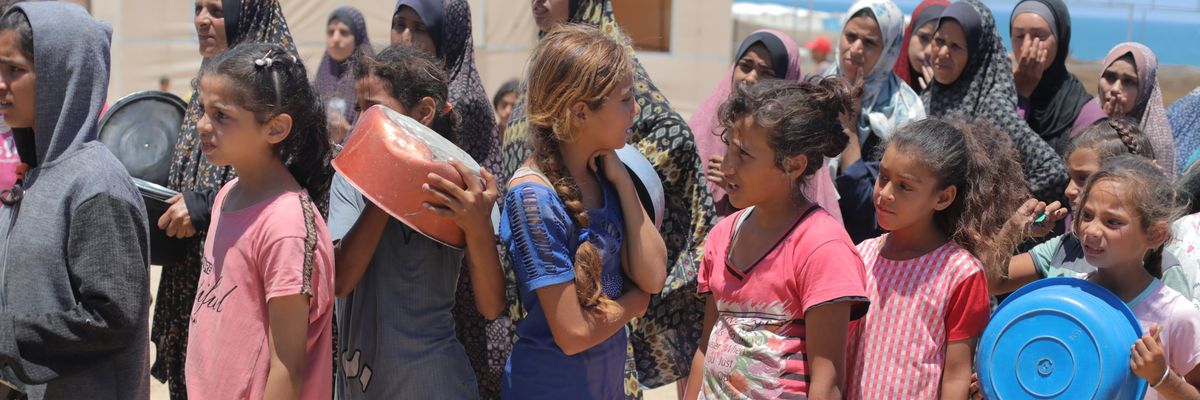
Palestinians wait in line to receive food distributed by charitable organizations amid Israeli attacks in Deir Al-Balah, Gaza on May 28, 2024. (Photo: Hassan Jedi/Anadolu via Getty Images)
“The fact that Israel is using starvation as a weapon of war in Gaza is not in contention,” said a Human Rights Watch researcher.
U.S. President Joe Biden said in an interview published Tuesday that he does not believe the Israeli government is using starvation as a weapon of warfare in Gaza, contradicting the findings of leading human rights organizations that have documented Israel’s deliberate obstruction of food aid as Palestinians die of malnutrition.
“No, I don’t think that,” Biden said in response to TIME magazine’s Washington bureau chief Massimo Calabresi and editor-in-chief Sam Jacobs, who noted some have “alleged that Israel is intentionally using starvation of civilians as a method of warfare.”
The president, who has approved more than 100 arms sales to Israel during its eight-month assault on the Gaza Strip, acknowledged that Israel’s military has “engaged in activity that is inappropriate” and that “Palestinians have suffered greatly.”
But he stopped well short of the conclusions reached by Oxfam International, Human Rights Watch (HRW), and the International Criminal Court, which recently applied for arrest warrants against Israeli Prime Minister Benjamin Netanyahu and Defense Minister Yoav Gallant for their role in the “starvation of civilians as a method of warfare” and other war crimes.
The U.S. Agency for International Development has also determined that Israel has unlawfully impeded the delivery of humanitarian assistance to Gaza, leading to a “deterioration of food security and nutrition in Gaza [that] is unprecedented in modern history.”
“The fact that Israel is using starvation as a weapon of war in Gaza is not in contention. It is clear as day,” Hiba Zayadin, a researcher at HRW, wrote in response to Biden’s TIME interview, pointing to her group’s December report that found the Israeli military was “deliberately blocking the delivery of water, food, and fuel, while willfully impeding humanitarian assistance, apparently razing agricultural areas, and depriving the civilian population of objects indispensable to their survival.”
“The evidence is even stronger today,” Zayadin added, citing HRW’s April report that focused specifically on the Israeli military’s starvation of Gaza children. Dozens of Palestinian kids, some just months old, have died of malnutrition since October, a figure that is almost certain to grow as Israel’s bombing campaign and ground offensive in Rafah continue.
The World Food Program said Wednesday that unless Israel’s assault on Gaza ends and desperately needed humanitarian aid is allowed to flow, more than a million people in the occupied enclave “are expected to face death and starvation… by mid-July.”
Humanitarian groups and experts—including an outspoken former U.S. State Department official—have argued that by continuing to arm Israel and provide it with diplomatic cover on the world stage, the Biden administration is complicit in Gaza’s increasingly dire hunger crisis.
“This is not just turning a blind eye to the man-made starvation of an entire population, it is direct complicity,” Josh Paul, who resigned from the State Department in October over the administration’s support for Israel’s assault on Gaza, told The Independent last month.
In a speech on the floor of the U.S. Senate earlier this week, Sen. Bernie Sanders (I-Vt.) displayed photos of emaciated children as he explained his decision to boycott Netanyahu’s upcoming speech to Congress.
“Blocking humanitarian aid and creating the conditions for famine is not only an act of extreme cruelty—using starvation as an act of war—but it is a violation of both American and international law,” Sanders added. “It is a war crime.”