Tag: constitutional crisis

  • US stands on the brink of a constitutional crisis as Donald Trump takes on America’s legal system

    Spread the love
    Neo-Fascist Climate Science Denier Donald Trump says Burn, Baby, Burn.
    Neo-Fascist Climate Science Denier Donald Trump says Burn, Baby, Burn.

    Anne Richardson Oakes, Birmingham City University

    As the 19th-century French political philosopher, Alexis de Tocqueville, memorably observed, Americans have a tendency to fight their political battles in court. Barely two months into his presidency, Donald Trump is demonstrating increasing frustration as trade unions, civil rights organisations and states attorneys general challenge the implementation of his policies with lawsuits alleging presidential overreach that undermines the constitutional separation of powers.

    More than 130 lawsuits are now pending. As a result, federal courts have put on hold key policies of the Trump administration and Trump lawyers have lodged emergency petitions invoking Supreme Court intervention.

    First to face court check was the federal funding freeze order. This was swiftly followed by court rulings against the birthright citizenship order. This controversial measure would withdraw citizenship for children born in the United States to undocumented or non-citizen parents who are in the country legally but temporarily.


    Sign up to receive our weekly World Affairs Briefing newsletter from The Conversation UK. Every Thursday we’ll bring you expert analysis of the big stories in international relations.


    Donald Trump decrees forbidden terms denying sexual diversity
    Donald Trump decrees forbidden terms denying sexual diversity. Image added by https://onaquietday.org

    Another court ruling has overturned the Pentagon’s ban on transgender people enlisting in the US armed forces. Yet another has blocked the Department of Government Efficiency’s (Doge’s) access to treasury department records containing the personal financial details of millions of Americans.

    This was blocked for the very fundamental grounds that this has not been authorised by Congress and is not within the scope of the presidential power. Whether Doge can even exist without Congressional authority is also in contention.

    The president’s increasing anger with the courts erupted on March 18. The US president launched an astonishing personal attack on a US federal judge who ruled against the summary deportation of alleged members of the Venezuelan Tren de Aragua gang and ordered the administration to turn around the plane carrying them that had already taken off.

    Donald Trump's post of TruthSocial calling for a judge to be impeached.
    The US president calls for a judge to be impeached. TruthSocial.

    Trump’s call for Judge James Boasberg to be impeached prompted a rare intervention from Supreme Court chief justice John Roberts. Roberts condemned the impeachment call in a statement that did not name the president but was clearly intended as a rebuke and a reminder of the constitutional boundaries that guarantee the role of the judiciary as the equal third branch of government.

    Unrepentant, Trump doubled down the next day on TruthSocial calling Judge Boasberg a “Radical Left Lunatic Judge” who wanted “to assume the role of president”. His charge was then echoed by White House press secretary Karoline Leavitt who accused the judiciary generally of attempting to paralyse the administration’s programme, usurp the power of the president and undermine the will of the American people.

    White House press secretary Karoline Leavitt on Judge James Boasberg.

    Despite Judge Boasberg’s order, the plane carrying the Venezuelans did not turn back. The administration has denied wrongdoing and Judge Boasberg has yet to impose any penalty.

    This was not the first occasion that the administration has appeared to openly defy court orders. The previous week Dr Raiza Alawieh, a Brown University professor with an American visa was deported despite an order from a federal judge in Boston requiring that the court be given advance notice before the government attempted to remove her.

    All eyes on the Supreme Court

    All these cases are likely to go to the US Supreme Court. As its name suggests, this is the highest level of the judiciary in the US. It has the final say on what the US constitution means and authorises. At issue will be the scope of the presidential power – and the outcome is uncertain.

    It’s important to bear in mind that the court now has a six-to-three majority of conservative justices – three of whom were Trump nominees. We also need to be aware that this court, in a previous ruling, considerably extended the scope of presidential immunity to cover all official “core acts” so that, whatever the outcome, the president himself is unlikely to attract personal liability.

    But we do know that the Supreme Court’s ruling on a constitutional issue is final – and that all government officials at federal and state level will be required to respect it. The fear now is that the administration may go ahead regardless in which case we will find ourselves in unknown constitutional territory.

    To find parallels we could go back to the desegregation era of the middle of the 20th century and specifically to Little Rock in Arkansas where the then governor, Orval Faubus, called out the national guard to prevent the court-ordered desegregation of the local high school.

    The ensuing crisis ended when the then president, Dwight D. Eisenhower, sent in federal troops to enforce the court order. The US Supreme Court unanimously declared that its interpretations of what the constitution required were the supreme law of the land, which bound the governor and the state legislature.

    The chief justice of that era, Earl Warren, later regarded this ruling (Cooper v Aaron) as the most important of his time on the Supreme Court – more important even than the actual desegregation decision itself (Brown v Board of Education).

    It is clear that the judicial branch depends upon the executive to put its orders into effect and demonstrate respect for the rule of law and the separation of powers. But we now see a president who demonstrates open hostility to judges whom he considers have opposed him. His administration has also begun to vindictively target with punitive blocking orders the big law firms who assisted in the prosecutions brought against him before he took office.

    Does a constitutional crisis loom? How all this plays out remains to be seen.

    Anne Richardson Oakes, Associate Professor and Director: Centre for American Legal Studies, Birmingham City University

    This article is republished from The Conversation under a Creative Commons license. Read the original article.

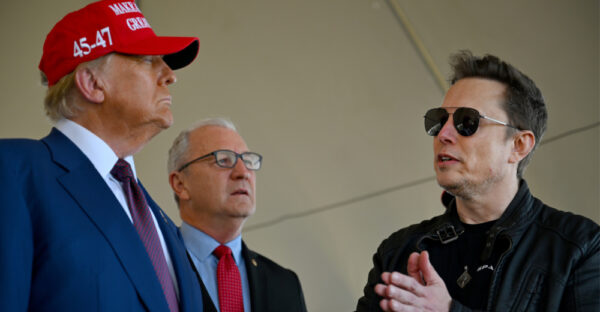
    Elon Musk urges you to be a Fascist like him, says that you can ignore facts and reality then.
    Elon Musk urges you to be a Fascist like him, says that you can ignore facts and reality then.
  • As Constitutional Crises Mount, US Press Sleepwalks Into Autocracy

    Spread the love

    Original article by Julie Hollar republished from FAIR under a Creative Commons Attribution-NonCommercial-NoDerivs 3.0 Unported License.

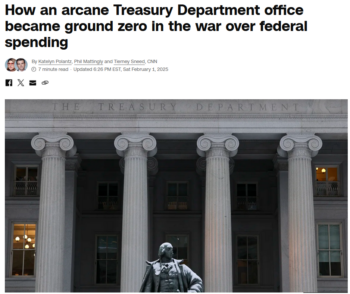
    CNN (1/31/25) framed Elon Musk’s extra-constitutional power grab as part of “the war over federal spending.”

    When President Donald Trump announced an unprecedented freeze on federal grants and loans last week, some of the most prominent US news outlets proved themselves largely uninterested in whether it was legal. Meanwhile, a few braver journalists called out the move as the constitutional crisis that it was (FAIR.org, 1/29/25).

    When Democratic attorneys general rushed to challenge the move in court, with positive results, Trump rescinded the order. But the crisis is hardly over.

    On the contrary: Elon Musk, the unelected centibillionaire who threw Nazi salutes at the inauguration, has wrested control of the Treasury Department’s payment system, after forcing out its most senior career civil servant, David Lebryk. As CNN (1/31/25) reported, the Treasury takeover happened after Trump’s team had repeatedly asked about the department’s ability to stop payments, to which Lebryk had insisted, “We don’t do that.”

    These payments include everything from Social Security checks to tax refunds, federal employee salaries to contractor payments. It’s over $5 trillion a year, a fifth of the US economy. The database Musk and his tech bro allies in the non–congressionally approved “Department of Government Efficiency” (DOGE) have access to also contains enormous amounts of sensitive personal information for most Americans, including Social Security numbers. And Musk and a 25-year-old former X employee have access to the code that controls the payment systems, allowing them to make irreversible changes to it, according to Wired (2/4/25).

    At the same time, Musk has infiltrated the General Services Administration and the Office of Personnel Management—two other rather obscure and nonpolitical but hugely consequential agencies that manage federal offices, technology and employees (Wired, 1/28/25, 1/31/25).

    ‘An idea that crosses party lines’

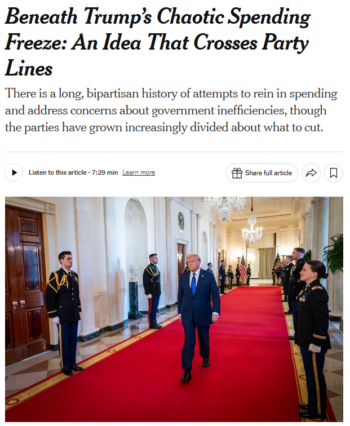
    The New York Times (1/31/25) put its seal of approval on Trump’s illegal attempt to freeze federal spending, calling the idea behind it “bipartisan.”

    Instead of appropriately pushing the increasing lawlessness and opacity to the forefront of their reporting, the New York Times and Washington Post largely buried these stories, downplaying their earth-shattering break from democratic norms.

    As Musk took over the Treasury system, the Times (1/31/25) did point out:

    Control of the system could give Mr. Musk’s allies the ability to unilaterally cut off money intended for federal workers, bondholders and companies, and open a new front in the Trump administration’s efforts to halt federal payments.

    And yet somehow this story struck editors as page 13 material.

    Meanwhile, a piece (1/31/25) by the Times‘ Michael Shear published online the same day was deemed front-page material, causing even seasoned media critics to spit out their morning beverage at its breathtaking ability to bothsides the situation: “Beneath Trump’s Chaotic Spending Freeze: An Idea That Crosses Party Lines.”

    Shear wrote that Trump is simply “continuing a mostly failed effort by a long series of presidents and Congress” to “somehow reverse the seemingly inexorable growth of the federal government, an issue that resonates with some Democrats as well as most Republicans.” He thus clearly communicated that he is not up for the task of reporting on this administration.

    The Times published Musk’s Treasury takeover on page 18, under the rather nonchalant headline: “Elon Musk’s Team Now Has Access to Treasury’s Payments System.” The subhead read:

    Treasury Secretary Scott Bessent gave Mr. Musk’s representatives at the so-called Department of Government Efficiency a powerful tool to monitor and potentially limit government spending.

    And hey, don’t worry, the article suggests:

    Mr. Musk’s initiative is intended to be part of a broader review of the payments system to allow improper payments to be scrutinized, and is not an effort to arbitrarily block individual payments, the people familiar with the matter said.

    At the Post, readers got language like, “The clash reflects an intensifying battle between Musk and the federal bureaucracy” (1/31/25), and “it is extremely unusual for anyone connected to political appointees to access” the payment systems (2/1/25). (In fact, it appears to be unprecedented—Independent, 2/3/25.)

    ‘Reminiscent of Stalin’

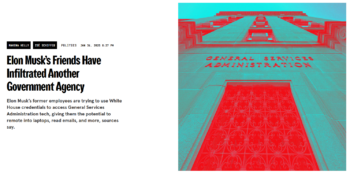
    Wired (1/31/25): Musk’s team is “attempting to use White House security credentials to gain unusual access to GSA tech, deploying a suite of new AI software, and recreating the office in X’s image.”

    There is another way to do journalism. It’s called connecting dots, asking questions, not accepting anonymous claims of benevolent intent—and helping people understand the gravity of the situation when unprecedented end-runs around democracy are happening before our very eyes. And it’s heartening to see quite a few news outlets engaging in it.

    For instance, Wired has been doing a tenacious job following Musk’s assault on the government, connecting the dots between his actions and explaining the dangers to the country. It broke the news (1/28/25) that Musk workers from his various companies had taken over management positions at the Office of Personnel Management—well before Trump’s nominee to take over the OPM has even had a confirmation hearing. Its subhead noted: “One expert found the takeover reminiscent of Stalin.”

    Wired explained that the installation of AI experts at OPM suggests a forthcoming effort to use AI on the reams of data it has access to in order to target federal employees for removal.

    Regarding the GSA infiltration, Wired reported (1/31/25):

    The access could give Musk’s proxies the ability to remote into laptops, listen in on meetings, read emails, among many other things, a former Biden official told Wired on Friday.

    “Granting DOGE staff, many of whom aren’t government employees, unfettered access to internal government systems and sensitive data poses a huge security risk to the federal government and to the American public,” the Biden official said. “Not only will DOGE be able to review procurement-sensitive information about major government contracts, it’ll also be able to actively surveil government employees.”

    Wired again put that danger (“the potential [for Musk minions] to remote into laptops, read emails, and more”) into its subhead—unlike the Times‘ muted headlines.

    ‘Incredibly dangerous’

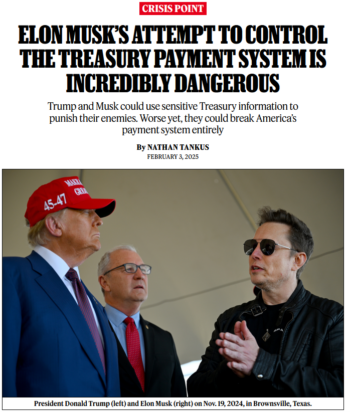
    Rolling Stone (2/3/25) pointed out that “the danger of operational access to the payments system is precisely that there are very little safeguards for its improper use or manipulation.”

    Others are also raising alarms in their headlines, as at Rolling Stone (2/3/25): “Elon Musk’s Attempt to Control the Treasury Payment System Is Incredibly Dangerous.” The subhead explained: “Trump and Musk could use sensitive Treasury information to punish their enemies. Worse yet, they could break America’s payment system entirely.”

    The piece, by Nathan Tankus, pointed out that there are glaring reasons to disbelieve administration claims about this being about “improper payments,” such as:

    At 3:14 a.m. Sunday, Musk pledged to shut down supposedly “illegal payments” to Global Refuge, a faith-based organization that exists to provide “safety and support to refugees, asylum seekers and immigrants from across the world.”

    Tankus also points out what the Post and Times won’t, which is that the seizure of the payment system means Trump and Musk

    can just impound agency payments themselves. They could also possibly stop paying federal employees they have forced on paid administrative leave, coercing them to resign.

    Even in bigger media, some critical voices could be heard. CNN‘s Zachary Wolf (2/1/25) asked some appropriate journalistic questions: “Has [Musk] taken an oath, like the federal workers he apparently has plans to fire, to uphold the Constitution?…. What are Musk’s conflicts of interests?”

    Accessories to the coup

    The Washington Post (2/4/25) assures readers that “the Education Department was created by Congress, and only Congress can eliminate it.”

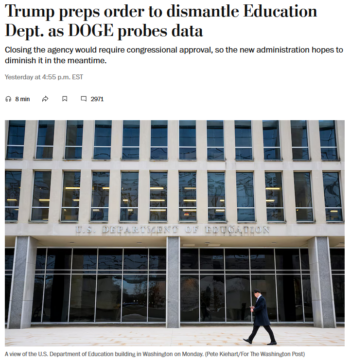
    The Washington Post put news about Musk’s takeovers on the front page today (2/4/25), as it reported on Trump preparing an executive order to dismantle the Department of Education, which Musk has apparently also infiltrated. But it still managed to sound rather sanguine about the threat: “The expected executive order would not shut down the agency, as there is widespread agreement in both parties that doing so would require congressional action.” Despite reporting daily on actions Trump and Musk have taken that have usurped congressional authority, the paper still seems to believe—and want readers to believe—against all evidence that our Constitution’s constraints on executive power continue to hold.

    And the New York Times finally published an article (2/3/25) taking a deeper look “Inside Musk’s Aggressive Incursion Into the Federal Government,” as the headline stated. Still, it seemed to find it difficult to use language in its early framing paragraphs any stronger than to say that Musk’s actions “have challenged congressional authority and potentially breached civil service protections,” as it explains in the third paragraph. These moves are “creating major upheaval,” the fifth paragraph allowed, and the sixth said it “represented an extraordinary flexing of power by a private individual.”

    The piece was not published in the print newspaper the next day; FAIR has yet to see it rise to the top of the paper’s homepage.

    As Musk and Trump continue to behave like kings, it’s incumbent upon news media to not just report on their actions, but put them in the proper context for the public to understand the threat level they represent; otherwise, we can’t respond appropriately.

    That kind of reporting takes real bravery in the kind of moment we are in: Musk has already (falsely) called it a crime to reveal the names of those working for him at the agencies DOGE is targeting, which Wired and others have done. The Trump-installed interim US attorney for DC has obsequiously promised Musk to go after those who identify his underlings—and to prosecute “anyone who impedes your work or threatens your people” (New Republic, 2/3/25).

    While that might sound laughable, media outlets have already paid Trump handsome settlements to settle lawsuits that should have been seen as similarly laughable (FAIR.org, 12/16/24; PBS, 1/29/25; New York Times, 1/30/25). When prominent news outlets won’t summon the courage to vigorously oppose this descent into autocracy, they are accessories to the coup. We must demand better from them, and support the outlets and journalists doing the critical work we as citizens require to defend our democracy.

    ACTION: Tell the New York Times and Washington Post to treat Musk’s actions like the existential threat to democracy that they are.

    CONTACT:

    New York Times
    Letters: letters@nytimes.com
    Bluesky: @NYTimes.com

    Washington Post
    Letters: letters@washpost.com,
    Bluesky: @washingtonpost.com

    Please remember that respectful communication is the most effective. Feel free to leave a copy of your message in the comments thread here.


    Correction (2/5/25): An earlier version of this article misstated the title of the official who threatened to prosecute those who revealed the names of DOGE employees. He is the interim US attorney for the District of Columbia.

    FAIR’s work is sustained by our generous contributors, who allow us to remain independent. Donate today to be a part of this important mission.

    Original article by Julie Hollar republished from FAIR under a Creative Commons Attribution-NonCommercial-NoDerivs 3.0 Unported License.

    Elon Musk urges you to be a Fascist like him, says that you can ignore facts and reality then.
    Elon Musk urges you to be a Fascist like him, says that you can ignore facts and reality then.
    Climate Science Denier Donald Trump says Burn, Baby, Burn.
    Climate Science Denier Donald Trump says Burn, Baby, Burn.
  • Constitutional Crisis Intensifies as Lawless Trump Ignores Federal Court Orders

    Spread the love

    Original article by Jake Johnson republished from Common Dreams under Creative Commons (CC BY-NC-ND 3.0).

    Protesters rally against U.S. President Donald Trump and Elon Musk outside the Michigan Capitol in Lansing, Michigan on February 5, 2025. 
    (Photo: Jeff Kowalsky/AFP via Getty Images)

    “We are in the midst of a constitutional crisis right now,” said one legal expert. “We never have seen anything like this.”

    The Trump administration’s defiance of court orders that threaten to hamper the president and unelected billionaire Elon Musk’s assault on federal agencies and basic rights has legal experts and other observers warning of a perilous new phase in the United States’ rolling constitutional crisis.

    On Monday, the Revolving Door Project (RDP) launched an effort to track the Trump administration’s refusal to comply with orders from the federal judiciary and detail the impact that obstinance is having across the country.

    The watchdog group pointed to several specific examples, including the Environmental Protection Agency’s refusal to “disperse already-awarded grants funded by the Inflation Reduction Act, in apparent defiance of” federal judges’ orders against the Trump administration’s sweeping funding freeze.

    “NOTHING is more important than civil society pressuring judges to have a spine in the face of Musk and Trump’s intransigence,” Jeff Hauser, RDP’s executive director, wrote on social media late Monday. “Judicial orders must be enforced!”

    Journalists Judd Legum and Noel Sims highlighted another example on Tuesday, noting that the administration is “prohibiting National Institutes of Health (NIH) staff from issuing virtually all grant funding” despite two federal court injunctions against the freeze.

    David Super, a professor at Georgetown University Law Center, told Legum and Sims that the Trump administration is “in contempt of court,” calling the continued freeze on NIH grants “completely unlawful.”

    “The administration cannot choose which law it will follow or ignore. These are not partisan or political issues. These are rule of law and process issues. We cannot afford to remain silent.”

    Super is among a growing number of legal experts sounding the alarm about the nation’s descent into a full-blown constitutional emergency.

    “We are in the midst of a constitutional crisis right now,” Erwin Chemerinsky, a constitutional law expert and dean of the University of California, Berkeley School of Law, told The New York Times late last week. “There have been so many unconstitutional and illegal actions in the first 18 days of the Trump presidency. We never have seen anything like this.”

    “Systematic unconstitutional and illegal acts create a constitutional crisis,” Chemerinsky added.

    Both President Donald Trump and Vice President JD Vance have levied criticism at the federal judiciary in recent days as it has put up roadblocks that have hindered the new administration’s ability to lawlessly impose its will.

    “Certain activists and highly political judges want us to slow down, or stop,” Trump wrote in a social media post early Tuesday, just days after Musk floated allowing “elected bodies” to terminate “the worst 1% of appointed judges.”

    Federal courts have proven a significant obstacle to the Musk-led Department of Government Efficiency( DOGE), whose efforts to take over critical systems and seize highly sensitive data have sparked high-stakes legal battles.

    In a statement on Monday, American Bar Association (ABA) president William Bay noted that “in the last 21 days, more than a dozen lawsuits have been filed alleging that the administration’s actions violate the rule of law and are contrary to the Constitution or laws of the United States.”

    “The administration cannot choose which law it will follow or ignore,” said Bay. “These are not partisan or political issues. These are rule of law and process issues. We cannot afford to remain silent. We must stand up for the values we hold dear. The ABA will do its part and act to protect the rule of law.”

    “We urge every attorney to join us and insist that our government, a government of the people, follow the law,” he added. “It is part of the oath we took when we became lawyers. Whatever your political party or your views, change must be made in the right way. Americans expect no less.”

    Original article by Jake Johnson republished from Common Dreams under Creative Commons (CC BY-NC-ND 3.0).

    Climate Science Denier Donald Trump says Burn, Baby, Burn.
    Climate Science Denier Donald Trump says Burn, Baby, Burn.
    Elon Musk urges you to be a Fascist like him, says that you can ignore facts and reality then.
    Elon Musk urges you to be a Fascist like him, says that you can ignore facts and reality then.