This work by Middle East Monitor is licensed under a Creative Commons Attribution-NonCommercial-ShareAlike 4.0 International License.
New York City Mayor Zohran Kwame Mamdani, joined by representatives from The Doe Fund and local community leaders, breaks ground on the Casanova Residence in the Bronx borough of New York City on Monday, Aug. 3, 2026. [Selçuk Acar – Anadolu Agency]
New York City Mayor Zohran Mamdani on Wednesday highlighted US “complicity” in the genocide in the Gaza Strip on the third anniversary of the Oct. 7, 2023 attacks, Anadolu reports.
“This day is profoundly painful for so many New Yorkers,” Mamdani said in a post on US social media platform X. “We grieve alongside our many friends and neighbors who still carry that unthinkable loss.”
He added that the suffering “did not begin nor end that day,” pointing to Israel’s genocide in Gaza, which has killed more than 74,000 Palestinians, including more than 21,000 children.
“Many New Yorkers are reckoning with this unbearable grief, and we mourn alongside them – all while knowing that our tax dollars fund these war crimes,” he said.
Mamdani urged people to reject “a world in which occupation and apartheid continue,” and criticized the US government for its “complicity with every arms shipment.”
“To honor the dead, we must fight for a world in which every person can live with freedom, safety, and dignity,” he added.
Following the Oct. 7 events, Israel launched a brutal offensive on Gaza, which has also injured 175,000 victims and turned the enclave into ruins.
Despite a ceasefire that took effect in October 2025, Israel has continued its daily attacks on Gaza, killing more than 1,400 Palestinians and injuring nearly 5,000, according to Gaza’s Health Ministry.
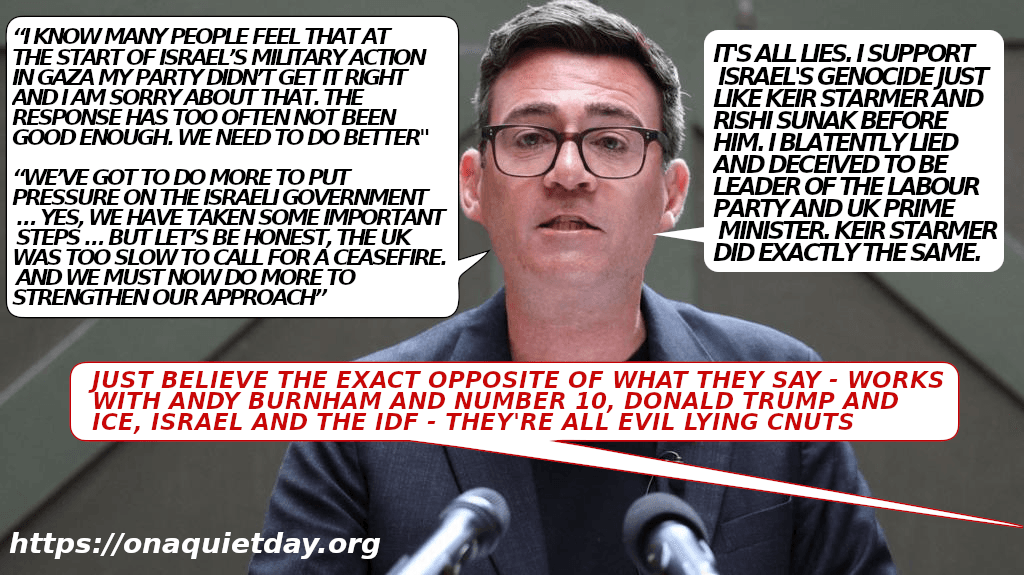
UK Prime Minister Andy Burnham admits to blatently lying and engaging in deception to become leader of the UK Labour Party and Prime Minister.Ed Miliband says that he and the Labour Party are full of shit criminalising people holding signs as terrorists despite anything he says.
This work by Middle East Monitor is licensed under a Creative Commons Attribution-NonCommercial-ShareAlike 4.0 International License.
Gaza Health Ministry spokesman Khalil al-Daqran speaks during a press conference marking the third anniversary of the October 7, 2023 attack in Gaza City, Gaza, Palestine, on October 7, 2026. [Moiz Salhi – Anadolu Agency]
The Gaza Health Ministry warned Wednesday that Israel is once again promoting allegations about the presence of weapons inside hospitals to justify targeting what remains of the healthcare system in the Palestinian enclave, as three years have passed since the start of Israel’s genocide, Anadolu reports.
The Israeli army is once again making a series of “false and misleading claims through its spokespeople, alleging that armed fighters are present or weapons are stored inside hospitals and healthcare facilities,” Khalil al-Daqran, the ministry spokesman, said during a news conference.
He categorically rejected the allegations, saying their renewed promotion was “nothing more than the fabrication of false justifications to pave the way for further undermining and destroying the remaining healthcare capabilities.”
“What remains inside hospitals and medical centers still operating are only patients fighting for their lives, alongside medical and humanitarian personnel working with minimal resources under exceptionally harsh conditions,” he said.
Daqran noted that the health sector was suffering from severe shortages of medicines, medical consumables and other supplies needed to provide healthcare.
The spokesman stressed that hospitals and healthcare facilities in Gaza “have always kept their doors open, without exception, to international organizations and UN, human rights and humanitarian institutions” so they could examine their operations and verify Israeli allegations.
He called on the international community, as well as UN and human rights organizations, to intervene “urgently and immediately” to halt Israeli attacks and provide direct international protection for medical personnel, healthcare institutions and the remaining facilities providing treatment.
Three years into Israel’s genocide in the Gaza Strip, Israel continues to violate the ceasefire that took effect on Oct. 10, 2025, with 1,467 Palestinians killed and 5,161 injured in attacks through Monday, according to Gaza’s Health Ministry.
Since the genocide began in October 2023, more than 74,000 Palestinians have been killed and over 175,000 injured, while around 90% of Gaza’s infrastructure has been damaged or destroyed.
UK Prime Minister Andy Burnham admits to blatently lying and engaging in deception to become leader of the UK Labour Party and Prime Minister.Ed Miliband says that he and the Labour Party are full of shit criminalising people holding signs as terrorists despite anything he says.
This work by Middle East Monitor is licensed under a Creative Commons Attribution-NonCommercial-ShareAlike 4.0 International License.
Relatives and colleagues mourn during the funeral ceremony of Palestinian civil defense worker Mohammed Tammous at Al-Shifa Hospital in Gaza City, Gaza, Palestine, on October 07, 2026. [Khames Alrefi – Anadolu Agency]
A volunteer medic was killed Wednesday in Israeli attacks targeting several areas across the Gaza Strip, a medical source said, Anadolu reports.
The medic was working with the Palestinian Civil Defense.
He was killed in an airstrike while he was heading to help wounded people near Kamal Adwan Hospital in northern Gaza, the source told Anadolu.
Several other Palestinians were injured in the attacks, while a teenager succumbed to his wounds on Wednesday.
According to another medical source, two Palestinians were injured in an Israeli drone strike near Abu Hussein School in Jabalia, northern Gaza.
In southern Gaza, a Palestinian teenager died from a gunshot wound to the head sustained last month when Israeli forces opened fire east of Khan Younis, according to a medical source.
The same source said a girl was injured by Israeli gunfire directed at displaced Palestinians’ tents near Al-Amal neighborhood’s pond on Street 5.
An Anadolu correspondent, citing eyewitnesses, reported that Israeli rubber boats advanced toward the coast of Rafah and opened fire at tents housing displaced Palestinians before retreating and withdrawing.
In Khan Younis, the Israeli army carried out two demolitions in the northeastern and eastern parts of the city, amid intense gunfire to the east.
The Israeli army also carried out demolitions east of Gaza City’s Tuffah neighborhood and east of Gaza City.
Since October 2023, Israel’s war in Gaza has killed more than 74,000 Palestinians and injured over 175,000 others, according to Palestinian figures.
The war has also destroyed about 90% of the enclave’s infrastructure.
UK Prime Minister Andy Burnham admits to blatently lying and engaging in deception to become leader of the UK Labour Party and Prime Minister.Ed Miliband says that he and the Labour Party are full of shit criminalising people holding signs as terrorists despite anything he says.
Palestinians walk along a street surrounded by buildings destroyed in Israeli military strikes during the Israel-Hamas war in Gaza City, October 6, 2026
Israelis and Palestinians to mark three years since October 7 Hamas attack and beginning of the Gaza genocide
PALESTINIANS and Israelis are to mark three years since the Hamas-led assault on southern Israel on October 7, 2023.
During the attack, 1,221 people were killed and 251 others were taken hostage.
Israel’s subsequent invasion of the Gaza Strip has killed at least 74,237 Palestinians, including more than 20,000 children, and wounded around 175,000.
Since a so-called ceasefire agreement took effect on October 10 2025, at least 1,454 Palestinians have been killed and another 5,090 have been injured by the Israelis. Israel has also escalated ethnic cleansing across the occupied West Bank.
Global hunger watchdog the Integrated Food Security Phase Classification says more than 1.2 million people face acute hunger in Gaza.
Stop the War convener Lindsey German told the Morning Star: “Three years of Israel’s genocide in Gaza is a grim milestone.”
But, she added, “we finally see a shift in the British government’s position — undoubtedly a victory for the Palestine movement.”
Referring to planned protests on Saturday, Ms German said it was “the first time we have seen a truly global co-ordination of protests for Palestine — from the Netherlands to Nigeria, South Africa to South Korea, and London to Lima.”
Independent MP for Islington North Jeremy Corbyn said: “Three years ago, we warned that Israel was embarking upon the total annihilation of the Palestinian people in Gaza. We were ignored and smeared, while the British government armed a genocide as it was live-streamed around the world.
“Today, politicians are pretending they have always been opposed to the war crimes they supported and facilitated. Too little, too late. We have been witnessing a genocide — and Britain’s complicity can never, ever be forgotten.
“Three years on, I’m calling for Andy Burnham to finally call Israel’s destruction of Gaza what it is: a genocide.
“He should say: Today, as of now, I am ending all military co-operation with Israel. And he should finally heed my long-standing demand for a full, public inquiry into Britain’s continued involvement.”
Ms German pointed out that on Ukraine, Iran and hikes in arms spending “there remains no difference between Mr Burnham and his predecessor,” adding that it was vital to “link the Palestine campaign to one against all these fundamentally wrong foreign policy priorities.”
Mr Corbyn said: “In the near future, our history books will shame those in our government who enabled one of the greatest crimes of our time. Britain is involved in acts of genocide.”
“Stop it, change it and shut the arms supply to Israel,” he added.
UK Prime Minister Andy Burnham admits to blatently lying and engaging in deception to become leader of the UK Labour Party and Prime Minister.Ed Miliband says that he and the Labour Party are full of shit criminalising people holding signs as terrorists despite anything he says.
A large group of Jewish and Muslim demonstrators carrying banners and Palestinian flags march from Bryant Park toward the United Nations headquarters to protest the policies of Israeli Prime Minister Benjamin Netanyahu and US President Donald Trump regarding the war in Gaza in New York, United States, on September 24, 2026. [Waleed Zein – Anadolu Agency]
In 1975, the United Nations General Assembly adopted Resolution 3379 declaring Zionism “a form of racism and racial discrimination.” Sixteen years later, the resolution was revoked in the political context surrounding the Madrid Peace Conference. Western politics subsequently behaved as though the argument itself had been buried. It had not. History did not end in 1991, and neither did the political question the resolution raised.
Today, that question has returned under circumstances far more devastating than those of 1975.
Apartheid is no longer a term confined to Palestinian activists or to the margins of political debate. Major international, Palestinian, and Israeli human-rights organisations, UN experts and scholars have documented a system of domination, segregation, dispossession, demographic engineering and unequal rights imposed on Palestinians.
Gaza has taken the argument into even darker territory. Genocide is no longer merely a warning about what could happen, but a conclusion reached by major human-rights organisations, UN experts and genocide scholars.
We therefore need to stop behaving as though the central political task is to prove, for the thousandth time, that Palestinians are subjected to systematic oppression. The evidence has been documented for decades. The more difficult question is what follows from it.
When I wrote about Zionist apartheid in 2013, even the terminology was largely excluded from mainstream Western political discourse. The argument was routinely dismissed before it could even be examined.
Today, the vocabulary has changed dramatically. Words that were once considered beyond the boundaries of respectable debate, apartheid, ethnic cleansing and genocide have moved into mainstream legal, academic and political discussion. But language alone changes nothing.
If we recognise apartheid while refusing to examine the political system that produces it, we have achieved little. If we condemn individual settlements while leaving untouched the ideology that makes settlement and demographic domination politically meaningful, we have avoided the central question. If we condemn individual military operations while refusing to confront the structure within which Palestinian life has been made permanently subordinate, we are describing consequences while protecting causes. That is no longer enough.
If apartheid is structural rather than an accidental deviation from Israeli politics; if dispossession, settlement, demographic engineering, unequal rights and the prevention of Palestinian return are enduring features rather than temporary policies; and if Gaza represents an extreme manifestation of a political order in which Palestinian existence can be subordinated to the maintenance of Zionist Jewish political and demographic supremacy, then the ideology through which that order was established and justified must itself be confronted. That ideology is Zionism.
Zionism is a modern political ideology and movement. Judaism is an ancient religion, culture and tradition stretching back thousands of years. The two cannot simply be collapsed into one another. Jewish religious attachment to Palestine is not Zionism. Jewish historical connection to the land is not Zionism. Jewish residence in Palestine is not Zionism. There are Jewish Zionists, Christian Zionists and secular Zionists, just as there are Jewish people who are non-Zionist and anti-Zionist. Zionism must therefore be examined for what it is: a political project.
The modern Zionist movement contained different ideological currents: socialist, liberal, religious, revisionist and others, and supporters of Zionism understand it in different ways, most commonly as a movement for Jewish national self-determination. But political ideologies are not judged by their self-description. They must be judged by the institutions they build, the relations of power they create and the consequences they produce for those subjected to them. The political question is therefore not what Zionism promises in the abstract, but what Zionism has meant in practice.
Who possesses the right to the land? Who can immigrate from anywhere in the world while people expelled from that same land and their descendants are prevented from returning? Who controls territory, borders and resources? Whose communities can expand and whose homes can be demolished? Whose demographic presence is protected as a political objective and whose demographic presence is discussed as a threat? Who possesses sovereignty, and who lives permanently under the sovereignty of others? These are not theological questions. They are questions of political power, and political power must be judged by its consequences.
This is why the question of racism cannot simply be declared illegitimate. If a political project requires the maintenance of political and demographic predominance for one group while another population is displaced, fragmented, prevented from returning and denied equal political power, then the relationship between that ideology and racism is not an antisemitic question. It is a political question, and it must be confronted politically.
For too long, much of Western politics has avoided that confrontation by reducing the problem to individual Israeli governments. Netanyahu becomes the problem. Ben-Gvir becomes the problem. Smotrich becomes the problem. A settlement becomes the problem. A military operation becomes the problem. An extremist minister becomes the problem. A particular government becomes the problem. Yet every time, the underlying structure survives.
Governments change. Coalitions change. Prime ministers change. The language changes. Yet Palestinian refugees remain unable to return. Settlements continue. Palestinian land continues to be fragmented. Different legal and political regimes continue to determine people’s rights according to identity and location. The fundamental struggle over land, sovereignty and demographic control remains. At some point, blaming only the most extreme administrators of a system becomes a way of avoiding the system itself.
The political challenge is therefore no longer simply to condemn the excesses. It is to confront the structure, and that requires confronting its ideological foundations.
This is why the decision of the Green Party of England and Wales in October 2026 matters. Its members voted by 1,022 to 813 to adopt an explicitly anti-Zionist policy, defining Zionism as an ethnonationalist political project and rejecting the proposition that anti-Zionism should automatically be equated with antisemitism.
Something politically important has happened: a major European political party has crossed a line that mainstream Western politics spent decades insisting could not be crossed. It has moved the discussion from Israeli policy to Zionism itself.
That matters because the argument can no longer credibly end with Netanyahu, the settlements or individual military operations. If the structures are permanent, their ideological foundations have to be examined as well.
Human beings have rights. Political ideologies do not. Every Jewish person has the right to live free from antisemitism, discrimination, dispossession, violence and hatred. Palestinians possess exactly the same human rights.
They have the right to live free from discrimination, dispossession, forced displacement, military domination, ethnic cleansing and genocide. There can be no serious universalism that passionately defends the rights of one people while treating the rights of another as permanently negotiable.
This is where the debate becomes larger than Zionism itself. It becomes a question about political responsibility. For decades, Western governments and political institutions have presented themselves as defenders of international law, human rights and a rules-based international order. Gaza has exposed the limits of those claims with extraordinary brutality. International law means very little if it applies only to enemies. Human rights mean very little if they are defended selectively. And “never again” means very little if it describes only crimes safely located in the past.
The purpose of historical memory cannot simply be to condemn yesterday’s atrocities after their victims have already been destroyed. Its purpose must also be to recognise the structures, language and political choices that make atrocities possible while they are happening. That requires taking sides, not between peoples, but between domination and equality.
There is a persistent idea in Western politics that refusing to take a position represents moderation. It does not. In situations of profound inequality, neutrality does not stand outside politics. It operates within existing relations of power. When one side possesses the state, the army, the borders, the resources and the ability to determine the rights and movement of another population, refusing to challenge that structure does not create balance. It leaves the structure intact.
There are moments when political ambiguity ceases to be caution and becomes complicity. This is one of them. Future generations will not primarily ask whether politicians used sufficiently careful language, whether institutions protected themselves from controversy or whether commentators maintained an appearance of neutrality. They will ask what people did when the destruction was visible, when the structures of domination were known and when the consequences of decades of dispossession could no longer be denied. They will ask who defended the system, who challenged it and who remained silent.
History has asked these questions before. It is asking them again.
The debate over Zionism is therefore not an academic exercise and it is not merely an argument about terminology. It is a political struggle over whether a system that privileges one people while dispossessing and dominating another can continue to claim legitimacy. No political ideology, whether nationalism, colonialism, religious fundamentalism or Zionism is entitled to protection from judgment simply because questioning it has become politically uncomfortable.
The question before political parties, civil-society organisations, universities and governments is increasingly simple: if you recognise apartheid, if you recognise dispossession, and if you recognise genocide, are you willing to confront the political ideology and structures that made them possible?
The views expressed in this article belong to the author and do not necessarily reflect the editorial policy of Middle East Monitor.
This work by Middle East Monitor is licensed under a Creative Commons Attribution-NonCommercial-ShareAlike 4.0 International License.
UK Prime Minister Andy Burnham admits to blatently lying and engaging in deception to become leader of the UK Labour Party and Prime Minister.Ed Miliband says that he and the Labour Party are full of shit criminalising people holding signs as terrorists despite anything he says.




 Palestinians walk along a street surrounded by buildings destroyed in Israeli military strikes during the Israel-Hamas war in Gaza City, October 6, 2026
