‘People Power Works’: Shell Backs Down in Anti-Protest Lawsuit Against Greenpeace

Spread the love

Original article by Jake Johnson republished from Common Dreams under Creative Commons (CC BY-NC-ND 3.0). 
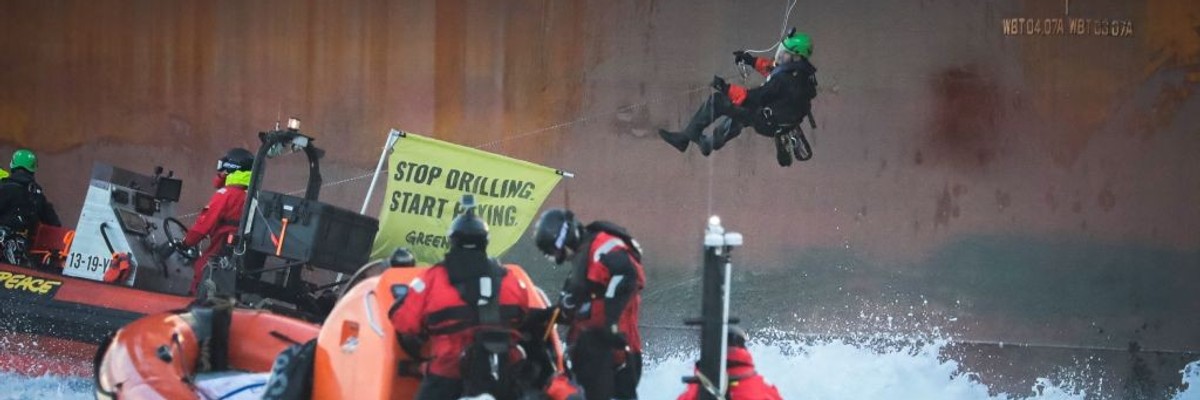
Greenpeace activists board a Shell platform headed toward the North Sea on February 6, 2023.  (Photo: Lou Benoist/AFP via Getty Images)

“Shell thought suing us for millions over a peaceful protest would intimidate us, but this case became a PR millstone tied around its neck,” said the co-executive director of Greenpeace U.K.

The United Kingdom-based oil giant Shell agreed Tuesday to settle a major lawsuit the company brought against Greenpeace after activists from the group boarded and occupied a company oil platform last year to protest fossil fuel expansion.

Greenpeace said in a statement that as part of the settlement, it agreed to donate £300,000—roughly $382,000—to the Royal National Lifeboat Institution, a charity that helps save lives at sea, but will pay nothing to Shell and accept no liability. The donation represents a fraction of the over $11 million in damages and legal costs defendants faced, the group said.

The Greenpeace defendants have also “agreed to avoid protesting for a period at four Shell sites in the northern North Sea.”

“Shell thought suing us for millions over a peaceful protest would intimidate us, but this case became a PR millstone tied around its neck,” said Areeba Hamid, co-executive director of Greenpeace U.K. “The public backlash against its bullying tactics made it back down and settle out of court.”

“This settlement shows that people power works. Thousands of ordinary people across the country backed our fight against Shell and their support means we stay independent and can keep holding Big Oil to account,” Hamid added. “This legal battle might be over, but Big Oil’s dirty tricks aren’t going away. With Greenpeace facing further legal battles around the world, we won’t stop campaigning until the fossil fuel industry stops drilling and starts paying for the damage it is causing to people and planet.”

“These aggressive legal tactics, the huge sums of money, and attempts to block the right to protest pose a massive threat.”

Shell brought the case, which Greenpeace characterized as a “textbook” strategic lawsuit against public participation (SLAPP), in February 2023 and sought $1 million in damages from activists who boarded a Shell-contracted ship carrying equipment to drill for oil in the North Sea.

“When the protest ended, the only damage Shell could find was a padlock which, they alleged, our activists broke. That’s it,” Greenpeace U.K. said Tuesday. “Yet they came after us with a million-dollar lawsuit, which they justified for their spending on safety.”

The group, which warned that the case had dire implications for the right to protest, credited a “sustained, year-long campaign against the suit” for forcing the oil behemoth to back down. The campaign, according to Greenpeace, “turned the legal move into a PR embarrassment for Shell.”

“The case was dubbed the ‘Cousin Greg’ lawsuit by Forbes after a scene in the Emmy-awarded drama Succession, in which the hapless character threatens to sue Greenpeace to universal dismay,” the environmental group noted Tuesday.

Greenpeace is currently facing several other SLAPP suits, including one brought by Energy Transfer, majority-owner of the Dakota Access pipeline. The group said Tuesday that the Energy Transfer suit “threatens the very existence of Greenpeace in the U.S.”

“These aggressive legal tactics, the huge sums of money, and attempts to block the right to protest pose a massive threat. It could stop Greenpeace being able to make a real difference on the things that matter most,” the organization said Tuesday. “It’s part of a growing trend by powerful corporations and governments to crush peaceful protest—using draconian laws or intimidation lawsuits like this.”

“It seeks to silence the people most impacted by the climate crisis. This threatens the global fight for climate justice,” the group added. “We won’t give up. This is Shell versus all of us.”

Original article by Jake Johnson republished from Common Dreams under Creative Commons (CC BY-NC-ND 3.0). 
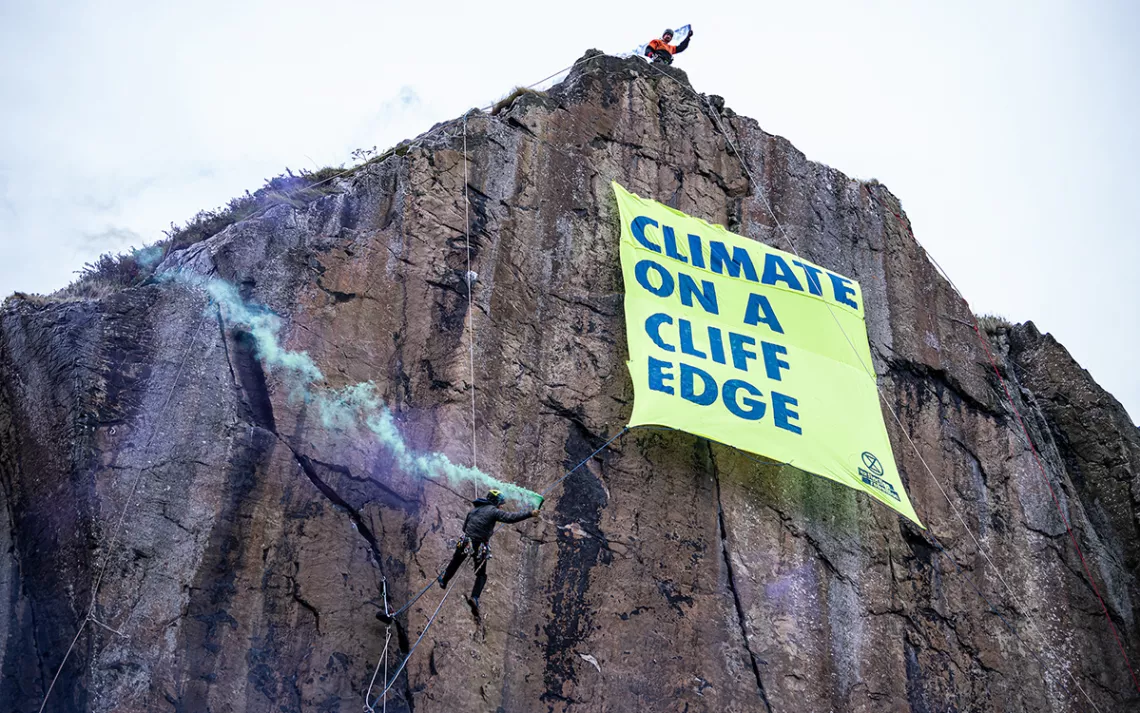
Experienced climbers scale a rock face near the historic Dumbarton castle in Glasgow, releasing a banner that reads “Climate on a Cliff Edge.” One activist, dressed as a globe, symbolically looms near the edge, while another plays the bagpipes on the shores below. | Photo courtesy of Extinction Rebellion and Mark Richards
Continue Reading‘People Power Works’: Shell Backs Down in Anti-Protest Lawsuit Against Greenpeace

Allies Vow to Fight Off Big Oil Lawsuit Aimed at Ending ‘Existence’ of Greenpeace

Spread the love

Original article by OLIVIA ROSANE republished from Common Dreams under Creative Commons (CC BY-NC-ND 3.0).

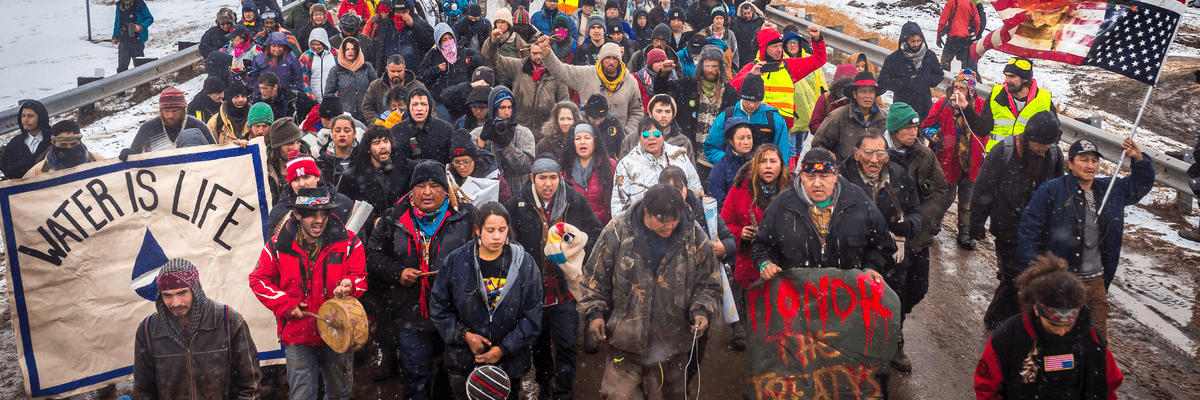
Dakota Access Pipeline protesters rally at Standing Rock Indian Reservation on February 22, 2017. (Photo: Michael Nigro/Pacific Press/LightRocket via Getty Images)

“No matter who you are, no matter what your politics are, this is one of the most important issues in America right now,” one Greenpeace spokesperson said.

Nearly 300 organizations and tens of thousands of individuals have signed an open letter supporting Greenpeace USA against a $300 million lawsuit brought against the environmental group by Energy Transfer—a company with a majority stake in the Dakota Access pipeline.

The corporation is falsely accusing Greenpeace of being the driving force behind Indigenous-led protests against the Dakota Access pipeline (DAPL) in 2016 and 2017.

Greenpeace USA announced its supporters on Thursday as it launched a campaign to raise awareness about the lawsuit—which it said could “functionally bankrupt” the organization, threatening its “existence.” However, Greenpeace said that the dangers posed by strategic lawsuits against public participation (SLAPPs), like the one it faces, extend far beyond one organization.

“No matter who you are, no matter what your politics are, this is one of the most important issues in America right now,” Greenpeace USA spokesperson Rolf Skar said in a statement. “Energy Transfer built the Dakota Access pipeline. But they’re suing anyway in order to send a message: If you dare to oppose us, we will financially ruin you.”

The Dakota Access pipeline drew massive protests from the Standing Rock Sioux Tribe, more than 300 other tribal nations, and non-Indigenous allies. While former U.S. President Donald Trump forced the pipeline through shortly after taking office in early 2017, the protests rattled the fossil fuel industry and their allies in government. After 2016, 18 states passed anti-protest laws that shielded around 60% of U.S. oil and gas production and related infrastructure from peaceful protests. The industry also turned to “judicial harassment.”

Energy Transfer (ET) initially brought suits against Standing Rock Tribal Chairman Dave Archambault and other Water Protectors, as well as a federal suit against Greenpeace in 2017.

At the time, ET CEO Kelcy Warren told a reporter: “Could we get some monetary damages out of this thing, and probably will we? Yeah, sure. Is that my primary objective? Absolutely not. It’s to send a message—you can’t do this, this is unlawful, and it’s not going to be tolerated in the United States.”

“Everyone who says they care about freedom—of whatever political stripe—should join together to support the Greenpeace campaign to protect people’s right to speak out against corporate abuses.”

While the 2017 cases were all dismissed, ET immediately filed a similar case against Greenpeace in North Dakota state court in 2019. The new case, which is scheduled to go to trial in February 2025, makes what Greenpeace called a “deeply racist” case that Greenpeace, and not Indigenous leaders, coordinated the Dakota Access protests.

“The lawsuit against Greenpeace is also an attack on the Indigenous movement in our fight for self-determination to protect Mother Earth, our waters, sacred and cultural sites, and our youth and future generations,” Morgan Brings Plenty of the Standing Rock Youth Council said in a statement. “These colonialist lawsuits are trying to send a warning to anyone who might consider speaking out and to be quiet—any of you could be next.”

ET also makes several claims that would set a dangerous precedent if upheld, including denouncing legitimate speech as defamatory and making anyone who is present at a protest liable for things that occurred at the same protest.

“The whole point of this type of lawsuit is to limit freedom of expression, so even if you don’t care about climate change, or you don’t care about Greenpeace, you should pay attention,” Skar said. “What’s at stake isn’t just Greenpeace or environmentalism, but the fundamental American rights to freedom of peaceful expression and advocacy for all of us.”

Greenpeace has circulated a letter to ET that has so far been signed by more than 290 organizations—including 350.orgPublic Citizen, ACLU North Dakota, SEIU, Indigenous Environmental Network, and Amnesty International USA—and tens of thousands of individuals, including prominent celebrities and activists like Jane Fonda, Susan Sarandon, Billie Eilish, and Adam McKay.

“This is corporate overreach that is part of a disturbing trend of attacks on advocacy and speech around the world,” the letter reads. “We will not allow lawsuits like this one to stop us from advocating for a just, green, and peaceful future. On the contrary, we will ensure they have the opposite effect, increasing the support for organizations like Greenpeace and strengthening the broader movement for justice.”

“This legal attack on Greenpeace is an attack on us all,” the letter continues. “We will not stand idly by. We will not be bullied. We will not be divided and we will not be silenced.”

Organizations also issued individual statements of support.

“Everyone who says they care about freedom—of whatever political stripe—should join together to support the Greenpeace campaign to protect people’s right to speak out against corporate abuses,” said Robert Weissman, co-president of Public Citizen. “As Greenpeace knows from its own experience, too often corporations use their political, economic, and legal power not just to run PR campaigns justifying their wrongdoing, but to threaten public interest advocates with bad-faith lawsuits (SLAPPs) and other intimidation tactics.”

Brian Hauss, a senior staff attorney for the ACLU, said: “Protesters and advocacy groups should never have to fear the weight of groups like ETP as a condition for expressing their First Amendment rights. The court should see this lawsuit for what it is and toss it.”

Progressives are also calling for a national legislative solution to the problem of SLAPP suits. While most states do have laws on the books against them, North Dakota is one of the 18 that do not.

Rep. Jamie Raskin (D-Md.) introduced the Strategic Lawsuits Against Public Participation (SLAPP) Protection Act during Congress’ last session, and plans to reintroduce it in September of this year.

“The case against Greenpeace illustrates how mega-corporations can use lawsuits to silence, intimidate, and ruin their critics,” Raskin said. “America must demand, and Congress must pass, bipartisan legislation to protect First Amendment rights against ruinous litigation practices.”

Original article by OLIVIA ROSANE republished from Common Dreams under Creative Commons (CC BY-NC-ND 3.0).

Continue ReadingAllies Vow to Fight Off Big Oil Lawsuit Aimed at Ending ‘Existence’ of Greenpeace