Original article by Peoples Dispatch republished from peoples dispatch under Creative Commons Attribution-ShareAlike 4.0 (CC BY-SA) license.
CONAIE reports that at least two people have been killed so far and more than a hundred have been injured. The government defends the actions of the security forces and promises to end the national strike in a few days.
The government of Daniel Noboa has opted to reinforce the security forces to definitively suppress the national strike called by the Confederation of Indigenous Nationalities of Ecuador (CONAIE), which has now been going on for 26 days. The protests, which have been concentrated in the province of Imbabura (although they have also taken place in dozens of other locations), demand the repeal of a presidential decree that eliminates the subsidy on diesel fuel, which is used especially by transporters, farmers, and rural workers. However, little by little, the demonstrations have taken on an anti-government tone that is evident in the mobilizations.
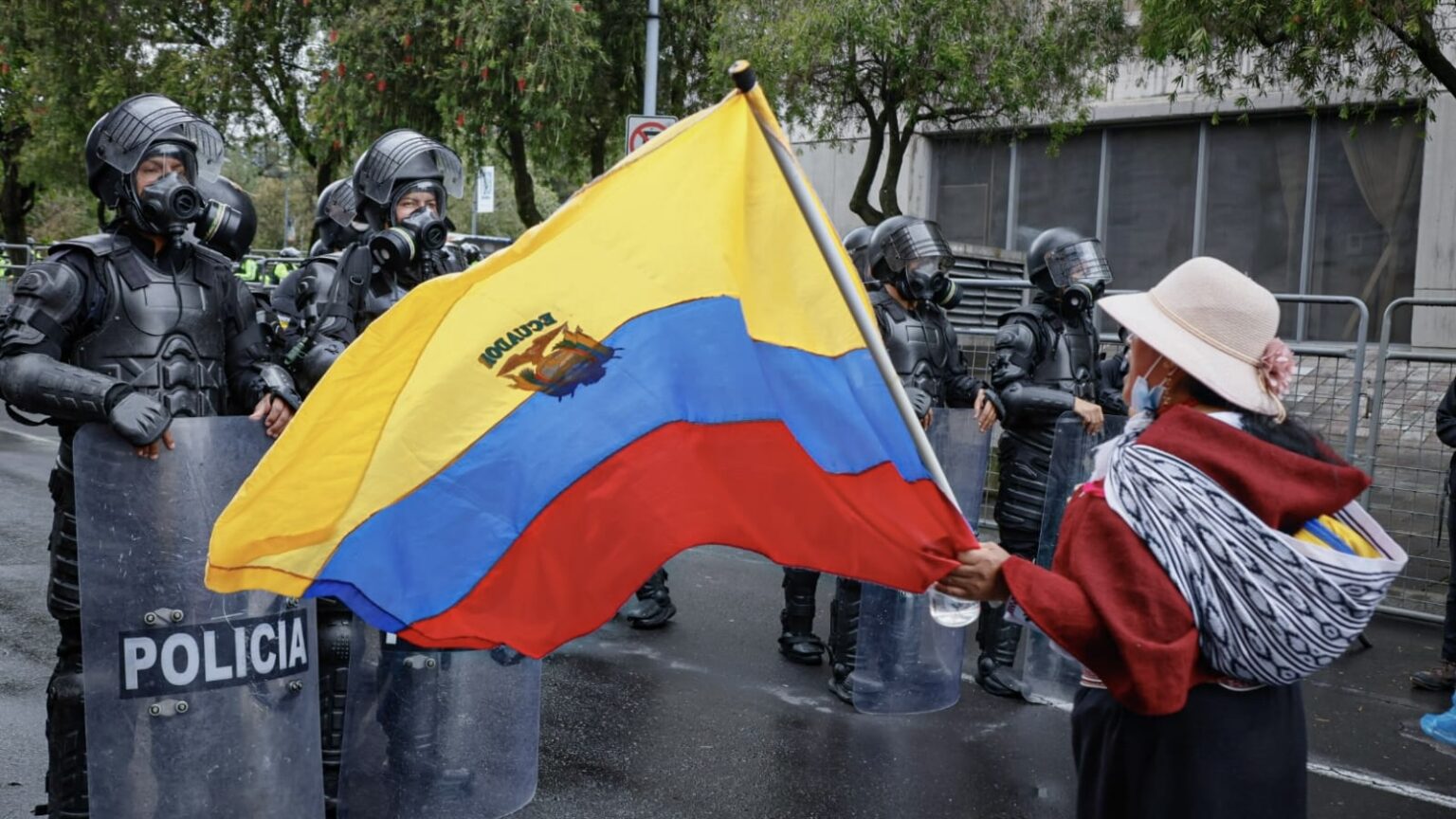
On October 12, various protests were organized across the country in support of the demonstrations. In the capital, Quito, the police and army cracked down hard on demonstrators, who were unable to gather in one place as they were dispersed with tear gas. Subsequently, several media outlets reported on the repression of several demonstrators who were beaten, shot with rubber bullets, and tear-gassed and pepper-sprayed.
Humanitarian convoy or vanguard of repression?
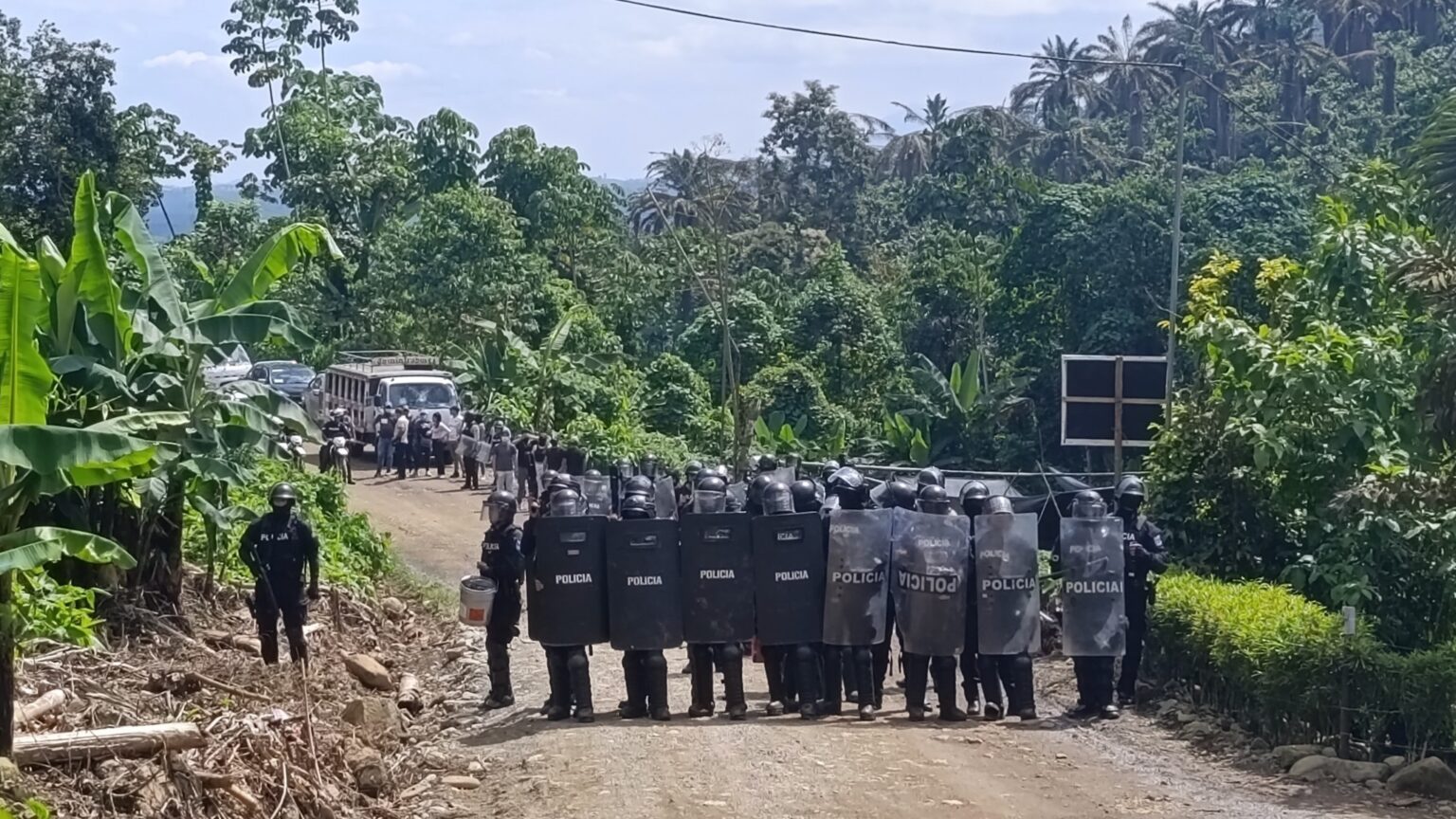
A few hours later, the Executive announced that it would send a second humanitarian convoy to Imbabura to, as it claimed, assist families affected by the protests. However, the so-called humanitarian convoy quickly became an advance group that attempted, using force and tear gas, to open the roads closed by Indigenous groups.
In this regard, Interior Minister John Reimberg announced on October 13 that the national strike “is ending now.” “We are going to use the police to completely open the roads, because this is ending now… We are going to arrive, we are going to dialogue, and if there is no dialogue and they want to become violent, the police are there to act,” said the minister.
In effect, the government ordered law enforcement to act more harshly against protesters who refused to end their protest measures. Several media outlets showed how the police and army acted forcefully against protesters, which has been denounced by various human rights organizations and opposition politicians. Videos depicted how soldiers and police officers beat detained protesters in groups, or how soldiers attempted to enter people’s homes to arrest protesters.
Alleged raids on hospitals and an increase in deaths
However, what has caused the most controversy has been the allegations made by several civil society groups, such as the Regional Foundation for Human Rights Advisory Services (Inredh), which warned of alleged raids by the military on hospitals to arrest injured protesters. Inredh has also reported that several doctors have been asked not to assist the wounded.
The clashes between police and protesters have left more than just the wounded. Several days ago, a video showed the death of Efraín Fuérez. However, following the latest incursions by the military and police, CONAIE has reported that another Indigenous man, José Guamán, died because of was hit by projectiles.
“We sadly report the death of our brother José Guamán, shot in the chest by the armed forces in the massacre ordered by the National Government in Otavalo… CONAIE expresses its deep solidarity and condolences to the family and community of Chachimbiro for this cruel murder. We join in the grief of his loved ones and demand truth and justice for José and for all the social activists who have been detained and killed in defense of the rights of our people,” CONAIE wrote in a statement.
In addition, it was reported that a woman died from suffocation caused by tear gas, bringing the death toll to three. According to the Alliance of Human Rights Organizations, there have been 310 alleged human rights violations, 144 injuries, and 103 arrests.
While road closures and law enforcement actions continue, talks to reach an agreement between various Indigenous leaders and government representatives are still going on in Otavalo, Imbabura, said the city’s mayor, Anabel Hermosa.
A long struggle against neoliberalism
According to sociologist Soledad Stoessel, the strike is part of a prolonged state crisis that began when Lenin Moreno (2017-2021), followed by Guillermo Lasso (2021-2023), and now Daniel Noboa (2023-present) initiated a transformation of the state to benefit the economic elites through a neoliberal economic program: “The current Ecuadorian state crisis has its roots in a process of institutional dismantling that began during the government of Lenín Moreno (2017-2021). Under the discourse and with the aim of ‘de-Correa-izing’ the state, Moreno reversed the social gains of the progressive cycle and restored the power of the economic elites. The 2018 referendum and the Productive Development Law paved the way for the cancellation of corporate debts, the subordination of the state to local economic elites and international financial capital, and the political proscription of Correísmo as a political force.”
The strike has revived memories of the recent waves of national and cross-sectoral mobilization against the neoliberal governments of Lenín Moreno (2019) and Guillermo Lasso (2022). Those mobilizations were waged against similar policies to the ones Noboa seeks to implement by force today, yet importantly had great adhesion from across the left movements and political parties.
For now, the government is under pressure to put an end to the protests, which have shown extraordinary resistance to the enormous deployment of police and military forces. In less than a month, there will be a referendum that will decide, among other things, whether to draft a new constitution that will almost certainly structure the neoliberal transformation of the state.
On the other hand, CONAIE has once again proven to be the only social and political organization in Ecuador capable of standing up to the neoliberal project promoted by the economic elites and sponsored by international powers such as the IMF and the United States, one of the most important allies of the Noboa government, who, incidentally, belongs to the richest family in the country.
Original article by Peoples Dispatch republished from peoples dispatch under Creative Commons Attribution-ShareAlike 4.0 (CC BY-SA) license.