NHS staff blockade the entrance to NHS England’s headquarters in central London demanding the cancellation of its contract with Palantir, which supplies advanced technology to Israel’s military, April 3, 2024
PALANTIR has been awarded a contract to analyse the Financial Conduct Authority’s (FCA) internal intelligence data, sparking concerns over possible leaks.
The FCA confirmed on Sunday that the US tech company will aim to help tackle financial crime and identify risks to consumers and markets.
A spokesman added: “We ran an open, competitive procurement process and have strict controls in place to ensure data is protected.”
But Cardiff University’s Professor Michael Levi, an internationally recognised expert in money laundering, told the Guardian that it was “a relevant question as to whether Palantir’s owners might tip off their friends about methodologies.”
He asked: “What are the protocols agreed between the FCA and Palantir about the onward use of things that they have learned in that process?”
…
Amnesty International UK’s business and human rights director Peter Frankental said: “Companies linked to human rights abuses should not be given access to sensitive UK public data full stop. First it was our health data, now it’s financial intelligence.
“The UK government is taking an unacceptable risk by allowing Palantir Technologies to embed itself in systems handling the public’s most sensitive information and profit from it at the expense of our privacy, integrity and values. We are calling for a full review into whether it is appropriate to grant this level of access to a company so closely associated with some of the most serious human rights concerns of our time.”
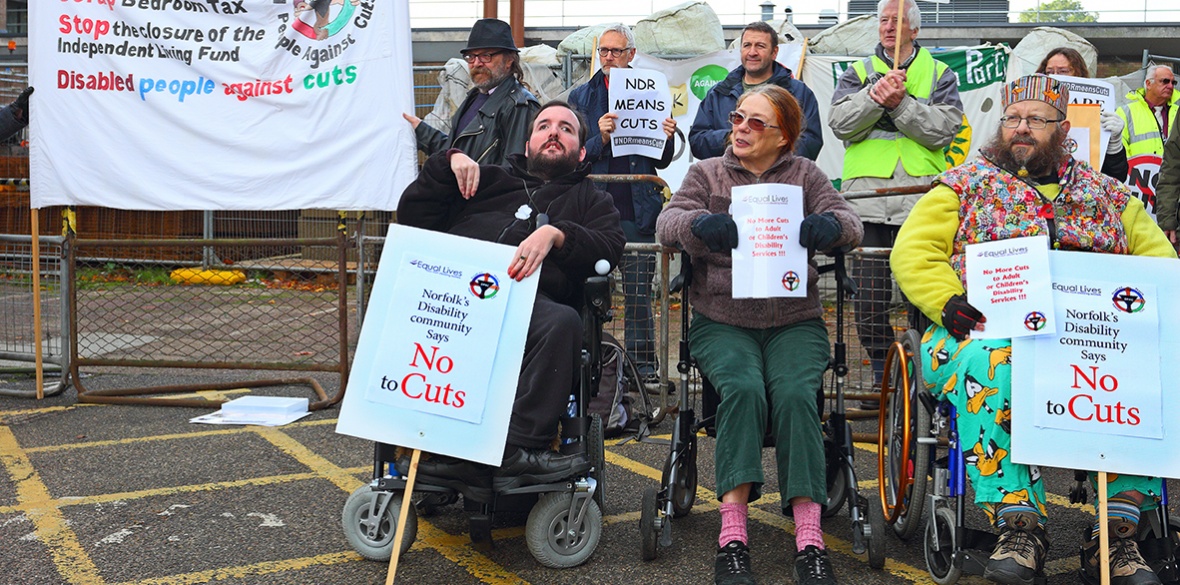
TORY 2015/LABOUR 2025 SPOT THE DIFFERENCE: (Above) Workers and disabled people protesting outside Norfolk County Hall against Norfolk County Council cuts to services on October 2015Photo: Roger Blackwell/flickr/CC
DR DYLAN MURPHY asks why Labour is continuing the Tory war on the disabled, when viable alternatives have been spelt out in detail
IN LATE February of 2025 the UN Committee on Economic, Social and Cultural Rights issued a damning report into the failures of Labour to address income inequality and the deepening levels of poverty in the UK.
The UN committee criticised Labour for failing to address “income inequality or reducing poverty,” which hamper “the progressive realisation of economic, social and cultural rights.’’
Ironically enough, the UN called on Labour to increase spending on housing, health, education and social security in order to reverse the huge damage caused by blue Tory austerity from 2010 to 2024. Since this call the red Tories in power have announced their intention to make massive cuts to public spending across all government departments except defence and maybe health.
On the issue of social security, over which Labour is determined to make killer cuts, the UN expressed serious concern about the impact of blue Tory austerity which had “resulted in severe economic hardship, increased reliance on food banks, homelessness, negative impacts on mental health and the stigmatisation of benefit claimants.”
Of course, food bank usage under Labour continues to grow as does the stigmatisation of benefit claimants which Starmer and company have engaged in with relish over the last few months.
Starmer, Reeves and Kendall seem to take a sadistic glee in attacking the disabled through the platforms of the Tory media using ultra right-wing rags such as The Telegraph and Sun to stigmatise the sick and disabled.
The biggest irony in this recent UN report is its call for Labour to actually increase the value of disability benefits such as PIP so that the UK can meet “the recommendations made by the special rapporteur on extreme poverty and human rights.”
Keir Starmer says pensioners can freeze to death and poor children can starve and be condemned to failure and misery all their lives.Keir Starmer explains the moral case for cutting disability benefits. He says work will set you free.
Jeremy Corbyn, MPs and politicians from the Green party, Plaid Cymru and others respond to the budget.
Labour’s first budget punishes the “working people” they claim to support. Keir Starmer and Rachel Reeves promised to deliver real change to the electorate, after 14 years of Tory rule. This week, they have broken that promise. This budget is austerity by another name.
While we welcome the government’s decision to invest in school and hospital buildings, it is extremely disappointing that these investments have been undermined by a swathe of public sector cuts, cruel attacks on the worst off, and a dogmatic refusal to redistribute wealth and power. These are not “tough choices” for government ministers, but for ordinary people who are forced to choose between heating their home and putting food on the table.
Labour is raising defence expenditure to 2.5% of GDP while telling us there is no money to lift 250,000 children out of poverty. This is a lie. There is plenty of money – it’s just in the wrong hands. The richest 1% in the UK hold more wealth than 70% of Britons. By refusing to impose a wealth tax, this government has chosen to force vulnerable communities to pay the price for years of economic failure, instead of making the richest pay their fair share. Labour’s first budget shows us whose side they’re on.
Years of austerity and privatisation have decimated our public services and pushed millions into poverty, disproportionately impacting women, people of colour and disabled people. Making millions of children, working, retired and disabled people poorer damages our entire economy and stretches our public services. An austerity economy is a false economy.
We, along with nearly 100 progressive Independent and Green politicians across the country, are calling on the Labour government to:1) introduce wealth taxes; 2) abolish the two-child benefit cap and stop attacking welfare recipients; 3) reverse cuts to winter fuel; 4) restore the £2 bus cap; and 5) invest in a Green New Deal.
We refuse to believe that child poverty, mass hunger and homelessness are inevitable in the sixth largest economy in the world. A progressive movement is growing up and down the country, demanding a real alternative to this race to the bottom between Labour and the Tories, which has seen the new government perpetuate decades of austerity and rampant corporate greed.
The Tories’ collapse allowed Labour to come to power with the lowest vote share ever won by any single-party majority government. Labour haemorrhaging votes to progressive independents and Greens in their heartlands should be a lesson to this government: you are wrong to believe that progressive voters have nowhere else to go. Our movement is growing every day – and you ignore the demand for a real alternative at your peril.
Jeremy Corbyn MP Independent,Carla Denyer MPGreen partyco-leader, Adrian Ramsay MP Green party co-leader, Sian Berry MP Green party, Ben Lake MPPlaid Cymru,Ann Davies MP Plaid Cymru, Liz Saville Roberts MP Plaid Cymru, Llinos Medi MP Plaid Cymru,Zack Polanski Green party deputy leader and London assembly member , Leanne Mohamad Independent candidate for Ilford North, Jamie Driscoll Former North of Tyne mayor, Andrew Feinstein Former ANC MPand Independent candidate for Holborn and St Pancras, Leanne WoodFormer leader, Plaid Cymru, Beth Winter Former Labour MPfor Cynon Valley, Hilary SchanChair, We Deserve Betterand Independent councillor in Worthing, Anthony SlaughterWales Green partyleader
This blog has previously experienced copyright take down notices. I am republishing this letter in full on the basis that the original authors have and retain rights of copyright and that they have indicated that they wanted it published by submitting it to the Guardian newspaper.
Keir Starmer, Angela Rayner and Rachel Reeves wear the uniform of the rich and powerful. They have all had clothes bought for them by multi-millionaire Labour donor Lord Alli. CORRECTION: It appears that Rachel Reeves clothing was provided by Juliet Rosenfeld.
Protest against nuclear war outside Westminster Abbey, London 2019 | Wiktor Szymanowicz/Future Publishing via Getty Images
What’s the difference between the defence policies of Labour and Conservatives? Spoiler alert: there isn’t one
Days after Rishi Sunak announced the country would be going to the ballots, Tory MP Jacob Rees-Mogg released a campaign video in which he declared “security is at the forefront of this general election”.
It was a grand claim, but an astute one. Sunak and Keir Starmer have indeed spent much of the past six weeks fighting over who is leading the party of defence, while the subject has also dominated headlines (or it did until Nigel Farage re-entered politics and made the election considerably more about immigration).
From existential concerns about the size of the British army to debates about who supports Trident (and who doesn’t) and the shock announcement of the possible return of National Service, you’d be forgiven for thinking the election is less about voting red, blue, green or yellow, and more about what shade of camouflage you’d prefer your leaders in.
But how, exactly, do Labour and the Tories differ when it comes to matters of defence? And how will rising fears from politicians and pundits over threats from Russia, Iran and China affect British politics?
Early on in the election campaign, Labour leader Starmer declared his the ‘party of national security’ – a sentiment echoed by his shadow defence secretary, John Healey, who said “Labour is now the party of defence.” Their claims came weeks after Starmer took to the pages of the Daily Mail, not his natural ally, to proclaim: “We will back our Armed Forces. We will back our nuclear deterrent. We will back Britain.”
This messaging appears to be working. That same pro-Tory paper reported in March that Labour is now more trusted than the Conservatives on defence, with voters reportedly associating the latter with cutting military spending, not increasing it.
This is all quite a reversal. For a time, much of the media painted Labour as actively hostile to the military. It led to the BBC even asking “Has Jeremy Corbyn ever supported a war?” And, in 2019, when a video emerged showing members of the British parachute regiment firing at a poster of the then-Labour leader at a target range in Kabul, it seemed to reflect a wide sentiment that the military and the left were no longer friends.
Matters military, it was long felt, were best left to the Tories. After all, in 2021, a Byline Times analysis found that 91% of the veterans who sit in either the House of Commons or the Lords were Conservatives. Of the 44 veteran MPs, 40 were Conservative, while only 2 were Labour.
It was not always thus. The 1945 General Election, for instance, held as an army of men returned home from World War Two, saw a massive victory for Labour in the UK. Labour won decisively with 393 seats, the Conservatives securing only 197. Labour’s emphasis on social reform clearly resonated with those who had served – the promise of a better country for those who had been ready to die defending it.
It could be that Starmer is seeking to reignite this spirit, where national defence and the left are not deemed antithetical. And there are some canny election reasons for this.
At Action on Armed Violence, we analysed the locations of the ten arms manufacturers based in the UK that have received the highest value and quantity of domestic defence contracts over 2022/3 – finding a significant Conservative bias. The ten firms have 130 locations (listed offices or factories) across 94 parliamentary constituencies – 67% of which are represented by Tory MPs. Labour represents just 16% of the seats.
Of the 20 constituencies with two or more arms manufacturers present, 14 were held by Conservative MPs and just three by Labour. But predicted voting data suggests the Tories will hold onto just two of them on 4 July, while 13 will switch to Labour.
It is no wonder the Starmer wrote in the Mail: “With Labour, the defence industry will be hardwired into my national mission to drive economic growth across the UK.” If polls are to be believed, the military-industrial complex is about to be painted red – and it’s no coincidence that at least 14 prospective MPs standing for Labour today are ex-military.
Where does this leave the Tories, then? Conservative Campaign Headquarters (CCHQ) is frantically coming up with new, harder-right ideas to separate the party from Labour. Its National Service ploy, Sunak claims, is “to strengthen our country’s security”. Exactly why battalions of 18-year-olds on Salisbury Plain will make the UK more secure than its nuclear arsenals is not clear.
As for other differences, while the Conservatives focus on defence spending and global strategic engagement, Labour emphasises European alliances and a broader security perspective. The Liberal Democrats and SNP, meanwhile, both advocate for strong European ties and proactive foreign policies, and the Greens prioritise environmental security.
In truth, though, there is seemingly not much to distinguish Labour and Conservatives when it comes to matters of defence. As with Starmer working to avoid the red-tops claiming the nation is not safe in his hands, Labour has been deafeningly silent on issues such as the inquiry into Special Forces’ extra-judicial killings in Afghanistan, the widespread concerns about misogyny, sexual assault and systemic racism in the British military.
When there is not so much as a camouflage fag paper between the defence policies of the right and the left, the danger is that there are no oppositional voices of any merit. And, in a world where sentiments of war seem to be spreading much faster than sentiments of peace, this lack of critique could easily lead us all to very bad places indeed.
Roger Hallam is on trial with others accused of conspiracy to cause a public nuisance. Photograph: Alecsandra Raluca Drăgoi/The Guardian
A climate protester ignored a judge’s instructions and refused to leave the witness box, instead delivering an hours-long speech telling jurors that his alleged role in a conspiracy to block the M25 was justified by the risk of human extinction.
Roger Hallam, 58, spoke for more than two hours on why a judge was wrong to rule that he and co-defendants could not bring evidence in their defence on the impacts of climate breakdown, and why such evidence justified the sort of acts of which they are accused.
The judge Christopher Hehir sent out the jury three times during Hallam’s extended address, left the court himself once, and interrupted Hallam many times to make clear it was not his place to instruct jurors on points of law.
But Hehir eventually let Hallam continue, to the defendant’s apparent surprise. “I apologise to you if I’m a little bit incoherent,” Hallam told jurors towards the end of his address. “I didn’t actually expect that I was going to get this far.”
Hallam is on trial alongside Louise Lancaster, Daniel Shaw, Cressida Gethin and Lucia Whittaker-de-Abreu on a charge of conspiracy to cause a public nuisance for allegedly organising activists to climb gantries on the M25 over four days in November 2022.
…
Hehir repeatedly interrupted Hallam. “I’m not going to permit you to lecture the jury, wrongly or rightly, about the law,” he said.
Hehir had ruled that the defendants could not bring extensive evidence about the impacts of climate breakdown but that they could speak about their political or philosophical beliefs on the issue, to give context to actions.
Hallam’s speech led Hehir to send the jury out of the courtroom three times. Hehir told jurors they were to take instructions on the law only from him and that Hallam’s evidence about the impacts of climate change was not relevant.

 NHS staff blockade the entrance to NHS England’s headquarters in central London demanding the cancellation of its contract with Palantir, which supplies advanced technology to Israel’s military, April 3, 2024