Tag: demand

  • Revealed: England’s June 2026 heatwave sparked record demand for ambulances

    Spread the love

    Article by Josh Gabbatiss republished from Carbon Brief under a CC license.

    Ambulance in the promenade in Bournemouth, UK. Credit: PA Images / Alamy Stock Photo

    All the ambulance services in England experienced some of their busiest-ever days during this summer’s record-breaking June heatwave, according to data obtained by Carbon Brief.

    In June, temperatures climbed past 37C in parts of the country as authorities declared only the second ever “red” extreme heat warning.

    Four out of 10 NHS ambulance services, including London’s, responded to unprecedented numbers of life-threatening emergencies on at least one day from 23-27 June.

    Another two services – in the south-west and east of the country – received their highest volume of 999 calls on record.

    Ambulance services provided data on their busiest days since records began, in response to freedom-of-information (FOI) requests from Carbon Brief.

    The results show how demand during the June heatwave exceeded levels seen during the traditionally busy winter season in other years – and even the height of the Covid-19 pandemic – for many services.

    Heat demand

    Extreme heat ramps up the risk of numerous life-threatening conditions, including heart disease and respiratory problems. 

    England experienced record-breaking temperatures at the end of June, with the whole country covered by amber or red “heat health alerts” from the government.

    A red alert, which was issued for the entire Midlands and south of England, indicates “significant risk to life for even the healthy population”. This was only the second time such an alert has been triggered.

    Researchers calculated that there were nearly 3,000 heat-related deaths in the UK this summer. There has also been unprecedented demand for A&E departments and some ambulance services.

    To investigate the strain facing ambulances, Carbon Brief sent FOI requests to the 10 NHS ambulance trusts in England, asking for lists of their busiest days. 

    This covered both the total volume of 999 calls and “category 1” responses – referring to incidents involving “life-threatening injuries and illnesses”, such as heart attacks.

    The chart below shows the busiest days on record for England’s ambulances, including both total calls and category 1 responses. Most services were able to provide records back to the 2010s. (See: Methodology.)

    The five-day period from 23-27 June is overrepresented in these results, with at least two heatwave days ranking in the top 20 for every service in the country.
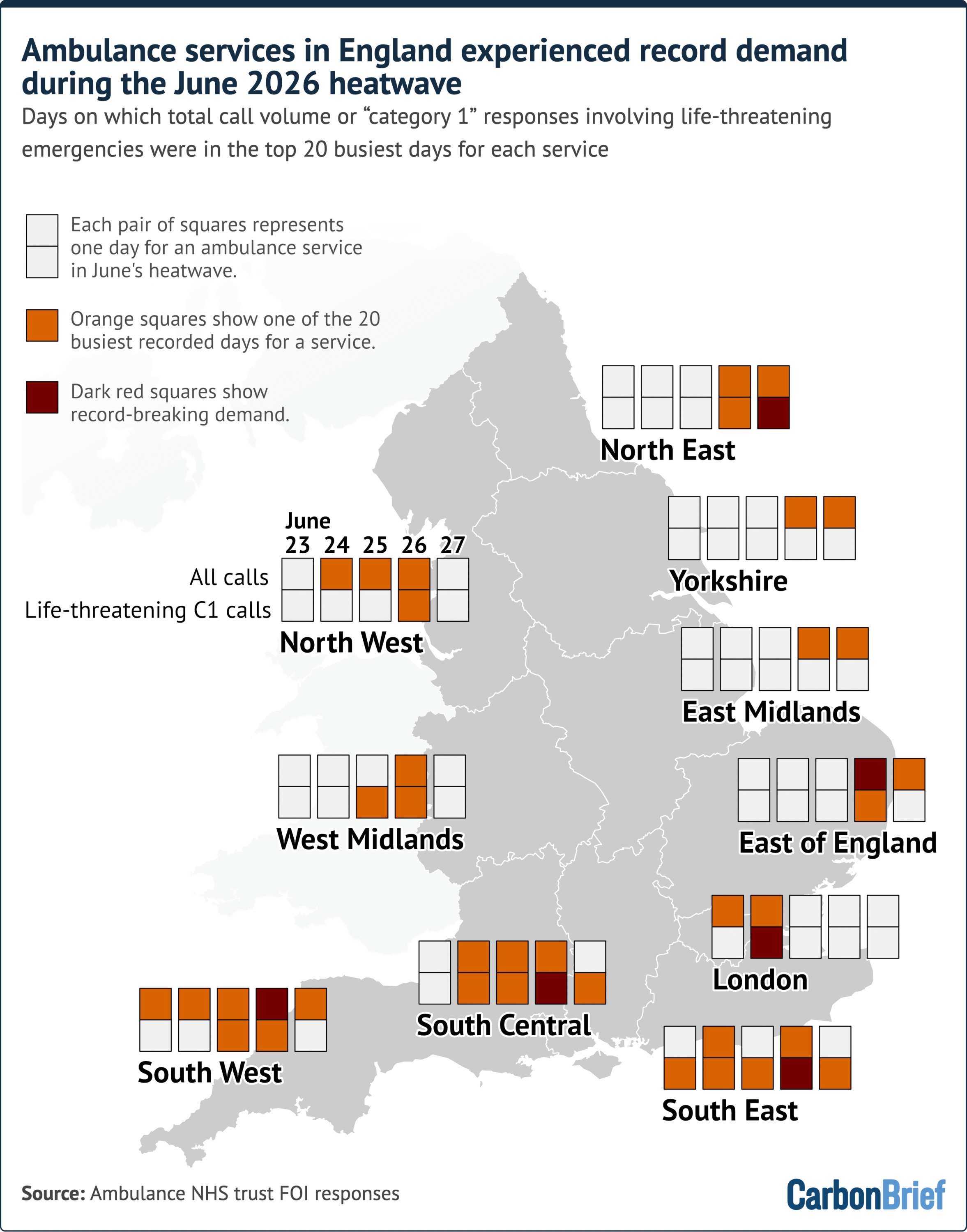
    Ambulance services in England experienced record demand during the June heatwave. Days on which total call volume or “category 1” responses involving life-threatening emergencies were in the top 20 busiest days for each service. A map shows high demand across regions from June 23-27. Source: Ambulance NHS trust FOI responses. (Alt text generated by Google Gemini)
    The top 20 rankings for services across England cover different periods of time. See Methodology for more details.

    This trend is especially pronounced in the south and east of England, where June temperatures exceeded 36C and even approached 38C in some regions.

    London, South East Coast, South Central and North East ambulance services all reported daily records for responding to life-threatening emergencies during the heatwave.

    For the South East Coast and South Central services – which cover a region stretching from Oxfordshire to Kent – 25, 26 and 27 June all saw unprecedented numbers of category 1 callouts. 

    South Western and East of England services both saw record numbers of 999 calls on 26 June, the same day the highest-ever June UK temperature was reported in Norfolk.

    It is worth noting that demand for ambulance services – including category 1 calls – has been growing for many years, driven by factors such as an ageing population, more complex health conditions and growing mental-health pressures.

    This helps to explain why dates from before the 2020s are rare in the top rankings provided to Carbon Brief.

    Beyond the heatwave, 2026 as a whole is on track to be a record year for ambulance demand.

    ‘Stifling heat’

    On 26 Junethe busiest day of the heatwave, ambulances across England responded to 4,084 life-threatening emergencies.

    The average daily volume of such incidents is normally around 2,500 during the summer months.

    Stu Holliday, head of emergency preparedness, resilience and response at North East Ambulance Service, tells Carbon Brief: 

    “During periods of hot weather, we typically see an increase in calls from people affected by dehydration, heat exhaustion and heatstroke, as well as those whose existing health conditions, particularly heart and respiratory illnesses, can be made worse by prolonged high temperatures.

    “Older people, young children and pregnant people can be especially vulnerable.”

    Ambulance teams are generally busier in the winter because cold weather and seasonal illnesses drive up the number of severe medical emergencies.

    However, the data from June shows that extremely hot days are starting to match or even edge out cold ones as the busiest days. This is a trend seen across the healthcare system.

    While not every service provided records back to 2019, the data broadly shows that ambulances were busier during the heatwave than at the height of the Covid-19 pandemic.

    As well as patients, heatwaves put pressure on ambulance workers. The UNISON union has warned of crews facing “stifling heat with faulty or no air conditioning” and “back-to-back callouts” due to increased demand.

    Methodology

    Carbon Brief requested data on the top 50 busiest days for England’s 10 main ambulance services.

    These are: London; South East Coast; South Central; South Western; West Midlands; East Midlands; East of England; North East; Yorkshire; and North West.

    Data was requested for as far back as service records go. Most were able to provide records going back to some point in the 2010s, with the exception of North East and South Central, which only had records from 2021 and 2022 onwards, respectively. 

    Rising annual demand for ambulance services means that most of the busiest days for ambulances have been in the 2020s. For example, all but four of the busiest days for category 1 emergencies reported to Carbon Brief were in the 2020s. 

    Carbon Brief requested data on ambulance demand for all the UK nations. In Scotland and Northern Ireland – where temperatures are cooler – services did not see call volumes reach the top 50 rankings during the June heatwave. The Welsh Ambulance Service did not respond to Carbon Brief’s request.

    Article by Josh Gabbatiss republished from Carbon Brief under a CC license.

    Nigel Farage urges you to ignore facts and reality and be a climate science denier like him and his Deputy Richard Tice. He says that Reform UK has received £Millions and £Millions from the fossil fuel industry to promote climate denial and destroy the planet.
    Nigel Farage urges you to ignore facts and reality and be a climate science denier like him and his Deputy Richard Tice. He says that Reform UK has received £Millions and £Millions from the fossil fuel industry to promote climate denial and destroy the planet.
    Power-mad orange gasbag Donald Trump says Burn, Baby, Burn.
    Power-mad orange gasbag Donald Trump says Burn, Baby, Burn.
    Elon Musk urges you to be a Fascist like him, says that you can ignore facts and reality then.
    Elon Musk urges you to be a Fascist like him, says that you can ignore facts and reality then.
  • ‘Sustainable’ aviation fuel and other myths about green airport expansion debunked

    Spread the love
    Taking off: emissions from the aviation sector. WildSnap/Shutterstock

    Jack Marley, The Conversation

    Environmentalists and locals have resisted a third runway at London’s Heathrow, Europe’s busiest airport, for more than two decades. Today, their efforts took a major setback.

    The UK government has announced it will give the green light to airport expansion. This is not guaranteed to increase growth in the national economy as Chancellor Rachel Reeves hopes. More flights and more emissions are certain, however, at a time when experts are practically screaming at governments to rein them in.


    This roundup of The Conversation’s climate coverage comes from our award-winning weekly climate action newsletter. Every Wednesday, The Conversation’s environment editor writes Imagine, a short email that goes a little deeper into just one climate issue. Join the 40,000+ readers who’ve subscribed.


    “No airport expansions should proceed” without a UK-wide plan to annually assess and control the sector’s climate impact said the government’s watchdog, the Climate Change Committee, in 2023. Aeroplanes are 8% of UK emissions and 2% of the world’s, but they also release gases that seed heat-trapping clouds in the upper atmosphere, which triples air travel’s greenhouse effect.

    While the government’s own advisers have effectively ruled out new runways for the sake of net zero, airport and airline bosses play a different tune. So what does the sector propose to manage its own pollution?

    Not enough cooking oil to save us

    Aviation is a notoriously difficult sector to decarbonise says Richard Sulley, a senior research fellow in sustainability policy at the University of Sheffield: “If electric or hydrogen-powered planes are possible, it won’t be for many years yet.”

    To justify air travel emissions ballooning in the meantime, the aviation sector has promised a mix of “supply-side” measures, like replacing kerosene with so-called “sustainable aviation fuel” (SAF), which Reeves described as “a game changer”, and making planes lighter and more fuel-efficient.

    Efficiency, in this context, is a slippery path to decarbonisation. When a high-emitting activity is reformed so that it consumes less energy, the efficiency savings are generally eclipsed by the increasing demand it drives.

    “Indeed, the sector’s own plans for growth will outstrip efforts to decarbonise through synthetic fuel, delivering a neutral effect at best,” Sulley says.

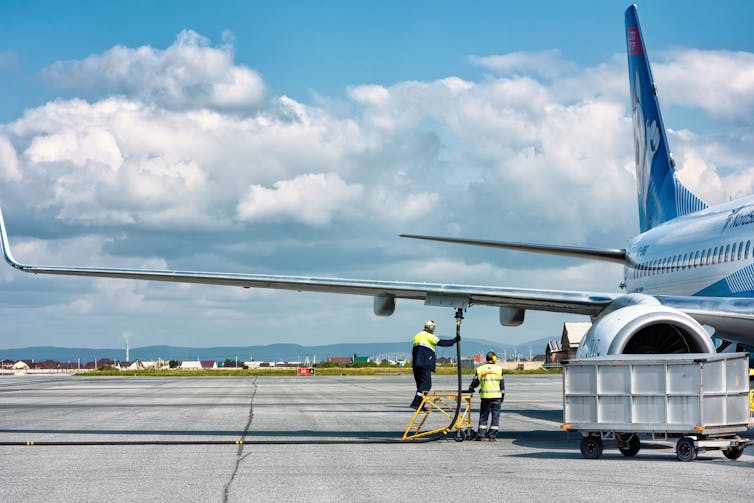
    Technicians refuel an aeroplane on the runway.
    Fuel consumption is the biggest emissions source in aviation. Sergey Ginak/Shutterstock

    “Demand-side” measures like fewer flights, taxes on frequent flying and domestic flight bans (see France) could cut emissions, he notes, but are seldom mentioned.

    The UK has set a target for airline fuel to be 10% SAF by 2030. So far we’re at 1.2% – and Sulley reports that the industry has not said how it will scale up in time.

    Even if airlines start taking their commitment to SAF seriously very soon, it’s a dubious solution to aviation’s climate impact according to political economists Gareth Dale (Brunel University) and Josh Moos (Leeds Beckett University).

    Earlier SAF test flights burned coconut oil – 3 million coconuts to power a journey from London to Amsterdam, as Dale and Moos calculate it. At that rate, they argue Heathrow would exhaust the world’s entire crop in a few weeks (there are 18,000 commercial airports worldwide).

    Modern SAF is blended with waste products from farms and kitchens. But the pair argue that the market for used cooking oil is “notoriously unregulated”. SAF may in fact be relabelled palm oil from plantations that are erasing orangutan habitat in the tropics. Again, Dale and Moos argue there is not enough used cooking oil to meet existing, let alone future, demand.

    Transport for the rich, by the rich

    At least the hype around SAF addresses the main problem, albeit misleadingly. Policy experts David Howarth (University of Essex) and Steven Griggs (De Montfort University) marvel at how often “carbon-neutral airports” in aviation sustainability strategies simply mean terminals powered by renewable energy.

    “A terminal’s heating or lighting is, of course, largely irrelevant when its core business is as emissions-intensive as flying,” says Sulley.

    Unfortunately for Rachel Reeves, a 2023 report by the New Economics Foundation found that any economic benefits of airport expansion will be largely confined to the airports themselves. Meanwhile, a wealthy subset of UK society can be expected to capture the biggest share of any new flight capacity. Each year, around half of British residents do not fly at all, Sulley points out.

    At the stratospheric heights of that subset are the private jet passengers who are served by “more or less dedicated airports” that are more obscure to the general public, says Raymond Woessner, a geographer at Sorbonne Université. A study published in November found that emissions from these flights rose by 46% between 2019 and 2023. The lead author described wealthy passengers using jets “like taxis”.

    “Discretion and anonymity” is what one airport nestled in the Oxfordshire countryside promises for “routine celebrity, head of state and royal visits”. Without state direction or regulation, it is these people who are setting the agenda for air travel.

    Woessner notes that the world’s richest man, Elon Musk, successfully lobbied to derail a high-speed rail project in California in 2013. Instead of an option that has shown its ability to cut flight demand, the US will be offered intercontinental rocket travel.

    Musk’s company SpaceX says that rockets could ferry passengers between New York and Shanghai in under an hour. Rockets would burn “vastly more fuel per trip than conventional aircraft”, says aerospace engineer Angadh Nanjangud of Queen Mary University of London, but this might “drive critical research into carbon-neutral” methane-based rocket fuel.

    It would not be the first time an industry seeking to grow has used an as yet fantastical fuel to justify more carbon in Earth’s atmosphere.

    “There is the potential to create a good life for all within planetary boundaries,” say Dale and Moos.

    “But getting there requires clipping the wings of the aviation industry.”

    Jack Marley, Environment + Energy Editor, The Conversation

    This article is republished from The Conversation under a Creative Commons license. Read the original article.

    Orcas comment on killer apes destroying the planet by continuing to burn fossil fuels.
    Orcas comment on killer apes destroying the planet by continuing to burn fossil fuels.
  • Ministers warned to stop the rush to ‘political suicide’

    Spread the love

    https://morningstaronline.co.uk/article/ministers-warned-to-stop-the-rush-to-political-suicide

    Chancellor of the Exchequer Rachel Reeves at the Confederation of British Industry (CBI) conference at the QEII Centre, London, November 25, 2024

    Leading left MP and former shadow chancellor John McDonnell issued the warning to Rachel Reeves as the Chancellor returned from her China trip to confront the bond market crisis.

    Mr McDonnell, presently suspended from the Labour whip for opposing the cruel two-child benefit cap, told BBC radio: “There is obviously a problem.

    “There’s turbulence in the international markets, and we’ve just got to see those through.

    “You don’t turn to cuts, certainly, because not only will that be politically suicidal, that would undermine the political support upon which Labour got elected.

    “In addition to that, you would be taking demand out of the economy, and you would be looking at turning a crisis into a recession.

    “So I think you just have to see through the turbulence in the markets.”

    Mr McDonnell also reminded the government that voters matter more than markets.

    https://morningstaronline.co.uk/article/ministers-warned-to-stop-the-rush-to-political-suicide