Tag: disease

  • ‘Horror Is Growing By the Minute,’ Says Rights Group, as Israel Starves Gaza

    Spread the love

    Original article by JULIA CONLEY republished from Common Dreams under Creative Commons (CC BY-NC-ND 3.0). 
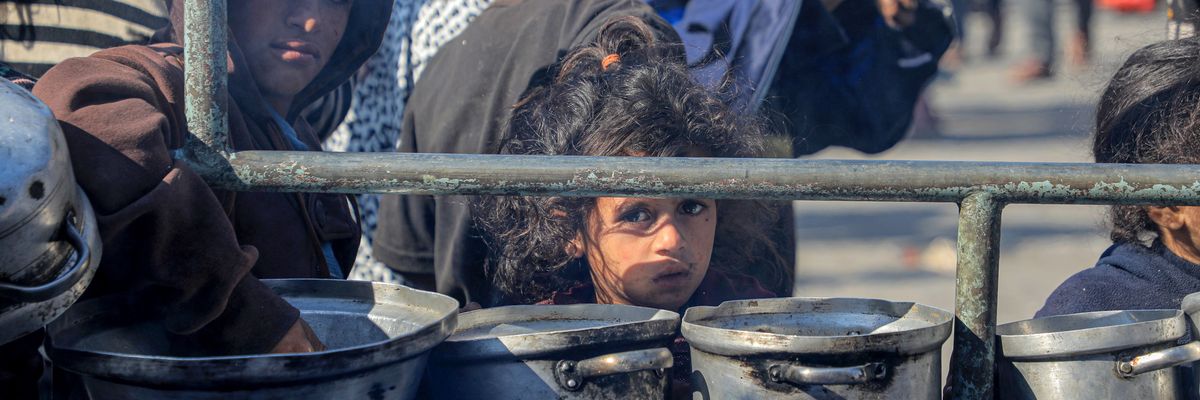
    Children wait for food relief in the southern Gaza Strip city of Rafah on December 31, 2023. (Photo: Rizek Abdeljawad/Xinhua via Getty Images)

    “If current conditions persist,” said Israeli group B’Tselem, “there is significant risk that famine will be declared throughout the entire Gaza Strip within six months.”

    The Israeli government “can, if it chooses to,” save more than 2 million people who are starving in Gaza by ending its blockade on aid, an Israel-based human rights group emphasized in a report on Monday, condemning the country for continuing to allow just a fraction of the food needed in the enclave through border crossings as it relentlessly bombs civilian targets.

    “Everyone in Gaza is going hungry,” said B’Tselem in the dispatch, bluntly titled, “Israel Is Starving Gaza.”

    The organization pointed to a recent analysis by the Integrated Food Security Phase Classification Famine Review Committee from late last month, which found that about 93% of Gaza’s over 2 million people were suffering from “acute food insecurity” at Phase 3, while more than 15%—378,000 people—were already at the most dire classification, Phase 5, with “extreme food shortages, hunger, and exhaustion.”

    By February 7, the entire population of Gaza is expected to reach Phase 3, and “if current conditions persist,” said B’Tselem, “there is significant risk that famine will be declared throughout the entire Gaza Strip within six months.”

    “Such a declaration is made when 20% of households read Phase 5, when 30% of children suffer from extreme malnutrition, and when two adults or four children out of 10,000 die of hunger every day,” said the group.

    Before Israel began its U.S.-backed bombardment of Gaza in retaliation for Hamas’ October 7 attack, about 80% of Gaza residents relied on humanitarian aid to survive.

    Israel’s destruction of cultivated fields, bakeries, food warehouses, and factories has meant that residents now wholly depend on food supplies from outside Gaza.

    That aid is still available, B’Tselem stressed, but cannot reach people because “Israel is deliberately denying the entry of enough food to meet the population’s needs.”

    About 500 aid trucks entered Gaza daily before the assault began, but only about 120 trucks are allowed through just two crossings—Rafah and Kerem Shalom—on a daily basis.

    The Rafah crossing is a designed for passenger vehicles rather than “massive commercial transports,” and the recent opening of the Kerem Shalom crossing was “merely a token addition that has failed to alleviate the hardship,” said B’Tselem.

    “The little food that does get in is very difficult to distribute due to constant bombings, destroyed roads, frequent communications blackouts, and shelters overflowing with hundreds of thousands of [internally displaced people] crowding into smaller and smaller areas,” said the group.

    Israel’s continued blockade has resulted in “children begging for food, people waiting in long lines for paltry handouts, and hungry residents charging at aid trucks,” B’Tselem added. “The horror is growing by the minute, and the danger of famine is real.”

    Martin Griffiths, undersecretary-general for humanitarian affairs and emergency relief coordinator at the United Nations, said late last week that Israel’s air and ground assault on Gaza has rendered the enclave “uninhabitable.”

    “A public health disaster is unfolding,” said Griffiths. “Infectious diseases are spreading in overcrowded shelters as sewers spill over. Some 180 Palestinian women are giving birth daily amidst this chaos. People are facing the highest levels of food insecurity ever recorded. Famine is around the corner.”

    “For children in particular, the past 12 weeks have been traumatic: No food. No water. No school,” he added. “Nothing but the terrifying sounds of war, day in and day out.”

    Last month, Human Rights Watch accused Israel of using starvation as a “method of warfare”—a war crime according to international humanitarian law.

    “Changing this policy is not just a moral obligation,” said B’Tselem. “Allowing food into the Gaza Strip is not an act of kindness but a positive obligation under international humanitarian law: Starvation as a method of warfare is prohibited, and when a civilian population lacks what it needs to survive, parties to the conflict have a positive obligation to allow rapid and unimpeded passage of humanitarian aid—including food.”

    “These two rules are considered customary law,” added the group, “and violating them constitutes a war crime under the Rome Statute of the International Criminal Court.”

    Original article by JULIA CONLEY republished from Common Dreams under Creative Commons (CC BY-NC-ND 3.0). 

  • Israel is decimating Gaza’s health infrastructure as disease threatens the majority of its population

    Spread the love

    The public health situation among people displaced by Israeli attacks worsens by the day, as targeting of health workers and infrastructure continues

    Original article by Ana Vračar republished from peoples dispatch under a Creative Commons Attribution-ShareAlike 4.0 (CC BY-SA) license.

    Healthcare workers at Al-Awda hospital. Photo: Al-Awda

    The number of people infected with contagious diseases in Gaza continues to rise. The latest data from the World Health Organization (WHO) warns that 180,000 people are currently suffering from respiratory infections. Additionally, the UN’s health agency reports that 55,000 people have lice and scabies, 42,000 are experiencing various forms of skin rashes, and 136,000, half of whom are children under 5 years old, have contracted diarrhea.

    While these diseases would not be deadly under conditions with a functioning health system and adequate living conditions, in the current situation, they could be life-threatening. “Unless something changes, the world faces the prospect of almost a quarter of Gaza’s 2 million population – close to half a million human beings – dying within a year. These would be largely deaths from preventable health causes and the collapse of the health system,” estimated Devi Sridhar, Chair in Global Public Health at the University of Edinburgh, at the end of 2023.

    If a permanent ceasefire does not take immediate effect, though, things are unlikely to change, as reiterated by WHO Director-General Tedros Adhanom Ghebreyesus in a statement. WHO teams, now participating in fairly regular missions on the ground, are sending reports about overcrowding in Gaza’s hospitals and shelters. According to the Palestinian Ministry of Health, on January 4, only 9 out of 36 hospitals were partially functioning in the Strip, resulting in an average bed occupancy of 351% and 261% occupancy in intensive care units.

    Israel’s attacks on healthcare in Palestine are affecting everyone, especially the most vulnerable. Cancer and dialysis patients cannot access the specific care they need, and most have not yet been transferred to hospitals abroad as announced. The Ministry of Health estimates that 5,300 patients need to be transferred abroad for treatment, but until January 5, less than 1,000 were moved. This number includes 571 people injured in the attacks and 401 patients who required distinct forms of care, including cancer patients.

    Children and pregnant women are also groups most at risk from the attacks and their consequences. Over 5,000 babies were born in Gaza just last month, all requiring adequate care and nutrition. With mothers and families going hungry, it is evident that some of them are also lacking proper food. Among the newborns are about 130 premature babies dependent on incubators, yet most incubators are located in northern Gaza, which, in terms used by the WHO, has become a medical disaster zone.

    In addition to going hungry and sleeping in overcrowded tents, newborns and children are also not getting vaccinated. Recounting the experience of a woman who recently gave birth, Nareman, who was “taken from her tent in a temporary camp by horse-drawn carriage to a hospital to give birth to her daughter, before returning to her makeshift home straight after,” the WHO warned that the health system in Gaza is struggling to ensure standard immunization routines. Nareman’s baby is among those who are yet to receive planned vaccines, and she is staying with her sisters and brothers at the camp, who are reportedly in ill health themselves.

    The UN Relief and Works Agency for Palestine Refugees in the Near East (UNRWA) has managed to deliver 600,000 key vaccines into Gaza in the period between December 25-29, 2023, and is planning to deliver some 960,000 more together with WHO and UNICEF. Yet, this is no easy feat as Israeli Occupying Forces (IOF) continue to target health infrastructure and health workers. Since the beginning of the attacks on October 7, 326 health workers in Palestine were killed by Israeli attacks, 764 were injured, and 65 were arrested, according to Ministry of Health data.

    Many more experienced violence and intimidation by the IOF, including ambulances and partners of the Palestinian Red Crescent Society (PRCS). On January 4, Israeli soldiers attacked a PRCS ambulance. Not long before that, the organization reported attacks targeting the house of Anwar Abu Holi, Director of the Central Gaza Ambulance Center, as well as multiple attacks on the Al-Amal Hospital in Khan Younis.

    As shelling in the proximity of the hospital began, Al-Amal offered shelter to approximately 14,000 forcibly displaced people. The attacks, said the PRCS, endangered the lives of thousands. “The displaced persons are living in an atmosphere of horror and panic.”

    The attacks that have taken place since the beginning of January killed 7 people, including a days-old baby, injured 11 more, and were reported by the PRCS to be ongoing on January 5, without a meaningful indication they would stop anytime soon.

    Original article by Ana Vračar republished from peoples dispatch under a Creative Commons Attribution-ShareAlike 4.0 (CC BY-SA) license.

  • Israel Orders Palestinians to Flee Parts of Southern Gaza, Continues Attacks on Hospitals

    Spread the love

    Original article republished from DEMOCRACY NOW! under a Creative Commons Attribution-Noncommercial-No Derivative Works 3.0 United States License.

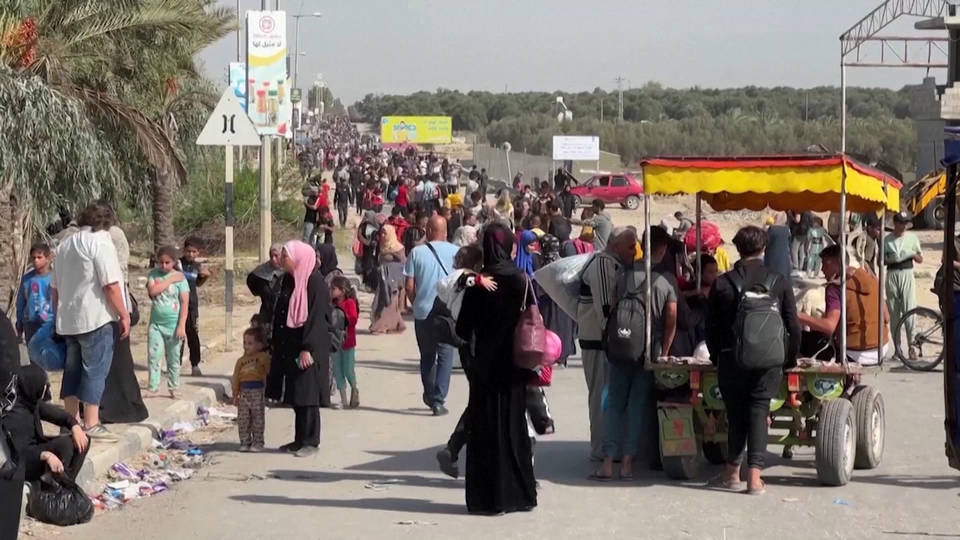
    Dozens of Palestinians have been killed in a 41st consecutive day of unrelenting attacks by Israel’s military on the Gaza Strip. Overnight, Israel’s Air Force dropped leaflets over parts of the southern city of Khan Younis ordering people to leave their homes and shelters “for their own safety.” Many are being expelled for a second time, after Israel last month ordered more than a million Palestinians to leave their homes in northern Gaza.

    On Wednesday, Israeli authorities allowed the first shipment of fuel into the Gaza Strip since early October. The U.N.’s agency for Palestinian refugees, UNRWA, says just over 6,000 gallons of fuel — half a tanker truck’s worth — was allowed to cross from Egypt. That’s just 9% of what UNRWA says is needed daily to sustain life-saving activities. Israel is not allowing the fuel to be used in hospitals or to power water and sewage pumps. 

    The U.N.’s human rights chief, Volker Türk, said outbreaks of disease and hunger in Gaza now appear “inevitable.” His remarks came amid a worsening humanitarian catastrophe at Gaza’s largest hospital, the Al-Shifa medical complex, which is being occupied by Israel’s army. Thousands of patients, medical workers and displaced Palestinians remain trapped inside the hospital and unable to leave. Medical workers report Israeli attacks have severely damaged Al-Shifa’s main surgery building, and about 200 people were reportedly blindfolded by Israeli troops and led away to interrogations. The World Health Organization’s Dr. Tedros Adhanom Ghebreyesus says 26 out of Gaza’s 36 hospitals are now closed due to damage from Israeli strikes or because they have run out of fuel.

    Tedros Adhanom Ghebreyesus: “Israel’s military incursion into Al-Shifa Hospital in Gaza City is totally unacceptable. Hospitals are not battlegrounds.”

    Original article republished from DEMOCRACY NOW! under a Creative Commons Attribution-Noncommercial-No Derivative Works 3.0 United States License.