Original article republished from MEMO under a Creative Commons Attribution-NonCommercial-ShareAlike 4.0 International License.
Israeli security forces demolish buildings and mosque in the Bedouin village of Umm al-Hiran, where an evacuation and demolition order has been issued for the construction of Israeli settlements, in Negev Region, Israel on November 14, 2024 [Mostafa Alkharouf/Anadolu Agency]
Israeli occupation forces have demolished more than 1,500 Palestinian structures in the occupied West Bank since the start of the year, resulting in the displacement of over 3,600 Palestinians and affecting nearly 164,000 others, according to the United Nations.
Data from the UN Office for the Coordination of Humanitarian Affairs (OCHA) reveals that between 1 January and 29 November, Israeli forces destroyed 1,528 structures, including 700 inhabited homes, 118 uninhabited homes and 398 agricultural facilities.
The demolitions have primarily targeted vulnerable Palestinian communities, displacing 3,637 people and severely impacting 163,769 others. The most affected area was the Tulkarm Refugee Camp in the northern occupied West Bank where 171 structures were destroyed, followed by the Nur Shams Refugee Camp which witnessed 118 demolitions, Jenin Refugee Camp, Jericho and other parts of the West Bank.
The Israeli government justifies these demolitions by claiming the structures were built without permits, although obtaining such permits is nearly impossible for Palestinians under the occupation’s restrictive policies.
Israeli demolition policies have escalated recently in the occupied West Bank and Jerusalem. They are intended to displace the Palestinians and expand illegal Jewish-only settlements amid the ongoing genocidal war against the Palestinian people in the occupied Palestinian territories.
It comes despite a landmark opinion by the International Court of Justice (ICJ) on 19 July, which declared Israel’s decades-long occupation of Palestinian land unlawful and called for the evacuation of all settlements in the West Bank and East Jerusalem.
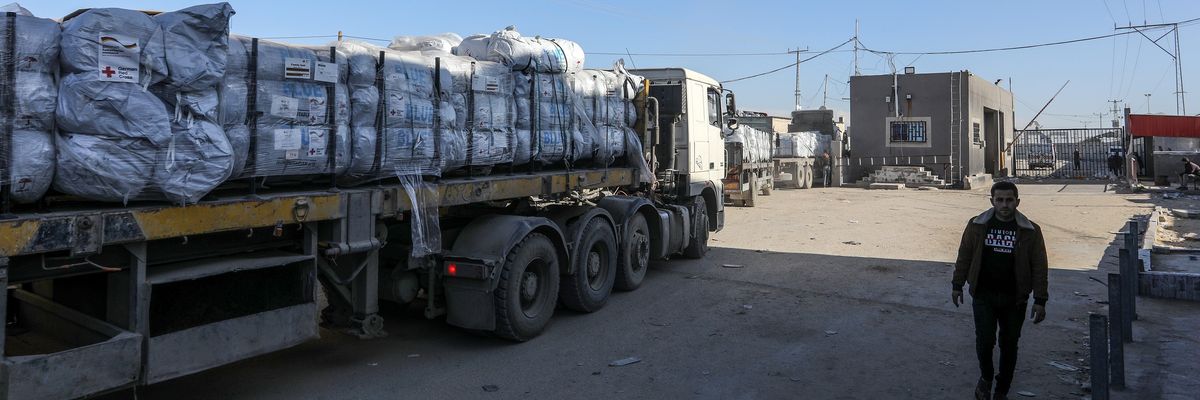
Trucks carrying aid supplies to Gaza are seen at the Karem Abu Salem border crossing on February 17, 2024. (Photo: Abed Rahim Khatib/Anadolu via Getty Images)
“Over 11 months, we have reached shocking levels of conflict, displacement, disease, and hunger,” said one campaigner.
Israel’s “complete siege” of the Gaza Strip “is driving a humanitarian disaster,” with 83% of required food aid failing to enter the embattled enclave, where the entire population is facing hunger and disease and almost half a million Palestinians are at risk of starvation, an analysis published Monday revealed.starvation,
The analysis by 15 international aid organizations noted that a record-low average of just 69 aid trucks are entering the Gaza Strip each day, compared with an already insufficient 500 daily truckloads a year ago. Additionally, the groups said that “only 17 out of Gaza’s 36 hospitals remain partially functional, and “critical infrastructure such as water networks, sanitation facilities, and bread mills” have been destroyed.
“While Israeli military attacks on Gaza intensify, lifesaving food, medicine, medical supplies, fuel, and tents have been systematically blocked from entering for almost a year,” the aid groups—which include ActionAid, American Friends Service Committee, CARE International, Christian Aid, Islamic Aid, Oxfam International, and Save the Children—said in a statement.
New data reveals: 83% of required food aid does not make it into #Gaza, up from 34% in 2023.
This means people in Gaza have gone from having an average of two meals a day to just one meal every other day.
The publication highlights numerous ways that “lifesaving aid is systematically obstructed on a daily basis” in Gaza.
“These include the denial of safety, with more than 40,000 Palestinians and nearly 300 aid workers killed since last October; the sharp tightening of a 17-year blockade to a full siege, which prevents aid from entering Gaza; delays and denials which restrict the movement of aid around Gaza; tightly restrictive and unpredictable control of imports; the destruction of public infrastructure such as schools and hospitals; and the displacement of civilians and humanitarian workers,” the analysis’ authors wrote.
Zenab, a 33-year-old Palestinian woman pregnant with her second child, said that her pregnancy “has been the hardest time of my life.”
“It was also hard to get the medication I needed,” she continued. Sometimes I had to walk for hours to different pharmacies, hospitals, and health centers to see if anyone had my medication available. For me as a pregnant woman, there has been hardly any healthcare support, no proper hygiene and sanitation, and no suitable mattress to sleep on.”
“I was suffering from complications during my pregnancy,” Zenab added. “We didn’t have enough water to drink, and had hardly any food. The doctors again told me that my pregnancy was in danger.”
Among the report’s key findings:
83% of required food aid doesn’t make it into Gaza, up from 34% in 2023;
An estimated 50,000 children aged between 6-59 months urgently require treatment for malnutrition by the end of the year;
65% of the insulin required and half of the required blood supply are not available in Gaza;
Availability of hygiene items has dropped to 15% of the amount available in September 2023, with 1 million women now going without the hygiene supplies they need;
Only around 1,500 hospital beds in Gaza remain operational, compared to around 3,500 beds in 2023 which was already well below sufficient to meet the needs of a population of more than 2 million people; and
1.87 million people are in need of shelter with at least 60% of homes destroyed or damaged as of January, yet tents for around just 25,000 people have entered Gaza since May 2024.
“There is a shortage of all humanitarian items. We are overwhelmed [with] these needs and [these] urgent requirements,” said Amjad Al Shawa, director of the Palestinian NGOs Network. “People [are] starving due to the shortage of aid. One hundred percent of the population depends on humanitarian aid.”
The authors of the analysis—which was released ahead of this week’s United Nations General Assembly in New York—are demanding that Israel secure an immediate and lasting cease-fire. They are also calling for an arms embargo on Israel and Israeli compliance with the recent International Court of Justice (ICJ) advisory opinion, which found that the occupation of Palestine is an illegal form of apartheid that must end immediately. Israel is on trial for genocide in a separate ICJ case.
“The situation was intolerable long before last October’s escalation and is beyond catastrophic now.”
“The situation was intolerable long before last October’s escalation and is beyond catastrophic now,” CARE International West Bank and Gaza country director Jolien Veldwijik said in a statement. “Over 11 months, we have reached shocking levels of conflict, displacement, disease, and hunger.”
That includes dozens of children who have died due to malnutrition, dehydration, and lack of adequate medical care.
“Aid is still not getting in, and humanitarian workers are risking their lives to do their jobs while attacks and violations of international law intensify,” Veldwijik added. “Aid, which is urgently required for 2.2 million people at risk of dying in the coming weeks and months, should never be politicized. We demand an immediate and sustained cease-fire, and the free flow of humanitarian aid into and throughout Gaza.”
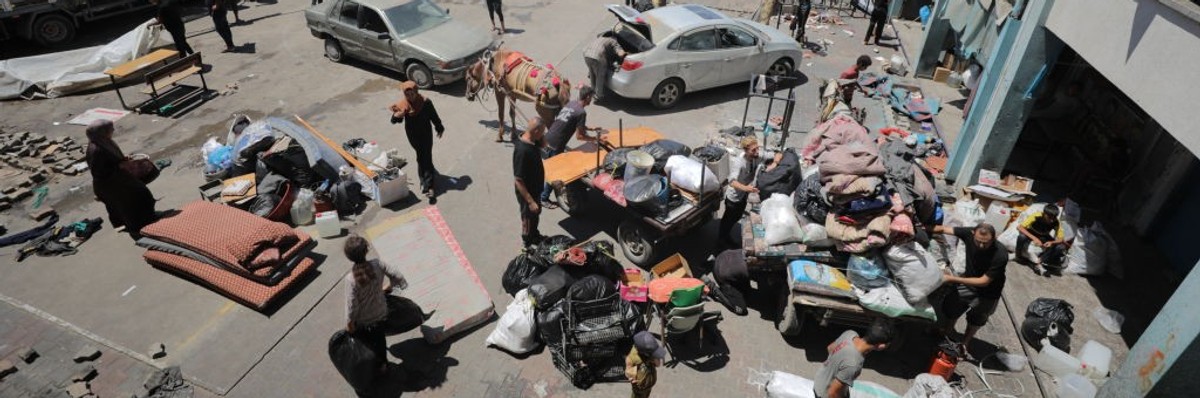
Palestinians, carrying their belongings, migrate towards areas they believe to be safer after the Israeli military issued an evacuation order for the eastern areas of Deir al-Balah in central Gaza on August 16, 2024. (Photo: Hassan Jedi/Anadolu via Getty Images)
“People remain trapped in an endless nightmare of death and destruction on a staggering scale,” the U.N. agency wrote on social media.
Following a series of evacuation orders this week, Israeli forces issued another on Friday for areas in central and southern Gaza, including “safe zones,” leaving Palestinian families gripped with fear and with “nowhere to go,” according to the U.N. Relief and Works Agency for Palestine Refugees in the Near East.
Israel’s Arabic spokesperson announced on social media that people in six neighborhood blocks in various towns, several of which were part of a proclaimed humanitarian zone, must “immediately move,” leading to a scramble of evacuations in those areas.
“Once again, fear spreads as families have nowhere to go,” UNRWA wrote on social media. “People remain trapped in an endless nightmare of death and destruction on a staggering scale.”
#Gaza: New evacuation orders have been issued by Israeli authorities, even inside the so-called “humanitarian zone”.
Once again, fear spreads as families have nowhere to go. People remain trapped in an endless nightmare of death and destruction on a staggering scale. pic.twitter.com/Myi6z6Ix87
Friday’s evacuation orders were for areas in eastern Deir el-Balah, al-Qarara, al-Mawasi, al-Jalaa, Hamad City, and Nasser, Al Jazeerareported.
An Israeli military strike on al-Mawasi, previously a humanitarian zone though long the target of Israeli strikes, killed four Palestinians including three children, the news outlet reported on Friday.
The Israeli army said Hamas had used the areas to fire mortar and rocket attacks, and explained that it had issued warning flyers and text message alerts to reduce the impact on the Palestinian civilian population, according toReuters.
Bombings and evacuations have continued this week—at least 80 Palestinians were killed in a strike on a school-turned-shelter on Sunday—even as peace talks proceeded in Doha, Qatar. A two-day session of talks finished Friday, with the United States, Egypt, and Qatar saying progress was made and they hoped to seal a deal between Israel and Hamas next week. Hamas didn’t directly participate in this week’s talks because the militant Palestinian group said Israel had added new demands to a proposal it had already agreed to in principle.
The death toll of Palestinians during the 10-month war, based on figures from Gaza’s health ministry, reached 40,000 this week—what the U.N. called a “dark milestone.”
“Most of the dead are women and children,” U.N. rights chief Volker Türk said in a statement. “This unimaginable situation is overwhelmingly due to recurring failures by the Israeli Defense Forces to comply with the rules of war.”
“On average, about 130 people have been killed every day in Gaza over the past 10 months,” he added, saying the “scale of the Israeli military’s destruction of homes, hospitals, schools, and places of worship [is] deeply shocking.”
Türk said that both Israel and armed Palestinian groups including Hamas had committed serious violations of international humanitarian law. The armed Palestinian groups killed more than 1,100 Israelis in a shocking and horrifying massacre in southern Israel on October 7 in which they also took some 250 hostages.
Israel’s sustained assault on Gaza over the last 10 months has not only killed a disproportionate number of children but also displaced most of those who’ve survived—and separated many from their families.
A report released Friday by the International Rescue Committee (IRC) documents the scale of the separation crisis and its psychological toll on unaccompanied children. UNICEF estimates that roughly 17,000 Gazan children are unaccompanied, but the IRC warns that the real figure may be much higher.
Unaccompanied youth are at risk of labor exploitation, starvation, and mental health problems that can plague them for the rest of their lives. Gazan children, shocked by the war, are “clinging to others during loud sounds, wetting the bed, having nightmares, and are wanting to sleep under the bed to feel secure,” the report says.
The Associated Pressreported Tuesday that Israeli strikes were leaving “children without parents and parents without children,” and has previously reported that the war has wiped out entire Palestinian extended families.
Israeli violence against Palestinians has not been restricted to Gaza. Israeli settlers attacked the West Bank town of Jit on Thursday night, setting fire to cars and houses, killing one Palestinian man and seriously injuring another. Jack Lew, the U.S. ambassador to Israel, said he was “appalled” by the attack and the perpetrators should be held accountable, but Israeli human rights group B’Tselem responded on social media by saying that the Israeli state and its leadership should be held accountable.
The U.N. Office for the Coordination of Humanitarian Affairs on Wednesday reported that it had recorded about 1,250 settler attacks on Palestinians since October 7. The settlements are illegal under international law, according to the International Court of Justice.
The push for a peace deal is aimed not just at ending the carnage in Gaza and defusing West Bank tensions but also preventing a wider war in the Middle East. Israel is bracing for retaliation from Iran and Hezbollah after it conducted assassinations of Hamas and Hezbollah leaders in Tehran and Beirut in late July.