This work by Middle East Monitor is licensed under a Creative Commons Attribution-NonCommercial-ShareAlike 4.0 International License
A view of a damaged building, belonged to medical charity Doctors Without Borders (MSF), following the Israeli attack in al-Mawasi, Khan Yunis, Gaza on February 21, 2024 [Ashraf Amra/Anadolu Agency]
Israeli occupation authorities have notified more than ten international humanitarian organisations that their permits to operate in the occupied West Bank and the Gaza Strip will be revoked, according to local reports.
A correspondent said the organisations affected include Doctors Without Borders and other international aid groups that are among the most active in providing humanitarian assistance in Gaza.
According to the Israeli notice, the permits will be withdrawn from 1 January 2026, and the organisations have been instructed to cease all operations by 1 March 2026.
Israeli authorities said the decision was taken because the organisations allegedly failed to complete newly required registration procedures for humanitarian work.
However, a source within one of the affected organisations said the dispute stems from an Israeli requirement that aid groups submit lists of Palestinian employees for so-called “security vetting”. The source said some organisations complied with the demand, while others refused.
Israeli authorities have claimed that some staff members working for the organisations are involved in what they described as “terrorist activity”. The source rejected the accusations, saying they are being used as a pretext to obstruct and restrict humanitarian work.
The decision is expected to result in the suspension of humanitarian operations by the affected organisations, the dismissal of hundreds of employees, and a further weakening of efforts to address the catastrophic humanitarian situation in the Gaza Strip.
Aid groups have repeatedly warned that any reduction in humanitarian presence would have severe consequences for civilians in Gaza, where basic services and lifesaving assistance already face extreme strain.
This work by Middle East Monitor is licensed under a Creative Commons Attribution-NonCommercial-ShareAlike 4.0 International License
Keir Starmer objects to criticism of the IDF. He asks how could anyone object to them starving people to death, forced marches like the Nazis did, bombing Gaza’s hospitals and universities, mass-murdering journalists, healthworkers and starving people queuing for food, killing and raping prisoners and murdering children. He calls for people to stop obstructing his genocide for Israel.Orcas discuss Genocide-supporting and complicit Zionists. Donald Trump, Keith Starmer, David Lammy, Rachel Reeves, Angela Rayner and Wes Streeting are acknowledged as evil genocide-complicit and supporting cnuts.Vote Labour for Genocide.
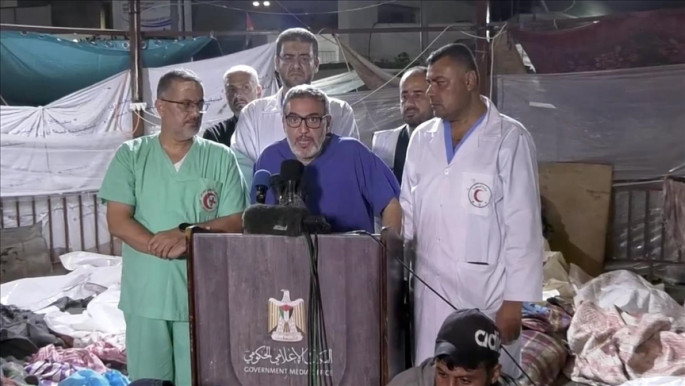
Ghassan Abu-Sittah and other health workers hold press conference after Israeli attacks on Gaza’s hospitals, October 2023. Source: Ghassan Abu-Sittah/X
A judge in a German court ruled that the ban on activity imposed on renowned Dr. Ghassan Abu-Sittah was unlawful.
The Palestine Congress in Berlin, which was organized in mid-April of last year, was violently shut down by the police on its first day, just minutes after it began. The pretext for this action, which was deemed unlawful by attorneys, was a live-stream of Palestinian historian Dr. Salman Abu Sitta.
His nephew, the doctor Ghassan Abu-Sittah, was banned from entering Germany on the morning of April 12, 2024. He had arrived on a flight from the UK, was detained and questioned for hours at Berlin airport, and then deported. He was also told that he was banned from practicing any political activities in Germany for the month of April, even from abroad. The organizers of the conference are taking legal action against the dissolution of the event, the trial of which is ongoing.
Witness to the genocide wins in Berlin
But Ghassan Abu-Sittah won a victory on Tuesday, July 15, at Berlin’s Administrative Court (Verwaltungsgericht). From the UK, the doctor had filed a lawsuit against the actions of the German authorities. The surgeon and rector of the University of Glasgow has worked as a doctor in a dozen war and crisis zones over the course of his life, including the Gaza Strip. Shortly after the genocide began in October 2023, he went there again as part of a “Doctors Without Borders” mission to provide aid at Al-Shifa Hospital. The hospital was repeatedly attacked and ultimately destroyed by the Israeli army in November 2023 and again in March/April 2024. Israeli forces massacred hundreds of doctors, patients, and refugees.
The court’s judge ruled that the ban on activity imposed on Abu-Sittah was unlawful. According to a spokeswoman for the court, there was no sufficient evidence that Abu-Sittah’s statements posed a threat to Germany’s constitutional order or public safety. In particular, the authorities were unable to produce any statements by the renowned doctor that referred positively to the Palestinian resistance’s “Al-Aqsa Flood” operation or even to possible war crimes committed by the Palestinian resistance. Even if such a danger had existed, a preventive ban on the doctor’s activities would have been disproportionate.
The spokesperson also pointed out that Abu-Sittah was heard as an eyewitness to the genocide in the International Criminal Court proceedings against Israeli government politicians, and was also announced as such at the Palestine Congress.
Racist repression
His lawyer, Alexander Gorki, explained on request: “The hearing showed that the ban on activities was unlawful from start to finish. What was to be sanctioned via the residency rights were opinions expressed by my client, who knew the situation on the ground in Gaza very well as a Palestinian and a doctor.” The court “put a stop to the abuse of immigration law”. However, the ruling will not prevent the immigration authorities from abusing their power in the future, warns the migration law expert. To counter this, “political pressure is needed”.
In fact, the repressive authorities in Germany have been using all kinds of tricks and legal means for years to bypass the courts and exert pressure on the Palestinian solidarity movement and Palestinians in Germany: from expulsions and deportations, to bans on organizing, employment bans and the cancellation of welfare benefits. Migrants and refugees with a precarious status are particularly affected. Just two weeks ago, on the orders of a court, Musaab Abu Atta, a Palestinian refugee and political activist, was released from four months of custody. The public prosecutor’s office is trying to lock him up again because of an alleged “flight risk”, even though he has a fiancée and a job in Berlin. At the same time, there are indications that they want to deport him to Syria.
Leon Wystrychowski is a former member of the Palästina Solidarität Duisburg (Palestine Solidarity Duisburg, PSDU).
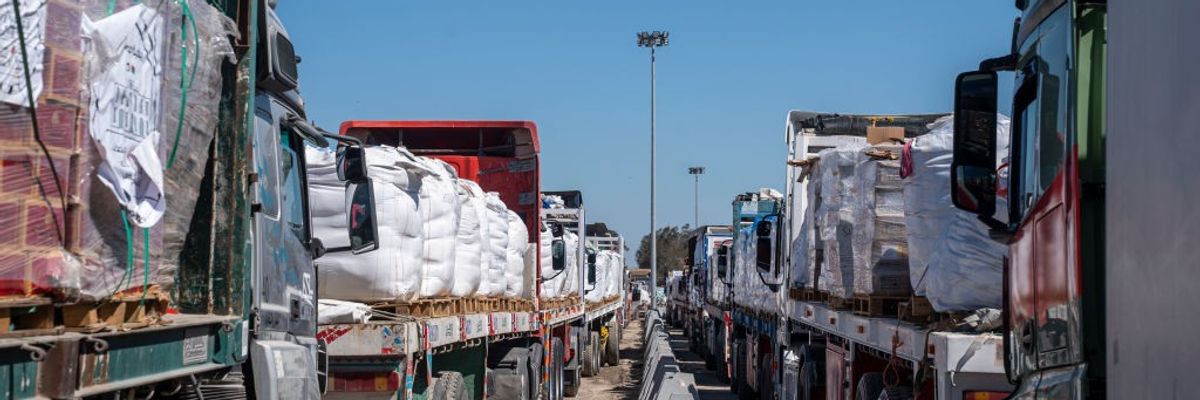
Trucks carrying aid wait in front of the Rafah border crossing on March 2, 2025 in Rafah, Egypt. The flow of humanitarian aid into Gaza has been blocked, after Israeli Prime Minister Benjamin Netanyahu’s office said Hamas had not accepted a US-proposed temporary extension to the ceasefire deal, following the expiration of the first phase on Saturday. Photo by Ali Moustafa/Getty Images
“There will be famine and chaos”
Israel has reneged on the existing ceasefire agreement they had agreed to with Hamas. The first phase of the ceasefire expired Saturday and Israel announced on Sunday it is halting all humanitarian aid and fuel deliveries to Gaza and closing the border between Israel and Gaza. Israeli Prime Minister Benjamin Netanyahu said on Sunday that he made the decision “in full coordination with President Trump and his people.”
In a statement Hamas called the suspension of aid a “war crime” and a violation of the ceasefire agreement. It said Netanyahu’s “decision to suspend humanitarian aid is cheap blackmail, a war crime and a blatant coup against the [ceasefire] agreement”.
Stephen Zunes, the director of Middle Eastern studies at the University of San Francisco, says the US’s apparent proposal favoring Israel follows a well-established pattern seen since the beginning of the war.
“This is typical,” he told Al Jazeera. “Hamas and Israel will agree to something. Then Israel will try to revise it in its favor. Then the US will put forward a new proposal that is in Israel’s favor and then the US will blame Hamas for not accepting that proposal.”
Israel’s decision to block all aid going into the Gaza Strip is a war crime under international law, a human rights expert says.
Kenneth Roth – former head of Human Rights Watch who is now a visiting professor at Princeton University – said Israel as an occupying power has an “absolute duty” to facilitate humanitarian aid under the Geneva Conventions.
“Israel’s latest threat to cut off all aid is a resumption of the war-crime starvation strategy” that led to the arrest warrant for Prime Minister Benjamin Netanyahu by the International Criminal Court, he said.
Doctors Without Borders said Israel’s decision is “outrageous and will have devastating consequences”, said the group’s emergency coordinator Caroline Seguin.
“Humanitarian aid should never be used as a tool of war,” added the charity, known by its French acronym MSF, in a statement. “Regardless of negotiations between warring parties, people in Gaza still need an immediate and massive scale-up of humanitarian supplies.”
Jeremy Corbyn, who once led the UK Labour Party, said that Israel’s blocking of humanitarian aid was a “resumption of genocide”, before adding that the current British government – led by Labour – was “complicit.”
Fayza Nassar, a woman living in the heavily destroyed urban Jabaliya refugee camp, said the closure would exacerbate already dire living conditions.
“There will be famine and chaos,” she said. “Closing the crossings is a heinous crime.”
Israel’s offensive has killed at least 48,388 Palestinians, according to Gaza’s Health Ministry. It says more than half of those killed were women and children.
Israel’s decision to halt aid into Gaza is alarming.
International humanitarian law is clear: We must be allowed access to deliver vital lifesaving aid.
We can’t roll back the progress of the past 42 days. We need to get aid in and the hostages out.
Israel's new cutoff of humanitarian aid to Gaza as a tactic to pressure Hamas is a resumption of the war-crime starvation strategy that led the International Criminal Court to file charges against Netanyahu and Gallant. https://t.co/GcoYeB80GC
BREAKING: MSF strongly denounces Israel’s announcement to block aid into Gaza.
Humanitarian aid should never be used as a tool of war. Regardless of negotiations between warring parties, people in Gaza still need an immediate and massive scale-up of humanitarian supplies.… pic.twitter.com/NhOWoRDbrU
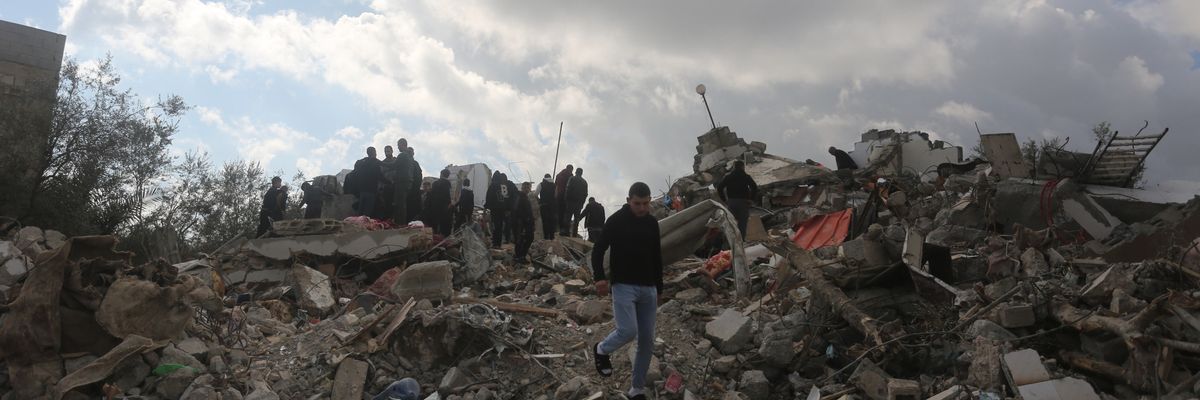
Palestinians inspect the rubble of a house after an Israeli airstrike in the village of Burqin in the West Bank on January 23, 2025. (Photo: Nasser Ishtayeh/SOPA Images/LightRocket via Getty Images)
“This echoes the tactics Israeli forces have employed in Gaza.”
Israeli Defense Minister Israel Katz said Wednesday that Israel’s military is applying “lessons” learned during its bombardment of Gaza to recent attacks on the West Bank—and a leading human rights group warned that as in Gaza, the Israel Defense Forces’ actions are resulting in “significant humanitarian consequences.”
Operations like “Iron Wall” in the West Bank refugee camp of Jenin and a “surge in settler attacks” that have been backed by the IDF “have heightened insecurity, displacement, and severe restrictions on Palestinian freedom of movement,” said the Norwegian Refugee Council (NRC) on Thursday.
Iron Wall began Tuesday, with the IDF launching airstrikes and ground attacks in the West Bank two days after a cease-fire took effect in Gaza.
At least 12 Palestinians have been killed in the Iron Wall attacks and 40 people have been injured, including medical workers, according to the Palestinian Ministry of Health.
After months of warnings from rights organizations that the IDF cut off access to essential services for Gaza residents with a near-total humanitarian aid blockade and the relentless bombardment of the enclave, the NRC said that Israeli forced have “increased checkpoints, roadblocks, and other physical barriers throughout the West Bank.”
“These measures further fragment Palestinian communities, restrict access to essential services, and prevent humanitarian agencies, like NRC, from reaching the communities we serve,” said the group.
The latest violence in the West Bank is part of a broader trend, with Israel having begun launching airstrikes in the territory after October 7, 2023, for the first time since the Second Intifada in 2000-05.
The IDF launched Iron Wall in Jenin two weeks after a shooting attack that Israel blamed on gunmen in the refugee camp, which has long been a hub for Palestinian resistance groups and is also home to more than 24,000 Palestinians who are registered in the camp.
Katz said in a statement Wednesday that with the Jenin raid, the IDF is applying “the first lesson from the method of repeated raids in Gaza.”
“We will not allow the arms of the Iranian regime and radical Sunni Islam to endanger the lives of [Israeli] settlers [in the West Bank] and establish a terrorist front east of the state of Israel,” he said.
In addition to the attacks in Jenin, masked Israeli settlers have been filmed setting fire to homes and vehicles in towns across the Israeli-occupied territory in what the Israel-based human rights group B’Tselem called an effort to “impose a ‘price tag’ for the release of Palestinians” as part of the cease-fire agreement in Gaza.
Residents told Al Jazeera that “constant gunfire and explosions” have been heard in Jenin since Iron Wall began, and the United Nations Relief and Works Agency for Palestine Refugees in the Near East (UNRWA) reported that the IDF has left the camp “nearly uninhabitable.”
An estimated 2,000 families have been displaced from the Jenin area since December, according to the agency.
“We are seeing disturbing patterns of unlawful use of force in the West Bank that is unnecessary, indiscriminate, and disproportionate. This echoes the tactics Israeli forces have employed in Gaza,” said Angelita Caredda, NRC’s Middle East and North Africa regional director. “Under international law, Israel must bring its occupation of Palestinian territory to an end as rapidly as possible. Until then, it must fully comply with its obligations as an occupying power, including the protection of civilians.”
In addition to airstrikes and ground attacks, the governor of Jenin, Kamal Abu al-Rub, told Agence France-Presse that Israeli military bulldozers have destroyed all roads leading to the camp and to the nearby hospital. Twenty Palestinians from villlages in the Jenin area have been detained since Iron Wall began on Tuesday, according to the governor.
“What we are seeing in Jenin camp is horrific, said one paramedic trained by Doctors Without Borders. “People are targeted while being evacuated, and the wounded cannot be reached by ambulance.”
In 2024, Israeli demolitions in the West Bank reached a record high, said the NRC, with 1,768 structures destroyed. IDF soldiers and settlers killed at least 499 Palestinians in the territory last year.
U.S. President Donald Trump has selected at least two nominees for high-level diplomatic positions—Rep. Elise Stefanik (R-N.Y.) for U.N. ambassador and former Arkansas Gov. Mike Huckabee for ambassador to Israel—who have expressed support for right-wing Israeli officials’ claim that Israel has a “Biblical right” to the West Bank.
Amid the settler violence and Jenin raid, Caredda called on the international community to “take decisive action to stop these violations and end the occupation.”
“Impunity for serious violations of international law has allowed Israel to unlawfully escalate violence in the occupied West Bank,” said Caredda.
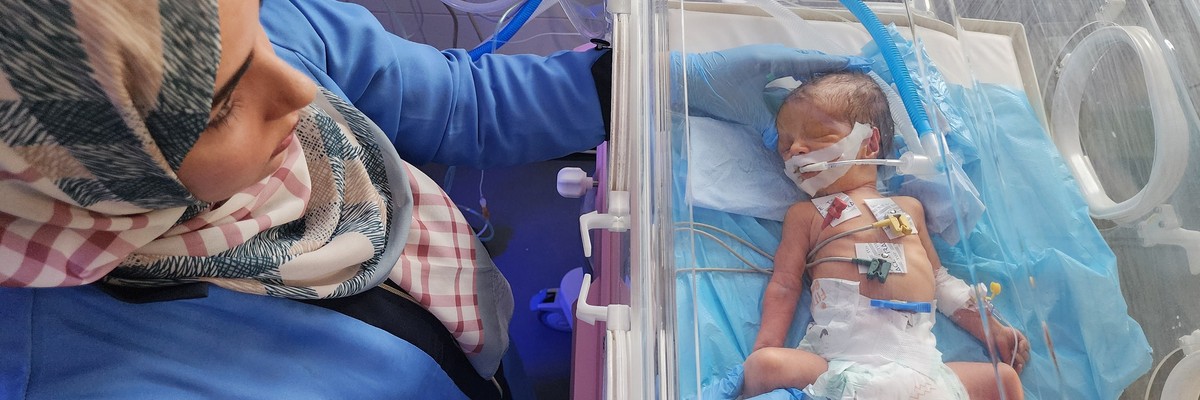
Newborn, baby and child patients are deprived of necessary treatment due to power crisis and lack of medicines as Israeli forces cutting off electricity, preventing the entry of fuel and various supplies disrupted the functioning of all hospitals in the region, at the Nasser Hospital in Khan Yunis, Gaza on July 04, 2024. (Photo: Hani Alshaer/Anadolu via Getty Images)
“It’s an impossible situation, because even if we prioritize the little fuel that is left to the most urgent departments, we know that they won’t last more than 36 to 48 hours,” said Julie Faucon, MSF medical team leader in Gaza.
The international humanitarian group Médecins Sans Frontières, also kno wn as Doctors Without Borders or MSF, warned in a Wednesday statement that newborn babies and other patients are at dire risk as southern Gaza’s Nasser Hospital runs out of fuel.
The group warned that electricity for the MSF-supported Nasser Hospital, where MSF members are providing emergency, maternity, pediatric, burn, and trauma care, may be cut off for some hospital departments leaving patients without “lifesaving care.” The hospital’s neonatal intensive care unit is currently treating children and newborns who are reliant on mechanical ventilation and incubators. All of these young patients are dependent on electricity from fuel generators, MSF wrote.
Nasser Hospital, as well as two other facilities in the Gaza Strip, Al-Aqsa Hospital and European Gaza Hospital, are nearing the need to close due to lack of fuel, the group reported Wednesday.
“It’s an impossible situation, because even if we prioritize the little fuel that is left to the most urgent departments, we know that they won’t last more than 36 to 48 hours,” said Julie Faucon, MSF medical team leader in Gaza, according to the statement. “While some patients are hanging on by a thread, the lack of sustained electricity is impacting the level of care we can provide to those with burns and trauma.”
Pascale Coissard, MSF emergency coordinator, said that the situation is “a consequence of Israel’s ongoing blockade and continuous criminal looting of lifesaving supplies.”
In mid-July, the United Nations reported that “Israeli authorities continue to tightly control allocations of incoming fuel, thereby limiting humanitarian operations, especially by local partners,” and just last week the body noted that only 16 of the region’s 36 hospitals remained partially in operation.
Pointing to lack of medical supplies, equipment, and personnel, Rik Peeperkorn, the World Health Organization representative for the West Bank and Gaza, told a recent U.N. Security Council meeting that “the health sector is being systematically dismantled.”
Attacks by the Israeli military have left northern Gaza’s three hospitals—the Kamal Adwan Hospital, al-Awda Hospital, and the Indonesian Hospital—either entirely out of service or barely functioning.
Hussam Abu Safia, the head of the Kamal Adwan Hospital, was detained by Israeli forces during their raid on Kamal Adwan Hospital in late December.
Human rights defenders and the medical community have called for his release, it’s believed that he is being held in an Israeli detention center, though the Israeli officials had given news media and human rights groups conflicting messages about his whereabouts.