Tag: Emmanuel Macron

  • Macron was right, and the scapegoats were chosen

    Spread the love

    This work by Middle East Monitor is licensed under a Creative Commons Attribution-NonCommercial-ShareAlike 4.0 International License. 

    French President Emmanuel Macron at the Elysee Palace in Paris, France on October 13, 2026. [Mustafa Yalçın – Anadolu Agency]

    Emmanuel Macron’s phrase landed like a cracked whip in the stale air of Western politics. “As unacceptable as they are stupid.” The target was not immigration policy, but a lie — the claim, amplified by Donald Trump and a chorus of right-wing figures, that Muslim migrants had set France alight. The protests that swept Paris, Lyon and Marseille were not a civilisational invasion. 

    They were a cry about grocery bills, overcrowded classrooms and a state that had cut 4,000 teaching posts while fuel prices climbed. Macron’s fury was therefore more than a defence of immigrants. It was a rejection of the most durable political technology of the age: the conversion of economic failure into cultural panic.

    The mechanics are almost elegant in their cynicism. When wages stagnate, and public services buckle, the scapegoat is not the tax code or the corporate margin. It is the most visible minority. Trump told Macron to “close your borders and take control before it is too late”. The facts said otherwise. 

    More than half a million people marched — students, trade unionists, farmers — against the cost of living and the decay of public provision. The violence was real, but the culprits were not a religious category. They were a political economy that has spent four decades redistributing risk downward while protecting wealth upward.

    The digital architecture of 2026 has made this old manoeuvre infinitely more potent. AI-generated images of an elderly couple “stripped and robbed,” of a Palestinian flag atop the Eiffel Tower, of “hordes” storming French streets, accumulated millions of views in hours. Macron named the mechanism precisely: foreign leaders, some mid-election campaign, “naively repeat AI-generated content or spread narratives that certain circles are clearly trying to promote”. 

    The grammar of the “Muslim threat” is centuries old; the delivery system is new. What once required a pamphlet or a tabloid now requires a prompt and an algorithm optimised for outrage.

    READ: Macron says France to deploy forces to protect Saudi oil export port

    Against this manufactured panic sits an empirical reality that is almost impolite to state.

    The OECD finds that 77 per cent of immigrants across its member states are economically active, and that migration attenuates labour shortages in ageing societies.

    Bruegel’s 2025 analysis is blunter still: with fertility rates unlikely to rebound, “continuingly high positive net-migration levels” are the only route to mitigate the economic effects of ageing, and inward migration can deliver a positive net contribution to public finances. 

    In Spain, the net annual fiscal contribution of the average immigrant has been estimated at some €1,600 more than the native-born, while costing the treasury 32 per cent less. The scapegoat, in other words, is subsidising the very state that is being told to fear him.

    France’s security apparatus tells a more troubling story about how the panic is institutionalised. The FSPRT file — the register of suspected Islamist radicalisation — contained some 15,800 individuals as of late 2024. The database does not measure crime; it measures risk, and risk is a category that expands to fill the political demand for it. When a state can see a population through the lens of pre-emptive suspicion while remaining structurally blind to the socioeconomic composition of a protest, it has perfected a form of strategic unknowing. 

    The Muslim is legible as a suspect, illegible as a citizen with a grievance. That asymmetry is not a bug in the liberal state. It is a feature of how the liberal state has learned to govern insecurity.

    This is where the global conversation must resist the imported script — and recognise that the script is no longer imported at all. It is written simultaneously in every major democracy.

    In the United States, Gallup found in June 2026 that 73 per cent of Americans still see immigration as a good thing, and that the share wanting less immigration had fallen from a peak of 55 per cent in 2024 to 30 per cent — yet the political class continues to behave as if the opposite were true. 

    In Europe, the Transatlantic Trends survey records that 47 per cent of Europeans and 50 per cent of Americans see immigration as more of a problem than an opportunity, with the divide sharpest among those without a secondary education and those who have no personal contact with migrants. In Berlin, where 85 per cent of households rent, advertised rents have nearly doubled since 2014, and the far-right AfD has converted the housing crisis into an argument for restricting immigration, reaching around 17 per cent in city polling. 

    In Canada, Nanos Research found 52 per cent of respondents favour admitting fewer immigrants and temporary residents, with housing shortages, strained public services and the cost of living cited as the drivers — even as population growth slowed sharply. The proximate grievances are real and material: housing scarcity, wage stagnation, underfunded hospitals and schools. 

    But the moment those grievances are translated into a cultural threat narrative. These solutions might actually work — denser cities, a functioning care economy, a tax base that funds public infrastructure, sectoral bargaining that lifts wages — are displaced by a politics of exclusion that leaves the underlying failure untouched and the underlying distribution of power intact. The scapegoat is not a misunderstanding of the crisis. It is a substitute for solving it.

    READ: France summons Iranian ambassador over alleged disinformation on student protests

    The far-right playbook now travels with a translation layer. The Guardian documented nationalist parties from the National Rally to Vox to Chega seizing on the same European unrest, each converting a housing or cost-of-living protest into evidence of “anarchic immigration” or an “uncontrolled influx”. The script is modular. Only the cast changes.

    Macron’s own record is compromised. His governments have passed anti-separatism laws that Muslim civil society experienced as a targeted gaze, and his defence of French Muslims against foreign slander sits awkwardly beside domestic policies that have often treated Islamic practice as a problem to be administered. That contradiction matters, because it reveals the deeper trap. 

    The liberal centre condemns the crudest scapegoating while maintaining a softer, more respectable version of the same logic: integration as cultural erasure, security as a permanent suspicion. The choice is not between Trump’s panic and Macron’s laïcité. It is between a politics that names the real sources of anger and one that keeps looking for a minority to absorb it.

    The lesson is not that immigration is costless or that every grievance is economic. It is that the political economy of scapegoating is now more profitable than the political economy of repair. A party that blames a migrant for a hospital queue need not explain why the hospital was starved of capital. A leader who warns of an Islamist takeover need not account for the energy shock, the fiscal squeeze or the algorithmic amplification that turned a local protest into a civilisational melodrama. 

    The costs of that evasion are not borne by the scapegoater. They are borne by the Muslim family in a Paris banlieue, the asylum seeker in a Mediterranean detention centre, the working-class neighbourhood in Ohio or Saxony told that its neighbours are the cause of its decline. They are borne by every community invited to trade solidarity for suspicion, and by every democracy that discovers, too late, that the anger it mobilised cannot be contained by the institutions it hollowed out.

    Macron’s word — stupid — was undiplomatic and precise. It named an intelligence failure disguised as a political strategy. The task for policymakers is to make that strategy expensive. That means provenance and transparency in digital information, so that fabricated images carry a cost. It means fiscal and industrial policy that makes migration’s contribution visible in the public ledger, not merely in think-tank working papers. It means a security architecture capable of distinguishing suspicion from citizenship. 

    And it means a political language that treats the cost-of-living crisis as a crisis of distribution, not of demography. The scapegoat is a substitute for argument. The only antidote is the argument itself — conducted with the courage to name who actually benefits when the crowd is pointed at the wrong gate.

    OPINION: When diplomacy arrived in Jakarta and justice did not

    The views expressed in this article belong to the author and do not necessarily reflect the editorial policy of Middle East Monitor.

    Donald Trump sings and dances, says that it's fun to kill everyone ... unless he gets distracted or falls asleep.
    Donald Trump sings and dances, says that it’s fun to kill everyone … unless he gets distracted or falls asleep.
    Orcas discuss rotting brain, front Orca says Sundown Syndrome is a dead givaway and he wishes someone would Lock Him Up
    Orcas discuss rotting brain, front Orca says Sundown Syndrome is a dead givaway and he wishes someone would Lock Him Up

  • Morning Star Editorial: Trump won’t stop here. Britain must break with him

    Spread the love

    https://morningstaronline.co.uk/article/trump-wont-stop-here-britain-must-break-him

     President Donald Trump listens as he was speaking with reporters while in flight on Air Force One, Sunday, Jan. 4, 2026, as returning to Joint Base Andrews, Md

    THIS doesn’t end here. Unless the United States faces consequences for what it is doing in Venezuela it will do it, or try to, again and again.

    It says so itself — one reason Keir Starmer, Friedrich Merz, Emmanuel Macron and other Trump appeasers appear so ridiculous.

    When Trump in his first term blurted out that US forces were in Syria “only for the oil,” his allies’ embarrassment could be glossed over by a media unwilling to expose years of its own propaganda about humanitarian interventions and counter-terror operations.

    Not now. Trump kidnaps a head of state and then announces Washington will “run” his country.

    What does that mean? Well, what remains of the Venezuelan government must grant Washington “total access. We need access to the oil and to other things in their country.” What if Venezuela’s Vice-President Delcy Rodriguez won’t do as she’s told? She’ll face “a situation worse than Maduro.” Maybe killed in the kidnapping operation, like the 32 brave Cuban soldiers who died defending her boss.

    The Trump White House narrative is in our faces every day. Who can take seriously Merz’s call for an explanation on how US actions are justified in international law, when Secretary for War Pete Hegseth vows to pursue “maximum lethality not tepid legality?” The politicians of the old Washington Consensus merely look pathetic through their “hear no evil, see no evil” approach to the new one.

    Hence the backlash against Starmer’s feeble fence-sitting, involving MPs well beyond the socialist left (such as Emily Thornberry), the TUC and the rapidly growing Greens.

    There are half-hearted efforts to depict Venezuela as a special case. But again the Trump White House’s loudmouth assertions undermine the pretence.

    Attacking Colombia and removing its elected president “sounds good to me,” says Trump. Cuba’s government is “going down.” The US “has to do something with Mexico,” “needs Greenland, absolutely.”

    …

    Article continues at https://morningstaronline.co.uk/article/trump-wont-stop-here-britain-must-break-him

    Donald Fuhrump says that Amerikkka doesn't bother with crimes or charges anymore, not being 100% Amerikkkan and opposing his real estate intentions is enough.
    Donald Fuhrump says that Amerikkka doesn’t bother with crimes or charges anymore, not being 100% Amerikkkan and opposing his real estate intentions is enough.
    Elon Musk urges you to be a Fascist like him, says that you can ignore facts and reality then.
    Elon Musk urges you to be a Fascist like him, says that you can ignore facts and reality then.
    Orcas discuss how Trump was re-elected and him being an obviously insane, xenophobic Fascist.
    Orcas discuss how Trump was re-elected and him being an obviously insane, xenophobic Fascist.

  • ‘Macron Get Out!’ Unions Lead Massive Anti-Austerity Protests Across France

    Spread the love

    Original article by Jessica Corbett republished from Common Dreams under Creative Commons (CC BY-NC-ND 3.0). 

    At least hundreds of thousands of protesters poured into the streets across France on September 18, 2025 to protest proposed austerity measures. (Photo by Sébastien Delogu/X)

    “We’re in a situation of injustice,” one protester said. “Workers can no longer feed themselves, students no longer have future prospects.”

    Echoing demonstrations against French President Emmanuel Macron’s pension reforms two years ago, hundreds of thousands of people joined protests across France on Thursday, outraged by the government’s proposed austerity measures.

    While the CGT trade union—one of several labor groups that pushed for the mass mobilization—put the count at over 1 million, French authorities, whose figures are usually much lower than unions, said more than 500,000 demonstrated nationwide, including 55,000 in Paris.

    Thursday’s demonstrations followed last week’s ”Block Everything” protests, which coincided with French Prime Minister Sébastien Lecornu’s first full day in office. Macron picked Lecornu, his ally and a former defense minister, for the post after François Bayrou lost a no-confidence vote in the National Assembly over the budget plan.

    Although “Lecornu quickly scrapped one of the most unpopular proposals—eliminating two public holidays—he has not ruled out the rest,” Euronews noted Thursday. “These include an overhaul of unemployment benefits, delinking pensions from inflation, and raising out-of-pocket medical costs.”

    A protester named Alexandre told Euronews that “right now, we have a government that doesn’t listen to us and is even the opposite of what the population needs. A government that robs fellow citizens, and it’s important for everyone to mobilise, for the people of France who want to be dignified and who also want to give others their dignity throughout the world.”

    “We’re in a situation of injustice,” he added. “Workers can no longer feed themselves, students no longer have future prospects.”

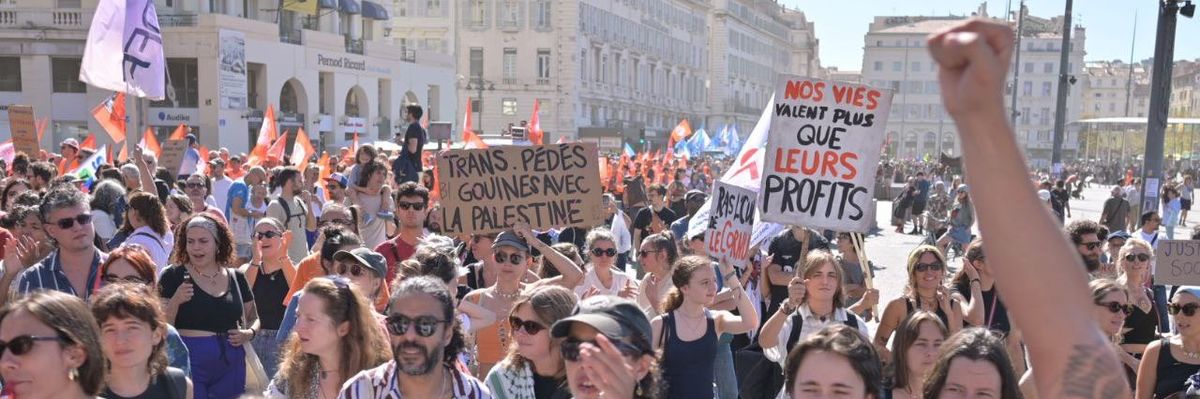
    Hospital staff, railway workers, students, and teachers were among those who poured into the streets across France—including major actions in cities such as Lyon, Marseille, and Paris—rallying behind the message: “Strikes, Blockades, Macron Get Out!”

    The Public Service Ministry said that nearly 11% of France’s 2.5 million state employees were on strike. According to Le Monde, “Around 1 in 6 teachers walked out of primary and secondary schools, 9 out of 10 pharmacies were shuttered, and severe disruption occurred on the Paris metro network, where only the three driverless automated lines are working normally.”

    Protesters want the government to not only kill the proposed austerity measures but also spend more on public services and impose higher taxes on the wealthy. Sophie Binet, the head of the CGT union, said that “the anger is huge, and so is the determination. My message to Mr. Lecornu today is this: It’s the streets that must decide the budget.”

    Multiple elected officials with La France Insoumise (LFI), a party founded by Jean-Luc Mélenchon that is now part of the Nouveau Front Populaire alliance, shared social media posts about them joining the protests.

    “The mobilization of youth continues,” said Claire Lejeune, an LFI member of the National Assembly, after speaking with secondary school students in Essonne who “no longer want this policy that is wrecking their future.”

    Citing “the dismantling of public education,” “war policy,” and “ecological inaction,” Lejeune said: “They are absolutely right; in the country, no one wants Lecornu or Macron anymore. I was in support of this peaceful mobilization, alongside the unions and teachers, and faced with a completely disproportionate police setup.”

    Approximately 80,000 police and gendarmes were deployed for the protests. Early Thursday, LFI’s Clémence Guetté, a vice president in the National Assembly, shared footage of officers kicking and shoving a woman.

    “Everywhere this morning, the repression strikes and hits without distinction or restraint,” she wrote. “The images reaching us are shameful. Here in Marseille. To everyone, be careful. France no longer has a government: Macron is the only one responsible.”

    After the 1 million estimate began circulating, Guetté called the mass action “immense, everywhere, impressive,” and declared: “The people are in the streets! We are going to win.”

    As Al Jazeera reported: “Across the country, Palestinian flags were visible as some protesters also stood in solidarity with Palestinians in Gaza during Israel’s war on the strip. Protesters blocked the Eurolinks arms factory in Marseille, which is believed to supply equipment to Israel, while holding a large banner that read: ‘Shut down the genocidal factory.‘”

    Noting the solidarity with the Palestinian people on Thursday, LFI’s Sarah Legrain called for sanctions, an arms embargo, and lifting Israel’s blockade of Gaza, where civilians are starving to death.

    Later Thursday, Legrain celebrated the massive turnout and pledged that “we will keep the pressure up until Macron leaves!”

    Original article by Jessica Corbett republished from Common Dreams under Creative Commons (CC BY-NC-ND 3.0). 

  • “Let’s Block Everything” protests challenge Macron’s austerity

    Spread the love

    Original article by Ana Vračar republished from peoples dispatch under a Creative Commons Attribution-ShareAlike 4.0 (CC BY-SA) license.

    September 10 mobilization in Paris. Source: Mathilde Panot/X

    Hundreds of mobilizations across France signaled public rejection of President Emmanuel Macron’s austerity path.

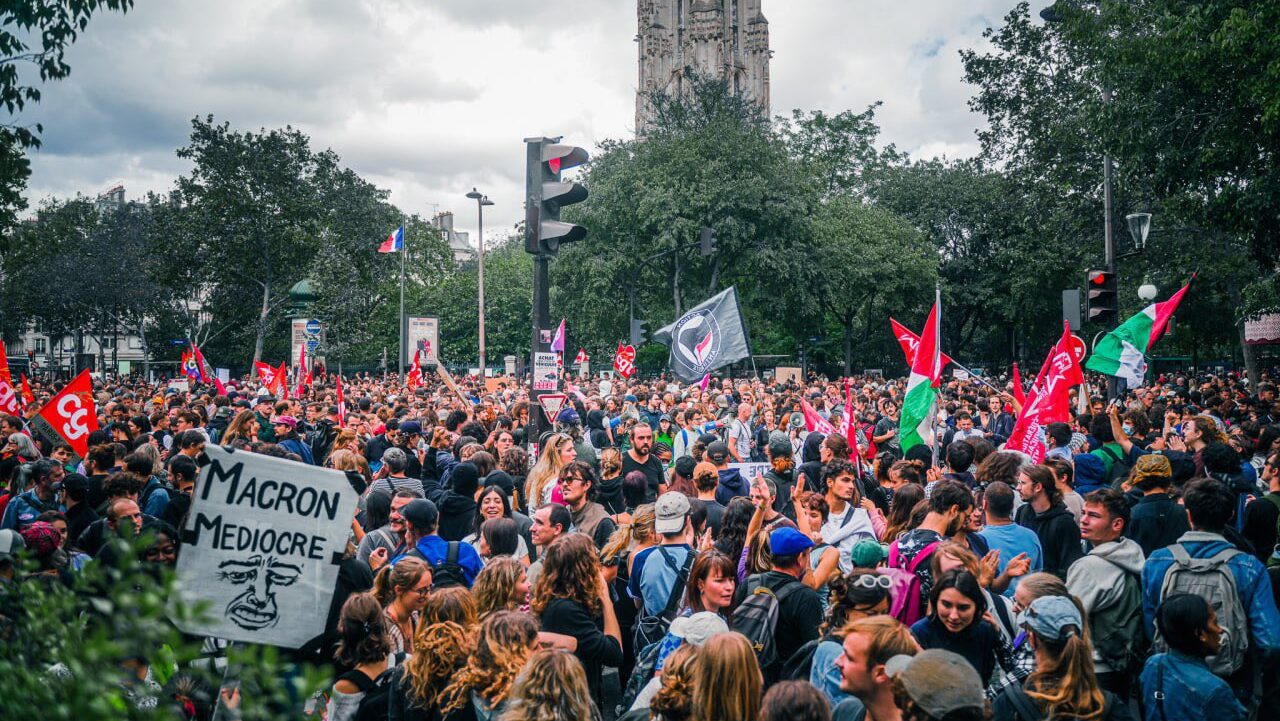
    Hundreds of mobilizations, including picket lines and strikes, took place across France on September 10, signaling general rejection of a new wave of austerity policies advanced by the neoliberal camp. Trade unions reported significant participation in multiple sectors, including railways, education, culture, and health – where at least 100 work stoppages occurred during the day.

    Grassroots networks estimate that approximately 500,000 people joined the demonstrations, held under the slogan “Let’s Block Everything” (Bloquons tout). Student collectives and Palestine solidarity groups were among those contributing to the day, among many others. Actions took place not only in major cities like Paris and Marseille but also in smaller towns such as Albi and Pau. The day was also marked by a heavy police presence and reports of violence against protesters, including the use of tear gas.

    The mobilization came just days after another prime minister appointed by President Emmanuel Macron, François Bayrou, lost a confidence vote in the National Assembly. Macron quickly replaced him with former defense minister Sébastien Lecornu, a representative of the center’s right-wing faction. The appointment irked the public further. Maurizio Coppola of the Italian left party Potere al Popolo, who took part in the actions, told Peoples Dispatch: “Many saw this hasty appointment of a new prime minister as a provocation on the eve of the mobilization.”

    Read more: Will another French prime minister fall over the austerity budget?

    Demonstrators also saw Lecornu’s appointment as a sign that Macron continues to pursue policies repeatedly rejected by the public. In a recent speech, France Unbowed (La France Insoumise) leader Jean-Luc Mélenchon highlighted the devastating social impact of neoliberal economic policies, pointing out that thousands of children and hundreds of thousands of people in France are homeless. Poverty and inequality, he described, plague the country. The trade union group Solidaires offered similar reflections on the day of action: “After the fall of the Bayrou government, the head of state’s desire to pursue the same policy in the service of special interests can only exacerbate fiscal and social inequalities and the ecological crisis.”

    “He must go”

    “Macron is to blame for this situation,” Mélenchon wrote on September 10. “He and his decisions are responsible for the chaos. He makes no effort whatsoever to show that he is receiving or listening to the messages coming from the National Assembly or the country. On the contrary, he brazenly pushes ahead to show that he remains in control of his strange and absurd plans. He must go.”

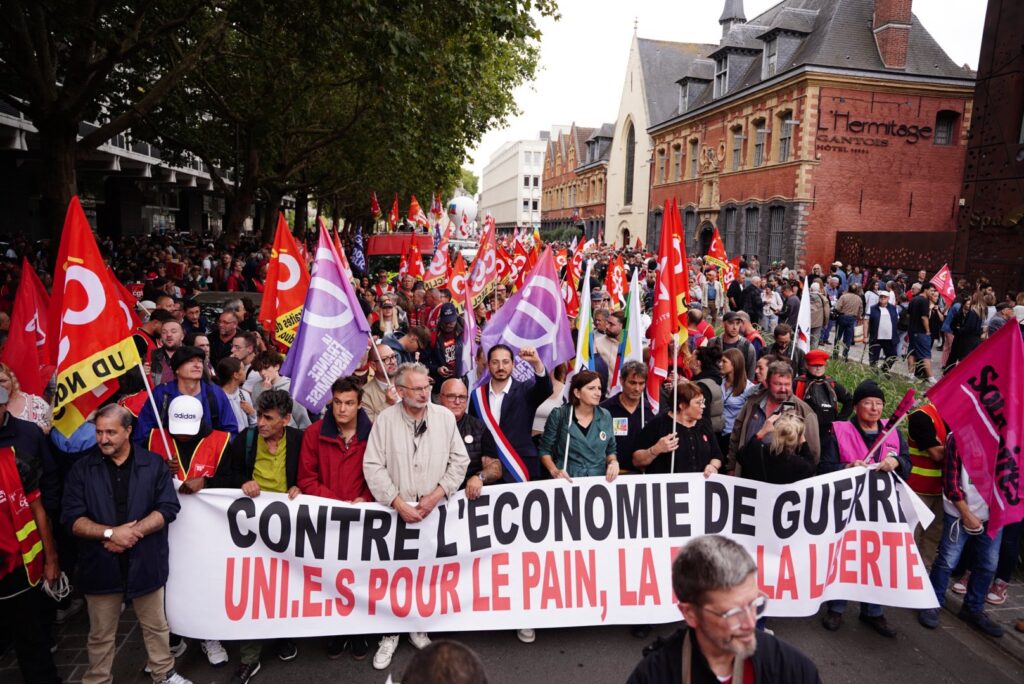
    Protesters marching with banner: “Against the war economy. United for bread, peace, and liberty.” Lille, September 10, 2025. Source: Aurélien Le Coq/X

    France Unbowed has campaigned for Macron’s removal since the 2024 national election, when he blocked the progressive New Popular Front (Nouveau Front Populaire) from forming a cabinet despite its electoral result, instead entrusting government formation to a succession of neoliberals. The party renewed its call after Bayrou’s collapse but also threw its weight behind the ongoing grassroots struggles. Coppola noted that activists from France Unbowed were active in preparing demonstrations across communities, helping amplify and link popular demands. “Their elected representatives marched with the protesters, defending them from police violence through their institutional status,” he added.

    The role of organized labor

    Despite the success of the day of action, questions remain. One concerns the role of labor unions, Coppola suggests. While certain unions and confederations, notably Solidaires, joined the call for September 10, others kept more distance. Branches of the General Confederation of Labor (Confédération générale du travail, CGT) and Workers’ Force (Force Ouvrière) participated in the actions, but their leadership chose to emphasize a strike call for September 18. By doing so, these organizations echoed popular demands against austerity but did not fully align themselves with the grassroots initiative.

    The ability of grassroots groups and labor unions to connect over and channel the anger that fueled the “Let’s Block Everything” protests may have an important impact on the mobilization’s long-term success. As Coppola points out, “where strikes and blockades were successful, this was only possible thanks to the presence of organized labor.” However, he also adds that some unions joined the day of action only because rank-and-file members pushed for it, highlighting how bottom-up participation remains vital across the struggle.

    Another unresolved question is the feasibility of France Unbowed’s proposal to remove Macron. While such an outcome would potentially be a significant victory against austerity, it would trigger new presidential elections with uncertain results. In 2024, the far-right National Rally (Rassemblement National) secured more votes than the left-progressive alliance, making the prospect of an extreme right president a genuine risk.

    Nevertheless, the message of September 10 was unmistakable and is unlikely to fade soon. “The message was clear everywhere: no to the [austerity] financial maneuver, [yes to the] strengthening of public services and workers’ rights, taxing the rich, and above all, the resignation of President Macron,” Coppola concluded.

    Original article by Ana Vračar republished from peoples dispatch under a Creative Commons Attribution-ShareAlike 4.0 (CC BY-SA) license.

  • Morning Star Editorial: Israeli extremism, Western hypocrisy and Palestinian statehood

    Spread the love

    https://morningstaronline.co.uk/article/israeli-extremism-western-hypocrisy-and-palestinian-statehood

     People walk down a street surrounded by buildings destroyed by Israeli bombardments in the Gaza Strip, July 29, 2025

    ISRAELI ministers have again exposed how hollow are Western claims to back a two-state solution.

    Yet global opinion on Israel’s colonial project has reached a tipping point — and the prospect of real change cannot be dismissed.

    National Security Minister Itamar Ben-Gvir leads settlers in a march through occupied East Jerusalem. En route, he calls for Israel to annex Gaza.

    Defence Minister Israel Katz decrees: “We will strengthen our hold and sovereignty over Jerusalem, at the Western Wall, and the Temple Mount, forever.”

    These are not aberrations: Israel’s Prime Minister Benjamin Netanyahu has vowed that he will never tolerate a Palestinian state.

    Faced with such extremism, any government serious about a Palestinian state would need to impose tough conditions on Israel: full withdrawal from the West Bank and Gaza included.

    Yet what conditions do they seek to apply?

    British Prime Minister Keir Starmer says Britain will recognise Palestine unless Israel “takes substantive steps to end the appalling situation in Gaza.”

    Feeble as that is, at least Starmer makes demands of the aggressor, Israel.

    Canada’s Mark Carney decided to lecture the people being massacred. Canada would recognise Palestine — subject to democratic reforms, including elections in which (very democratically) Hamas would be banned.

    France’s Emmanuel Macron repeated that an independent Palestine would need to be demilitarised — as if Palestine threatens the existence of Israel, rather than the other way around.

    The coloniser’s mindset. Palestine can be “independent,” but only if it chooses leaders we like, and has no means of defending itself.

    …

    Article continues at https://morningstaronline.co.uk/article/israeli-extremism-western-hypocrisy-and-palestinian-statehood

    Keir Starmer objects to criticism of the IDF. He asks how could anyone object to them starving people to death, forced marches like the Nazis did, bombing Gaza's hospitals and universities,mass-murdering journalists, healthworkers and starving people queuing for food, killing and raping prisoners and murdering children. He calls for people to stop obstructing his genocide for Israel.
    Keir Starmer objects to criticism of the IDF. He asks how could anyone object to them starving people to death, forced marches like the Nazis did, bombing Gaza’s hospitals and universities,mass-murdering journalists, healthworkers and starving people queuing for food, killing and raping prisoners and murdering children. He calls for people to stop obstructing his genocide for Israel.
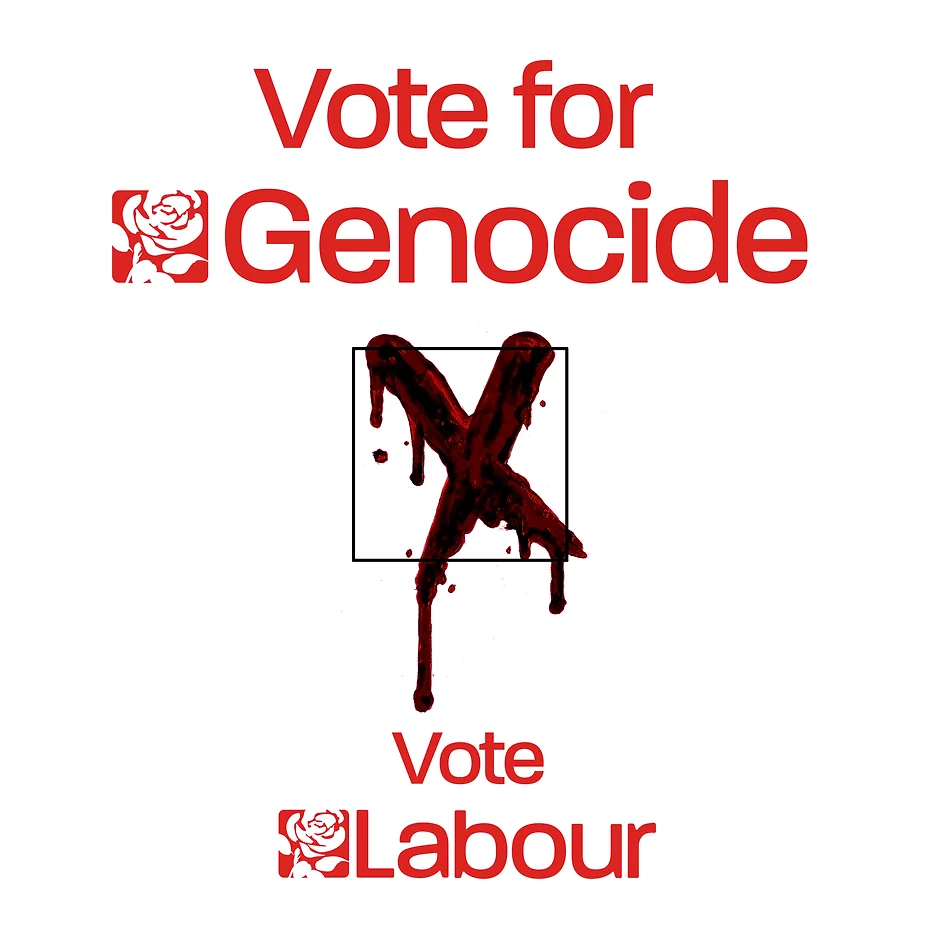
    Vote Labour for Genocide.
    Vote Labour for Genocide.
    UK Labour Party government ministers Keir Starmer, Angela Rayner and Rachel Reeves explain that they are partners complicit in Israel's Gaza genocide. The UK has provided Israel with arms, military and air force support. They explain that they don't do gas chambers but do do forced marches, starvation, destroy hospitals, mass-murders of journalists and healthcare workers.
    UK Labour Party government ministers Keir Starmer, Angela Rayner and Rachel Reeves explain that they are partners complicit in Israel’s Gaza genocide. The UK has provided Israel with arms, military and air force support. They explain that they don’t do gas chambers but do do forced marches, starvation, destroy hospitals, mass-murders of journalists and healthcare workers.