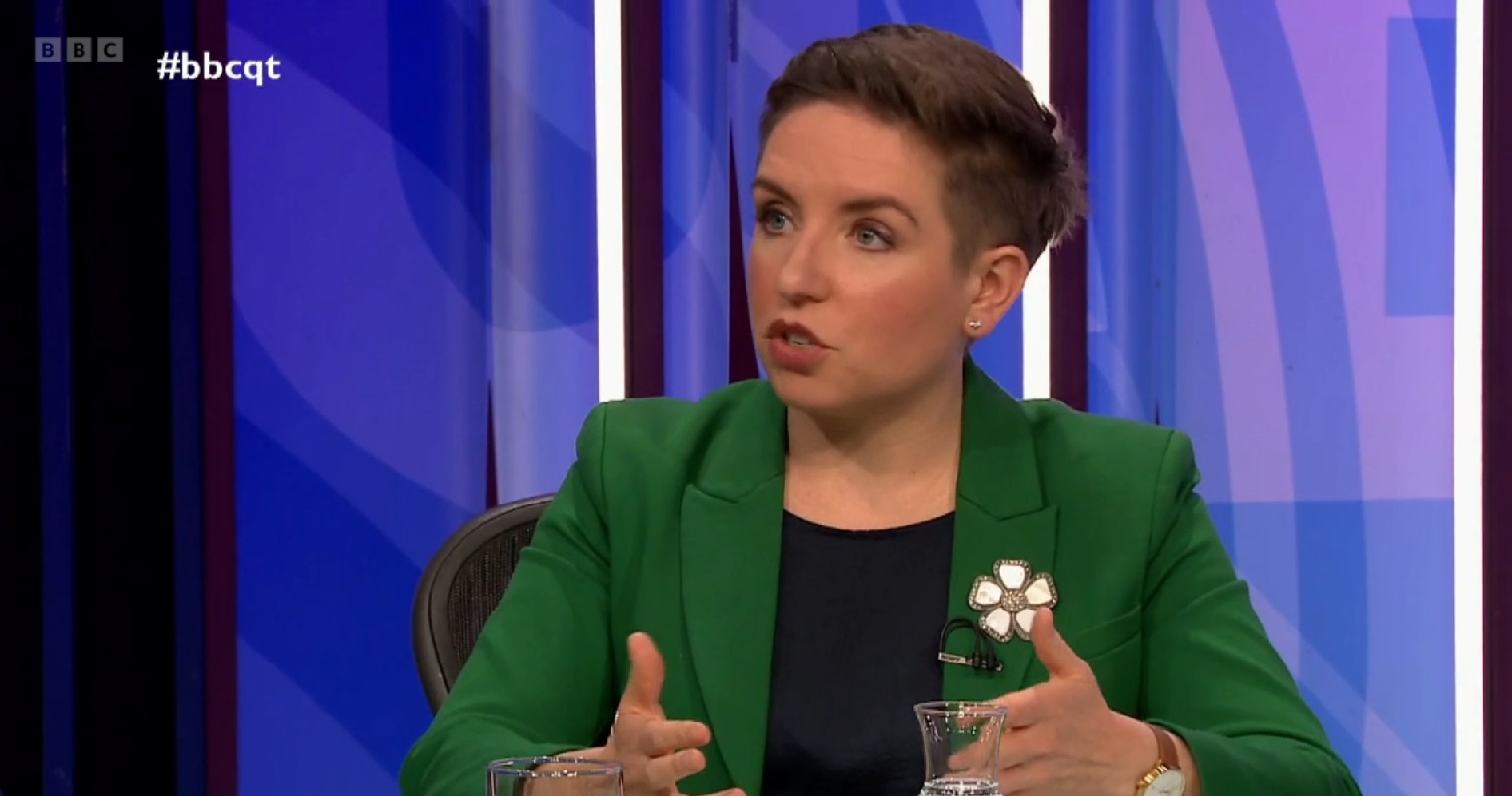
Image of the Green Party’s Carla Denyer on BBC Question Time.
Reacting to a new report from the Office for Environmental Protection which says: “government will not meet its ambition that most water bodies will be on the road to good condition or else already in that state by 2027,” Green Party co-leader Carla Denyer said:
“The Green Party wants to see much greater protection of nature in law, and that includes our rivers.
“We would set up an Independent Commission for Nature that would set targets for nature protection and restoration, enforced through the courts.
“This would be groundbreaking and make future governments act to protect our waterways from agricultural and industrial pollution.
“It would allow for the first time the possibility of individuals, communities and conservation groups taking legal action on behalf of nature. Currently, every time our rivers, seas or land is polluted, prosecution is left to hopelessly underfunded quangos.
“We also need water companies in public ownership and an end to leaking sewage.
“We need to give space for all of nature to thrive, and that includes protecting our rivers.”
Southampton University slammed after openDemocracy uncovered its involvement in Exxon’s ‘greenwashing’ project
A senior professor has accused his own university of betraying its values by working with ExxonMobil on a project that has been condemned as greenwash.
Ian Williams, professor in applied environmental science at the University of Southampton, made the allegations after openDemocracy revealed that Exxon had made misleading claims about capturing carbon at the UK’s biggest oil refinery at Fawley in Hampshire.
We reported last month that Paul Greenwood, Exxon’s UK lead, had admitted that the oil giant would need a “magic wand” to deliver the project, which has no funding and no licence to store carbon.
Exxon refers prominently to its collaboration with the University of Southampton in publications about the scheme.
Williams suggested the university had been “fooled” into joining forces with the oil giant to launch the ‘Solent Cluster’, an industrial decarbonisation scheme focused on CCS.
Lindsay-Marie Armstrong, the academic cluster lead at the University of Southampton, has joined senior Exxon executives at several events to promote the scheme, including a reception at the House of Commons in February.
Williams hit out at the partnership during a lecture entitled “Working with the enemy: Why universities should not work with ‘Big Oil’” on 24 April, as part of the University of Southampton’s annual Green Week.
He said Exxon had a long history of undermining climate science and funding groups that promoted climate scepticism, asking: “Why does the University of Southampton work with companies that operate against our values and deny our research data?”
Williams pointed out the university’s collaboration with Exxon is at odds with two of its stated core values: its commitment to “embed environmental sustainability in everything we do” and its pledge to work with partners to “improve the environment”.
He added that his decision to speak out means he is “not very popular in some quarters of the university” and might be branded a “rogue academic”.
But Southampton University’s decision to partner with Exxon has also been criticised by many who study there. Heidi Wheatley, a second-year environmental science student, told openDemocracy that “the university’s relationship with the fossil fuel industry undermines my whole reasoning for studying this subject at this institution”.
Wheatley added: “Students are already calling for the university to re-evaluate its relationship with the industry through its research activities and are petitioning the university to withdraw its multimillion-pound investments in fossil fuel companies. I implore the university to listen to its students and live up to its own strategic commitments to sustainability.”
Williams quoted from openDemocracy’s investigation during his Green Week lecture, including our revelation that Exxon had so far refused to commit its own money to build the CCS plant and had instead focused investment on increasing diesel production at the refinery, spending £800m to produce an extra six million litres a day.
He also quoted Doug Parr, chief scientist for Greenpeace UK, who told openDemocracy that Exxon’s CCS scheme “stands out as greenwashing”.
openDemocracy revealed in November that fossil companies had ploughed more than £147m into British universities in seven years.
Williams said: “Universities must be robust and healthy enough to resist commercial lobbying and greenwash. We must not be fooled again.”
Urging Southampton University to extend its ban on working with tobacco companies to fossil fuel firms, he added: “Universities should say no to collaboration with fossil fuel companies, no to funding from or with fossil fuel companies, no to green washing, no to climate washing.”
He also recommended the university commit to “not work[ing] on any form of greenwash project”, including “CCS” and “blue hydrogen” – a product made from natural gas, where most of the carbon dioxide from the gas is captured and stored. Blue hydrogen has come under fire from scientists, who have branded it a distraction from proven low-carbon alternatives to fossil fuels based on renewable energy.
Williams also called on Southampton University to sign up to the People and Planet Fossil Free Campaign, which demands universities stop investing in and accepting funds from fossil fuel companies.
A University of Southampton spokesperson did not respond to any of Williams’ recommendations when contacted by openDemocracy.
Instead, they said: “Decarbonisation necessitates engagement with the sector that produces carbon and universities have a vital role to play in applying knowledge and expertise to address real areas of environmental concern.
“This is what the Solent Cluster was set up and receives government funding for, with our role here to work alongside 120 organisations and businesses, including nine local governments and three other universities.
“We uphold our value to embed environmental sustainability in everything that we do and require that all outputs from research undertaken with energy companies – and industry more widely – can be published, following our stated policies for responsible and open research.”
An Exxon spokesperson said the company would give further detail on the CCS project “in due course”.
Another recent openDemocracy investigation found that more than £281m of anonymous donations had poured into so-called Russell Group universities, including Southampton, since 2017. This prompted more than 120 academics, politicians and campaigners to sign an open letter calling for transparency over university funding in the UK.
The universities’ secrecy over donations means any potential conflicts of interest and commercial influences, including those related to fossil fuel production, remain hidden.
Some universities routinely invite fossil fuel companies to attend private meetings after donating millions of pounds.
1. Environment. This is the biggest single issue. Trump is a real-life world-destroying Thanos from the Avengers, and is trying his best to commit planeticide. His policies will kill the earth. The human race has a window of about 20 years to avoid the worst impacts of the climate emergency. We should have swung into action years ago to vastly reduce our use of coal, gasoline and natural gas. Trump has presided over an increase in our annual carbon dioxide emissions rather than, as he should have, greatly reducing them. If Americans give him another four years to wreak this kind of destruction, it will be game over for normal human life on the planet. We will see gargantuan disruptions, with turbocharged hurricanes, massive wildfires, raging sea level rise, coastal flooding, and mass extinctions. These disasters can be light or heavy. Trump is doing his best to ensure they are heavy.
…
2. Trump’s second biggest failure was in dealing with the coronavirus pandemic. For the most part, he adopted an ostrich policy of burying his head in the ground and pretending that it wasn’t there, or would abruptly disappear “like a miracle,” or that its consequences were not grave.
…
3. Trump’s failure on the coronavirus is also a failure on the economy. China dealt with the pandemic in a scientific way, and is now past the crisis. It will grow 1.2 percent this year, whereas US GDP will be in negative territory. Trump blames governors’ shutdown orders for harming businesses.
…
4. Health Care. Trump has tried to kneecap Obamacare, which had allowed an extra 22 million Americans to afford health care insurance. Trump has undermined the program at every turn. He is presently in court attempting get rid of the Affordable Care Act entirely. He has also consistently challenged the requirement that insurers insure people with pre-existing conditions. Trump brazenly lies about his opposition to health care for people and his attempt to get rid of the provision about pre-existing conditions. But you have to look at what he does, not what he says. What he has done is to sue to get rid of them and to get rid of the ACA. He lies and says he has a better plan in mind, but the Republicans have had a decade to produce an alternative and they never have given us a bill to examine.
5. Under Trump, the US trade deficit has climbed 14% from where it was in Obama’s last year. It skyrocketed with China, but then Trump used tariffs (paid for by Americans) to wrestle it back down to just about where it was in 2016. It then just grew with other countries.
A selection of recent UK and international news articles
Home Secretary waited until terror suspect was abroad before stripping citizenship | The Bureau of Investigative Journalism … [Home Secretary Theresa May] denied that it has a policy of waiting until individuals are out of the UK before removing their citizenship. But research by the Bureau has also found that of the 18 individuals we have identified who have lost their UK nationality removed since 2006, at least 15 were known to be abroad when orders to remove their citizenship were issued. Of those individuals, two – Mohammed Sakr and Bilal al-Berjawi – were killed in US drone strikes in Somalia. Another, Mahdi Hashi, was rendered to the United States where he’s currently awaiting trial on terror charges in a high-security jail. Speaking in the parliamentary debate, Diane Abbott pointed out that debate around citizenship-stripping often failed to presume the innocence of individuals who had not faced criminal charges. ‘We are talking about terror suspects. Nowadays in Parliament, saying that someone is suspected of terrorist activity is enough for the political class to assume that that person does not deserve due process,’ she said. …
If the government gets its way, from May this year your family’s patient-identifiable data will be uploaded from your GP surgery to a single, centralised database for the very first time. This ‘care-data’ database will include your NHS number, date of birth, postcode, ethnicity and gender. Your medical diagnoses, including cancer and mental health, your referrals to specialists, your prescriptions, your body mass index, details of your vaccinations and screening tests and your smoking and alcohol habits will be on there too.
The scheme, led by health secretary Jeremy Hunt, is being hailed as a revolution in the use of information to improve our healthcare and to advance medical research – admirable aims indeed. But once it goes live, organisations including drug and insurance firms will be able to apply to purchase ‘pseudonymised’ details about patients. And ‘backdoors’ to the database will allow bodies like the police to enjoy direct access to your medical records as well.
These floods are washing away the founding logic of David Cameron’s government | Jonathan Freedland | Comment is free | The Guardian… But that is the least of the damage that Cameron’s words have inflicted on himself. For this government was built, the coalition formed, on a single, simple premise: that austerity was unavoidable, that there was no alternative. There could be no more spending, an assertion endorsed by the outgoing Labour government in what must rank as one of the most ill-judged jokes of modern times: “There’s no money left,” said Liam Byrne in a note left for his successor at the Treasury. But now, less than four years on, it turns out that this is no longer true. The PM has told us that, should the need be urgent enough, there is money after all. Limitless supplies of it in fact; enough to defeat nature’s wrath. To quote Cameron in full, “Money is no object in this relief effort. Whatever money is needed for it will be spent.” This rather undermines the austerity message, for it shows what was always true – that the national belt is not tightened universally and for ever but can be loosened when the government wants to loosen it. The last demonstration of that truth came nearly two years ago, when George Osborne cut the top rate of tax from 50p to 45p. That destroyed at a stroke the claim that we were all in it together, but it also illuminated a more obvious fact: that, despite all the “no alternative” talk, the government had not lost its power of discretion. Even in the age of austerity, it still got to decide what to spend money on and what not to spend it on. …
Your bills help British Gas to £600m profit – Business News – Business – The Independent Centrica is set to announce on Thursday that its British Gas household supply arm made a profit of nearly £600m last year, helped by a 10.4 per cent hike in gas prices in November and an 8.4 per cent rise in electricity prices. Politicians and campaigners said the bumper profits provided further evidence that showed the Big Six were overcharging customers in an uncompetitive market.
17/2/14 edit: That would be Alex Salmon “accused of overheating production of Scottish farmed salmond to meet Japan’s insatiable demand for sushi in return for China’s loan of two pandas to Edinburgh Zoo.”
Bottom trawling: how to empty the seas in just 150 years | Environment | The Observer“For every hour spent fishing today, in boats bristling with the latest fish-finding electronics, fishers land a mere 6% of what they did 120 years ago. Put another way, fishers today have to work 17 times harder to get the same catch as people did in the 19th century.” And the reason for this startling state of affairs is straightforward: we have caught so much fish in our own waters over the past 150 years, there is little left for us today. Some species hover at the edge of extinction. Our seas, and the floor below them, have been stripped of their riches.