As the latest UNEP reports we will blow past 1.5°C, we must prioritise solutions that work, rather than focusing on complex, unproven technologies
For anyone who’s been paying attention, it’s no surprise that the United Nations Environment Program (UNEP) reports that we will now inevitably blow past the global average temperature threshold of 1.5°C above pre-industrial levels.
Climate scientists like myself have been warning for years that we are about to cross this invisible red line, while quietly worrying that global average temperatures will end up being double that. Personally, I said goodbye to 1.5°C several years ago, but it still feels momentous to see it written in print, and that too by the UN.
The target to keep warming to 1.5°C above pre-industrial temperatures isn’t some hard red line in the sand, because all warming carries some risk, but it’s relevant because limiting warming to 1.5°C gives us a good chance of avoiding some of the worst impacts of climate heating. We’ve already had a glimpse of what this looks like in the myriad heatwaves, wildfires, floods, droughts and storms that have made headlines this year.
Every tenth of a degree of heating means real-terms impacts for peoples’ lives, livelihoods and property, and increases the risk of the extreme events that we’ve already seen tragically claim so many lives. It also increases the likelihood of exceeding critical tipping points such as the collapse of the West Antarctic Ice Sheet, beyond which there’s no return.
We’ve already had single years that have exceeded the 1.5°C limit, but the widely discussed Paris Agreement target is a multi-year average. That means we won’t know we’ve reached it until it’s in the rearview mirror, but it’s also possible to “overshoot” 1.5°C, temporarily peak at higher temperatures, and then bring them back down – and that’s now the best-case scenario outlined by UNEP.
This would mean we would have to take drastic action to bring temperatures back down again rather than continuing to drive them ever upwards. Which, in the current political climate, feels like a bit of a stretch.
Temperatures won’t stabilise until we reach net zero emissions, where we remove as much carbon from the atmosphere as we add to it. Until then, we will still be increasing greenhouse gas concentrations in the atmosphere and turning up the dial on the thermostat. Net zero isn’t a nice to have, despite what certain parts of the political spectrum would have you believe, it’s an essential if we want to have a liveable planet.
In fact, UNEP’s latest report points to the need to take action beyond net zero:
Once we have limited heating to 2°C or below — which currently feels optimistic — we will have to roll out carbon dioxide removal (CDR) to reduce temperatures on an enormous scale.
CDR often connotes high-tech solutions to suck carbon dioxide out of the atmosphere, but it can also mean one of the oldest technologies in the world: trees. That’s why restoring nature and preventing deforestation is so important for climate action.
But UNEP reports that CDR only works if we limit heating to 2C or below. As the stakes of climate heating continue to rise, another idea is moving from the sidelines to centre-stage: geoengineering, or deliberate technological interventions to alter the Earth’s climate.
Geoengineering is a spectrum, ranging from the comparatively reasonable and well-researched (injecting particles into the stratosphere to reflect incoming sunlight and cool the surface, much like major volcanic eruptions have done) to downright barmy (launching mirrors into space – you can imagine which silicon valley billionaires love that idea). And while there are sensible (if heated) scientific discussions about how to actually do it, there are also some very serious ethical and governance hurdles to overcome.
The tech bros will tell you that geoengineering will save us and allow us to keep doing what we’re doing while still ‘fixing’ climate change. But beware any arguments that downplay the importance of emissions cuts. We can’t simply geoengineer our way out of this crisis.
For example: who decides when to deploy? What happens if an intervention makes things better for some and worse for others? How do we safeguard against bad actors acting unilaterally? These questions are largely unanswered, and that’s before we get to the scientific questions around unintended consequences, like disrupting the Arctic food chain while trying to refreeze ice, or what happens if we stop the intervention, resulting in a so-called termination shock, where temperatures would shoot back up with devastating effect.
In some senses the climate crisis is relatively simple: we’re pumping planet-heating carbon dioxide into the atmosphere, and it’s heating the planet. To reverse it, we need first to stop adding planet-heating carbon dioxide to the atmosphere, and then to start removing it.
The good news is that we do know what we need to do to achieve that. Climate action is less a knowledge problem, and more an implementation one.
Proponents of geoengineering argue that it’s not an either/or between emissions cuts and major interventions. But in a world with finite resources, expensive and unproven geoengineering solutions should not be a priority, rather, we should prioritise the simple stuff we know works: decarbonising energy production, improving public transport, retrofitting and building greener housing, reducing meat and dairy consumption, restoring natural ecosystems.
That said, we are now committed to some level of change, and we need to behave as such. That means we need to prepare for the sea level rise that’s to come, and adapt societies, behaviours and infrastructure to a less predictable and more extreme climate.
If the summer of 2026 has taught us anything in the UK, it’s that our houses, schools, offices, railways, emergency services, power networks and public transport are simply not fit for purpose in the heat. Nor are they built to withstand the wet, stormy, flood-prone autumn and winter that is on its way. We’re not equipped to deal with the rapidly extremifying climate or the weather whiplash it brings. Simply put: our infrastructure was built for a climate that no longer exists.
If we are to survive the coming decades, we need to build preparedness and climate resilience into our society. Extreme events are already exposing our vulnerabilities, and if we thought 2026 was bad, count my words: we ain’t seen nothing yet.
In the wake of our hottest summer on record, it’s abundantly clear that we need to slash emissions to save lives, and at the same time prepare for the changes that are now committed.
The geoengineers are right about one thing: It’s not an either/or. We have to reduce emissions to net zero and remove carbon from the atmosphere and adapt to what’s in store. There’s no other safe option.
Dr. Ella Gilbert is a climate scientist and multi-award-winning presenter with a PhD in Antarctic climate change.
Donald Trump urges you to be a Climate Science denier like him. He says that he makes millions and millions for destroying the planet, Burn, Baby, Burn and Flood, Baby, Flood.Nigel Farage urges you to ignore facts and reality and be a climate science denier like him and his Deputy Richard Tice. He says that Reform UK has received £Millions and £Millions from the fossil fuel industry to promote climate denial and destroy the planet.Elon Musk urges you to be a Fascist like him, says that you can ignore facts and reality then.
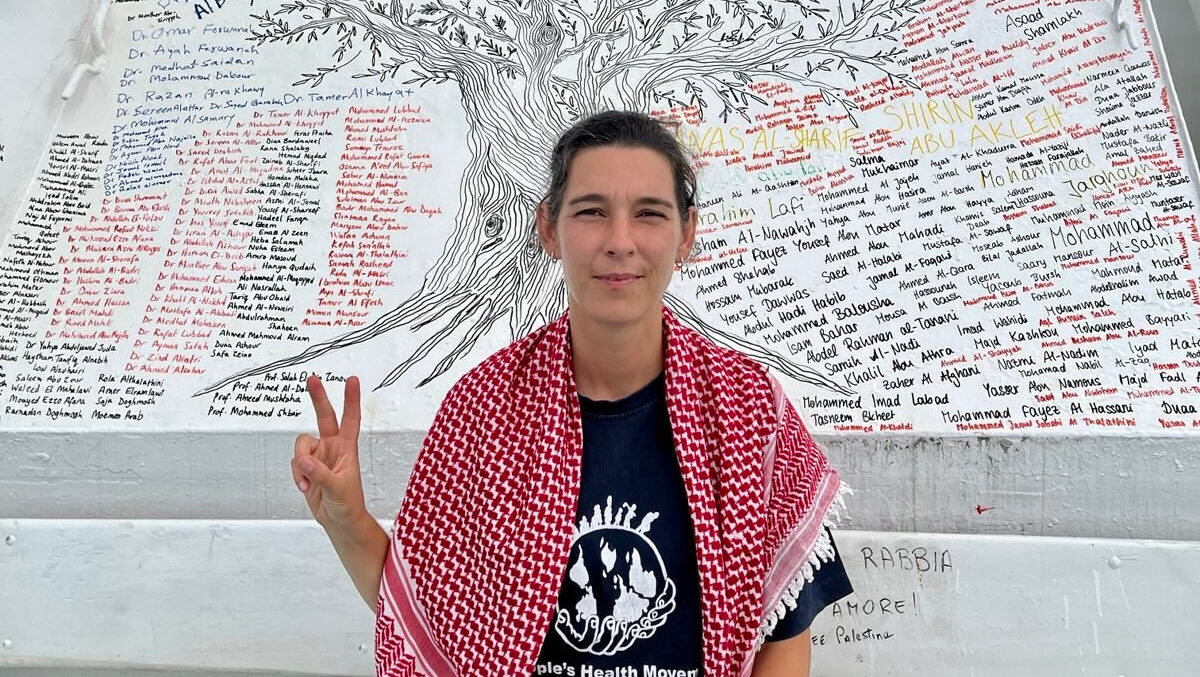
Hanne Bosselaers on the “Conscience”. Source: People’s Health Movement
Physician Hanne Bosselaers, from Medics for the People (MPLP-GVHV) and the People’s Health Movement (PHM), was among dozens of health workers aboard the “Conscience” – one of the vessels that recently sailed to break Israel’s illegal blockade of Gaza and draw attention to the targeting of medical and media workers during the genocide. People’s Health Dispatch spoke with Dr. Bosselaers about her experience following her kidnapping by Israeli occupation forces and about why continued mobilization, especially within the medical community, remains essential to the struggle for Palestinian liberation.
People’s Health Dispatch: Let’s begin with your experience on board the “Conscience”: what it was like to travel as part of that mission, and then to go through the violent interception and kidnapping by the Israeli occupation forces.
Hanne Bosselaers: It was a great honor to join the “Conscience”, a large ship with 92 participants. We were mainly medics and journalists because we wanted to emphasize that these are the two professions most targeted during the genocide in Gaza. We wanted to show solidarity with our colleagues there.
Almost all participants had direct links with people in Gaza through humanitarian work or Palestinian NGOs like Awda Association. Several doctors on board had worked in Gaza during the genocide, and many journalists were in touch with Palestinian citizen journalists and local news agencies. We wanted to reach Gaza to report and to offer medical assistance: that was the core message of the “Conscience”.
Normally, in any conflict, humanitarian workers and journalists have access to document conditions and preserve the right to health. Gaza is really an exception, with Israel’s illegal blockade preventing any such access. So we sailed this large ship together with eight smaller sailing boats from the Thousand Madleens mission. This was a second wave of boats, following the Global Sumud Flotilla, the 47 boats that left from Barcelona, Sicily, and Tunis at the end of August.
It was a very positive experience on board. We had a strong sense of team spirit. Life on a large ship had to be organized: we took turns at chores, cleaning, cooking, and doing safety drills several times a day. We were led by four experienced women from the Freedom Flotilla Coalition, including Palestinian-American lawyer Huwaida Arraf, Vigdis Bjorvand, an activist from Norway who had previously sailed on the “Handala”, Zohar Regev a Palestinian-German activist, and Madeleine Habib from Australia, who steered the ship. These four women had all participated in earlier flotillas and prepared us very well. They knew what violent interception and imprisonment could look like because they had already experienced it, and they talked us through every step. Thanks to them, we were ready and united for what was ahead.
We kept our spirits high and held onto the hope of reaching Gaza. At one point, we had a call with my colleagues for Al-Awda. They told us: “This is exactly what we expect from you as Westerners, that you use your privilege to draw attention to our situation and to go as far as you can to reach us.” They deeply appreciated what we were doing.
I felt quite guilty not to make it to the shores of Gaza, but of course that was not in our hands. I think we did everything we could. The objectives of the flotillas were really met – the attention they drew, the participation of thousands, the local actions, the strikes in Italy, the massive demonstrations across many countries – all of this created significant pressure on Israel. I believe this helped bring about the ceasefire. Even if that ceasefire remains insufficient, it’s still a victory for the flotillas and the global movement that stood behind them.
PHD: You mentioned that the “Conscience” had a specific focus, its crew made up mostly of journalists and health workers. As a health worker, how did you experience the conditions during your imprisonment in Israel?
HB: In our case, the Israeli Occupation Forces (IOF) boarded our ship very violently. They came with three helicopters and a large navy frigate. More than 30 armed soldiers stormed our ship against 90 unarmed journalists and medics. It was clearly a show of force. We were still 200 kilometers from the Israeli coast, about 15 hours of full steam sailing from the port of Ashdod. So the interception itself was completely illegal and disproportionate.
During the whole voyage to shore, we were held in a small, confined, and very hot space. Some participants were elderly, the oldest was Isaline Choury, an 83-year-old French woman, the niece of Danielle Casanova, who was a well-known member of the French Resistance. She was experienced but had health problems, and she wasn’t allowed access to her medication for the entire 15 hours. She had to beg just to go outside for a few minutes of fresh air, which was sometimes refused. So even before imprisonment, our treatment amounted to captivity.
Once in prison, it became worse. What we experienced is only a fraction of what Palestinians face, but it was still meant to humiliate. Guards insulted us all the time. They used minor physical violence on me and other women – twisting arms, pulling hair – not severe beatings, but completely unnecessary since no one resisted. You could really feel that this is a society built on hate, racism, and violence.
We were taken to Ktzi’ot prison, the largest in Israel, because between our group and the Global Sumud Flotilla, there were around 500 detainees. The prison itself looks like a concentration camp: massive concrete walls, five to ten meters high, reminding you of the wall in the West Bank, topped with barbed wire, and surrounded by an army of guards.
Access to medical care was extremely limited. You could request to see a medic, but they always made you wait. Some participants who depended on medication didn’t get it until their consular representatives managed to intervene, and sometimes they were only able to visit their citizens after hours of waiting, which is completely illegal. The prison authorities behave as if they are above the law and can do whatever they want.
If this is how they treat Europeans and US citizens, I don’t dare to imagine how Palestinians are treated. The food was scarce and very poor, and we didn’t receive bottled water, only tap water that looked brownish. Some people were isolated. We stayed for 48 hours, but if someone had to stay for months or years, the effects on both mental and physical health would be devastating.
PHD: You mentioned the psychological impact of imprisonment. Could you speak a bit more about what prolonged imprisonment means for Palestinians, what kind of mental health consequences it has, and how health workers like yourself react when hearing about the experiences of Palestinian political prisoners?
HB: They regularly use these tactics to break people mentally. Nothing is regular, nothing is certain. For Palestinians, this begins from the moment of arrest. They are often kidnapped – at work, at home, in the middle of the night – without trial or due process. There’s no chance to say goodbye to family members. Once they’re taken, everything becomes uncertain: the duration of detention, whether they’ll be charged, whether they’ll ever be released. The occupation authorities can prolong imprisonment whenever they want.
What they did with us, I imagine they do with Palestinians all the time: sleep deprivation, psychological manipulation. Every two hours the guards would bang on the door shouting: “You’re going home!” The first time we believed them, so we got up, went to the toilet, waited, but nothing happened. Two hours later, the same again. At this point we knew it was just about making us have less sleep. And when they finally came for real, we didn’t believe them anymore and stayed in bed until they shouted at us to get up. It’s a tactic to exhaust you, to destroy your sense of reality.
I actually had an exchange with the guard who made us enter our cell. She said: “Welcome to your new home. Welcome to hell.” I told her: “No, you are the one staying here. I’m going home soon. You’re the one trapped in this system of violence. I really pity you.” Because that’s what it is – industrial-scale violence.
Imagine the young Palestinians, some as young as fourteen, living under constant threat from these violent, vicious guards. You can see how this leads to psychosis, depression, and other severe mental disorders. There are already many reports documenting this.
To me as a health worker, it’s deeply concerning. We have to keep campaigning for the release of these people – these hostages, because that’s what they are. They’re not prisoners, they haven’t committed any crime, and they should not be in prison at all.
PHD: Before boarding the “Conscience”, you were also preparing to join the Global Sumud Flotilla with Aziz Rhali and James Smith, comrades from the People’s Health Movement. Why is it so important for health workers to take an active role in the struggle for the liberation of Palestine and to express solidarity? How does this connect to your mission as a health worker?
HB: I see a health worker as someone who defends the right to health for everyone, everywhere. And if you look at what has happened to health in Gaza, it’s the worst situation in the world. Every right related to health has been denied: the right to housing, to education, to clean water, food, and of course healthcare itself. These were the first targets of Israel’s attacks.
After October 7, several hospitals were bombed. But even before that, in every Israeli assault on Gaza, hospitals were hit and healthcare workers were targeted. The number of medical workers killed during the genocide is unprecedented: more than 1,500 have been killed, over 300 imprisoned, and many more injured while at work, inside hospitals. Patients have been killed in their hospital beds, and entire hospitals burned to the ground. It’s a genocidal strategy aimed at erasing the entire healthcare system.
Then there’s the blockade. No medicine, medical equipment, or supplies are allowed in. Even humanitarian workers face extreme restrictions. Only a few foreign health workers can enter, and when they do, they can’t bring medical materials, just a few kilograms of personal luggage and a small amount of money enough to sustain themselves, not to share with anyone else. These inhumane restrictions are illegal under international law. There is no other conflict where the destruction of health infrastructure reaches this scale. Of course, there are other very cruel conflicts – in Sudan, in the Congo – but there, at least some minimal humanitarian access and healthcare structures exist. Gaza is different. The healthcare sector has been a primary target.
And yet, when you look at the response of Palestinian health workers, it’s extraordinary. In Al-Awda, they continue to build and sustain field hospitals, expand capacity, and help their people. They’ve grown from 400 to over a thousand volunteers working in makeshift hospitals and camps. Their courage and resilience are deeply inspiring.
So as a defender of the right to health, standing with Palestine is not only a moral obligation, it’s also an act of professional solidarity. Palestinian health workers show us what it truly means to uphold dignity, even in completely inhuman conditions. They refuse to abandon their patients. They’ve said: “We will stay until the last unit of blood, until the last pill.”
These health workers are unique. They’re my greatest source of inspiration, and I feel honored to dedicate much of my activism to them. They deserve liberation, rights, and the full realization of the right to health for their entire people. For me, standing by them is not difficult, it’s the easiest and most natural thing to do.
PHD: It was really moving to see Dr. Ahmed Muhanna return to Al-Awda the other day, and to hear the speech he gave. It’s been impossible to ignore the incredible work Palestinian health workers have done over the past two years, it’s truly inspiring.
HB: Absolutely. That video made me cry with joy. Honestly, I had feared he wasn’t alive anymore, we hadn’t heard any news for such a long time. I wasn’t expecting to see him again. When I did, he looked physically exhausted, he’d lost so much weight, but the strength of his words, his spirit, was incredible. It was deeply inspiring.
PHD:At the same time, we see the mainstream media and much of the political establishment in Europe talking about Donald Trump’s so-called peace plan. But even in the first hours and days after it was announced, Israel violated the ceasefire. For health workers, for Palestinians, and for those standing in solidarity with them, the struggle clearly continues. As someone who has been involved in this movement for a long time, what do you see as the most important priorities for activists in Europe and around the world in the coming weeks?
HB: You’re right, Israel is already violating the ceasefire agreement. I asked this morning [October 17] whether any of the supplies that entered Gaza had actually reached people, and the answer was no. There has been no scaling up of humanitarian aid, and the crossings are still closed. So Israel is already violating the most important parts of the agreement.
On the other hand, the fact that Gaza still stands and that there are talks about reconstruction is itself a kind of victory. It may seem small, and the situation remains a massive violation of rights, still colonization, but we shouldn’t underestimate it. We can’t expect anything good from Netanyahu, Trump, or Blair, but their plan was to create a “Gaza Riviera,” to completely cleanse the Strip, and they failed. They didn’t manage to empty Gaza of its people, and that’s also because of the global movement, the resistance, and partly the flotillas, which showed that we would not let that happen.
Gaza will stay, and this is the moment to scale up mobilizations and to fight for Palestinians’ right to self-determination over their land and to lead their own reconstruction. There’s a big danger now that all kinds of colonial NGOs will move in and take control of reconstruction efforts. Yes, there will be funding from Arab countries and others, but this process must be led by Palestinians, according to their own priorities.
We want to listen to our partners there, the grassroots Palestinian NGOs and community groups who know best what their people need. They must lead decisions about what is rebuilt and how. So right now, direct solidarity with Palestinians in Gaza and their organizations is absolutely essential. We’ll continue to speak about this, to show what they’re doing, and to raise support and mobilization in Belgium and across the world.
That’s also what we, as participants of the flotillas, agreed on: this ceasefire is not an end. It’s the beginning, a small but real moment of hope. And we need to nurture that hope and keep going.
PHD:You’ve already touched on what lies ahead, but maybe there’s more to add on how we can help ensure reconstruction and health justice?
HB: Yes, there’s an unimaginable amount of work to be done. Even just clearing the rubble and unexploded devices to make space for people to return to their land will be an enormous operation that takes a lot of time. But as I’ve said, this work must be in the hands of Palestinians. They are the ones best equipped to rebuild. They don’t need Western paternalism – and it’s Israel that must pay for what it destroyed.
That’s something we really need to fight for: accountability. You can’t just destroy the homes of two million people without any consequence. Israel must be held responsible and pay reparations for the devastation it caused. It hasn’t happened after previous assaults, but this time it must be part of the conversation within the solidarity movement. And of course there will be a need for international support, but we have to avoid a new wave of NGO colonialism. Organizations that stand in true solidarity with Palestinians should take the lead, not by flying in to “rebuild” or by constructing fancy projects nobody asked for, but by supporting Palestinians’ own initiatives and priorities. We can fund, assist, and advocate, but the leadership has to remain local.
So when we speak of health justice, it means full justice: ending Israel’s impunity and the ongoing violations of all rights. There can be no right to health under apartheid and occupation. We have to break both, or any talk of health in all Palestine will remain meaningless. Because we have to remember that the West Bank is also severely affected by settler colonial violence, home demolitions, and mass arrests. We often focus on Gaza, but we must not forget the daily displacement and repression in the West Bank. It’s all part of the same system.
PHD:Thank you, Hanne. Is there anything you’d like to add before we close?
HB: Just that the flotillas have been incredibly inspiring for people all over Europe. You could really feel how this collective effort awakened and motivated so many who had never been involved before. For Medics for the People (MPLP-GVHV), joining the “Conscience” was a collective decision. We felt it was important for our organization to take part directly, to build international connections and send a clear message of solidarity. And it worked: people in Belgium who had never thought much about Palestine suddenly started to care and to learn.
Interview slightly edited for length.
People’s Health Dispatchis a fortnightly bulletin published by thePeople’s Health Movementand Peoples Dispatch. For more articles and subscription to People’s Health Dispatch, clickhere.
Genocide denier and Current UK Prime Minister Keir Starmer is quoted that he supports Zionism without qualification. He also confirms that UK air force support has been essential in Israel’s mass-murdering genocide. Includes URLs https://www.declassifieduk.org/keir-starmers-100-spy-flights-over-gaza-in-support-of-israel/ and https://youtu.be/O74hZCKKdpAKeir Starmer objects to criticism of the IDF. He asks how could anyone object to them starving people to death, forced marches like the Nazis did, bombing Gaza’s hospitals and universities, mass-murdering journalists, healthworkers and starving people queuing for food, killing and raping prisoners and murdering children. He calls for people to stop obstructing his genocide for Israel.Orcas discuss Genocide-supporting and complicit Zionists. Donald Trump, Keith Starmer, David Lammy, Rachel Reeves, Angela Rayner and Wes Streeting are acknowledged as evil genocide-complicit and supporting cnuts.
Rapidly phasing out fossil fuels and limiting energy consumption to tackle climate change is “a strategy doomed to fail” according to former UK prime minister Tony Blair.
In the foreword of a new report, Blair urges governments to rethink their approach to reaching net zero emissions.
Instead of policies that are seen by people as involving “financial sacrifices”, he says world leaders should deploy carbon capture and storage, including technological and nature-based approaches, to meet the rising demand for fossil fuels.
But speak to many academic experts on climate change and they will tell a very different story: that there is no strategy for addressing climate change that does not involve ending, or at least massively reducing, fossil fuel combustion.
“There is a wealth of scientific evidence demonstrating that a fossil fuel phase-out will be essential for reining in the greenhouse gas emissions driving climate change,” says Steve Pye, an associate professor of energy at UCL.
“I know because I have published some of it.”
Ed Hawkins, a climate scientist at the University of Reading, agrees.
“Rapidly reducing our reliance on fossil fuels, and not issuing new licenses to extract oil and gas, is the most effective way of minimising future climate-related disruptions,” he says.
“The sooner those with the power to shape our future recognise this, the better.”
Fossil fuels are responsible for 90% of the carbon dioxide heating the climate. The amount burned annually is still rising, and so is the rate at which the world is getting hotter. Scientists now fear we are approaching irreversible tipping points in the climate system, hence their support for an urgent replacement of fossil fuels with renewable energy.
Blair is confident that an emergency response on this scale can be avoided by absorbing CO₂ immediately after burning fossil fuels, from the smokestacks where the greenhouse gas is concentrated.
Not all of the emissions responsible for climate change would be prevented. UCL earth system scientist Mark Maslin says that natural gas, which would linger as an energy source thanks to carbon capture, still leaks from pipelines and storage vessels upstream of power plants.
Commercial applications of the technology also have a poor track record. Just two large-scale coal-fired power plants are operating with CCS worldwide – one in the US and one in Canada.
“Both have experienced consistent underperformance, recurring technical issues and ballooning costs,” Maslin says.
Blair might baulk at what he perceives to be the expense of ditching fossil fuels. But economic modelling led by Oxford University’s Andrea Bacilieri suggests his concern is misplaced. A rapid phase-out of fossil fuels could save US$30 trillion (US$1 trillion a year) by 2050 she concludes, compared with allowing power plants and factories to keep burning them with CCS.
Developing CCS will be necessary to help manage an orderly transition from fossil fuels according to Myles Allen, a professor of geosystem science at Oxford University. But it is not a substitute for undergoing that transition, he says.
“Above all, we need to make sure the availability of CCS does not encourage yet more CO₂ production.”
Keeping the public on board
Is Blair right to fret about a public backlash to lower energy use? Academics suggest multiple reasons to think otherwise if the alternative is prolonging the use of fossil fuels.
Replacing a gas boiler with a heat pump that runs on electricity, for example, can lower a household’s energy consumption without a deliberate effort. That’s because renewable appliances convert power to heat more efficiently (how much depends on how well insulated the home is).
In fact, it’s dependence on fossil fuel that is preventing many households from making this switch. The high wholesale price of gas determines the cost of electricity for UK consumers.
“Crucially, the public wants and needs the government to show clear and consistent leadership on climate change,” they say.
Meanwhile, what can corrode public acceptance of sacrifices is the high-consuming behaviour of a minority (think pop stars in rockets, as Westlake recently argued). And, arguably, the statements of powerful people like Blair.
New research even suggests the politics that Blair and many others like him favour might also play a role here. Felix Schulz (Lund University) and Christian Bretter (The University of Queensland) are social scientists who study how ideology affects personal views on climate policy.
They identified respondents in six countries (the UK, US, Germany, Brazil, South Africa and China) who shared Blair’s neoliberal worldview, which the pair define as a belief that individuals are primarily responsible for their own fortune, and need to take care of themselves – as well as an abiding faith in the free market.
“We observed a strong link between a neoliberal worldview and lack of support for the climate policies in our study,” they say.
Schulz and Bretter urge us to consider how someone’s ideology ultimately shapes their understanding of the problem and its solutions as well.
Protesters on Whitehall in London, as Chancellor of the Exchequer Rachel Reeves delivers her spring statement to MPs in the House of Commons, March 26, 2025
Government must take action, union warns: ‘We can’t go on with billionaires getting ever richer whilst working people suffer’
CASH-STRAPPED Britons will be squeezed for an extra £66 every month from April as a barrage of bill hikes sees the cost-of-living crisis bite.
Millions of hard-up households, already paying what MPs said were “world-beatingly” high bills, will be forced to shell out even more for essentials from Tuesday.
GMB union urged ministers to take bold steps to help working people facing across-the-board price rises for energy, water, council tax, internet, road tax and the TV licence.
“Households have been struggling with the cost-of-living crisis for several years now,” said the union’s national secretary Andy Prendergast. “This latest set of increases shows there still isn’t any light at the end of the tunnel.
“The government must take bold steps to put money in people’s pockets,” he thundered. “We can’t go on with billionaires getting ever richer whilst working people suffer.”
…
Cat Hobbs, founder and director of public service campaign group We Own It, said: “With bill hikes across many essential services this spring, it looks like the cost-of-living crisis is sadly here to stay.
“The word ‘essential’ is important here. Heat, shelter, water — these are all things that we need to survive and none of them are getting cheaper.
“Water is the poster-child for the failed privatisation experiment, with companies on the brink of collapse scrambling for more of our money.
“Companies that have racked up huge debts to pay dividends are now running out of other people’s cash.
“Decades of underinvestment has killed our rivers and put the whole water network at risk.
“Modern, publicly owned services must be the goal for any progressive government.”
Keir Starmer, Angela Rayner and Rachel Reeves wear the uniform of the rich and powerful. They have all had clothes bought for them by multi-millionaire Labour donor Lord Alli. CORRECTION: It appears that Rachel Reeves clothing was provided by Juliet Rosenfeld.
A view of the Senedd, the Welsh parliament building in Cardiff
POLITICIANS and candidates in Wales who deliberately lie should face punishment, a Senedd scrutiny committee recommended last night.
The Senedd standards of conduct committee said truthfulness from politicians is essential to rebuild public trust in politics and the way Members of the Senedd (MSs) are held to account must be strengthened.
In January, the committee published a report calling for a new “recall” system, allowing the Senedd to recommend that voters can choose to remove and replace a Member of the Senedd (MS) if they seriously breach the Code of Conduct.
But now the committee is going further, calling on the Welsh government to strengthen the law to prevent and punish politicians and election candidates who deliberately lie.