Zack Polanski delivers ‘reality check’ to Burnham over ‘biggest crisis since WWII’ after summer of extreme heat

Spread the love
Green party leader Zack Polanski (Green Party of England and Wales). Image: Bristol Green Party Creative Commons CC0 1.0 Universal Public Domain Dedication.
  • Polanski calls for financial support for homes to keep cool, and free cool spaces in every community
  • Says extreme weather poses threats to safety, food and water supply, and our way of life
  • Calls for fossil fuel giants to pay cost of adapting to extreme weather and fire risk

Green Party leader Zack Polanski has delivered a ‘reality check’ to the Prime Minister as he ‘sounded the alarm’ about the impacts of extreme heat and wildfires in the UK.

Speaking at the end of yet another heat health alert, Polanski warned that ‘what we’re living through right now are likely some of the least extreme summer temperatures we’ll experience in our lifetimes’ and accused new Prime Minister Andy Burnham of failing to act.

The Green leader set out a series of measures he called on Burnham to take to keep people safe from extreme heat, including financial support to keep homes cool and cool spaces in every area, after an estimated 3000 people died as a result of dangerous temperatures in recent months.

Warning that the crisis risked food and water shortages, Polanski called on the government to bring water into full public ownership – saying that water companies had failed to secure our water supply with leaky pipes and a failure to build new reservoirs.

He also cited farmers warning of the risk of empty shelves, after flooding followed by drought led to the UK facing its worst harvest on record.

Polanski was joined at a press conference by an ex-soldier, a GP, and a firefighter, who described the consequences of extreme weather they had seen in their work – and broadcaster Chris Packham who sounded the alarm about the future risks of the climate crisis.

Polanski said:

“The scenes we have seen play out on our television screens are frankly apocalyptic.

“And yet the response from our government is to pretend none of this is happening. It’s an astonishing dereliction of duty from those whose first responsibility is to keep us safe.

“And from the media – with some brilliant and notable exceptions – we’ve seen more clamouring for North Sea drilling in the last few weeks than raising the alarm on climate breakdown.

“While our country has come together – to offer shelter to those who had to leave their homes due to wildfires, to check in with elderly neighbours, to care for those who are sick because of the heat – the government has been far, far too quiet.”

He went on:

“In the immediate term, we need to keep people safe from extreme temperatures. That means a free, accessible cool space in every local area. And financial support for households to heatproof their home.

“Second, we need a robust wildfire prevention strategy. A fire service with the resources it needs to tackle blazes when they come. That must include firefighting helicopters where needed, and not again seeing the shocking sight of requiring a charity to step in to contract a private firm to help fight the fires.

“And this should be funded by taxing the fossil fuel giants who are profiting from fuelling these infernos.

“Finally, to secure our water supply, prevent droughts and protect our food system we need to bring water back into public hands. Right now, money is flowing out of our hands into the pockets of shareholders – just like water is flowing out of these companies’ leaky pipes in the middle of a drought.”

Carl Benfield, former soldier and engineer, said:

“As a soldier and an engineer, I was used to conducting threat assessments and defensive plans. It is clear to me that climate change is the single greatest threat to human security we face.

“Removing climate resilience from our national defence priorities was an act of complete strategic blindness.

“You cannot defend a nation if you refuse to acknowledge the very force that makes its infrastructure obsolete, burns its countryside, and threatens its food and water supply.”
Continue ReadingZack Polanski delivers ‘reality check’ to Burnham over ‘biggest crisis since WWII’ after summer of extreme heat

OBR: Net-zero is much cheaper than thought for UK – and unchecked global warming far more costly

Spread the love

Original article by Simon Evans republished from Carbon Brief under a CC license.

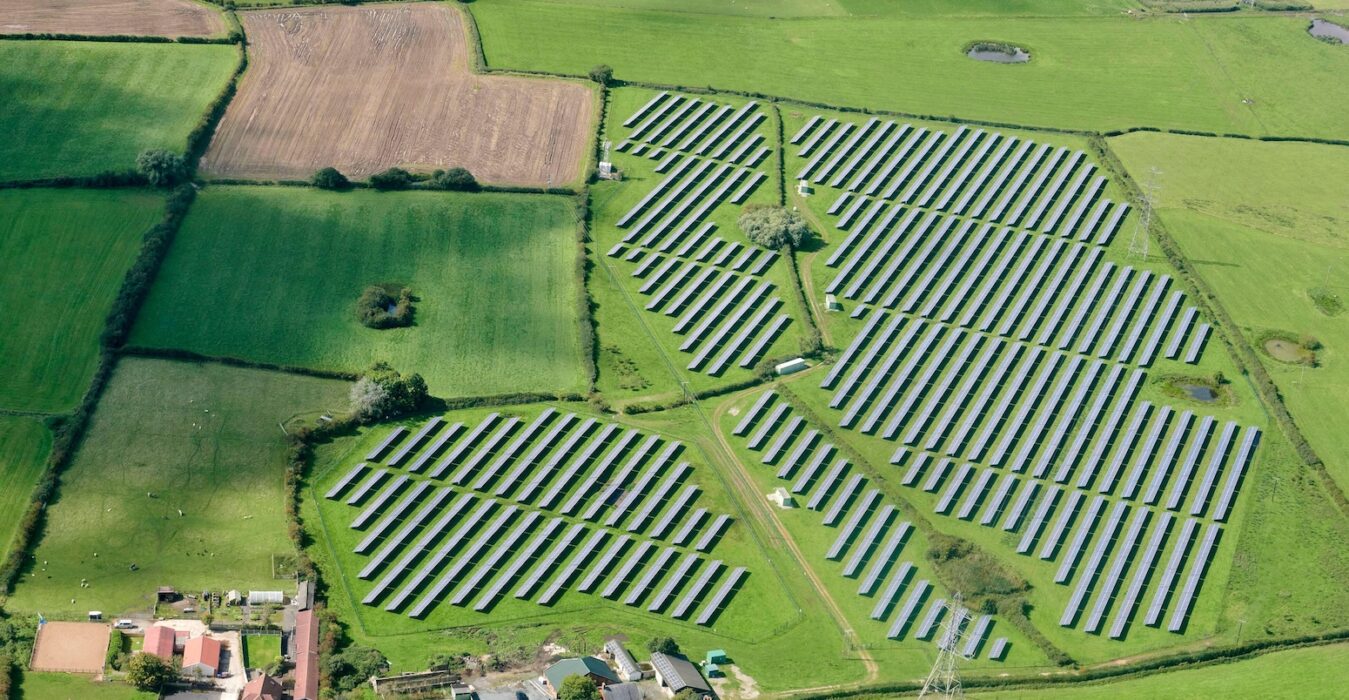
Aerial view of a solar farm, north west England, UK. Credit: Paul White – UK Industries / Alamy Stock Photo

Reaching net-zero will be much cheaper for the UK government than previously expected – and the economic damages of unmitigated climate change far more severe.

These are two key conclusions from the latest report on risks to the government finances from the independent Office for Budget Responsibility (OBR), which includes a chapter on climate change.

The new OBR report shows very clearly that the cost of cutting emissions to net-zero is significantly smaller than the economic damages of failing to act.

Here are four key charts from the OBR report.

Climate damages could reach 8% of GDP by 2070s

The UK could take an 8% hit to its economy by the early 2070s, if the world warms by 3C this century, according to the new OBR report.

(This aspect of the OBR report has been picked up in a Reuters headline: “Global 3C warming would hurt UK economy much more than previously predicted, OBR says.”)

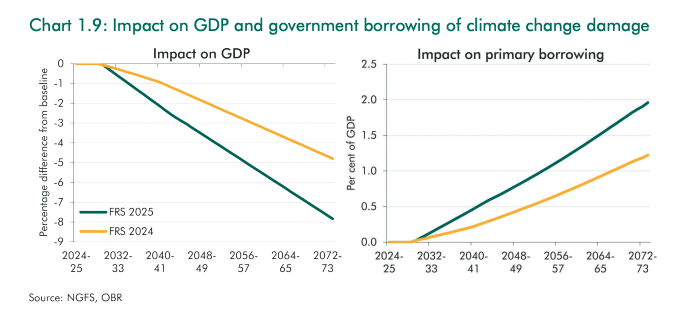
Its latest estimate (blue line) of the impact of “climate-related damages” by the 2070s is three percentage points (60%) higher than thought just last year (yellow), as shown in the figure below.

Chart 1.9: Impact on GDP and government borrowing of climate change damage
Left: Impact of climate damages on UK GDP, if global warming reaches 3C by the end of the century. Right: Impact on government borrowing. Blue lines show the latest estimates whereas yellow lines are from last year’s report. Credit: OBR

The OBR says that the increase in its estimate of climate damages is due to using a “more comprehensive and up-to-date analysis”.

(The world is currently on track to warm by only slightly less than 3C this century.)

Unchecked damages could double hit to borrowing

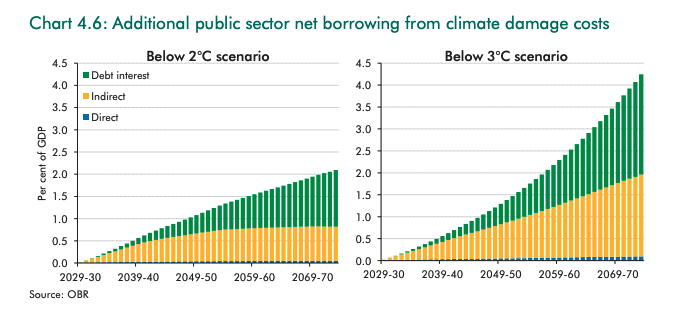
The impact of climate damages on government borrowing would be nearly twice as high by the 2070s, if global warming goes unchecked and reaches 3C, according to the OBR report.

This is shown in the figure below, which compares additional government borrowing each year, as a share of GDP, if warming is limited to less than 2C this century (left) or if it climbs to 3C (right).

Chart 4.6: Additional public sector net borrowing from climate damage costs
Additional government borrowing each year due to climate damages, as a share of GDP, %, if warming is limited to less than 2C this century (left) or 3C (right). Credit: OBR.

The OBR explains that the largest impact of climate damages on government borrowing is “lower productivity and employment and, therefore, lower tax receipts”.

Cost of net-zero halved

When it comes to cutting UK emissions, the OBR says the government will only need to invest just over half as much on reaching net-zero, compared with what it expected four years earlier.

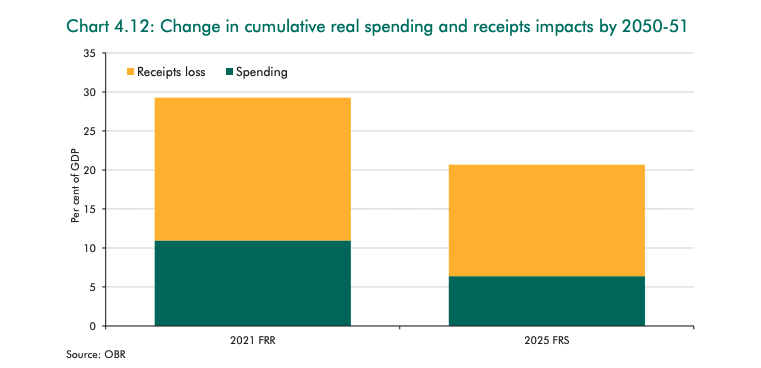
This is shown in the figure below, with the latest 2025 estimate (right) showing a cumulative government investment of 6% of GDP across the 25 years to 2050, down from 11% (left).

(Note that the large majority of “lost government receipts”, shown in yellow in the figure below, are due to fuel duty evaporating as drivers shift to electric vehicles. As the OBR notes, the government could choose to recoup these losses via other types of motoring taxes.)

Chart 4.12: Change in cumulative real spending and receipts impacts by 2050-51
Cumulative change in government lost receipts (yellow) and extra investment (green), as a share of GDP, %. Left: OBR’s 2021 report. Right: Latest 2025 report. Credit: OBR.

The OBR takes its estimates of the costs and benefits of cutting emissions to net-zero from the government’s Climate Change Committee (CCC). The CCC recently issued significantly lower estimates for net-zero investment costs, due to more rapidly falling clean-technology costs.

Acknowledging this shift, the OBR says the latest CCC estimates on the cost of reaching net-zero are “significantly lower” than earlier figures.

It notes that the net cost to the economy of reaching net-zero emissions by 2050 is now put at £116bn over 25 years, some £204bn lower than previously expected.

In very rough terms, this figure – which excludes health co-benefits due to cutting emissions and avoided climate damages – is equivalent to less than £70 per person per year.

Cost of action far lower than cost of inaction

Taken together, the OBR findings show more clearly than ever before that the cost of taking action to tackle climate change would be far lower than the cost of unchecked warming.

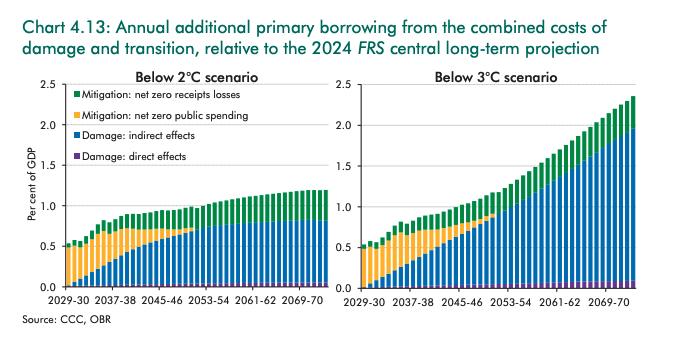
For the first time, its latest report combines the estimated cost of cutting emissions with the expected damages due to rising temperatures in a single figure, shown below.

The comparison illustrates that climate damages (blue bars in the chart) are set to impose severe costs on the UK public finances, even if warming is limited to less than 2C this century (left).

The OBR also shows how the cost of government investment in cutting emissions (yellow) is both temporary and relatively small in comparison to climate damages.

Moreover, it highlights how unchecked warming of 3C this century (right) would impose far higher climate damages on the UK government’s finances than if global temperatures are kept in check.

Specifically, global action to limit warming to 2C instead of 3C could prevent more than 1 percentage point of climate damages being added to annual government borrowing by the 2070s.

In contrast, the combined estimated cost to government of action to cut emissions never exceeds 0.6 percentage points – even if lost receipts due to fuel duty are not replaced (green).

CHart 4.13: Annual additional primary borrowing from the combined costs of damage and transition, relative to the 2024 FRS central long-term projection
Annual additional government borrowing as a result of action to cut emissions (yellow, green) and from climate damages (blue, purple). Left: 2C of warming this century. Right: 3C. Credit: OBR.

Beyond these new numbers, the OBR acknowledges that it still does not include the cost of adapting to climate change, or the impact this could have on reducing damages.

Nor does it consider the potential for accelerated transitions towards clean energy, technological advances that make this shift cheaper or the risk of tipping points, which could cause “large and irreversible changes” to the global climate.

Original article by Simon Evans republished from Carbon Brief under a CC license.

Donald Trump urges you to be a Climate Science denier like him. He says that he makes millions and millions for destroying the planet, Burn, Baby, Burn and Flood, Baby, Flood.
Nigel Farage urges you to ignore facts and reality and be a climate science denier like him. He says that Reform UK has received millions and millions from the fossil fuel industry to promote climate denial and destroy the planet.
Neo-Fascist Climate Science Denier Donald Trump says Burn, Baby, Burn.
Continue ReadingOBR: Net-zero is much cheaper than thought for UK – and unchecked global warming far more costly