Original article by Pilar Troya Fernández republished from peoples dispatch under a Creative Commons Attribution-ShareAlike 4.0 (CC BY-SA) license.
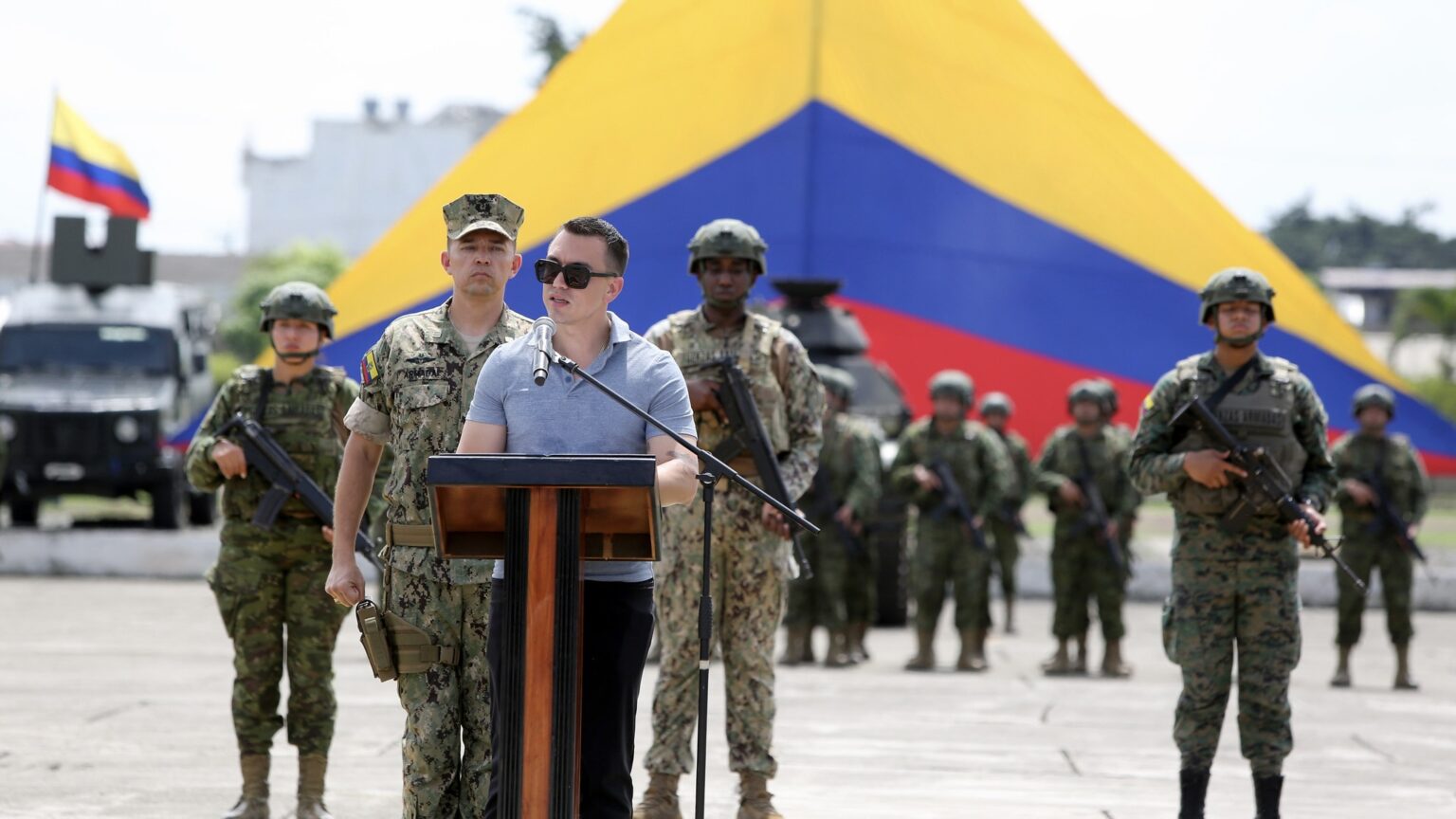
Ecuadorian President Daniel Noboa has not only deepened the crisis in the country, but is also attempting to change the country’s institutions and laws through loopholes and force.
Daniel Noboa’s government in Ecuador is characterized by the implementation of neoliberal austerity policies dictated by the IMF, the violent repression of social protests, and a series of legal reforms aimed at increasing state authoritarianism, and aligning the country with US foreign policy. All this is taking place amid an unprecedented security crisis.
The security crisis
During the first half of 2025, Ecuador recorded 4,619 homicides, setting a new historical record and representing a 47% increase over the same period in 2024. This figure makes the country the most violent on the continent. No one knows what the Phoenix Plan, implemented by the Noboa government since 2024, consists of, and it has not produced positive results. On the contrary, citizen insecurity has worsened. The constant states of emergency that have militarized the country have also failed to reverse the situation.
Austerity policies
Re-elected in April 2025, Daniel Noboa has implemented a far-right program aligned with the demands of the IMF. In June, he dismissed 5,000 civil servants and merged four ministries. In the most serious case, environmental responsibilities were transferred to the Ministry of Natural Resources and Hydrocarbons, highlighting the government’s extractivist orientation. These measures represent the path toward the minimal state advocated by neoliberalism and respond to the conditions of the latest IMF loan.
On September 12, Noboa withdrew the subsidy on diesel, whose price rose from USD 1.80 to USD 2.80 per gallon until December. Subsequently, the price would depend on a band system tied to international market prices. This measure triggered a national transport strike on September 13, with transport workers quickly reaching an agreement with the government in exchange for subsidies, and subsequently the national strike called by the Confederation of Indigenous Nationalities of Ecuador (CONAIE) on September 18, demanding the repeal of the measure, a reduction in the VAT from 15% to 12%, no mining, respect for prior consultation, and more investment in education and health. It should be noted that public hospitals are in precarious conditions, without medicines or supplies. The media reports that patients who required dialysis treatment died because they did not receive it.
Submission to the United States and constitutional reforms
On June 3, the National Assembly, where the government has a majority, approved an amendment to Article 5 of the Constitution allowing foreign military bases. This amendment required the approval of the Constitutional Court and subsequently a referendum. On September 5, the Constitutional Court rejected four of the eight questions that Noboa had sent for popular consultation and referendum, including this issue.
Authoritarian laws and the Constitutional Court as the last bastion
In June 2025, the government managed to pass three new laws that were sent as economically urgent without actually being so: on Intelligence, National Solidarity, and Public Integrity. The progressive camp filed 23 constitutional challenges with the Constitutional Court because they violate rights related to children and adolescents, freedom of expression, intimacy, and privacy, among others. The Court provisionally suspended 16 articles of these laws, prompting a smear campaign organized by the government, which accused the Court of leaving the country defenseless against crime.
The National Solidarity Law sought to institutionalize the concept of “internal armed conflict” that Noboa used in a decree in January 2024. This implied: free use of the military in police operations; prior pardon for security personnel for potential crimes and human rights violations; criminalization of opposition organizations by classifying them as armed groups; and treatment of areas, movable and immovable property presumed to belong to criminal groups as military targets.
The Intelligence Law sought to intercept any communication without a court order, require information within two days without a court order, access personal data without a court order, reinstate confidential expenses (non-transparent discretionary funds), and incinerate documents rather than keep them on file.
On September 27, the Constitutional Court definitively rejected two of the laws, the National Security Law and the Public Integrity Law, as flagrantly unconstitutional.
The Constitutional Court is the only state body that the Noboa government does not control. The National Court of Justice and the Attorney General’s Office have supported the government by implementing lawfare against the opposition, especially Rafael Correa’s Citizen Revolution party, while failing to investigate any of the signs of corruption in the current government. These include million-dollar contracts with companies owned by Noboa’s relatives, new mining concessions that also lead to his relatives, 48 generators purchased to provide electricity, of which 30 are not compatible with the Ecuadorian system, and the scandal of the contract with Progen for the electrical system, for which USD 149 million was paid without results, leaving open the possibility that last year’s 14-hour daily blackouts will be repeated.
Read more: Ecuador in the dark: Daniel Noboa increases power cuts to 14 hours a day
Abuses, protests, and repression
On September 16, in Cuenca, the country’s third largest city with 800,000 inhabitants, the largest environmental march in the country’s history took place: 100,000 people marched against the Loma Larga mining project in the Quimsacocha area, which would put water sources for agricultural and human use at risk. The project had been suspended by a local court for failing to comply with prior consultation and environmental requirements.
On September 19, Noboa ordered the National Electoral Council, by decree, to organize a National Constituent Assembly without seeking the opinion of the Constitutional Court, which constitutes a violation of the Constitution and was interpreted as an attempted coup d’état. The Court admitted five constitutional challenges and the execution of the decree was blocked, although the CNE quickly launched the call for elections for the Constituent Assembly.
At the time of publication of this article, the national strike called by CONAIE continued after 20 days, with support in several cities, especially from students. Roadblocks, protests, and shutdowns are spreading throughout the country, but are strongest in the Sierra, where the Indigenous movement is the main actor in the popular camp.
Tanks and military vehicles repressed the protests in the province of Imbabura, even firing on unarmed Indigenous communities. The Minister of Government, Zaida Rovira, said that it was a humanitarian convoy “ambushed by terrorist structures”. The convoy arrived without prior warning while all internet communication was interrupted, and there is no terrorist group linked to the incident. Efraín Fuérez was killed by the military in a nearby area. A Spanish journalist reporting from the area, Lautaro Bernat, was deported.
Read more: One dead and nearly 100 arrested amid heavy repression of protests in Ecuador
At least 100 people have been detained and 10 are missing. On September 26, twelve detainees were sent to one of the maximum security prisons where a prison massacre had taken place the day before, killing 17 people. These massacres have been repeated even with prisons under military control since 2024. These people were falsely accused of terrorism and of having criminal records. The government has frozen the bank accounts of popular leaders and organizations without a court order, claiming without evidence that the strike is being financed by the Venezuelan drug trafficking organization, “Tren de Aragua”.
The former president of CONAIE, Leonidas Iza, leader of the 2019 and 2022 uprisings, suffered an attempt on his life by agents of the National Intelligence Directorate on August 18, 2025. Four children from a suburb of Guayaquil were tortured and extrajudicially executed by the military in December 2024. The level of authoritarianism is such that the US State Department itself denounces it in a report that points to serious human rights violations in Ecuador between 2024 and 2025. International reports show that since 2024 there has been an increase in crimes of abuse of power in the execution of official duties, torture, forced disappearances, and extrajudicial executions.
Noboa’s response to the Constitutional Court’s rejection of the two laws was, on September 30, to send a new urgent economic law to facilitate donations to the National Police and the Armed Forces.
There are no negotiations with the actors on strike. Faced with demands for more democracy and state investment, the government responds with austerity, increased repression, and a communication strategy that seeks to establish the false narrative that all protesters are criminals and/or terrorists. In line with this, on October 8, the presidential guard, after attacking an Indigenous demonstration in the province of Cañar, broke the windows of the presidential motorcade’s vehicles and then claimed that it was an attempt to assassinate the president. This would be the first time that an attempt has been made to assassinate a president by throwing stones at the presidential motorcade, which is protected by the military, police, and private security, who had been warned about the protest by the mayor days earlier.
Pilar Troya Fernández is an Ecuadorian anthropologist with a master’s degree in gender studies and a researcher at the Tricontinental Institute for Social Research. She was an advisor to the National Secretariat of Planning, an advisor to the National Secretariat of Higher Education, Science, Technology, and Innovation, and Deputy Secretary General of Higher Education in Ecuador. She currently resides in Brazil.
This article was produced by Globetrotter.
Original article by Pilar Troya Fernández republished from peoples dispatch under a Creative Commons Attribution-ShareAlike 4.0 (CC BY-SA) license.